
Eltoprazine (CHEM099513)
| Record Information | |||||||||
|---|---|---|---|---|---|---|---|---|---|
| Version | 1.0 | ||||||||
| Creation Date | 2026-04-05 10:47:12 UTC | ||||||||
| Update Date | 2026-08-18 18:47:04 UTC | ||||||||
| Accession Number | CHEM099513 | ||||||||
| Identification | |||||||||
| Common Name | Eltoprazine | ||||||||
| Class | Small Molecule | ||||||||
| Description | Eltoprazine is an organic compound with the chemical formula C12H16N2O2 and an average molecular weight of 220.27 g/mol. Eltoprazine belongs to the piperazines, a subclass of diazinanes within the organic compounds. It is further categorized under the superclass of organoheterocyclic compounds. Regarding its pharmacological activity, eltoprazine interacts with three recorded protein targets. It acts as an agonist or antagonist of the 5-hydroxytryptamine receptor 1A (HTR1A), the 5-hydroxytryptamine receptor 2C (HTR2C), and the 5-hydroxytryptamine receptor 1B (HTR1B). | ||||||||
| Contaminant Sources | Not Available | ||||||||
| Contaminant Type | Not Available | ||||||||
| Chemical Structure | 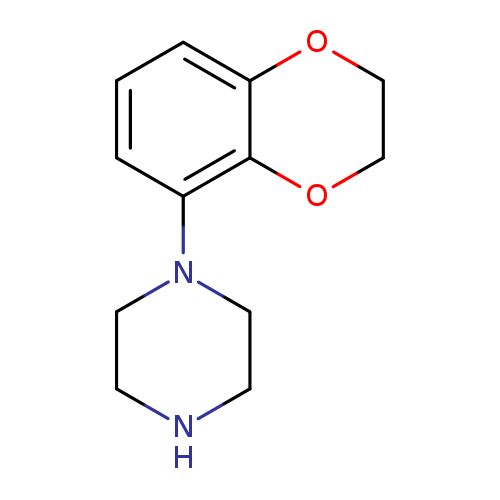 | ||||||||
| Synonyms | Not Available | ||||||||
| Chemical Formula | C12H16N2O2 | ||||||||
| Average Molecular Mass | 220.272 g/mol | ||||||||
| Monoisotopic Mass | 220.121 g/mol | ||||||||
| CAS Registry Number | 98224-03-4 | ||||||||
| IUPAC Name | 1-(2,3-dihydro-1,4-benzodioxin-5-yl)piperazine | ||||||||
| Traditional Name | Not Available | ||||||||
| SMILES | C1CN(CCN1)C1=CC=CC2=C1OCCO2 | ||||||||
| InChI Identifier | InChI=1S/C12H16N2O2/c1-2-10(14-6-4-13-5-7-14)12-11(3-1)15-8-9-16-12/h1-3,13H,4-9H2 | ||||||||
| InChI Key | WVLHGCRWEHCIOT-UHFFFAOYSA-N | ||||||||
| Chemical Taxonomy | |||||||||
| Classification | Not classified | ||||||||
| Biological Properties | |||||||||
| Status | Detected and Not Quantified | ||||||||
| Origin | Not Available | ||||||||
| Cellular Locations | Not Available | ||||||||
| Biofluid Locations | Not Available | ||||||||
| Tissue Locations | Not Available | ||||||||
| Pathways | Not Available | ||||||||
| Applications | Not Available | ||||||||
| Biological Roles | Not Available | ||||||||
| Chemical Roles | Not Available | ||||||||
| Physical Properties | |||||||||
| State | Not Available | ||||||||
| Appearance | Not Available | ||||||||
| Experimental Properties |
| ||||||||
| Predicted Properties | Not Available | ||||||||
| Spectra | |||||||||
| Spectra |
| ||||||||
| Toxicity Profile | |||||||||
| Route of Exposure | Not Available | ||||||||
| Mechanism of Toxicity | Not Available | ||||||||
| Metabolism | Not Available | ||||||||
| Toxicity Values | Not Available | ||||||||
| Lethal Dose | Not Available | ||||||||
| Carcinogenicity (IARC Classification) | Not Available | ||||||||
| Uses/Sources | Not Available | ||||||||
| Minimum Risk Level | Not Available | ||||||||
| Health Effects | Not Available | ||||||||
| Symptoms | Not Available | ||||||||
| Treatment | Not Available | ||||||||
| Concentrations | |||||||||
| Not Available | |||||||||
| External Links | |||||||||
| Identifiers | Not Available | ||||||||
| References | |||||||||
| Synthesis Reference | Not Available | ||||||||
| MSDS | Not Available | ||||||||
| General References | Not Available | ||||||||
