Record Information
Version1.0
Creation Date2014-09-11 02:04:51 UTC
Update Date2026-03-31 18:14:19 UTC
Accession NumberCHEM003642
Identification
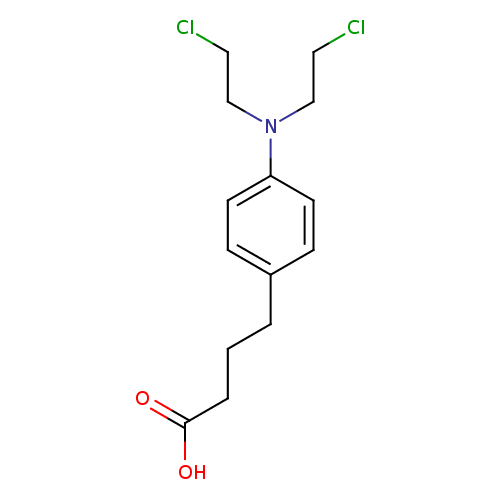
Common NameChlorambucil
ClassSmall Molecule
DescriptionA nitrogen mustard alkylating agent used as antineoplastic agent for the treatment of various malignant and nonmalignant diseases. Although it is less toxic than most other nitrogen mustards, it has been listed as a known carcinogen in the Fourth Annual Report on Carcinogens (NTP 85-002, 1985).
Contaminant Sources
  • Clean Air Act Chemicals
  • HMDB Contaminants - Urine
  • IARC Carcinogens Group 1
  • STOFF IDENT Compounds
  • T3DB toxins
  • ToxCast & Tox21 Chemicals
Contaminant Type
  • Amine
  • Antineoplastic Agent, Alkylating
  • Drug
  • Metabolite
  • Organic Compound
  • Organochloride
  • Synthetic Compound
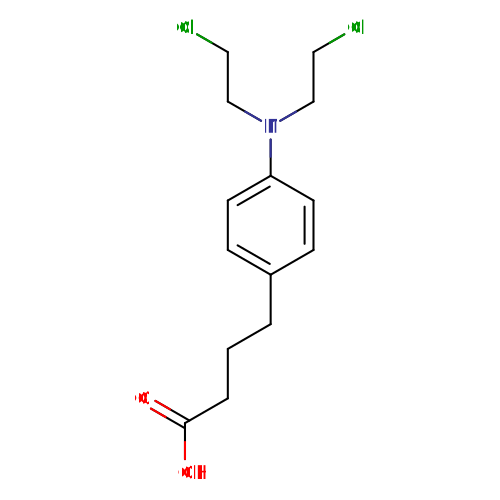
Chemical Structure
Thumb
Synonyms
ValueSource
4-(p-Bis(beta-chloroethyl)aminophenyl)butyric acidChEBI
4-[p-[Bis(2-chloroethyl)amino]phenyl]butyric acidChEBI
AmbochlorinChEBI
ChloraminophenChEBI
gamma-[p-Di(2-chloroethyl)aminophenyl]butyric acidChEBI
LeukeranChEBI
N,N-Di-2-chloroethyl-gamma-p-aminophenylbutyric acidChEBI
Phenylbutyric acid nitrogen mustardChEBI
4-(p-Bis(b-chloroethyl)aminophenyl)butyrateGenerator
4-(p-Bis(b-chloroethyl)aminophenyl)butyric acidGenerator
4-(p-Bis(beta-chloroethyl)aminophenyl)butyrateGenerator
4-(p-Bis(β-chloroethyl)aminophenyl)butyrateGenerator
4-(p-Bis(β-chloroethyl)aminophenyl)butyric acidGenerator
4-[p-[Bis(2-chloroethyl)amino]phenyl]butyrateGenerator
g-[p-Di(2-chloroethyl)aminophenyl]butyrateGenerator
g-[p-Di(2-chloroethyl)aminophenyl]butyric acidGenerator
gamma-[p-Di(2-chloroethyl)aminophenyl]butyrateGenerator
Γ-[p-di(2-chloroethyl)aminophenyl]butyrateGenerator
Γ-[p-di(2-chloroethyl)aminophenyl]butyric acidGenerator
N,N-Di-2-chloroethyl-g-p-aminophenylbutyrateGenerator
N,N-Di-2-chloroethyl-g-p-aminophenylbutyric acidGenerator
N,N-Di-2-chloroethyl-gamma-p-aminophenylbutyrateGenerator
N,N-Di-2-chloroethyl-γ-p-aminophenylbutyrateGenerator
N,N-Di-2-chloroethyl-γ-p-aminophenylbutyric acidGenerator
Phenylbutyrate nitrogen mustardGenerator
ChlocambucilHMDB
ChloraminopheneHMDB
ChlorbutinHMDB
ChlorbutineHMDB
ChloroambucilHMDB
ChlorobutinHMDB
ChlorobutineHMDB
LympholysinHMDB
4-(Bis(2-chloroethyl)amino)benzenebutanoic acidHMDB
AmboclorinHMDB
Glaxo wellcome brand OF chlorambucilHMDB
GlaxoSmithKline brand OF chlorambucilHMDB
N,N-Di-(2-chloroethyl)-p-aminophenylbutyric acidHMDB
Wellcome brand OF chlorambucilHMDB
Chemical FormulaC14H19Cl2NO2
Average Molecular Mass304.212 g/mol
Monoisotopic Mass303.079 g/mol
CAS Registry Number305-03-3
IUPAC Name4-{4-[bis(2-chloroethyl)amino]phenyl}butanoic acid
Traditional Namechlorambucil
SMILESOC(=O)CCCC1=CC=C(C=C1)N(CCCl)CCCl
InChI IdentifierInChI=1S/C14H19Cl2NO2/c15-8-10-17(11-9-16)13-6-4-12(5-7-13)2-1-3-14(18)19/h4-7H,1-3,8-11H2,(H,18,19)
InChI KeyJCKYGMPEJWAADB-UHFFFAOYSA-N
Chemical Taxonomy
Description belongs to the class of organic compounds known as nitrogen mustard compounds. Nitrogen mustard compounds are compounds having two beta-haloalkyl groups bound to a nitrogen atom.
KingdomOrganic compounds
Super ClassOrganic nitrogen compounds
ClassOrganonitrogen compounds
Sub ClassNitrogen mustard compounds
Direct ParentNitrogen mustard compounds
Alternative Parents
Substituents
  • Aniline or substituted anilines
  • Dialkylarylamine
  • Tertiary aliphatic/aromatic amine
  • Nitrogen mustard
  • Monocyclic benzene moiety
  • Benzenoid
  • Amino acid or derivatives
  • Amino acid
  • Tertiary amine
  • Carboxylic acid derivative
  • Carboxylic acid
  • Monocarboxylic acid or derivatives
  • Alkyl chloride
  • Organohalogen compound
  • Organochloride
  • Organooxygen compound
  • Hydrocarbon derivative
  • Organic oxide
  • Carbonyl group
  • Organopnictogen compound
  • Organic oxygen compound
  • Amine
  • Alkyl halide
  • Aromatic homomonocyclic compound
Molecular FrameworkAromatic homomonocyclic compounds
External Descriptors
Biological Properties
StatusDetected and Not Quantified
OriginExogenous
Cellular Locations
  • Cytoplasm
  • Membrane
Biofluid LocationsNot Available
Tissue LocationsNot Available
PathwaysNot Available
ApplicationsNot Available
Biological RolesNot Available
Chemical RolesNot Available
Physical Properties
StateSolid
AppearanceWhite powder.
Experimental Properties
PropertyValue
Melting Point65°C
Boiling PointNot Available
Solubility1.24E+004 mg/L
Predicted Properties
PropertyValueSource
Water Solubility0.077 g/LALOGPS
logP3.81ALOGPS
logP3.94ChemAxon
logS-3.6ALOGPS
pKa (Strongest Acidic)4.46ChemAxon
pKa (Strongest Basic)1.72ChemAxon
Physiological Charge-1ChemAxon
Hydrogen Acceptor Count3ChemAxon
Hydrogen Donor Count1ChemAxon
Polar Surface Area40.54 ŲChemAxon
Rotatable Bond Count9ChemAxon
Refractivity79.68 m³·mol⁻¹ChemAxon
Polarizability31.98 ųChemAxon
Number of Rings1ChemAxon
Bioavailability1ChemAxon
Rule of FiveYesChemAxon
Ghose FilterYesChemAxon
Veber's RuleNoChemAxon
MDDR-like RuleNoChemAxon
Spectra
Spectra
Spectrum TypeDescriptionSplash KeyView
Predicted GC-MSPredicted GC-MS Spectrum - GC-MS (Non-derivatized) - 70eV, Positivesplash10-066u-2790000000-bf4786edba412b2ccaaeSpectrum
Predicted GC-MSPredicted GC-MS Spectrum - GC-MS (1 TMS) - 70eV, Positivesplash10-024i-5393000000-3be6fe379684458bfa85Spectrum
Predicted GC-MSPredicted GC-MS Spectrum - GC-MS (Non-derivatized) - 70eV, PositiveNot AvailableSpectrum
LC-MS/MSLC-MS/MS Spectrum - LC-ESI-qTof , Positivesplash10-004i-0002900000-472e293a011d716bb5a8Spectrum
LC-MS/MSLC-MS/MS Spectrum - , positivesplash10-0zfr-0519000000-1bca00472dfc8c30a465Spectrum
Predicted LC-MS/MSPredicted LC-MS/MS Spectrum - 10V, Positivesplash10-0udr-0096000000-3899963778fe2e6e88deSpectrum
Predicted LC-MS/MSPredicted LC-MS/MS Spectrum - 20V, Positivesplash10-08g0-3591000000-6ae3349b3f490c58310dSpectrum
Predicted LC-MS/MSPredicted LC-MS/MS Spectrum - 40V, Positivesplash10-0j4i-6920000000-15483700b73ee5d5c44bSpectrum
Predicted LC-MS/MSPredicted LC-MS/MS Spectrum - 10V, Negativesplash10-0udi-0039000000-b8ff9ca35aa22b00bd35Spectrum
Predicted LC-MS/MSPredicted LC-MS/MS Spectrum - 20V, Negativesplash10-0uxr-1193000000-7606e0823853c0c258eeSpectrum
Predicted LC-MS/MSPredicted LC-MS/MS Spectrum - 40V, Negativesplash10-052f-9540000000-f5720e555315984712a6Spectrum
Predicted LC-MS/MSPredicted LC-MS/MS Spectrum - 10V, Negativesplash10-001i-9004000000-788a1a6f740556f91441Spectrum
Predicted LC-MS/MSPredicted LC-MS/MS Spectrum - 20V, Negativesplash10-001i-9000000000-724cdb1db65352c21f6cSpectrum
Predicted LC-MS/MSPredicted LC-MS/MS Spectrum - 40V, Negativesplash10-001i-9100000000-58ace4115f9b048a722eSpectrum
Predicted LC-MS/MSPredicted LC-MS/MS Spectrum - 10V, Positivesplash10-0udr-0098000000-d1dce37c9e184d7829deSpectrum
Predicted LC-MS/MSPredicted LC-MS/MS Spectrum - 20V, Positivesplash10-00kr-0091000000-f4d0cc5c505d1414f7cdSpectrum
Predicted LC-MS/MSPredicted LC-MS/MS Spectrum - 40V, Positivesplash10-014m-1920000000-59f8073bfe41e45f2bdbSpectrum
MSMass Spectrum (Electron Ionization)splash10-0udi-2491000000-ddb7d5da8316562dba36Spectrum
Toxicity Profile
Route of ExposureNot Available
Mechanism of ToxicityAlkylating agents work by three different mechanisms: 1) attachment of alkyl groups to DNA bases, resulting in the DNA being fragmented by repair enzymes in their attempts to replace the alkylated bases, preventing DNA synthesis and RNA transcription from the affected DNA, 2) DNA damage via the formation of cross-links (bonds between atoms in the DNA) which prevents DNA from being separated for synthesis or transcription, and 3) the induction of mispairing of the nucleotides leading to mutations.
MetabolismRoute of Elimination: Chlorambucil is extensively metabolized in the liver primarily to phenylacetic acid mustard. The pharmacokinetic data suggests that oral chlorambucil undergoes rapid gastrointestinal absorption and plasma clearance and that it is almost completely metabolized, having extremely low urinary excretion. Half Life: 1.5 hours
Toxicity ValuesNot Available
Lethal DoseNot Available
Carcinogenicity (IARC Classification)1, carcinogenic to humans. (3)
Uses/SourcesFor treatment of chronic lymphatic (lymphocytic) leukemia, childhood minimal-change nephrotic syndrome, and malignant lymphomas including lymphosarcoma, giant follicular lymphoma, Hodgkin's disease, non-Hodgkin's lymphomas, and Waldenstrн_mду»s Macroglobulinemia.
Minimum Risk LevelNot Available
Health EffectsNot Available
SymptomsNot Available
TreatmentNot Available
Concentrations
Not Available
DrugBank IDDB00291
HMDB IDHMDB0014436
FooDB IDNot Available
Phenol Explorer IDNot Available
KNApSAcK IDNot Available
BiGG IDNot Available
BioCyc IDNot Available
METLIN IDNot Available
PDB IDNot Available
Wikipedia LinkChlorambucil
Chemspider ID2607
ChEBI ID28830
PubChem Compound ID2708
Kegg Compound IDC06900
YMDB IDNot Available
ECMDB IDNot Available
References
Synthesis Reference

Phillips, A. P. and Mentha, J.W.; U.S.Patent 3,046,301; July 24, 1962; assigned to Burroughs
Wellcome & Co. (U.S.A.) Inc.

MSDSLink
General References
1. Rai KR, Peterson BL, Appelbaum FR, Kolitz J, Elias L, Shepherd L, Hines J, Threatte GA, Larson RA, Cheson BD, Schiffer CA: Fludarabine compared with chlorambucil as primary therapy for chronic lymphocytic leukemia. N Engl J Med. 2000 Dec 14;343(24):1750-7.
2. Yang K, Tan J, Wu T: Alkylating agents for Waldenstrom's macroglobulinaemia. Cochrane Database Syst Rev. 2009 Jan 21;(1):CD006719. doi: 10.1002/14651858.CD006719.pub3.
3. https://www.ncbi.nlm.nih.gov/pubmed/?term=22025197
4. https://www.ncbi.nlm.nih.gov/pubmed/?term=22978684
5. https://www.ncbi.nlm.nih.gov/pubmed/?term=23233721
6. https://www.ncbi.nlm.nih.gov/pubmed/?term=23295789
7. https://www.ncbi.nlm.nih.gov/pubmed/?term=23521128
8. https://www.ncbi.nlm.nih.gov/pubmed/?term=23665800
9. https://www.ncbi.nlm.nih.gov/pubmed/?term=23667729
10. https://www.ncbi.nlm.nih.gov/pubmed/?term=23683018
11. https://www.ncbi.nlm.nih.gov/pubmed/?term=23725434
12. https://www.ncbi.nlm.nih.gov/pubmed/?term=23822827
13. https://www.ncbi.nlm.nih.gov/pubmed/?term=24098639
14. https://www.ncbi.nlm.nih.gov/pubmed/?term=24147900
15. https://www.ncbi.nlm.nih.gov/pubmed/?term=24223689