Record Information
Version1.0
Creation Date2014-08-29 06:51:04 UTC
Update Date2026-05-14 17:28:44 UTC
Accession NumberCHEM003369
Identification
Common NameXanthine
ClassSmall Molecule
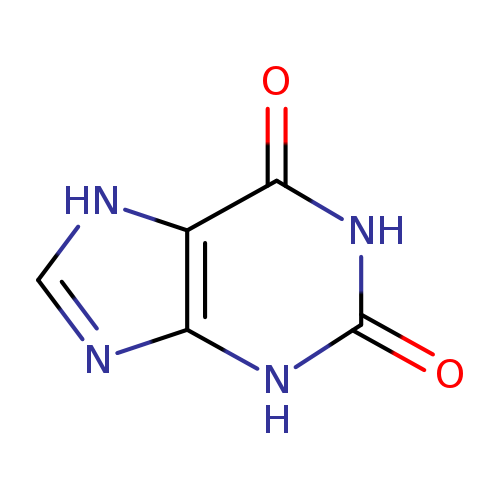
DescriptionXanthine is a purine base found in most body tissues and fluids, certain plants, and some urinary calculi. It is an intermediate in the degradation of adenosine monophosphate to uric acid, being formed by oxidation of hypoxanthine. The methylated xanthine compounds caffeine, theobromine, and theophylline and their derivatives are used in medicine for their bronchodilator effects. (Dorland, 28th ed.).
Contaminant Sources
  • FooDB Chemicals
  • HMDB Contaminants - Feces
  • HMDB Contaminants - Urine
  • STOFF IDENT Compounds
  • T3DB toxins
Contaminant Type
  • Animal Toxin
  • Food Toxin
  • Metabolite
  • Natural Compound
  • Organic Compound
Chemical Structure
Thumb
Synonyms
ValueSource
2,6-DihydroxypurineChEBI
2,6-Dioxo-1,2,3,6-tetrahydropurineChEBI
9H-Purine-2,6-(1H,3H)-dioneChEBI
Purine-2(3H),6(1H)-dioneChEBI
XanChEBI
1H-Purine-2,6-diolHMDB
2,6(1,3)-PurinedionHMDB
2,6-DioxopurineHMDB
3,7-Dihydro-1H-purine-2,6-dioneHMDB
3,7-Dihydropurine-2,6-dioneHMDB
9H-Purine-2,6(1H,3H)-dioneHMDB
9H-Purine-2,6-diolHMDB
DioxopurineHMDB
IsoxanthineHMDB
PseudoxanthineHMDB
Purine-2,6(1H,3H)-dioneHMDB
Purine-2,6-diolHMDB
Xanthic oxideHMDB
XanthinHMDB
Chemical FormulaC5H4N4O2
Average Molecular Mass152.111 g/mol
Monoisotopic Mass152.033 g/mol
CAS Registry Number69-89-6
IUPAC Name2,3,6,7-tetrahydro-1H-purine-2,6-dione
Traditional Namexanthine
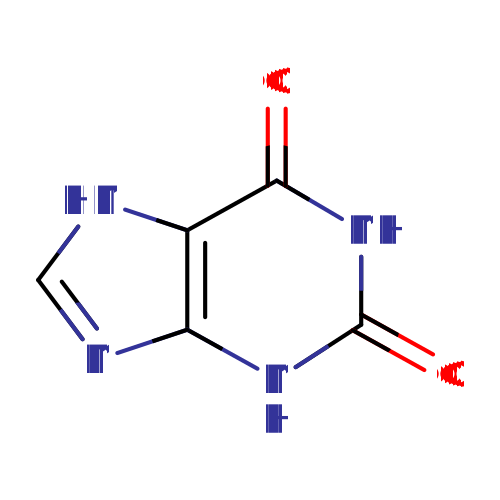
SMILESO=C1NC2=C(NC=N2)C(=O)N1
InChI IdentifierInChI=1S/C5H4N4O2/c10-4-2-3(7-1-6-2)8-5(11)9-4/h1H,(H3,6,7,8,9,10,11)
InChI KeyLRFVTYWOQMYALW-UHFFFAOYSA-N
Chemical Taxonomy
Description belongs to the class of organic compounds known as xanthines. These are purine derivatives with a ketone group conjugated at carbons 2 and 6 of the purine moiety.
KingdomOrganic compounds
Super ClassOrganoheterocyclic compounds
ClassImidazopyrimidines
Sub ClassPurines and purine derivatives
Direct ParentXanthines
Alternative Parents
Substituents
  • Xanthine
  • 6-oxopurine
  • Purinone
  • Alkaloid or derivatives
  • Pyrimidone
  • Pyrimidine
  • Azole
  • Imidazole
  • Heteroaromatic compound
  • Vinylogous amide
  • Lactam
  • Urea
  • Azacycle
  • Hydrocarbon derivative
  • Organic oxide
  • Organooxygen compound
  • Organonitrogen compound
  • Organic nitrogen compound
  • Organopnictogen compound
  • Organic oxygen compound
  • Aromatic heteropolycyclic compound
Molecular FrameworkAromatic heteropolycyclic compounds
External Descriptors
Biological Properties
StatusDetected and Not Quantified
OriginEndogenous
Cellular Locations
  • Cytoplasm
  • Extracellular
  • Peroxisome
Biofluid LocationsNot Available
Tissue Locations
  • Bladder
  • Epidermis
  • Fibroblasts
  • Intestine
  • Kidney
  • Liver
  • Prostate
  • Skeletal Muscle
  • Testes
Pathways
NameSMPDB LinkKEGG Link
Purine MetabolismSMP00050 map00230
Xanthinuria type ISMP00512 Not Available
Xanthinuria type IISMP00513 Not Available
Molybdenium Cofactor DeficiencySMP00203 Not Available
Xanthine Dehydrogenase Deficiency (Xanthinuria)SMP00220 Not Available
ApplicationsNot Available
Biological Roles
Chemical RolesNot Available
Physical Properties
StateSolid
AppearanceWhite powder.
Experimental Properties
PropertyValue
Melting Point> 300°C
Boiling PointNot Available
Solubility0.069 mg/mL at 16°C; 9.5 mg/mL (sodium salt)
Predicted Properties
PropertyValueSource
Water Solubility4.91 g/LALOGPS
logP-0.65ALOGPS
logP-0.21ChemAxon
logS-1.5ALOGPS
pKa (Strongest Acidic)7.95ChemAxon
pKa (Strongest Basic)-0.7ChemAxon
Physiological Charge0ChemAxon
Hydrogen Acceptor Count3ChemAxon
Hydrogen Donor Count3ChemAxon
Polar Surface Area86.88 ŲChemAxon
Rotatable Bond Count0ChemAxon
Refractivity36.92 m³·mol⁻¹ChemAxon
Polarizability12.7 ųChemAxon
Number of Rings2ChemAxon
Bioavailability1ChemAxon
Rule of FiveYesChemAxon
Ghose FilterNoChemAxon
Veber's RuleNoChemAxon
MDDR-like RuleNoChemAxon
Spectra
Spectra
Spectrum TypeDescriptionSplash KeyView
GC-MSGC-MS Spectrum - GC-EI-TOF (Pegasus III TOF-MS system, Leco; GC 6890, Agilent Technologies) (Non-derivatized)splash10-0f6t-0924000000-9b80e0a2a60c73ca0180Spectrum
GC-MSGC-MS Spectrum - GC-EI-TOF (Non-derivatized)splash10-0f6t-0924000000-9b80e0a2a60c73ca0180Spectrum
GC-MSGC-MS Spectrum - GC-EI-TOF (Non-derivatized)splash10-0f6t-0924000000-30dc5892eecde860846aSpectrum
Predicted GC-MSPredicted GC-MS Spectrum - GC-MS (Non-derivatized) - 70eV, Positivesplash10-0kai-7900000000-2dc30b0fc4cff2239dbeSpectrum
Predicted GC-MSPredicted GC-MS Spectrum - GC-MS (Non-derivatized) - 70eV, PositiveNot AvailableSpectrum
LC-MS/MSLC-MS/MS Spectrum - Quattro_QQQ 10V, Positive (Annotated)splash10-0udi-0900000000-a70539989d121bfacee0Spectrum
LC-MS/MSLC-MS/MS Spectrum - Quattro_QQQ 25V, Positive (Annotated)splash10-0a4i-6900000000-b047b06406308dbaeda8Spectrum
LC-MS/MSLC-MS/MS Spectrum - Quattro_QQQ 40V, Positive (Annotated)splash10-0a4i-9300000000-ed480ed920c3e9b576ecSpectrum
LC-MS/MSLC-MS/MS Spectrum - LC-ESI-QTOF (UPLC Q-Tof Premier, Waters) , Negativesplash10-0zfr-0900000000-efb049914c9bce596267Spectrum
LC-MS/MSLC-MS/MS Spectrum - LC-ESI-QTOF , negativesplash10-0zfr-0900000000-efb049914c9bce596267Spectrum
LC-MS/MSLC-MS/MS Spectrum - , negativesplash10-0udi-0900000000-5fee91293851bb02193eSpectrum
LC-MS/MSLC-MS/MS Spectrum - LC-ESI-IT , positivesplash10-000i-0900000000-4568a814903ff411923aSpectrum
LC-MS/MSLC-MS/MS Spectrum - 40V, Negativesplash10-00kf-9000000000-e078a358156f5a04d4c1Spectrum
LC-MS/MSLC-MS/MS Spectrum - 20V, Negativesplash10-0a4i-3900000000-250f7dc30d6fd96a4ef6Spectrum
LC-MS/MSLC-MS/MS Spectrum - 20V, Positivesplash10-0ik9-0900000000-3a6dad2473c1654789f6Spectrum
LC-MS/MSLC-MS/MS Spectrum - 10V, Negativesplash10-0udi-0900000000-a4e9443b51c3ac2fc58bSpectrum
LC-MS/MSLC-MS/MS Spectrum - 40V, Negativesplash10-00kf-9000000000-d23801a49488b1a5f0a2Spectrum
LC-MS/MSLC-MS/MS Spectrum - 20V, Negativesplash10-0a4i-4900000000-b177a2a36043e5e87efcSpectrum
LC-MS/MSLC-MS/MS Spectrum - 35V, Negativesplash10-0udi-0900000000-cb3b35c3117b7f36bf5cSpectrum
LC-MS/MSLC-MS/MS Spectrum - 10V, Negativesplash10-0zfr-0900000000-8d2a19e7c37d2cb7658fSpectrum
LC-MS/MSLC-MS/MS Spectrum - 30V, Negativesplash10-05mo-9300000000-33d00ab2288aaa055517Spectrum
LC-MS/MSLC-MS/MS Spectrum - 20V, Positivesplash10-0ik9-1900000000-3a6dad2473c1654789f6Spectrum
LC-MS/MSLC-MS/MS Spectrum - 40V, Positivesplash10-001i-9000000000-37e76df2401a85967caaSpectrum
LC-MS/MSLC-MS/MS Spectrum - 35V, Negativesplash10-0udi-0900000000-4132da06dda895afc3abSpectrum
Predicted LC-MS/MSPredicted LC-MS/MS Spectrum - 10V, Positivesplash10-0udi-0900000000-2e9e069e2df414aed037Spectrum
Predicted LC-MS/MSPredicted LC-MS/MS Spectrum - 20V, Positivesplash10-0w29-0900000000-fa52193346bc456d89e8Spectrum
Predicted LC-MS/MSPredicted LC-MS/MS Spectrum - 40V, Positivesplash10-0a5i-9400000000-bbf70998e8b7515cb440Spectrum
Predicted LC-MS/MSPredicted LC-MS/MS Spectrum - 10V, Negativesplash10-0udi-0900000000-566d663553ce4f0ec207Spectrum
Predicted LC-MS/MSPredicted LC-MS/MS Spectrum - 20V, Negativesplash10-0zfr-1900000000-d0a5d2c0f89f8d42d903Spectrum
Predicted LC-MS/MSPredicted LC-MS/MS Spectrum - 40V, Negativesplash10-0006-9000000000-351d9f8ee3470f911829Spectrum
MSMass Spectrum (Electron Ionization)splash10-0udi-7900000000-2d5ab5d5db8ff4981467Spectrum
1D NMR1H NMR SpectrumNot AvailableSpectrum
1D NMR13C NMR SpectrumNot AvailableSpectrum
1D NMR1H NMR SpectrumNot AvailableSpectrum
1D NMR13C NMR SpectrumNot AvailableSpectrum
1D NMR1H NMR SpectrumNot AvailableSpectrum
1D NMR13C NMR SpectrumNot AvailableSpectrum
1D NMR1H NMR SpectrumNot AvailableSpectrum
1D NMR13C NMR SpectrumNot AvailableSpectrum
1D NMR1H NMR SpectrumNot AvailableSpectrum
1D NMR13C NMR SpectrumNot AvailableSpectrum
1D NMR1H NMR SpectrumNot AvailableSpectrum
1D NMR13C NMR SpectrumNot AvailableSpectrum
1D NMR1H NMR SpectrumNot AvailableSpectrum
1D NMR13C NMR SpectrumNot AvailableSpectrum
1D NMR1H NMR SpectrumNot AvailableSpectrum
1D NMR13C NMR SpectrumNot AvailableSpectrum
1D NMR1H NMR SpectrumNot AvailableSpectrum
1D NMR13C NMR SpectrumNot AvailableSpectrum
1D NMR1H NMR SpectrumNot AvailableSpectrum
1D NMR13C NMR SpectrumNot AvailableSpectrum
1D NMR1H NMR SpectrumNot AvailableSpectrum
1D NMR13C NMR SpectrumNot AvailableSpectrum
1D NMR1H NMR SpectrumNot AvailableSpectrum
2D NMR[1H,1H] 2D NMR SpectrumNot AvailableSpectrum
2D NMR[1H,13C] 2D NMR SpectrumNot AvailableSpectrum
Toxicity Profile
Route of ExposureEndogenous, Ingestion, Dermal (contact)
Mechanism of ToxicityXanthine is a poorly soluble compound. As a result high concentrations of serum xanthine can lead to the formation of kidney stones (xanthine kidney stones) which can, over the long term, induce kidney failure.
MetabolismXanthine is readily converted to uric acid. The enzyme xanthine oxidase makes uric acid from xanthine and hypoxanthine, which in turn are produced from other purines. In humans and higher primates, uric acid is the final oxidation (breakdown) product of purine metabolism and is excreted in urine.
Toxicity ValuesNot Available
Lethal DoseNot Available
Carcinogenicity (IARC Classification)No indication of carcinogenicity to humans (not listed by IARC).
Uses/SourcesNaturally produced by the body (endogenous).
Minimum Risk LevelNot Available
Health EffectsChronically high concentrations of xanthine can lead to health problems such as renal failure and xanthine kidney stones, one of the rarest types of kidney stones. Chronically high levels of xanthine are associated with at least 4 inborn errors of metabolism including: Xanthinuria type I, Xanthuria type II, Molybdenium Cofactor Deficiency, and Xanthinuria.
SymptomsMay lead to arthropathy, myopathy, crystal nephropathy, urolithiasis, or renal failure.
TreatmentChronic Exposure: Kidney dialysis is usually needed to relieve the symptoms of xanthine toxicity until normal kidney function can be restored. Acute Exposure: EYES: irrigate opened eyes for several minutes under running water. INGESTION: do not induce vomiting. Rinse mouth with water (never give anything by mouth to an unconscious person). Seek immediate medical advice.
Concentrations
Not Available
DrugBank IDDB02134
HMDB IDHMDB0000292
FooDB IDFDB001977
Phenol Explorer IDNot Available
KNApSAcK IDC00019660
BiGG ID34825
BioCyc IDXANTHINE
METLIN ID82
PDB IDNot Available
Wikipedia LinkXanthine
Chemspider ID1151
ChEBI ID17712
PubChem Compound ID1188
Kegg Compound IDC00385
YMDB IDYMDB00263
ECMDB IDECMDB00292
References
Synthesis Reference

John P. Zikakis, “Preparation of high purity xanthine oxidase from bovine milk.” U.S. Patent US4172763, issued October 30, 1979.

MSDSLink
General References
1. Procedure for the production of xanthine and xanthine-like materials. Fr. (1967), 4 pp.
2. Tiemeyer W, Stohrer M, Giesecke D: Metabolites of nucleic acids in bovine milk. J Dairy Sci. 1984 Apr;67(4):723-8. doi: 10.3168/jds.S0022-0302(84)81361-2.
3. Procedure for the production of xanthine and xanthine-like materials. Fr. (1967), 4 pp.
4. Ihara H, Shino Y, Morita Y, Kawaguchi E, Hashizume N, Yoshida M: Is skeletal muscle damaged by the oxidative stress following anaerobic exercise? J Clin Lab Anal. 2001;15(5):239-43.
5. Niklasson F: Simultaneous liquid-chromatographic determination of hypoxanthine, xanthine, urate, and creatinine in cerebrospinal fluid, with direct injection. Clin Chem. 1983 Aug;29(8):1543-6.
6. Teeuwen HW, Elbers EL, van Rossum JM: Rapid and sensitive gas-chromatographic determination of caffeine in blood plasma, saliva, and xanthine beverages. Mol Biol Rep. 1991 Feb;15(1):1-7.
7. Castro-Gago M, Rodriguez IN, Rodriguez-Nunez A, Guitian JP, Rocamonde SL, Rodriguez-Segade S: Therapeutic criteria in hydrocephalic children. Childs Nerv Syst. 1989 Dec;5(6):361-3.
8. Kaya M, Moriwaki Y, Ka T, Inokuchi T, Yamamoto A, Takahashi S, Tsutsumi Z, Tsuzita J, Oku Y, Yamamoto T: Plasma concentrations and urinary excretion of purine bases (uric acid, hypoxanthine, and xanthine) and oxypurinol after rigorous exercise. Metabolism. 2006 Jan;55(1):103-7.
9. Liu Z, Li T, Wang E: Simultaneous determination of guanine, uric acid, hypoxanthine and xanthine in human plasma by reversed-phase high-performance liquid chromatography with amperometric detection. Analyst. 1995 Aug;120(8):2181-4.
10. Becker MA, Kisicki J, Khosravan R, Wu J, Mulford D, Hunt B, MacDonald P, Joseph-Ridge N: Febuxostat (TMX-67), a novel, non-purine, selective inhibitor of xanthine oxidase, is safe and decreases serum urate in healthy volunteers. Nucleosides Nucleotides Nucleic Acids. 2004 Oct;23(8-9):1111-6.
11. Kawasaki N, Tanimoto T, Tanaka A, Hayakawa T, Miyasaka N: Determination of non-protein-bound iron in human synovial fluid by high-performance liquid chromatography with electrochemical detection. J Chromatogr B Biomed Appl. 1994 Jun 17;656(2):436-40.
12. Cooper N, Khosravan R, Erdmann C, Fiene J, Lee JW: Quantification of uric acid, xanthine and hypoxanthine in human serum by HPLC for pharmacodynamic studies. J Chromatogr B Analyt Technol Biomed Life Sci. 2006 Jun 6;837(1-2):1-10. Epub 2006 May 2.
13. Eells JT, Spector R: Purine and pyrimidine base and nucleoside concentrations in human cerebrospinal fluid and plasma. Neurochem Res. 1983 Nov;8(11):1451-7.
14. Kiss A, Barenyi M, Csontai A: Xanthine stone in the urinary bladder of a male child. Urol Int. 1999;63(4):242-4.
15. Kjaergaard N, Moller-Petersen JF, Kristiansen FV, Petersen PL, Ekelund S, Skovbo P: Xanthine and hypoxanthine in amniotic fluid during pregnancy. Dan Med Bull. 1990 Dec;37(6):559-60.
16. Wiley DM, Szabo I, Maguire MH, Finley BE, Bennett TL: Measurement of hypoxanthine and xanthine in late-gestation human amniotic fluid by reversed-phase high-performance liquid chromatography with photodiode-array detection. J Chromatogr. 1990 Nov 30;533:73-86.
17. Gudbjornsson B, Zak A, Niklasson F, Hallgren R: Hypoxanthine, xanthine, and urate in synovial fluid from patients with inflammatory arthritides. Ann Rheum Dis. 1991 Oct;50(10):669-72.
18. Ginsburg I: Could synergistic interactions among reactive oxygen species, proteinases, membrane-perforating enzymes, hydrolases, microbial hemolysins and cytokines be the main cause of tissue damage in infectious and inflammatory conditions? Med Hypotheses. 1998 Oct;51(4):337-46.
19. Sreekumar A, Poisson LM, Rajendiran TM, Khan AP, Cao Q, Yu J, Laxman B, Mehra R, Lonigro RJ, Li Y, Nyati MK, Ahsan A, Kalyana-Sundaram S, Han B, Cao X, Byun J, Omenn GS, Ghosh D, Pennathur S, Alexander DC, Berger A, Shuster JR, Wei JT, Varambally S, Beecher C, Chinnaiyan AM: Metabolomic profiles delineate potential role for sarcosine in prostate cancer progression. Nature. 2009 Feb 12;457(7231):910-4. doi: 10.1038/nature07762.
20. Elshenawy S, Pinney SE, Stuart T, Doulias PT, Zura G, Parry S, Elovitz MA, Bennett MJ, Bansal A, Strauss JF 3rd, Ischiropoulos H, Simmons RA: The Metabolomic Signature of the Placenta in Spontaneous Preterm Birth. Int J Mol Sci. 2020 Feb 4;21(3). pii: ijms21031043. doi: 10.3390/ijms21031043.
21. https://www.ncbi.nlm.nih.gov/pubmed/?term=22770225