Record Information
Version1.0
Creation Date2014-08-29 06:33:48 UTC
Update Date2026-04-05 11:33:09 UTC
Accession NumberCHEM003317
Identification
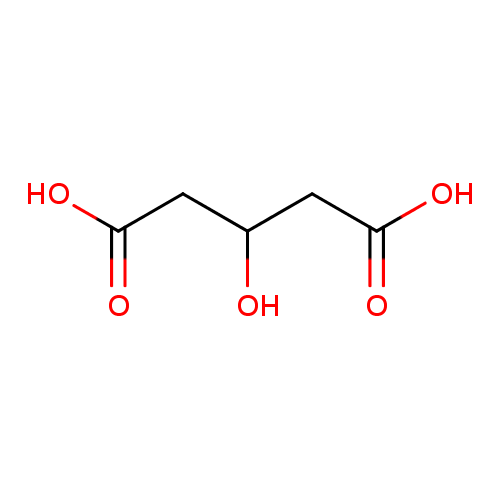
Common Name3-Hydroxyglutaric acid
ClassSmall Molecule
Description3-Hydroxyglutaric acid is a key metabolite in glutaryl co-enzyme A dehydrogenase deficiency, and is considered to be a potential neurotoxin. The urine level of 3-Hydroxyglutaric acid is elevated in Glutaric Aciduria Type I (glutaryl-CoA dehydrogenase deficiency) patients. (1).
Contaminant Sources
  • FooDB Chemicals
  • HMDB Contaminants - Urine
  • T3DB toxins
Contaminant Type
  • Animal Toxin
  • Food Toxin
  • Metabolite
  • Natural Compound
  • Organic Compound
Chemical Structure
Thumb
Synonyms
ValueSource
3-Hydroxy-glutaric acidChEBI
beta-Hydroxyglutaric acidChEBI
3-Hydroxy-glutarateGenerator
b-HydroxyglutarateGenerator
b-Hydroxyglutaric acidGenerator
beta-HydroxyglutarateGenerator
Β-hydroxyglutarateGenerator
Β-hydroxyglutaric acidGenerator
3-HydroxyglutarateGenerator
3-Hydroxypentanedioic acidHMDB
2,4-Dideoxypentaric acidHMDB
3-HydroxypentanedioateHMDB
3-Hydroxyglutaric acidMeSH
Chemical FormulaC5H8O5
Average Molecular Mass148.114 g/mol
Monoisotopic Mass148.037 g/mol
CAS Registry Number638-18-6
IUPAC Name3-hydroxypentanedioic acid
Traditional Name3-hydroxyglutaric acid
SMILESOC(CC(O)=O)CC(O)=O
InChI IdentifierInChI=1S/C5H8O5/c6-3(1-4(7)8)2-5(9)10/h3,6H,1-2H2,(H,7,8)(H,9,10)
InChI KeyZQHYXNSQOIDNTL-UHFFFAOYSA-N
Chemical Taxonomy
Description belongs to the class of organic compounds known as beta hydroxy acids and derivatives. Beta hydroxy acids and derivatives are compounds containing a carboxylic acid substituted with a hydroxyl group on the C3 carbon atom.
KingdomOrganic compounds
Super ClassOrganic acids and derivatives
ClassHydroxy acids and derivatives
Sub ClassBeta hydroxy acids and derivatives
Direct ParentBeta hydroxy acids and derivatives
Alternative Parents
Substituents
  • Short-chain hydroxy acid
  • Beta-hydroxy acid
  • Fatty acid
  • Dicarboxylic acid or derivatives
  • Secondary alcohol
  • Carboxylic acid
  • Carboxylic acid derivative
  • Organic oxygen compound
  • Organic oxide
  • Hydrocarbon derivative
  • Organooxygen compound
  • Carbonyl group
  • Alcohol
  • Aliphatic acyclic compound
Molecular FrameworkAliphatic acyclic compounds
External DescriptorsNot Available
Biological Properties
StatusDetected and Not Quantified
OriginEndogenous
Cellular Locations
  • Cytoplasm
  • Extracellular
Biofluid LocationsNot Available
Tissue Locations
  • Neuron
Pathways
NameSMPDB LinkKEGG Link
Glutaric Aciduria Type ISMP00185 Not Available
ApplicationsNot Available
Biological RolesNot Available
Chemical RolesNot Available
Physical Properties
StateSolid
AppearanceWhite powder.
Experimental Properties
PropertyValue
Melting PointNot Available
Boiling PointNot Available
SolubilityNot Available
Predicted Properties
PropertyValueSource
Water Solubility172 g/LALOGPS
logP-1.2ALOGPS
logP-1ChemAxon
logS0.06ALOGPS
pKa (Strongest Acidic)3.52ChemAxon
pKa (Strongest Basic)-2.9ChemAxon
Physiological Charge-2ChemAxon
Hydrogen Acceptor Count5ChemAxon
Hydrogen Donor Count3ChemAxon
Polar Surface Area94.83 ŲChemAxon
Rotatable Bond Count4ChemAxon
Refractivity29.5 m³·mol⁻¹ChemAxon
Polarizability12.81 ųChemAxon
Number of Rings0ChemAxon
Bioavailability1ChemAxon
Rule of FiveYesChemAxon
Ghose FilterNoChemAxon
Veber's RuleNoChemAxon
MDDR-like RuleNoChemAxon
Spectra
Spectra
Spectrum TypeDescriptionSplash KeyView
Predicted GC-MSPredicted GC-MS Spectrum - GC-MS (Non-derivatized) - 70eV, Positivesplash10-0536-9200000000-95922095d2aa1db75f8bSpectrum
Predicted GC-MSPredicted GC-MS Spectrum - GC-MS (3 TMS) - 70eV, Positivesplash10-00gs-9081000000-c273d86d7f22986f4bcdSpectrum
Predicted GC-MSPredicted GC-MS Spectrum - GC-MS (Non-derivatized) - 70eV, PositiveNot AvailableSpectrum
Predicted GC-MSPredicted GC-MS Spectrum - GC-MS (TMS_1_1) - 70eV, PositiveNot AvailableSpectrum
Predicted GC-MSPredicted GC-MS Spectrum - GC-MS (TMS_1_2) - 70eV, PositiveNot AvailableSpectrum
Predicted GC-MSPredicted GC-MS Spectrum - GC-MS (TMS_2_1) - 70eV, PositiveNot AvailableSpectrum
Predicted GC-MSPredicted GC-MS Spectrum - GC-MS (TMS_2_2) - 70eV, PositiveNot AvailableSpectrum
Predicted GC-MSPredicted GC-MS Spectrum - GC-MS (TBDMS_1_1) - 70eV, PositiveNot AvailableSpectrum
Predicted GC-MSPredicted GC-MS Spectrum - GC-MS (TBDMS_1_2) - 70eV, PositiveNot AvailableSpectrum
Predicted GC-MSPredicted GC-MS Spectrum - GC-MS (TBDMS_2_1) - 70eV, PositiveNot AvailableSpectrum
Predicted GC-MSPredicted GC-MS Spectrum - GC-MS (TBDMS_2_2) - 70eV, PositiveNot AvailableSpectrum
Predicted GC-MSPredicted GC-MS Spectrum - GC-MS (TBDMS_3_1) - 70eV, PositiveNot AvailableSpectrum
LC-MS/MSLC-MS/MS Spectrum - 40V, Negativesplash10-0a4l-9000000000-9249b84ab50ffbbbab00Spectrum
LC-MS/MSLC-MS/MS Spectrum - 20V, Negativesplash10-0a4i-9100000000-a007a5c975eeaa894298Spectrum
LC-MS/MSLC-MS/MS Spectrum - 10V, Negativesplash10-0fbi-4900000000-111cef5b8a6a577bf701Spectrum
Predicted LC-MS/MSPredicted LC-MS/MS Spectrum - 10V, Positivesplash10-01qa-1900000000-83e00bd7b92b7f2f9832Spectrum
Predicted LC-MS/MSPredicted LC-MS/MS Spectrum - 20V, Positivesplash10-01qi-5900000000-da4f8a92eae4f7ae9a73Spectrum
Predicted LC-MS/MSPredicted LC-MS/MS Spectrum - 40V, Positivesplash10-000i-9000000000-a255aedbfaa3bce837b8Spectrum
Predicted LC-MS/MSPredicted LC-MS/MS Spectrum - 10V, Negativesplash10-0002-2900000000-6ea9c60bf78cda297a39Spectrum
Predicted LC-MS/MSPredicted LC-MS/MS Spectrum - 20V, Negativesplash10-0pbj-9800000000-db9f014d4e5dce1cc78fSpectrum
Predicted LC-MS/MSPredicted LC-MS/MS Spectrum - 40V, Negativesplash10-0a4i-9100000000-89edd1cbe710cf97835dSpectrum
Predicted LC-MS/MSPredicted LC-MS/MS Spectrum - 10V, Positivesplash10-0019-9400000000-3231e946df512b24401aSpectrum
Predicted LC-MS/MSPredicted LC-MS/MS Spectrum - 20V, Positivesplash10-0076-9200000000-4ffdd7ac7861294da783Spectrum
Predicted LC-MS/MSPredicted LC-MS/MS Spectrum - 40V, Positivesplash10-006x-9000000000-f46770ad7298e670b4b7Spectrum
Predicted LC-MS/MSPredicted LC-MS/MS Spectrum - 10V, Negativesplash10-0f72-5900000000-c4e9005c7c37f89f6fe3Spectrum
Predicted LC-MS/MSPredicted LC-MS/MS Spectrum - 20V, Negativesplash10-052f-9100000000-de505ca4195705703e19Spectrum
Predicted LC-MS/MSPredicted LC-MS/MS Spectrum - 40V, Negativesplash10-0a4l-9000000000-cae7897ab9482c2d43bcSpectrum
1D NMR1H NMR SpectrumNot AvailableSpectrum
2D NMR[1H,13C] 2D NMR SpectrumNot AvailableSpectrum
Toxicity Profile
Route of ExposureNot Available
Mechanism of ToxicityNot Available
MetabolismNot Available
Toxicity ValuesNot Available
Lethal DoseNot Available
Carcinogenicity (IARC Classification)No indication of carcinogenicity to humans (not listed by IARC).
Uses/SourcesThis is an endogenously produced metabolite found in the human body. It is used in metabolic reactions, catabolic reactions or waste generation.
Minimum Risk LevelNot Available
Health EffectsChronically high levels of 3-hydroxyglutaric acid are associated with Glutaric Aciduria Type I.
SymptomsNot Available
TreatmentNot Available
Concentrations
Not Available
DrugBank IDDB04594
HMDB IDHMDB0000428
FooDB IDFDB022040
Phenol Explorer IDNot Available
KNApSAcK IDNot Available
BiGG IDNot Available
BioCyc IDNot Available
METLIN ID5417
PDB IDNot Available
Wikipedia LinkAlpha-Hydroxyglutaric acid
Chemspider ID158277
ChEBI ID39980
PubChem Compound ID181976
Kegg Compound IDNot Available
YMDB IDNot Available
ECMDB IDNot Available
References
Synthesis ReferenceNot Available
MSDSLink
General References
1. https://www.ncbi.nlm.nih.gov/pubmed/?term=10066389
2. https://www.ncbi.nlm.nih.gov/pubmed/?term=10604139
3. https://www.ncbi.nlm.nih.gov/pubmed/?term=11597592
4. https://www.ncbi.nlm.nih.gov/pubmed/?term=11768583
5. https://www.ncbi.nlm.nih.gov/pubmed/?term=14598231
6. https://www.ncbi.nlm.nih.gov/pubmed/?term=14693719
7. https://www.ncbi.nlm.nih.gov/pubmed/?term=15262270
8. https://www.ncbi.nlm.nih.gov/pubmed/?term=15505388
9. https://www.ncbi.nlm.nih.gov/pubmed/?term=15702406
10. https://www.ncbi.nlm.nih.gov/pubmed/?term=16055049
11. https://www.ncbi.nlm.nih.gov/pubmed/?term=16111821
12. https://www.ncbi.nlm.nih.gov/pubmed/?term=16330550
13. https://www.ncbi.nlm.nih.gov/pubmed/?term=16439578
14. https://www.ncbi.nlm.nih.gov/pubmed/?term=16573641
15. https://www.ncbi.nlm.nih.gov/pubmed/?term=1986098
16. https://www.ncbi.nlm.nih.gov/pubmed/?term=20978942
17. https://www.ncbi.nlm.nih.gov/pubmed/?term=29098534
18. https://www.ncbi.nlm.nih.gov/pubmed/?term=30218917
19. https://www.ncbi.nlm.nih.gov/pubmed/?term=30570710
20. https://www.ncbi.nlm.nih.gov/pubmed/?term=30686684
21. https://www.ncbi.nlm.nih.gov/pubmed/?term=31240164
22. https://www.ncbi.nlm.nih.gov/pubmed/?term=9266362
23. Arnaud, Nathalie; Picard, Claude; Cazaux, Louis; Tisnes, Pierre. Synthesis of macrocyclic polyhydroxy tetralactams derived from L-tartaric acid and b-hydroxyglutaric acid. Tetrahedron (1997), 53(40), 13757-13768.
24. Baric I, Wagner L, Feyh P, Liesert M, Buckel W, Hoffmann GF: Sensitivity and specificity of free and total glutaric acid and 3-hydroxyglutaric acid measurements by stable-isotope dilution assays for the diagnosis of glutaric aciduria type I. J Inherit Metab Dis. 1999 Dec;22(8):867-81.
25. Kolker S, Hoffmann GF, Schor DS, Feyh P, Wagner L, Jeffrey I, Pourfarzam M, Okun JG, Zschocke J, Baric I, Bain MD, Jakobs C, Chalmers RA: Glutaryl-CoA dehydrogenase deficiency: region-specific analysis of organic acids and acylcarnitines in post mortem brain predicts vulnerability of the putamen. Neuropediatrics. 2003 Jun;34(5):253-60.
26. Wajner M, Kolker S, Souza DO, Hoffmann GF, de Mello CF: Modulation of glutamatergic and GABAergic neurotransmission in glutaryl-CoA dehydrogenase deficiency. J Inherit Metab Dis. 2004;27(6):825-8.
27. Nyhan WL, Zschocke J, Hoffmann G, Stein DE, Bao L, Goodman S: Glutaryl-CoA dehydrogenase deficiency presenting as 3-hydroxyglutaric aciduria. Mol Genet Metab. 1999 Mar;66(3):199-204.
28. Molven A, Matre GE, Duran M, Wanders RJ, Rishaug U, Njolstad PR, Jellum E, Sovik O: Familial hyperinsulinemic hypoglycemia caused by a defect in the SCHAD enzyme of mitochondrial fatty acid oxidation. Diabetes. 2004 Jan;53(1):221-7.
29. Haworth JC, Booth FA, Chudley AE, deGroot GW, Dilling LA, Goodman SI, Greenberg CR, Mallory CJ, McClarty BM, Seshia SS, et al.: Phenotypic variability in glutaric aciduria type I: Report of fourteen cases in five Canadian Indian kindreds. J Pediatr. 1991 Jan;118(1):52-8.
30. Sauer SW, Okun JG, Fricker G, Mahringer A, Muller I, Crnic LR, Muhlhausen C, Hoffmann GF, Horster F, Goodman SI, Harding CO, Koeller DM, Kolker S: Intracerebral accumulation of glutaric and 3-hydroxyglutaric acids secondary to limited flux across the blood-brain barrier constitute a biochemical risk factor for neurodegeneration in glutaryl-CoA dehydrogenase deficiency. J Neurochem. 2006 May;97(3):899-910. Epub 2006 Mar 29.