Record Information
Version1.0
Creation Date2014-08-29 06:30:04 UTC
Update Date2026-04-03 00:38:18 UTC
Accession NumberCHEM003302
Identification
Common NameMethylsuccinic acid
ClassSmall Molecule
DescriptionMethylsuccinic acid is a normal metabolite found in human fluids. Increased urinary levels of Methylsuccinic acid (together with ethylmalonic acid) are the main biochemical measurable features in ethylmalonic encephalopathy (OMIM 602473 ), a rare metabolic disorder with an autosomal recessive mode of inheritance that is clinically characterized by neuromotor delay, hyperlactic acidemia, recurrent petechiae, orthostatic acrocyanosis, and chronic diarrhea. T he underlying biochemical defect involves isoleucine catabolism. It has been found decreases in the urine of animals under D-serine-induced nephrotoxicity (D-Serine causes selective necrosis of the proximal straight tubules in the rat kidney). (1, 2, 3).
Contaminant Sources
  • FooDB Chemicals
  • HMDB Contaminants - Feces
  • HMDB Contaminants - Urine
  • T3DB toxins
Contaminant Type
  • Animal Toxin
  • Food Toxin
  • Metabolite
  • Natural Compound
  • Organic Compound
Chemical Structure
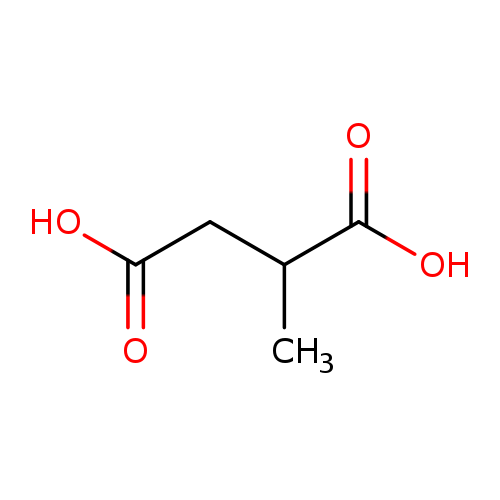
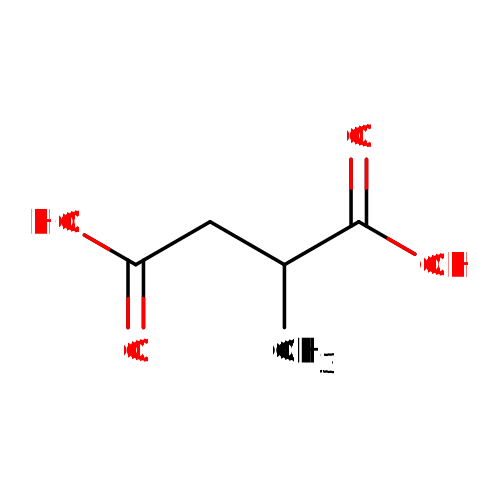
Thumb
Synonyms
ValueSource
MethylsuccinateGenerator
2-Methylbutanedioic acidHMDB
Methylsuccinic acid, (+-)-isomerHMDB
(S)-2-Hydroxy-2-methylsuccinateHMDB
(S)-2-Hydroxy-2-methylsuccinic acidHMDB
(S)-CitramalateHMDB
(S)-Citramalic acidHMDB
2-MethylbutanedioateHMDB
2-MethylsuccinateHMDB
2-Methylsuccinic acidHMDB
Methyl succinateHMDB
Methyl succinic acidHMDB
MethylbutanedioateHMDB
Methylbutanedioic acidHMDB
MEZHMDB
PyrotartarateHMDB
Pyrotartaric acidHMDB
Chemical FormulaC5H8O4
Average Molecular Mass132.115 g/mol
Monoisotopic Mass132.042 g/mol
CAS Registry Number498-21-5
IUPAC NameNot Available
Traditional Namemethylsuccinic acid
SMILESCC(CC(O)=O)C(O)=O
InChI IdentifierInChI=1S/C5H8O4/c1-3(5(8)9)2-4(6)7/h3H,2H2,1H3,(H,6,7)(H,8,9)
InChI KeyWXUAQHNMJWJLTG-UHFFFAOYSA-N
Chemical Taxonomy
Description belongs to the class of organic compounds known as methyl-branched fatty acids. These are fatty acids with an acyl chain that has a methyl branch. Usually, they are saturated and contain only one or more methyl group. However, branches other than methyl may be present.
KingdomOrganic compounds
Super ClassLipids and lipid-like molecules
ClassFatty Acyls
Sub ClassFatty acids and conjugates
Direct ParentMethyl-branched fatty acids
Alternative Parents
Substituents
  • Methyl-branched fatty acid
  • Dicarboxylic acid or derivatives
  • Carboxylic acid
  • Carboxylic acid derivative
  • Organic oxygen compound
  • Organic oxide
  • Hydrocarbon derivative
  • Organooxygen compound
  • Carbonyl group
  • Aliphatic acyclic compound
Molecular FrameworkAliphatic acyclic compounds
External Descriptors
Biological Properties
StatusDetected and Not Quantified
OriginEndogenous
Cellular Locations
  • Cytoplasm
  • Extracellular
Biofluid LocationsNot Available
Tissue LocationsNot Available
Pathways
NameSMPDB LinkKEGG Link
Ethylmalonic EncephalopathySMP00181 Not Available
Short Chain Acyl CoA Dehydrogenase Deficiency (SCAD Deficiency)SMP00235 Not Available
ApplicationsNot Available
Biological RolesNot Available
Chemical RolesNot Available
Physical Properties
StateSolid
AppearanceWhite powder.
Experimental Properties
PropertyValue
Melting Point117.5°C
Boiling PointNot Available
Solubility516.5 mg/mL
Predicted Properties
PropertyValueSource
Water Solubility103 g/LALOGPS
logP0.13ALOGPS
logP0.14ChemAxon
logS-0.11ALOGPS
pKa (Strongest Acidic)3.99ChemAxon
Physiological Charge-2ChemAxon
Hydrogen Acceptor Count4ChemAxon
Hydrogen Donor Count2ChemAxon
Polar Surface Area74.6 ŲChemAxon
Rotatable Bond Count3ChemAxon
Refractivity28.11 m³·mol⁻¹ChemAxon
Polarizability11.91 ųChemAxon
Number of Rings0ChemAxon
Bioavailability1ChemAxon
Rule of FiveYesChemAxon
Ghose FilterNoChemAxon
Veber's RuleNoChemAxon
MDDR-like RuleNoChemAxon
Spectra
Spectra
Spectrum TypeDescriptionSplash KeyView
GC-MSGC-MS Spectrum - GC-EI-TOF (Pegasus III TOF-MS system, Leco; GC 6890, Agilent Technologies) (Non-derivatized)splash10-0002-0910000000-b99795b0e5069d573c2dSpectrum
GC-MSGC-MS Spectrum - EI-B (Non-derivatized)splash10-0002-0920000000-c96774045667ea1804dfSpectrum
GC-MSGC-MS Spectrum - GC-EI-TOF (Non-derivatized)splash10-0002-0910000000-b99795b0e5069d573c2dSpectrum
Predicted GC-MSPredicted GC-MS Spectrum - GC-MS (Non-derivatized) - 70eV, Positivesplash10-007c-9100000000-bb48993db83be2104b10Spectrum
Predicted GC-MSPredicted GC-MS Spectrum - GC-MS (2 TMS) - 70eV, Positivesplash10-00du-9320000000-5f34c9f97642781028e4Spectrum
LC-MS/MSLC-MS/MS Spectrum - Quattro_QQQ 10V, Positive (Annotated)splash10-014i-3900000000-4afd6f9cd1309a7a392bSpectrum
LC-MS/MSLC-MS/MS Spectrum - Quattro_QQQ 25V, Positive (Annotated)splash10-00kr-9600000000-e212a368f465b41cc1faSpectrum
LC-MS/MSLC-MS/MS Spectrum - Quattro_QQQ 40V, Positive (Annotated)splash10-0l0i-9200000000-c712b36382fde51f3ae5Spectrum
LC-MS/MSLC-MS/MS Spectrum - LC-ESI-QTOF (UPLC Q-Tof Premier, Waters) , Negativesplash10-000i-9400000000-f709b1c905420a006038Spectrum
LC-MS/MSLC-MS/MS Spectrum - LC-ESI-QTOF (UPLC Q-Tof Premier, Waters) 30V, Negativesplash10-0019-9400000000-40a1055d8102e323a077Spectrum
LC-MS/MSLC-MS/MS Spectrum - LC-ESI-QTOF , negativesplash10-000i-9400000000-f709b1c905420a006038Spectrum
LC-MS/MSLC-MS/MS Spectrum - LC-ESI-QTOF , negativesplash10-0019-9400000000-40a1055d8102e323a077Spectrum
Predicted LC-MS/MSPredicted LC-MS/MS Spectrum - 10V, Positivesplash10-014i-5900000000-e50cb8068b9ea6aa88c8Spectrum
Predicted LC-MS/MSPredicted LC-MS/MS Spectrum - 20V, Positivesplash10-014r-9100000000-86a85f9d829697c248ddSpectrum
Predicted LC-MS/MSPredicted LC-MS/MS Spectrum - 40V, Positivesplash10-0006-9000000000-687b61805462d04b5dedSpectrum
Predicted LC-MS/MSPredicted LC-MS/MS Spectrum - 10V, Negativesplash10-001r-5900000000-4fd3ea5da8eb91f1951dSpectrum
Predicted LC-MS/MSPredicted LC-MS/MS Spectrum - 20V, Negativesplash10-0019-9500000000-ec3019482baef20b293dSpectrum
Predicted LC-MS/MSPredicted LC-MS/MS Spectrum - 40V, Negativesplash10-00kf-9000000000-23ddfbfc967e6df1168eSpectrum
MSMass Spectrum (Electron Ionization)splash10-0077-9000000000-1bd08b69cec7f9966cb2Spectrum
1D NMR1H NMR SpectrumNot AvailableSpectrum
1D NMR13C NMR SpectrumNot AvailableSpectrum
2D NMR[1H,13C] 2D NMR SpectrumNot AvailableSpectrum
Toxicity Profile
Route of ExposureNot Available
Mechanism of ToxicityNot Available
MetabolismNot Available
Toxicity ValuesNot Available
Lethal DoseNot Available
Carcinogenicity (IARC Classification)No indication of carcinogenicity to humans (not listed by IARC).
Uses/SourcesThis is an endogenously produced metabolite found in the human body. It is used in metabolic reactions, catabolic reactions or waste generation.
Minimum Risk LevelNot Available
Health EffectsNot Available
SymptomsNot Available
TreatmentNot Available
Concentrations
Not Available
DrugBank IDNot Available
HMDB IDHMDB0001844
FooDB IDFDB022704
Phenol Explorer IDNot Available
KNApSAcK IDNot Available
BiGG IDNot Available
BioCyc IDDIETHYL-2R3R-2-METHYL-3-HYDROXYSUCCIN
METLIN ID6344
PDB IDNot Available
Wikipedia Link2-Methylsuccinic acid
Chemspider ID9922
ChEBI ID91315
PubChem Compound ID10349
Kegg Compound IDC08645
YMDB IDNot Available
ECMDB IDNot Available
References
Synthesis ReferenceNot Available
MSDSLink
General References
1. Guneral F, Bachmann C: Age-related reference values for urinary organic acids in a healthy Turkish pediatric population. Clin Chem. 1994 Jun;40(6):862-6.
2. Bhala A, Willi SM, Rinaldo P, Bennett MJ, Schmidt-Sommerfeld E, Hale DE: Clinical and biochemical characterization of short-chain acyl-coenzyme A dehydrogenase deficiency. J Pediatr. 1995 Jun;126(6):910-5.
3. Grosso S, Mostardini R, Farnetani MA, Molinelli M, Berardi R, Dionisi-Vici C, Rizzo C, Morgese G, Balestri P: Ethylmalonic encephalopathy: further clinical and neuroradiological characterization. J Neurol. 2002 Oct;249(10):1446-50.
4. Nowaczyk MJ, Lehotay DC, Platt BA, Fisher L, Tan R, Phillips H, Clarke JT: Ethylmalonic and methylsuccinic aciduria in ethylmalonic encephalopathy arise from abnormal isoleucine metabolism. Metabolism. 1998 Jul;47(7):836-9.
5. Williams RE, Major H, Lock EA, Lenz EM, Wilson ID: D-Serine-induced nephrotoxicity: a HPLC-TOF/MS-based metabonomics approach. Toxicology. 2005 Feb 14;207(2):179-90.