Record Information
Version1.0
Creation Date2014-08-29 06:17:59 UTC
Update Date2026-05-14 18:08:53 UTC
Accession NumberCHEM003268
Identification
Common NameIndole
ClassSmall Molecule
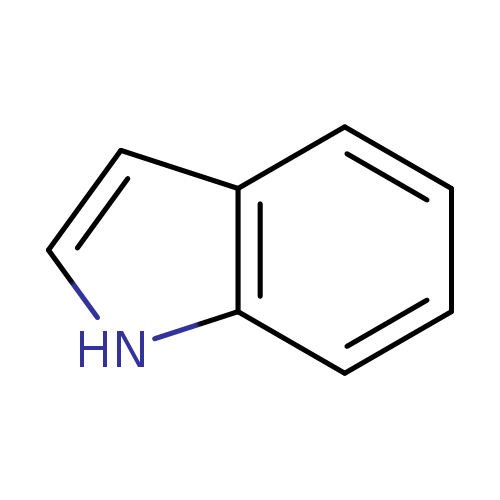
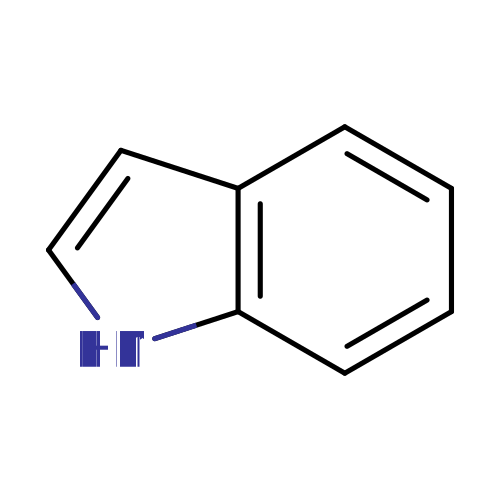
DescriptionIndole is an aromatic heterocyclic organic compound. It has a bicyclic structure, consisting of a six-membered benzene ring fused to a five-membered nitrogen-containing pyrrole ring. It can be produced by bacteria as a degradation product of the amino acid tryptophan. It occurs naturally in human feces and has an intense fecal smell. At very low concentrations, however, it has a flowery smell, and is a constituent of many flower scents (such as orange blossoms) and perfumes. Natural jasmine oil, used in the perfume industry, contains around 2.5% of indole. Indole also occurs in coal tar. The participation of the nitrogen lone electron pair in the aromatic ring means that indole is not a base, and it does not behave like a simple amine.
Contaminant Sources
  • EAFUS Chemicals
  • FooDB Chemicals
  • HMDB Contaminants - Feces
  • HMDB Contaminants - Urine
  • HPV EPA Chemicals
  • STOFF IDENT Compounds
  • T3DB toxins
  • ToxCast & Tox21 Chemicals
Contaminant Type
  • Animal Toxin
  • Food Toxin
  • Industrial/Workplace Toxin
  • Metabolite
  • Natural Compound
  • Organic Compound
Chemical Structure
Thumb
Synonyms
ValueSource
2,3-BenzopyrroleChEBI
indolChEBI
1-AzaindeneHMDB
1-BenzazoleHMDB
Benzo[b]pyrroleHMDB
KetoleHMDB
IndoleHMDB
Chemical FormulaC8H7N
Average Molecular Mass117.148 g/mol
Monoisotopic Mass117.058 g/mol
CAS Registry Number120-72-9
IUPAC Name1H-indole
Traditional Nameindole
SMILESN1C=CC2=C1C=CC=C2
InChI IdentifierInChI=1S/C8H7N/c1-2-4-8-7(3-1)5-6-9-8/h1-6,9H
InChI KeySIKJAQJRHWYJAI-UHFFFAOYSA-N
Chemical Taxonomy
Description belongs to the class of organic compounds known as indoles. Indoles are compounds containing an indole moiety, which consists of pyrrole ring fused to benzene to form 2,3-benzopyrrole.
KingdomOrganic compounds
Super ClassOrganoheterocyclic compounds
ClassIndoles and derivatives
Sub ClassIndoles
Direct ParentIndoles
Alternative Parents
Substituents
  • Indole
  • Benzenoid
  • Heteroaromatic compound
  • Pyrrole
  • Azacycle
  • Organic nitrogen compound
  • Organopnictogen compound
  • Hydrocarbon derivative
  • Organonitrogen compound
  • Aromatic heteropolycyclic compound
Molecular FrameworkAromatic heteropolycyclic compounds
External Descriptors
Biological Properties
StatusDetected and Not Quantified
OriginEndogenous
Cellular Locations
  • Membrane
Biofluid LocationsNot Available
Tissue Locations
  • Epidermis
  • Fibroblasts
  • Intestine
  • Nerve Cells
  • Neuron
Pathways
NameSMPDB LinkKEGG Link
Blue diaper syndromeSMP00583 Not Available
ApplicationsNot Available
Biological RolesNot Available
Chemical RolesNot Available
Physical Properties
StateSolid
AppearanceWhite powder.
Experimental Properties
PropertyValue
Melting Point52.5°C
Boiling Point253°C (487.4°F)
Solubility3.56 mg/mL
Predicted Properties
PropertyValueSource
Water Solubility5.31 g/LALOGPS
logP2.29ALOGPS
logP2.07ChemAxon
logS-1.3ALOGPS
pKa (Strongest Acidic)16.44ChemAxon
Physiological Charge0ChemAxon
Hydrogen Acceptor Count0ChemAxon
Hydrogen Donor Count1ChemAxon
Polar Surface Area15.79 ŲChemAxon
Rotatable Bond Count0ChemAxon
Refractivity37.14 m³·mol⁻¹ChemAxon
Polarizability12.82 ųChemAxon
Number of Rings2ChemAxon
Bioavailability1ChemAxon
Rule of FiveYesChemAxon
Ghose FilterNoChemAxon
Veber's RuleYesChemAxon
MDDR-like RuleNoChemAxon
Spectra
Spectra
Spectrum TypeDescriptionSplash KeyView
GC-MSGC-MS Spectrum - EI-B (Non-derivatized)splash10-014i-6900000000-09af4d0af4e5f7259a59Spectrum
GC-MSGC-MS Spectrum - EI-B (Non-derivatized)splash10-014i-9800000000-4160749bd673d5e00048Spectrum
GC-MSGC-MS Spectrum - EI-B (Non-derivatized)splash10-014i-9800000000-33bf321019a6a8e3401aSpectrum
GC-MSGC-MS Spectrum - EI-B (Non-derivatized)splash10-014i-6900000000-09af4d0af4e5f7259a59Spectrum
GC-MSGC-MS Spectrum - EI-B (Non-derivatized)splash10-014i-9800000000-4160749bd673d5e00048Spectrum
GC-MSGC-MS Spectrum - EI-B (Non-derivatized)splash10-014i-9800000000-33bf321019a6a8e3401aSpectrum
Predicted GC-MSPredicted GC-MS Spectrum - GC-MS (Non-derivatized) - 70eV, Positivesplash10-014i-7900000000-2a9e4ccc61fee73a480eSpectrum
Predicted GC-MSPredicted GC-MS Spectrum - GC-MS (Non-derivatized) - 70eV, PositiveNot AvailableSpectrum
LC-MS/MSLC-MS/MS Spectrum - Quattro_QQQ 10V, Positive (Annotated)splash10-014i-0900000000-622dfed80152ea08d52aSpectrum
LC-MS/MSLC-MS/MS Spectrum - Quattro_QQQ 25V, Positive (Annotated)splash10-0006-9100000000-2531cceca05522a5489eSpectrum
LC-MS/MSLC-MS/MS Spectrum - Quattro_QQQ 40V, Positive (Annotated)splash10-014l-9000000000-5e07c15293929ff4440fSpectrum
LC-MS/MSLC-MS/MS Spectrum - EI-B (MX-1303) , Positivesplash10-014i-6900000000-09af4d0af4e5f7259a59Spectrum
LC-MS/MSLC-MS/MS Spectrum - EI-B (Unknown) , Positivesplash10-014i-9800000000-4160749bd673d5e00048Spectrum
LC-MS/MSLC-MS/MS Spectrum - EI-B (HITACHI M-68) , Positivesplash10-014i-9800000000-33bf321019a6a8e3401aSpectrum
LC-MS/MSLC-MS/MS Spectrum - LC-ESI-QTOF (UPLC Q-Tof Premier, Waters) , Positivesplash10-014i-0900000000-e6b11e225744a0d85f71Spectrum
LC-MS/MSLC-MS/MS Spectrum - LC-ESI-QTOF , positivesplash10-014i-0900000000-e6b11e225744a0d85f71Spectrum
LC-MS/MSLC-MS/MS Spectrum - ESI-ITFT , positivesplash10-014i-0900000000-7b49c1c370d7355c5e6fSpectrum
LC-MS/MSLC-MS/MS Spectrum - ESI-ITFT , positivesplash10-0006-9000000000-050ef45f3ec404d7eb65Spectrum
LC-MS/MSLC-MS/MS Spectrum - ESI-ITFT , positivesplash10-0006-9000000000-79ff95be504a5efad264Spectrum
LC-MS/MSLC-MS/MS Spectrum - ESI-ITFT , positivesplash10-0006-9000000000-31ff8b484e0dc207fcc9Spectrum
LC-MS/MSLC-MS/MS Spectrum - ESI-ITFT , positivesplash10-0006-9000000000-864a48552fea562fc370Spectrum
LC-MS/MSLC-MS/MS Spectrum - ESI-ITFT , positivesplash10-014i-0900000000-bd82bfab4567619b5c41Spectrum
LC-MS/MSLC-MS/MS Spectrum - ESI-ITFT , positivesplash10-014i-0900000000-6bff353534e6f5f9105bSpectrum
LC-MS/MSLC-MS/MS Spectrum - ESI-ITFT , positivesplash10-014i-0900000000-c4e339d4a1d3fda0a949Spectrum
LC-MS/MSLC-MS/MS Spectrum - ESI-ITFT , positivesplash10-014i-2900000000-100cd0cc67ac9eda3f4eSpectrum
LC-MS/MSLC-MS/MS Spectrum - ESI-ITFT , positivesplash10-014l-5900000000-79447b563349d08aacc0Spectrum
LC-MS/MSLC-MS/MS Spectrum - ESI-ITFT , positivesplash10-00kf-9800000000-a1ce5da5416e6d003ff9Spectrum
Predicted LC-MS/MSPredicted LC-MS/MS Spectrum - 10V, Positivesplash10-014i-0900000000-aba5022e03d31dcbcc86Spectrum
Predicted LC-MS/MSPredicted LC-MS/MS Spectrum - 20V, Positivesplash10-014i-0900000000-78c0f569df5b7f51c52cSpectrum
Predicted LC-MS/MSPredicted LC-MS/MS Spectrum - 40V, Positivesplash10-014i-6900000000-bacb6e9a65a688229f96Spectrum
Predicted LC-MS/MSPredicted LC-MS/MS Spectrum - 10V, Negativesplash10-014i-0900000000-e93b2f48040666dd7fe0Spectrum
Predicted LC-MS/MSPredicted LC-MS/MS Spectrum - 20V, Negativesplash10-014i-0900000000-07d8a93ec0ace38ef3b3Spectrum
Predicted LC-MS/MSPredicted LC-MS/MS Spectrum - 40V, Negativesplash10-014i-6900000000-8abfc9b162cc93f153acSpectrum
MSMass Spectrum (Electron Ionization)splash10-014i-9700000000-3b1ec48b5bce79adb282Spectrum
1D NMR1H NMR SpectrumNot AvailableSpectrum
1D NMR13C NMR SpectrumNot AvailableSpectrum
1D NMR1H NMR SpectrumNot AvailableSpectrum
1D NMR13C NMR SpectrumNot AvailableSpectrum
2D NMR[1H,1H] 2D NMR SpectrumNot AvailableSpectrum
2D NMR[1H,13C] 2D NMR SpectrumNot AvailableSpectrum
Toxicity Profile
Route of ExposureNot Available
Mechanism of ToxicityNot Available
MetabolismNot Available
Toxicity ValuesNot Available
Lethal DoseNot Available
Carcinogenicity (IARC Classification)No indication of carcinogenicity to humans (not listed by IARC).
Uses/SourcesThis is an endogenously produced metabolite found in the human body. It is used in metabolic reactions, catabolic reactions or waste generation.
Minimum Risk LevelNot Available
Health EffectsNot Available
SymptomsNot Available
TreatmentNot Available
Concentrations
Not Available
DrugBank IDDB04532
HMDB IDHMDB0000738
FooDB IDFDB012008
Phenol Explorer IDNot Available
KNApSAcK IDC00001418
BiGG IDNot Available
BioCyc IDINDOLE
METLIN ID286
PDB IDNot Available
Wikipedia LinkIndole
Chemspider ID776
ChEBI ID16881
PubChem Compound ID798
Kegg Compound IDC00463
YMDB IDYMDB16120
ECMDB IDECMDB00738
References
Synthesis Reference

Ernst Schefczik, “Preparation of indole derivatives.” U.S. Patent US4611064, issued June, 1900.

MSDSLink
General References
1. Grigoleit, Georg; Oberkobusch, Rudolf; Collin, Gerd. Indole from 2-ethylaniline. Ger. Offen. (1973), 6 pp.
2. Gambhir KK, McMenamy RH, Watson F: Positions in human serum albumin which involve the indole binding site. Sequence of 107-residue fragment. J Biol Chem. 1975 Sep 10;250(17):6711-9.
3. Welch DF, Ahlin PA, Matsen JM: Differentiation of Haemophilus spp. in Respiratory isolate cultures by an indole spot test. J Clin Microbiol. 1982 Feb;15(2):216-9.
4. Kunka RL, Hussey EK, Shaw S, Warner P, Aubert B, Richard I, Fowler PA, Pakes GE: Safety, tolerability, and pharmacokinetics of sumatriptan suppositories following single and multiple doses in healthy volunteers. Cephalalgia. 1997 Jun;17(4):532-40.
5. Scott AK: Sumatriptan clinical pharmacokinetics. Clin Pharmacokinet. 1994 Nov;27(5):337-44.
6. Coowar D, Bouissac J, Hanbali M, Paschaki M, Mohier E, Luu B: Effects of indole fatty alcohols on the differentiation of neural stem cell derived neurospheres. J Med Chem. 2004 Dec 2;47(25):6270-82.
7. Citron DM, Baron EJ, Finegold SM, Goldstein EJ: Short prereduced anaerobically sterilized (PRAS) biochemical scheme for identification of clinical isolates of bile-resistant Bacteroides species. J Clin Microbiol. 1990 Oct;28(10):2220-3.
8. Agatsuma S, Sekino H, Watanabe H: Indoxyl-beta-D-glucuronide and 3-indoxyl sulfate in plasma of hemodialysis patients. Clin Nephrol. 1996 Apr;45(4):250-6.
9. Aoyama I, Miyazaki T, Niwa T: Preventive effects of an oral sorbent on nephropathy in rats. Miner Electrolyte Metab. 1999 Jul-Dec;25(4-6):365-72.
10. Cooke M, Leeves N, White C: Time profile of putrescine, cadaverine, indole and skatole in human saliva. Arch Oral Biol. 2003 Apr;48(4):323-7.
11. Yoshida M, Mishiro Y: [Indole production in human whole saliva]. Shigaku. 1989 Aug;77(2):472-86.
12. Freedman DX, Belendiuk K, Belendiuk GW, Crayton JW: Blood tryptophan metabolism in chronic schizophrenics. Arch Gen Psychiatry. 1981 Jun;38(6):655-9.
13. Takken W, van Loon JJ, Adam W: Inhibition of host-seeking response and olfactory responsiveness in Anopheles gambiae following blood feeding. J Insect Physiol. 2001 Mar;47(3):303-310.
14. Raw I, Schmidt BJ, Merzel J: Catecholamines and congenital pain insensitivity. Braz J Med Biol Res. 1984;17(3-4):271-9.
15. Claus G, Kutzner HJ: Degradation of indole by Alcaligenes spec. Syst Appl Microbiol. 1983;4(2):169-80. doi: 10.1016/S0723-2020(83)80046-0.
16. Kamath AV, Vaidyanathan CS: New pathway for the biodegradation of indole in Aspergillus niger. Appl Environ Microbiol. 1990 Jan;56(1):275-80.
17. Doukyu N, Aono R: Biodegradation of indole at high concentration by persolvent fermentation with Pseudomonas sp. ST-200. Extremophiles. 1997 May;1(2):100-5.
18. Patel M, Fowler D, Sizer J, Walton C: Faecal volatile biomarkers of Clostridium difficile infection. PLoS One. 2019 Apr 15;14(4):e0215256. doi: 10.1371/journal.pone.0215256. eCollection 2019.
19. Kim J, Park W: Indole: a signaling molecule or a mere metabolic byproduct that alters bacterial physiology at a high concentration? J Microbiol. 2015 Jul;53(7):421-8. doi: 10.1007/s12275-015-5273-3. Epub 2015 Jun 27.
20. Kumar A, Sperandio V: Indole Signaling at the Host-Microbiota-Pathogen Interface. mBio. 2019 Jun 4;10(3). pii: mBio.01031-19. doi: 10.1128/mBio.01031-19.