Record Information
Version1.0
Creation Date2014-08-29 06:17:08 UTC
Update Date2026-05-14 16:55:05 UTC
Accession NumberCHEM003260
Identification
Common NameDopamine
ClassSmall Molecule
DescriptionOne of the catecholamine neurotransmitters in the brain. It is derived from tyrosine and is the precursor to norepinephrine and epinephrine. Dopamine is a major transmitter in the extrapyramidal system of the brain, and important in regulating movement. A family of receptors (receptors, dopamine) mediate its action. [PubChem]
Contaminant Sources
  • FooDB Chemicals
  • HMDB Contaminants - Feces
  • HMDB Contaminants - Urine
  • STOFF IDENT Compounds
  • T3DB toxins
  • ToxCast & Tox21 Chemicals
Contaminant Type
  • Amine
  • Animal Toxin
  • Cardiotonic Agent
  • Dopamine Agent
  • Drug
  • Food Toxin
  • Human Neurotoxin
  • Metabolite
  • Natural Compound
  • Organic Compound
  • Sympathomimetic
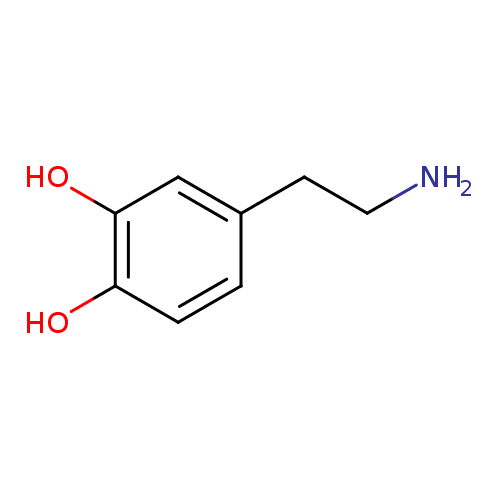
Chemical Structure
Thumb
Synonyms
ValueSource
2-(3,4-Dihydroxyphenyl)ethylamineChEBI
3,4-DihydroxyphenethylamineChEBI
3-HydroxytyramineChEBI
4-(2-Aminoethyl)-1,2-benzenediolChEBI
4-(2-Aminoethyl)benzene-1,2-diolChEBI
4-(2-Aminoethyl)catecholChEBI
4-(2-Aminoethyl)pyrocatecholChEBI
DeoxyepinephrineChEBI
DopaminaChEBI
DopaminumChEBI
HydroxytyraminChEBI
MedopaKegg
3,4-DihydroxyphenylethylamineHMDB
4-(2-Aminoethyl)-pyrocatecholHMDB
a-(3,4-Dihydroxyphenyl)-b-aminoethaneHMDB
alpha-(3,4-Dihydroxyphenyl)-beta-aminoethaneHMDB
DopaminHMDB
DopastatHMDB
DophamineHMDB
DynatraHMDB
HydroxytyramineHMDB
IntropinHMDB
OxytyramineHMDB
RevivanHMDB
3,4 DihydroxyphenethylamineHMDB
Hydrochloride, dopamineHMDB
Dopamine hydrochlorideHMDB
Chemical FormulaC8H11NO2
Average Molecular Mass153.178 g/mol
Monoisotopic Mass153.079 g/mol
CAS Registry Number51-61-6
IUPAC Name4-(2-aminoethyl)benzene-1,2-diol
Traditional Namedopamine
SMILESNCCC1=CC(O)=C(O)C=C1
InChI IdentifierInChI=1S/C8H11NO2/c9-4-3-6-1-2-7(10)8(11)5-6/h1-2,5,10-11H,3-4,9H2
InChI KeyVYFYYTLLBUKUHU-UHFFFAOYSA-N
Chemical Taxonomy
Description belongs to the class of organic compounds known as catecholamines and derivatives. Catecholamines and derivatives are compounds containing 4-(2-Aminoethyl)pyrocatechol [4-(2-aminoethyl)benzene-1,2-diol] or a derivative thereof formed by substitution.
KingdomOrganic compounds
Super ClassBenzenoids
ClassPhenols
Sub ClassBenzenediols
Direct ParentCatecholamines and derivatives
Alternative Parents
Substituents
  • Catecholamine
  • Phenethylamine
  • 2-arylethylamine
  • 1-hydroxy-4-unsubstituted benzenoid
  • 1-hydroxy-2-unsubstituted benzenoid
  • Aralkylamine
  • Monocyclic benzene moiety
  • Amine
  • Hydrocarbon derivative
  • Primary amine
  • Organopnictogen compound
  • Organooxygen compound
  • Organonitrogen compound
  • Primary aliphatic amine
  • Organic oxygen compound
  • Organic nitrogen compound
  • Aromatic homomonocyclic compound
Molecular FrameworkAromatic homomonocyclic compounds
External Descriptors
Biological Properties
StatusDetected and Not Quantified
OriginEndogenous
Cellular Locations
  • Cytoplasm
  • Extracellular
Biofluid LocationsNot Available
Tissue Locations
  • Adipose Tissue
  • Adrenal Cortex
  • Adrenal Gland
  • Adrenal Medulla
  • Bladder
  • Brain
  • Epidermis
  • Fibroblasts
  • Kidney
  • Muscle
  • Myelin
  • Nerve Cells
  • Neuron
  • Pancreas
  • Placenta
  • Platelet
  • Skeletal Muscle
  • Spleen
  • Striatum
  • Testes
Pathways
NameSMPDB LinkKEGG Link
Catecholamine BiosynthesisSMP00012 map00350
Tyrosine MetabolismSMP00006 map00350
Aromatic L-Aminoacid Decarboxylase DeficiencySMP00170 Not Available
Dopamine beta-hydroxylase deficiencySMP00498 Not Available
Applications
Biological Roles
Chemical RolesNot Available
Physical Properties
StateSolid
AppearanceWhite powder.
Experimental Properties
PropertyValue
Melting Point128°C
Boiling Point227°C at 2.30E+01 mm Hg
Solubility600 g/L
Predicted Properties
PropertyValueSource
Water Solubility7.43 g/LALOGPS
logP-0.4ALOGPS
logP0.03ChemAxon
logS-1.3ALOGPS
pKa (Strongest Acidic)10.01ChemAxon
pKa (Strongest Basic)9.27ChemAxon
Physiological Charge1ChemAxon
Hydrogen Acceptor Count3ChemAxon
Hydrogen Donor Count3ChemAxon
Polar Surface Area66.48 ŲChemAxon
Rotatable Bond Count2ChemAxon
Refractivity43.25 m³·mol⁻¹ChemAxon
Polarizability16.21 ųChemAxon
Number of Rings1ChemAxon
Bioavailability1ChemAxon
Rule of FiveYesChemAxon
Ghose FilterNoChemAxon
Veber's RuleNoChemAxon
MDDR-like RuleNoChemAxon
Spectra
Spectra
Spectrum TypeDescriptionSplash KeyView
GC-MSGC-MS Spectrum - GC-EI-TOF (Pegasus III TOF-MS system, Leco; GC 6890, Agilent Technologies) (Non-derivatized)splash10-00di-1900000000-117a1a7207245f5377e7Spectrum
GC-MSGC-MS Spectrum - GC-MS (4 TMS)splash10-00di-1900000000-8b7dcae82868308513daSpectrum
GC-MSGC-MS Spectrum - GC-EI-TOF (Non-derivatized)splash10-00di-1900000000-117a1a7207245f5377e7Spectrum
GC-MSGC-MS Spectrum - GC-MS (Non-derivatized)splash10-00di-1900000000-8b7dcae82868308513daSpectrum
Predicted GC-MSPredicted GC-MS Spectrum - GC-MS (Non-derivatized) - 70eV, Positivesplash10-001i-8900000000-752bc8c11fa321b8a7acSpectrum
Predicted GC-MSPredicted GC-MS Spectrum - GC-MS (2 TMS) - 70eV, Positivesplash10-0089-9280000000-c894c19dda88ac048dd4Spectrum
Predicted GC-MSPredicted GC-MS Spectrum - GC-MS (Non-derivatized) - 70eV, PositiveNot AvailableSpectrum
Predicted GC-MSPredicted GC-MS Spectrum - GC-MS (TMS_1_1) - 70eV, PositiveNot AvailableSpectrum
Predicted GC-MSPredicted GC-MS Spectrum - GC-MS (TMS_1_2) - 70eV, PositiveNot AvailableSpectrum
Predicted GC-MSPredicted GC-MS Spectrum - GC-MS (TMS_1_3) - 70eV, PositiveNot AvailableSpectrum
Predicted GC-MSPredicted GC-MS Spectrum - GC-MS (TMS_2_2) - 70eV, PositiveNot AvailableSpectrum
Predicted GC-MSPredicted GC-MS Spectrum - GC-MS (TMS_2_3) - 70eV, PositiveNot AvailableSpectrum
Predicted GC-MSPredicted GC-MS Spectrum - GC-MS (TMS_2_4) - 70eV, PositiveNot AvailableSpectrum
Predicted GC-MSPredicted GC-MS Spectrum - GC-MS (TBDMS_1_1) - 70eV, PositiveNot AvailableSpectrum
Predicted GC-MSPredicted GC-MS Spectrum - GC-MS (TBDMS_1_2) - 70eV, PositiveNot AvailableSpectrum
Predicted GC-MSPredicted GC-MS Spectrum - GC-MS (TBDMS_1_3) - 70eV, PositiveNot AvailableSpectrum
Predicted GC-MSPredicted GC-MS Spectrum - GC-MS (TBDMS_2_1) - 70eV, PositiveNot AvailableSpectrum
Predicted GC-MSPredicted GC-MS Spectrum - GC-MS (TBDMS_2_2) - 70eV, PositiveNot AvailableSpectrum
Predicted GC-MSPredicted GC-MS Spectrum - GC-MS (TBDMS_2_3) - 70eV, PositiveNot AvailableSpectrum
Predicted GC-MSPredicted GC-MS Spectrum - GC-MS (TBDMS_2_4) - 70eV, PositiveNot AvailableSpectrum
LC-MS/MSLC-MS/MS Spectrum - Quattro_QQQ 10V, Positive (Annotated)splash10-0uxu-4900000000-ff51177ebcb89b8c956cSpectrum
LC-MS/MSLC-MS/MS Spectrum - Quattro_QQQ 25V, Positive (Annotated)splash10-0006-9200000000-a554eb700a06cecb8292Spectrum
LC-MS/MSLC-MS/MS Spectrum - Quattro_QQQ 40V, Positive (Annotated)splash10-014l-9000000000-db9813e1025f237a549bSpectrum
LC-MS/MSLC-MS/MS Spectrum - LC-ESI-QQ (API3000, Applied Biosystems) 10V, Negativesplash10-0udi-0900000000-27e0d71db6d14d79759cSpectrum
LC-MS/MSLC-MS/MS Spectrum - LC-ESI-QQ (API3000, Applied Biosystems) 20V, Negativesplash10-0uk9-0900000000-f1cf97c0d0dd509e229eSpectrum
LC-MS/MSLC-MS/MS Spectrum - LC-ESI-QQ (API3000, Applied Biosystems) 30V, Negativesplash10-00di-0900000000-aa09a2411e287abe74edSpectrum
LC-MS/MSLC-MS/MS Spectrum - LC-ESI-QQ (API3000, Applied Biosystems) 40V, Negativesplash10-00di-1900000000-97c42b109cab2005373dSpectrum
LC-MS/MSLC-MS/MS Spectrum - LC-ESI-QQ (API3000, Applied Biosystems) 50V, Negativesplash10-006x-9700000000-974bd18febffcceea2d6Spectrum
LC-MS/MSLC-MS/MS Spectrum - LC-ESI-QQ (API3000, Applied Biosystems) 10V, Positivesplash10-0f79-0900000000-099173d4201beca9e548Spectrum
LC-MS/MSLC-MS/MS Spectrum - LC-ESI-QQ (API3000, Applied Biosystems) 20V, Positivesplash10-000i-1900000000-9dc09f2661247c9d84b0Spectrum
LC-MS/MSLC-MS/MS Spectrum - LC-ESI-QQ (API3000, Applied Biosystems) 30V, Positivesplash10-0006-9300000000-8b85fa9aac1ffb4c2873Spectrum
LC-MS/MSLC-MS/MS Spectrum - LC-ESI-QQ (API3000, Applied Biosystems) 40V, Positivesplash10-0006-9000000000-9ea16d2057010279d433Spectrum
LC-MS/MSLC-MS/MS Spectrum - LC-ESI-QQ (API3000, Applied Biosystems) 50V, Positivesplash10-014l-9000000000-32ca2db8fe2b4729ab94Spectrum
LC-MS/MSLC-MS/MS Spectrum - LC-ESI-QQ (API3000, Applied Biosystems) 10V, Positivesplash10-0f79-0900000000-ff587935c79b4592ffcfSpectrum
LC-MS/MSLC-MS/MS Spectrum - LC-ESI-QQ (API3000, Applied Biosystems) 20V, Positivesplash10-000i-1900000000-8a35d8a2241bc18d6c50Spectrum
LC-MS/MSLC-MS/MS Spectrum - LC-ESI-QQ (API3000, Applied Biosystems) 30V, Positivesplash10-0006-9300000000-356a4b8f268863c7893eSpectrum
LC-MS/MSLC-MS/MS Spectrum - LC-ESI-QQ (API3000, Applied Biosystems) 40V, Positivesplash10-0006-9000000000-a88c1004f357858fbc6cSpectrum
LC-MS/MSLC-MS/MS Spectrum - LC-ESI-QQ (API3000, Applied Biosystems) 50V, Positivesplash10-014l-9000000000-271874005dcb90288512Spectrum
LC-MS/MSLC-MS/MS Spectrum - LC-ESI-QFT , negativesplash10-0udi-0900000000-cfa7e1cb9f02ffb4447dSpectrum
Predicted LC-MS/MSPredicted LC-MS/MS Spectrum - 10V, Positivesplash10-0udr-0900000000-4e409c6edda911de39feSpectrum
Predicted LC-MS/MSPredicted LC-MS/MS Spectrum - 20V, Positivesplash10-000i-1900000000-90aa0e0866454c2eacc7Spectrum
Predicted LC-MS/MSPredicted LC-MS/MS Spectrum - 40V, Positivesplash10-1000-9400000000-210fd696305d8cf76164Spectrum
Predicted LC-MS/MSPredicted LC-MS/MS Spectrum - 10V, Negativesplash10-0udi-0900000000-ff95007680e484d3c57eSpectrum
Predicted LC-MS/MSPredicted LC-MS/MS Spectrum - 20V, Negativesplash10-0udi-1900000000-6dcfecebbd98220ef746Spectrum
Predicted LC-MS/MSPredicted LC-MS/MS Spectrum - 40V, Negativesplash10-0kil-6900000000-f476cfd569c441bc84aaSpectrum
MSMass Spectrum (Electron Ionization)splash10-00e9-8900000000-88acdc978fe4a64e0fc5Spectrum
1D NMR1H NMR SpectrumNot AvailableSpectrum
1D NMR13C NMR SpectrumNot AvailableSpectrum
1D NMR1H NMR SpectrumNot AvailableSpectrum
1D NMR13C NMR SpectrumNot AvailableSpectrum
1D NMR1H NMR SpectrumNot AvailableSpectrum
1D NMR13C NMR SpectrumNot AvailableSpectrum
1D NMR1H NMR SpectrumNot AvailableSpectrum
1D NMR13C NMR SpectrumNot AvailableSpectrum
1D NMR1H NMR SpectrumNot AvailableSpectrum
1D NMR13C NMR SpectrumNot AvailableSpectrum
1D NMR1H NMR SpectrumNot AvailableSpectrum
1D NMR13C NMR SpectrumNot AvailableSpectrum
1D NMR1H NMR SpectrumNot AvailableSpectrum
1D NMR13C NMR SpectrumNot AvailableSpectrum
1D NMR1H NMR SpectrumNot AvailableSpectrum
1D NMR13C NMR SpectrumNot AvailableSpectrum
1D NMR1H NMR SpectrumNot AvailableSpectrum
1D NMR13C NMR SpectrumNot AvailableSpectrum
1D NMR1H NMR SpectrumNot AvailableSpectrum
1D NMR13C NMR SpectrumNot AvailableSpectrum
2D NMR[1H,13C] 2D NMR SpectrumNot AvailableSpectrum
Toxicity Profile
Route of ExposureDopamine is rapidly absorbed from the small intestine.
Mechanism of ToxicityDopamine is a precursor to norepinephrine in noradrenergic nerves and is also a neurotransmitter in certain areas of the central nervous system. Dopamine produces positive chronotropic and inotropic effects on the myocardium, resulting in increased heart rate and cardiac contractility. This is accomplished directly by exerting an agonist action on beta-adrenoceptors and indirectly by causing release of norepinephrine from storage sites in sympathetic nerve endings. In the brain, dopamine actas as an agonist to the five dopamine receptor subtypes (D!, D2, D3, D4, D5).
MetabolismBiotransformation of dopamine proceeds rapidly to yield the principal excretion products, 3-4-dihydroxy-phenylacetic acid (DOPAC) and 3-methoxy-4-hydroxy-phenylacetic acid (homovanillic acid, HVA). Route of Elimination: It has been reported that about 80% of the drug is excreted in the urine within 24 hours, primarily as HVA and its sulfate and glucuronide conjugates and as 3,4-dihydroxyphenylacetic acid. A very small portion is excreted unchanged. Half Life: 2 minutes
Toxicity ValuesLD50 oral mice = 1460 mg/kg, LD50 oral rats = 1780 mg/kg
Lethal DoseNot Available
Carcinogenicity (IARC Classification)No indication of carcinogenicity to humans (not listed by IARC).
Uses/SourcesFor the correction of hemodynamic imbalances present in the shock syndrome due to myocardial infarction, trauma, endotoxic septicemia, open-heart surgery, renal failure, and chronic cardiac decompensation as in congestive failure
Minimum Risk LevelNot Available
Health EffectsChronically high levels of dopamine are associated with at least 2 inborn errors of metabolism including: Aromatic L-Amino acid Decarboxylase Deficiency and Norepinephrine deficiency.
SymptomsNot Available
TreatmentNot Available
Concentrations
Not Available
DrugBank IDDB00988
HMDB IDHMDB0000073
FooDB IDFDB012163
Phenol Explorer IDNot Available
KNApSAcK IDC00001408
BiGG ID42467
BioCyc IDDOPAMINE
METLIN ID64
PDB IDNot Available
Wikipedia LinkDopamine
Chemspider ID661
ChEBI ID18243
PubChem Compound ID681
Kegg Compound IDC03758
YMDB IDNot Available
ECMDB IDECMDB00073
References
Synthesis Reference

Klaus Schoellkopf, Rudolf Albrecht, Manfred Lehmann, Gertrud Schroeder, “Novel dopamine derivatives, processes for their preparation, and their use as medicinal agents.” U.S. Patent US4958026, issued February, 1972.

MSDSLink
General References
1. Klaus Schoellkopf, Rudolf Albrecht, Manfred Lehmann, Gertrud Schroeder, "Novel dopamine derivatives, processes for their preparation, and their use as medicinal agents." U.S. Patent US4958026, issued February, 1972.
2. Xi X, Kwok LY, Wang Y, Ma C, Mi Z, Zhang H: Ultra-performance liquid chromatography-quadrupole-time of flight mass spectrometry MS(E)-based untargeted milk metabolomics in dairy cows with subclinical or clinical mastitis. J Dairy Sci. 2017 Jun;100(6):4884-4896. doi: 10.3168/jds.2016-11939. Epub 2017 Mar 23.
3. Klaus Schoellkopf, Rudolf Albrecht, Manfred Lehmann, Gertrud Schroeder, "Novel dopamine derivatives, processes for their preparation, and their use as medicinal agents." U.S. Patent US4958026, issued February, 1972.
4. Raskind MA, Peskind ER, Holmes C, Goldstein DS: Patterns of cerebrospinal fluid catechols support increased central noradrenergic responsiveness in aging and Alzheimer's disease. Biol Psychiatry. 1999 Sep 15;46(6):756-65.
5. Mannelli M, Ianni L, Lazzeri C, Castellani W, Pupilli C, La Villa G, Barletta G, Serio M, Franchi F: In vivo evidence that endogenous dopamine modulates sympathetic activity in man. Hypertension. 1999 Sep;34(3):398-402.
6. Jiang H, Betancourt L, Smith RG: Ghrelin amplifies dopamine signaling by cross talk involving formation of growth hormone secretagogue receptor/dopamine receptor subtype 1 heterodimers. Mol Endocrinol. 2006 Aug;20(8):1772-85. Epub 2006 Apr 6.
7. Brody AL, Mandelkern MA, Olmstead RE, Scheibal D, Hahn E, Shiraga S, Zamora-Paja E, Farahi J, Saxena S, London ED, McCracken JT: Gene variants of brain dopamine pathways and smoking-induced dopamine release in the ventral caudate/nucleus accumbens. Arch Gen Psychiatry. 2006 Jul;63(7):808-16.
8. Bauman A: Unilateral adrenal catecholamine excess. Pheochromocytoma or possible sporadic medullary hyperplasia. Arch Intern Med. 1982 Feb;142(2):377-8.
9. Goldstein DS, Eisenhofer G, Kopin IJ: Sources and significance of plasma levels of catechols and their metabolites in humans. J Pharmacol Exp Ther. 2003 Jun;305(3):800-11. Epub 2003 Mar 20.
10. King BM: The rise, fall, and resurrection of the ventromedial hypothalamus in the regulation of feeding behavior and body weight. Physiol Behav. 2006 Feb 28;87(2):221-44. Epub 2006 Jan 18.
11. Cucchi ML, Frattini P, Santagostino G, Preda S, Orecchia G: Catecholamines increase in the urine of non-segmental vitiligo especially during its active phase. Pigment Cell Res. 2003 Apr;16(2):111-6.
12. Sjoberg S, Eriksson M, Nordin C: L-thyroxine treatment and neurotransmitter levels in the cerebrospinal fluid of hypothyroid patients: a pilot study. Eur J Endocrinol. 1998 Nov;139(5):493-7.
13. Engelborghs S, Marescau B, De Deyn PP: Amino acids and biogenic amines in cerebrospinal fluid of patients with Parkinson's disease. Neurochem Res. 2003 Aug;28(8):1145-50.
14. Kobayashi K, Yasuhara T, Agari T, Muraoka K, Kameda M, Ji Yuan W, Hayase H, Matsui T, Miyoshi Y, Shingo T, Date I: Control of dopamine-secretion by Tet-Off system in an in vivo model of parkinsonian rat. Brain Res. 2006 Aug 2;1102(1):1-11. Epub 2006 Jun 27.
15. Schenarts PJ, Sagraves SG, Bard MR, Toschlog EA, Goettler CE, Newell MA, Rotondo MF: Low-dose dopamine: a physiologically based review. Curr Surg. 2006 May-Jun;63(3):219-25.
16. Piazza O, Zito G, Valente A, Tufano R: Effects of dopamine infusion on forearm blood flow in critical patients. Med Sci Monit. 2006 Feb;12(2):CR90-3. Epub 2006 Jan 26.
17. Wang HY, Xiao Y, Han J, Chang XS: Simultaneous determination of dopamine and carvedilol in human serum and urine by first-order derivative fluorometry. Anal Sci. 2005 Nov;21(11):1281-5.
18. Elchisak MA, Carlson JH: Assay of free and conjugated catecholamines by high-performance liquid chromatography with electrochemical detection. J Chromatogr. 1982 Dec 10;233:79-88.
19. Eklundh T, Eriksson M, Sjoberg S, Nordin C: Monoamine precursors, transmitters and metabolites in cerebrospinal fluid: a prospective study in healthy male subjects. J Psychiatr Res. 1996 May-Jun;30(3):201-8.
20. Kopieniak M, Wieczorkiewicz-Plaza A, Maciejewski R: Dopamine activity changes in cerebral cortex in the course of experimental acute pancreatitis. Ann Univ Mariae Curie Sklodowska Med. 2004;59(1):382-6.
21. Raw I, Schmidt BJ, Merzel J: Catecholamines and congenital pain insensitivity. Braz J Med Biol Res. 1984;17(3-4):271-9.
22. Nikolelis DP, Drivelos DA, Simantiraki MG, Koinis S: An optical spot test for the detection of dopamine in human urine using stabilized in air lipid films. Anal Chem. 2004 Apr 15;76(8):2174-80.
23. Eisenhofer G, Aneman A, Friberg P, Hooper D, Fandriks L, Lonroth H, Hunyady B, Mezey E: Substantial production of dopamine in the human gastrointestinal tract. J Clin Endocrinol Metab. 1997 Nov;82(11):3864-71.
24. Thiele I, Swainston N, Fleming RM, Hoppe A, Sahoo S, Aurich MK, Haraldsdottir H, Mo ML, Rolfsson O, Stobbe MD, Thorleifsson SG, Agren R, Bolling C, Bordel S, Chavali AK, Dobson P, Dunn WB, Endler L, Hala D, Hucka M, Hull D, Jameson D, Jamshidi N, Jonsson JJ, Juty N, Keating S, Nookaew I, Le Novere N, Malys N, Mazein A, Papin JA, Price ND, Selkov E Sr, Sigurdsson MI, Simeonidis E, Sonnenschein N, Smallbone K, Sorokin A, van Beek JH, Weichart D, Goryanin I, Nielsen J, Westerhoff HV, Kell DB, Mendes P, Palsson BO: A community-driven global reconstruction of human metabolism. Nat Biotechnol. 2013 May;31(5):419-25. doi: 10.1038/nbt.2488. Epub 2013 Mar 3.
25. Berridge KC, Robinson TE: What is the role of dopamine in reward: hedonic impact, reward learning, or incentive salience? Brain Res Brain Res Rev. 1998 Dec;28(3):309-69.
26. Giuliano F, Allard J: Dopamine and sexual function. Int J Impot Res. 2001 Aug;13 Suppl 3:S18-28.
27. Giuliano F, Allard J: Dopamine and male sexual function. Eur Urol. 2001 Dec;40(6):601-8.
28. Pecina S, Cagniard B, Berridge KC, Aldridge JW, Zhuang X: Hyperdopaminergic mutant mice have higher "wanting" but not "liking" for sweet rewards. J Neurosci. 2003 Oct 15;23(28):9395-402.
29. Barron AB, Maleszka R, Vander Meer RK, Robinson GE: Octopamine modulates honey bee dance behavior. Proc Natl Acad Sci U S A. 2007 Jan 30;104(5):1703-7. Epub 2007 Jan 19.
30. Mezzelani A, Landini M, Facchiano F, Raggi ME, Villa L, Molteni M, De Santis B, Brera C, Caroli AM, Milanesi L, Marabotti A: Environment, dysbiosis, immunity and sex-specific susceptibility: a translational hypothesis for regressive autism pathogenesis. Nutr Neurosci. 2015 May;18(4):145-61. doi: 10.1179/1476830513Y.0000000108. Epub 2014 Jan 21.
31. https://www.ncbi.nlm.nih.gov/pubmed/?term=10629745
32. https://www.ncbi.nlm.nih.gov/pubmed/?term=11149432
33. https://www.ncbi.nlm.nih.gov/pubmed/?term=9422813