Record Information
Version1.0
Creation Date2014-08-29 06:15:15 UTC
Update Date2026-05-14 18:09:37 UTC
Accession NumberCHEM003245
Identification
Common NameCorticosterone
ClassSmall Molecule
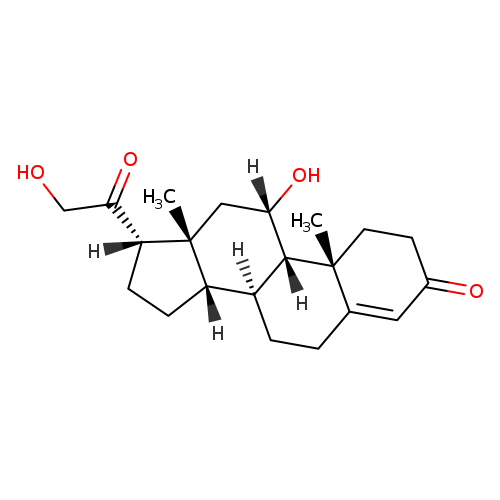
DescriptionCorticosterone is an adrenocortical steroid that has modest but significant activities as a mineralocorticoid and a glucocorticoid. (From Goodman and Gilman's The Pharmacological Basis of Therapeutics, 8th ed, p1437).
Contaminant Sources
  • FooDB Chemicals
  • STOFF IDENT Compounds
  • T3DB toxins
  • ToxCast & Tox21 Chemicals
Contaminant Type
  • Animal Toxin
  • Ester
  • Food Toxin
  • Metabolite
  • Natural Compound
  • Organic Compound
Chemical Structure
Thumb
Synonyms
ValueSource
(11beta)-11,21-Dihydroxypregn-4-ene-3,20-dioneChEBI
11beta,21-Dihydroxy-4-pregnene-3,20-dioneChEBI
11beta,21-DihydroxyprogesteroneChEBI
17-DeoxycortisolChEBI
Kendall's compound bChEBI
Reichstein's substance HChEBI
(11b)-11,21-Dihydroxypregn-4-ene-3,20-dioneGenerator
(11Β)-11,21-dihydroxypregn-4-ene-3,20-dioneGenerator
11b,21-Dihydroxy-4-pregnene-3,20-dioneGenerator
11Β,21-dihydroxy-4-pregnene-3,20-dioneGenerator
11b,21-DihydroxyprogesteroneGenerator
11Β,21-dihydroxyprogesteroneGenerator
11,21-Dihydroxypregn-4-ene-3,20-dioneHMDB
11,21-DihydroxyprogesteroneHMDB
11-HydroxycorticoaldosteroneHMDB
4-Pregnene-11 corticosteronHMDB
Chemical FormulaC21H30O4
Average Molecular Mass346.461 g/mol
Monoisotopic Mass346.214 g/mol
CAS Registry Number50-22-6
IUPAC Name(1S,3aS,3bS,9aR,9bS,10S,11aS)-10-hydroxy-1-(2-hydroxyacetyl)-9a,11a-dimethyl-1H,2H,3H,3aH,3bH,4H,5H,7H,8H,9H,9aH,9bH,10H,11H,11aH-cyclopenta[a]phenanthren-7-one
Traditional Name(1S,2R,10S,11S,14S,15S,17S)-17-hydroxy-14-(2-hydroxyacetyl)-2,15-dimethyltetracyclo[8.7.0.0^{2,7}.0^{11,15}]heptadec-6-en-5-one
SMILES[H][C@@]1(CC[C@@]2([H])[C@]3([H])CCC4=CC(=O)CC[C@]4(C)[C@@]3([H])[C@@]([H])(O)C[C@]12C)C(=O)CO
InChI IdentifierInChI=1S/C21H30O4/c1-20-8-7-13(23)9-12(20)3-4-14-15-5-6-16(18(25)11-22)21(15,2)10-17(24)19(14)20/h9,14-17,19,22,24H,3-8,10-11H2,1-2H3/t14-,15-,16+,17-,19+,20-,21-/m0/s1
InChI KeyOMFXVFTZEKFJBZ-HJTSIMOOSA-N
Chemical Taxonomy
Description belongs to the class of organic compounds known as 21-hydroxysteroids. These are steroids carrying a hydroxyl group at the 21-position of the steroid backbone.
KingdomOrganic compounds
Super ClassLipids and lipid-like molecules
ClassSteroids and steroid derivatives
Sub ClassHydroxysteroids
Direct Parent21-hydroxysteroids
Alternative Parents
Substituents
  • Progestogin-skeleton
  • 21-hydroxysteroid
  • Pregnane-skeleton
  • 20-oxosteroid
  • 3-oxo-delta-4-steroid
  • 3-oxosteroid
  • 11-hydroxysteroid
  • 11-beta-hydroxysteroid
  • Oxosteroid
  • Delta-4-steroid
  • Cyclohexenone
  • Alpha-hydroxy ketone
  • Cyclic alcohol
  • Ketone
  • Secondary alcohol
  • Cyclic ketone
  • Hydrocarbon derivative
  • Organic oxide
  • Carbonyl group
  • Organic oxygen compound
  • Alcohol
  • Organooxygen compound
  • Primary alcohol
  • Aliphatic homopolycyclic compound
Molecular FrameworkAliphatic homopolycyclic compounds
External Descriptors
Biological Properties
StatusDetected and Not Quantified
OriginEndogenous
Cellular Locations
  • Cytoplasm
  • Endoplasmic reticulum
  • Extracellular
  • Membrane
  • Mitochondria
Biofluid LocationsNot Available
Tissue Locations
  • Adipose Tissue
  • Adrenal Cortex
  • Adrenal Gland
  • Brain
  • Epidermis
  • Fibroblasts
  • Gonads
  • Hypothalamus
  • Intestine
  • Kidney
  • Liver
  • Nerve Cells
  • Neuron
  • Placenta
  • Platelet
  • Spleen
  • Stratum Corneum
  • Testes
Pathways
NameSMPDB LinkKEGG Link
SteroidogenesisSMP00130 map00140
Adrenal Hyperplasia Type 5 or Congenital Adrenal Hyperplasia due to 17 Alpha-hydroxylase DeficiencySMP00372 Not Available
ApplicationsNot Available
Biological Roles
Chemical RolesNot Available
Physical Properties
StateSolid
AppearanceWhite powder.
Experimental Properties
PropertyValue
Melting Point179°C
Boiling PointNot Available
Solubility0.199 mg/mL
Predicted Properties
PropertyValueSource
Water Solubility0.046 g/LALOGPS
logP2.09ALOGPS
logP2.02ChemAxon
logS-3.9ALOGPS
pKa (Strongest Acidic)13.86ChemAxon
pKa (Strongest Basic)-0.26ChemAxon
Physiological Charge0ChemAxon
Hydrogen Acceptor Count4ChemAxon
Hydrogen Donor Count2ChemAxon
Polar Surface Area74.6 ŲChemAxon
Rotatable Bond Count2ChemAxon
Refractivity96 m³·mol⁻¹ChemAxon
Polarizability38.83 ųChemAxon
Number of Rings4ChemAxon
Bioavailability1ChemAxon
Rule of FiveYesChemAxon
Ghose FilterYesChemAxon
Veber's RuleNoChemAxon
MDDR-like RuleNoChemAxon
Spectra
Spectra
Spectrum TypeDescriptionSplash KeyView
GC-MSGC-MS Spectrum - GC-MS (2 MEOX; 2 TMS)splash10-0f9l-4920000000-13c56138ef34befd6786Spectrum
GC-MSGC-MS Spectrum - GC-MS (2 MEOX; 2 TMS)splash10-0f7c-4921100000-1d2ace868fd94080c88eSpectrum
GC-MSGC-MS Spectrum - EI-B (Non-derivatized)splash10-014i-1798000000-b39fe3c8aaf8f09d7cdeSpectrum
GC-MSGC-MS Spectrum - GC-MS (Non-derivatized)splash10-0f9l-4920000000-13c56138ef34befd6786Spectrum
GC-MSGC-MS Spectrum - GC-MS (Non-derivatized)splash10-0f7c-4921100000-1d2ace868fd94080c88eSpectrum
Predicted GC-MSPredicted GC-MS Spectrum - GC-MS (Non-derivatized) - 70eV, Positivesplash10-000i-1968000000-377b49ad20a23591ce73Spectrum
Predicted GC-MSPredicted GC-MS Spectrum - GC-MS (2 TMS) - 70eV, Positivesplash10-004i-2640900000-6a05b10a0e80ea76b38aSpectrum
Predicted GC-MSPredicted GC-MS Spectrum - GC-MS (Non-derivatized) - 70eV, PositiveNot AvailableSpectrum
LC-MS/MSLC-MS/MS Spectrum - Quattro_QQQ 10V, Positive (Annotated)splash10-0002-0009000000-81d0a5e41401c962645eSpectrum
LC-MS/MSLC-MS/MS Spectrum - Quattro_QQQ 25V, Positive (Annotated)splash10-05fs-2910000000-7a585bd042169de23cfeSpectrum
LC-MS/MSLC-MS/MS Spectrum - Quattro_QQQ 40V, Positive (Annotated)splash10-0597-6900000000-4c9bb40342921d7ff55eSpectrum
LC-MS/MSLC-MS/MS Spectrum - EI-B (HITACHI M-80) , Positivesplash10-014i-1798000000-e8ef26b439701fc96537Spectrum
LC-MS/MSLC-MS/MS Spectrum - LC-ESI-qTof , Positivesplash10-0002-0759000000-8c04fadb6bd7d3e86c28Spectrum
LC-MS/MSLC-MS/MS Spectrum - LC-ESI-qTof , Positivesplash10-05gi-3920000000-db0dc9413f5ca5cb69e3Spectrum
LC-MS/MSLC-MS/MS Spectrum - LC-ESI-QTOF , positivesplash10-0002-0009000000-362accabc0136898e549Spectrum
LC-MS/MSLC-MS/MS Spectrum - LC-ESI-QTOF , positivesplash10-0002-0459000000-e31660ef75e29d9d9d78Spectrum
LC-MS/MSLC-MS/MS Spectrum - LC-ESI-QTOF , positivesplash10-00fr-0941000000-1453953f7526fa9b8de6Spectrum
LC-MS/MSLC-MS/MS Spectrum - LC-ESI-QTOF , positivesplash10-00e9-0920000000-da03f39d4590a6248157Spectrum
LC-MS/MSLC-MS/MS Spectrum - LC-ESI-QTOF , positivesplash10-00gi-0900000000-2ec9e62e392a282f6de4Spectrum
LC-MS/MSLC-MS/MS Spectrum - LC-ESI-QFT , positivesplash10-0002-0009000000-1db6d72ffc02b6efa63dSpectrum
LC-MS/MSLC-MS/MS Spectrum - LC-ESI-QFT , positivesplash10-00ba-1964000000-d35661aaf929a1609854Spectrum
LC-MS/MSLC-MS/MS Spectrum - LC-ESI-QFT , positivesplash10-00dj-2920000000-b29d21507e63bc379164Spectrum
LC-MS/MSLC-MS/MS Spectrum - LC-ESI-QFT , positivesplash10-05fv-3900000000-8cd56447e4fa2da8c30bSpectrum
LC-MS/MSLC-MS/MS Spectrum - LC-ESI-QFT , positivesplash10-0596-4900000000-0fdf5a6f27425f6540baSpectrum
LC-MS/MSLC-MS/MS Spectrum - LC-ESI-QFT , positivesplash10-052f-6900000000-d6cd49302b0991f7a681Spectrum
LC-MS/MSLC-MS/MS Spectrum - LC-ESI-QFT , positivesplash10-00mo-9800000000-fcf363e8a5a69914ad88Spectrum
LC-MS/MSLC-MS/MS Spectrum - LC-ESI-QFT , positivesplash10-00mp-9600000000-493d479336ae32a15124Spectrum
Predicted LC-MS/MSPredicted LC-MS/MS Spectrum - 10V, Positivesplash10-004j-0029000000-7c715165a4b71930bea5Spectrum
Predicted LC-MS/MSPredicted LC-MS/MS Spectrum - 20V, Positivesplash10-02dj-0349000000-ccef7282ed548096a4d8Spectrum
Predicted LC-MS/MSPredicted LC-MS/MS Spectrum - 40V, Positivesplash10-06dj-4391000000-c5bd1940f400fd8a11f1Spectrum
Predicted LC-MS/MSPredicted LC-MS/MS Spectrum - 10V, Negativesplash10-0002-0009000000-e0a478591970f0721633Spectrum
Predicted LC-MS/MSPredicted LC-MS/MS Spectrum - 20V, Negativesplash10-00mk-2049000000-d03aea1301697772cf2eSpectrum
Predicted LC-MS/MSPredicted LC-MS/MS Spectrum - 40V, Negativesplash10-0abi-3092000000-80dac4c435cb4f3567a6Spectrum
MSMass Spectrum (Electron Ionization)splash10-014i-8953000000-cdd7d53a6012a6eb3f28Spectrum
1D NMR1H NMR SpectrumNot AvailableSpectrum
1D NMR13C NMR SpectrumNot AvailableSpectrum
2D NMR[1H,13C] 2D NMR SpectrumNot AvailableSpectrum
Toxicity Profile
Route of ExposureNot Available
Mechanism of ToxicityNot Available
MetabolismNot Available
Toxicity ValuesNot Available
Lethal DoseNot Available
Carcinogenicity (IARC Classification)No indication of carcinogenicity to humans (not listed by IARC).
Uses/SourcesThis is an endogenously produced metabolite found in the human body. It is used in metabolic reactions, catabolic reactions or waste generation.
Minimum Risk LevelNot Available
Health EffectsNot Available
SymptomsNot Available
TreatmentNot Available
Concentrations
Not Available
DrugBank IDDB04652
HMDB IDHMDB0001547
FooDB IDFDB022684
Phenol Explorer IDNot Available
KNApSAcK IDNot Available
BiGG ID39187
BioCyc IDCORTICOSTERONE
METLIN ID6314
PDB IDNot Available
Wikipedia LinkCorticosterone
Chemspider ID5550
ChEBI ID16827
PubChem Compound ID5753
Kegg Compound IDC02140
YMDB IDNot Available
ECMDB IDNot Available
References
Synthesis ReferenceNot Available
MSDSLink
General References
1. https://www.ncbi.nlm.nih.gov/pubmed/?term=10438974
2. https://www.ncbi.nlm.nih.gov/pubmed/?term=11448093
3. https://www.ncbi.nlm.nih.gov/pubmed/?term=16817814
4. https://www.ncbi.nlm.nih.gov/pubmed/?term=24446162
5. Oliveto, Eugene P.; Smith, Herbert Q.; Gerold, Corinne; Rausser, Richard; Hershberg, E. B. 11-Oxygenated steroids. XIV. New syntheses of corticosterone. Journal of the American Chemical Society (1956), 78 1414-16.
6. Oliveto, Eugene P.; Smith, Herbert Q.; Gerold, Corinne; Rausser, Richard; Hershberg, E. B. 11-Oxygenated steroids. XIV. New syntheses of corticosterone. Journal of the American Chemical Society (1956), 78 1414-16.
7. Oprica M, Zhu S, Goiny M, Pham TM, Mohammed AH, Winblad B, Bartfai T, Schultzberg M: Transgenic overexpression of interleukin-1 receptor antagonist in the CNS influences behaviour, serum corticosterone and brain monoamines. Brain Behav Immun. 2005 May;19(3):223-34.
8. Hajdasz P: [Mineralocorticoids in cervical mucous and female blood serum: levels in the preovulatory phase of the menstrual cycle]. Ginekol Pol. 2000 Sep;71(9):1007-10.
9. Ghulam A, Kouach M, Racadot A, Boersma A, Vantyghem MC, Briand G: Quantitative analysis of human serum corticosterone by high-performance liquid chromatography coupled to electrospray ionization mass spectrometry. J Chromatogr B Biomed Sci Appl. 1999 Apr 30;727(1-2):227-33.
10. Pravosudov VV, Omanska A: Prolonged moderate elevation of corticosterone does not affect hippocampal anatomy or cell proliferation rates in mountain chickadees (Poecile gambeli). J Neurobiol. 2005 Jan;62(1):82-91.
11. Pardridge WM, Sakiyama R, Judd HL: Protein-bound corticosteroid in human serum is selectively transported into rat brain and liver in vivo. J Clin Endocrinol Metab. 1983 Jul;57(1):160-5.
12. Kahri AI, Voutilainen R, Salmenpera M: Different biological action of corticosteroids, corticosterone and cortisol, as a base of zonal function of adrenal cortex. Acta Endocrinol (Copenh). 1979 Jun;91(2):329-37.
13. Pruett SB, Fan R, Myers LP, Wu WJ, Collier S: Quantitative analysis of the neuroendocrine-immune axis: linear modeling of the effects of exogenous corticosterone and restraint stress on lymphocyte subpopulations in the spleen and thymus in female B6C3F1 mice. Brain Behav Immun. 2000 Dec;14(4):270-87.
14. Evans SB, Wilkinson CW, Bentson K, Gronbeck P, Zavosh A, Figlewicz DP: PVN activation is suppressed by repeated hypoglycemia but not antecedent corticosterone in the rat. Am J Physiol Regul Integr Comp Physiol. 2001 Nov;281(5):R1426-36.
15. Lescoat G, Feliot J, Maniey J: [Evolution of plasma corticosterone concentration in basal conditions or after psychic aggression during growth in the Rat. Influence of neonatal gonadectomy (author's transl)]. J Physiol (Paris). 1978 Dec;74(6):591-9.
16. Slominski A, Zbytek B, Semak I, Sweatman T, Wortsman J: CRH stimulates POMC activity and corticosterone production in dermal fibroblasts. J Neuroimmunol. 2005 May;162(1-2):97-102.
17. Kero J, Poutanen M, Zhang FP, Rahman N, McNicol AM, Nilson JH, Keri RA, Huhtaniemi IT: Elevated luteinizing hormone induces expression of its receptor and promotes steroidogenesis in the adrenal cortex. J Clin Invest. 2000 Mar;105(5):633-41.