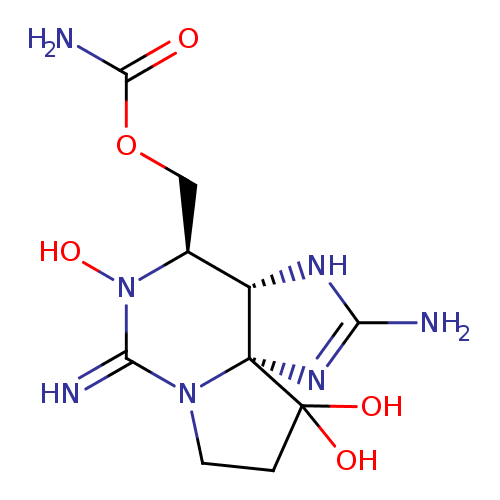
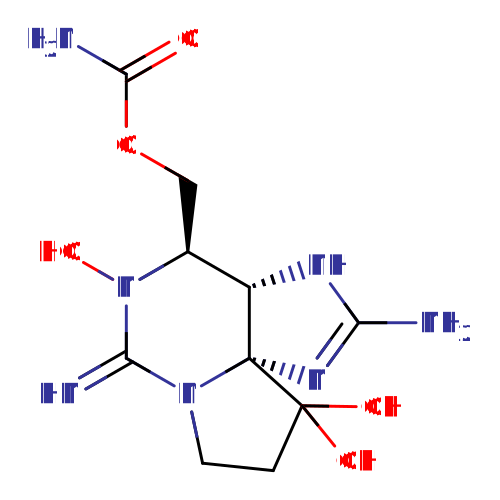
Neosaxitoxin is produced by Protogonyaulax and found in shellfish. Neosaxitoxin has been shown to exhibit anesthetic function. Neosaxitoxin belongs to the family of Saxitoxins, Gonyautoxins, and Derivatives. These are compounds whose structure is based on a 2,6-diamino-4-methyl-pyrrolo[1,2-c]purin-10-ol skeleton. (1).
belongs to the class of organic compounds known as saxitoxins, gonyautoxins, and derivatives. Saxitoxins, gonyautoxins, and derivatives are compounds with a structure based on a 2,6-diamino-4-methyl-pyrrolo[1,2-c]purin-10-ol skeleton.
Neosaxitoxin (NSTX) blocks the extracellular portion, the outer vestibule, of some voltage gated sodium channels in a very powerful and reversible manner, without affection of other ion channels. NSTX and other site 1 blockers (i.e., tetrodotoxin and saxitoxin) have high affinity (very low dissociation constant) and high specificity for Nav channels ("Voltage gated", also called "voltage sensitive" and "voltage dependant" sodium channel also known as "VGSCs" or "Nav channel"). The action of NSTX produces minimal effect on cardiac Nav, where it exhibits about 20_60 fold lesser affinity than in Nav channels from rat skeletal muscle and rat brain. Toxins such as neosaxitoxin and tetrodotoxin have less affinity for most cardiac Nav channels than for most Nav channels in nerve tissue. Moreover, NSTX is so active on nerve Nav channel than is roughly a million-fold more potent than lidocaine. (Wikipedia)