Record Information
Version1.0
Creation Date2013-04-25 07:56:55 UTC
Update Date2026-03-26 22:56:33 UTC
Accession NumberCHEM002895
Identification
Common NameThiophanate-methyl
ClassSmall Molecule
DescriptionThiophanate-Methyl (TM) is a systemic fungicide. It was first registered to be used as a fungicide by the EPA in 1973. It is effective against a wide range of fungal pathogens including: eyespot and other diseases of cereals; scab on apples and pears; Monilia disease and Gloeosporim rot on apples; Monilia app. On stone fruit; Canker on fruit trees; powdery mildews on pome fruit, stone fruit, vegetables, cucurbits, strawberries, vines, roses. Thiophanate methyl is also used on almonds, pecans, tea, coffee, peanuts, soya beans, tobacco, chestnuts, sugar cane, citrus fruit, figs, hops, mulberries, and many other crops.
Contaminant Sources
  • Clean Air Act Chemicals
  • HPV EPA Chemicals
  • STOFF IDENT Compounds
  • T3DB toxins
  • ToxCast & Tox21 Chemicals
Contaminant Type
  • Amine
  • Carbamate
  • Ester
  • Ether
  • Fungicide
  • Organic Compound
  • Pesticide
  • Synthetic Compound
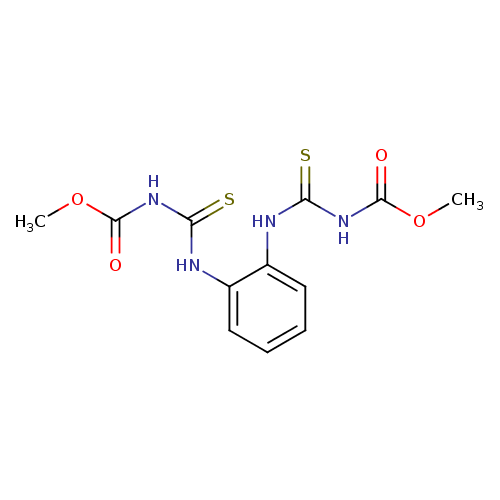
Chemical Structure
Thumb
Synonyms
ValueSource
1,2-Bis(3-(methoxycarbonyl)-2-thioureido)benzeneChEBI
1,2-Bis(methoxycarbonylthioureido)benzeneChEBI
1,2-Di-(3-methoxycarbonyl-2-thioureido)benzeneChEBI
Dimethyl 4,4'-(O-phenylene)bis(3-thioallophanate)ChEBI
Dimethyl N,n'-[1,2-phenylenebis(azanediylcarbonothioyl)]dicarbamateChEBI
Dimethyl N,n'-[1,2-phenylenebis(iminocarbonothioyl)]bis[carbamate]ChEBI
Methyl thiophanateChEBI
MethylthiofanateChEBI
MethylthiophanateChEBI
O-Bis(3-methoxycarbonyl-2-thioureido)benzeneChEBI
Dimethyl 4,4'-(O-phenylene)bis(3-thioallophanic acid)Generator
Dimethyl N,n'-[1,2-phenylenebis(azanediylcarbonothioyl)]dicarbamic acidGenerator
Dimethyl N,n'-[1,2-phenylenebis(iminocarbonothioyl)]bis[carbamic acid]Generator
Methyl thiophanic acidGenerator
Methylthiofanic acidGenerator
Methylthiophanic acidGenerator
Thiophanic acid-methylGenerator
Cercobin m 70MeSH
Dimethylphenylene bis-thioallophanateMeSH
ThiophanateMeSH
Dimethylphenylene bis thioallophanateMeSH
MildothaneMeSH
Bis-thioallophanate, dimethylphenyleneMeSH
Cercobin m-70MeSH
Thiophanate methylMeSH
Cercobin m70MeSH
Chemical FormulaC12H14N4O4S2
Average Molecular Mass342.394 g/mol
Monoisotopic Mass342.046 g/mol
CAS Registry Number23564-05-8
IUPAC Namemethyl N-{[2-({[(methoxycarbonyl)amino]methanethioyl}amino)phenyl]carbamothioyl}carbamate
Traditional Namezyban
SMILESCOC(=O)NC(=S)NC1=CC=CC=C1NC(=S)NC(=O)OC
InChI IdentifierInChI=1S/C12H14N4O4S2/c1-19-11(17)15-9(21)13-7-5-3-4-6-8(7)14-10(22)16-12(18)20-2/h3-6H,1-2H3,(H2,13,15,17,21)(H2,14,16,18,22)
InChI KeyQGHREAKMXXNCOA-UHFFFAOYSA-N
Chemical Taxonomy
Description belongs to the class of organic compounds known as benzene and substituted derivatives. These are aromatic compounds containing one monocyclic ring system consisting of benzene.
KingdomOrganic compounds
Super ClassBenzenoids
ClassBenzene and substituted derivatives
Sub ClassNot Available
Direct ParentBenzene and substituted derivatives
Alternative Parents
Substituents
  • Monocyclic benzene moiety
  • Organic 1,3-dipolar compound
  • Propargyl-type 1,3-dipolar organic compound
  • Organic nitrogen compound
  • Organic oxygen compound
  • Organopnictogen compound
  • Hydrocarbon derivative
  • Organosulfur compound
  • Organooxygen compound
  • Organonitrogen compound
  • Imine
  • Aromatic homomonocyclic compound
Molecular FrameworkAromatic homomonocyclic compounds
External Descriptors
Biological Properties
StatusDetected and Not Quantified
OriginExogenous
Cellular Locations
  • Membrane
Biofluid LocationsNot Available
Tissue LocationsNot Available
PathwaysNot Available
ApplicationsNot Available
Biological RolesNot Available
Chemical RolesNot Available
Physical Properties
StateSolid
AppearanceWhite powder.
Experimental Properties
PropertyValue
Melting PointNot Available
Boiling PointNot Available
SolubilityNot Available
Predicted Properties
PropertyValueSource
Water Solubility0.0058 g/LALOGPS
logP1.57ALOGPS
logP2.78ChemAxon
logS-4.8ALOGPS
pKa (Strongest Acidic)7.8ChemAxon
Physiological Charge0ChemAxon
Hydrogen Acceptor Count2ChemAxon
Hydrogen Donor Count4ChemAxon
Polar Surface Area100.72 ŲChemAxon
Rotatable Bond Count4ChemAxon
Refractivity91.5 m³·mol⁻¹ChemAxon
Polarizability33.1 ųChemAxon
Number of Rings1ChemAxon
Bioavailability1ChemAxon
Rule of FiveYesChemAxon
Ghose FilterYesChemAxon
Veber's RuleNoChemAxon
MDDR-like RuleNoChemAxon
Spectra
Spectra
Spectrum TypeDescriptionSplash KeyView
Predicted GC-MSPredicted GC-MS Spectrum - GC-MS (Non-derivatized) - 70eV, PositiveNot AvailableSpectrum
LC-MS/MSLC-MS/MS Spectrum - NA , positivesplash10-001m-0493000000-9206bd309beff0fefcd7Spectrum
LC-MS/MSLC-MS/MS Spectrum - NA , positivesplash10-001j-0692000000-181d532e1d669a8b3953Spectrum
LC-MS/MSLC-MS/MS Spectrum - NA , positivesplash10-0udi-0900000000-04ba0cfb08ba0f0d14edSpectrum
LC-MS/MSLC-MS/MS Spectrum - NA , positivesplash10-0udi-0900000000-fa1543d36d143517e076Spectrum
LC-MS/MSLC-MS/MS Spectrum - NA , positivesplash10-0udi-0900000000-12b59ca94144d9c8552eSpectrum
LC-MS/MSLC-MS/MS Spectrum - LC-ESI-QTOF 10V, positivesplash10-0006-0239000000-e04c531367d91a9db3cbSpectrum
LC-MS/MSLC-MS/MS Spectrum - LC-ESI-QTOF 20V, positivesplash10-0udi-0910000000-67902a0d481dfdebca27Spectrum
LC-MS/MSLC-MS/MS Spectrum - LC-ESI-QTOF 30V, positivesplash10-0udi-0900000000-7efcc2fc958d0975d870Spectrum
LC-MS/MSLC-MS/MS Spectrum - LC-ESI-QTOF 50V, positivesplash10-0udi-0900000000-eef649baa1d657401cbdSpectrum
LC-MS/MSLC-MS/MS Spectrum - LC-ESI-QTOF 28V, positivesplash10-0udi-0900000000-6a3e84442d9748f38f90Spectrum
LC-MS/MSLC-MS/MS Spectrum - NA , negativesplash10-0002-0900000000-5797ac3e11dd48f28922Spectrum
LC-MS/MSLC-MS/MS Spectrum - 90V, Negativesplash10-066r-1900000000-154dfa6211b96dcbf00bSpectrum
LC-MS/MSLC-MS/MS Spectrum - 75V, Negativesplash10-05mk-0900000000-c60fb4df2799cc31230aSpectrum
LC-MS/MSLC-MS/MS Spectrum - 60V, Negativesplash10-052b-0900000000-a6e1d001b11feaadae82Spectrum
LC-MS/MSLC-MS/MS Spectrum - 45V, Negativesplash10-052b-0900000000-02ac28374832932d3f31Spectrum
LC-MS/MSLC-MS/MS Spectrum - 15V, Negativesplash10-0002-0900000000-abe097dd1b3cccb658eaSpectrum
LC-MS/MSLC-MS/MS Spectrum - 30V, Negativesplash10-0002-0900000000-b1bfab9fbf58ee6059e2Spectrum
LC-MS/MSLC-MS/MS Spectrum - 45V, Positivesplash10-0udi-1900000000-7fd6e318ca5e49d6883bSpectrum
LC-MS/MSLC-MS/MS Spectrum - 60V, Positivesplash10-0udi-3900000000-1c5b759187e151a2ca67Spectrum
Predicted LC-MS/MSPredicted LC-MS/MS Spectrum - 10V, Positivesplash10-0006-0069000000-42b2b7d1fe773f7c71a1Spectrum
Predicted LC-MS/MSPredicted LC-MS/MS Spectrum - 20V, Positivesplash10-0mji-2191000000-5e4ad4f9e36741f39399Spectrum
Predicted LC-MS/MSPredicted LC-MS/MS Spectrum - 40V, Positivesplash10-0aou-6890000000-07aa9f75bd43da357cc8Spectrum
Predicted LC-MS/MSPredicted LC-MS/MS Spectrum - 10V, Negativesplash10-066r-6797000000-f9d5a25515c64f560fd9Spectrum
Predicted LC-MS/MSPredicted LC-MS/MS Spectrum - 20V, Negativesplash10-06di-4971000000-bccd4bec96ce78b2b40fSpectrum
Predicted LC-MS/MSPredicted LC-MS/MS Spectrum - 40V, Negativesplash10-05n0-9850000000-055d02c535528ae533cbSpectrum
1D NMR1H NMR SpectrumNot AvailableSpectrum
1D NMR13C NMR SpectrumNot AvailableSpectrum
Toxicity Profile
Route of ExposureNot Available
Mechanism of ToxicityNot Available
MetabolismNot Available
Toxicity ValuesNot Available
Lethal DoseNot Available
Carcinogenicity (IARC Classification)Not listed by IARC.
Uses/SourcesThis is a man-made compound that is used as a pesticide.
Minimum Risk LevelNot Available
Health EffectsThiophanate-methyl is likely a human carcinogen. It increases of risk of liver tumours in mice. Thyroid/parathyroid weights were increased The developmental toxicity studies showed the decreased fetal body weight and increases in skeletal variations in the fetuses of rabbits exposed to thiophanate-methyl. It induced histopathological damages in rat thyroid and adrenal glands.
SymptomsThiophanate-methyl can cause skin, eye and respiratory irritation, shortness of breath, chest pains, burning eyes, dizziness, and fatigue.
TreatmentRinse dermal exposure with water, irrigate exposed eyes with water, remove the contaminated clothing. Intubate the patients with altered mental status or airway injury. Treat acidosis and seizures. Patients should be treated with activated charcoal after large ingestions of thiophanate-methyl if they can drink the charcoal.
Concentrations
Not Available
DrugBank IDNot Available
HMDB IDHMDB0259025
FooDB IDNot Available
Phenol Explorer IDNot Available
KNApSAcK IDNot Available
BiGG IDNot Available
BioCyc IDNot Available
METLIN IDNot Available
PDB IDNot Available
Wikipedia LinkThiophanate-methyl
Chemspider ID2297683
ChEBI ID35014
PubChem Compound IDNot Available
Kegg Compound IDC14432
YMDB IDNot Available
ECMDB IDNot Available
References
Synthesis ReferenceNot Available
MSDSNot Available
General References
1. https://www.ncbi.nlm.nih.gov/pubmed/?term=22057426
2. https://www.ncbi.nlm.nih.gov/pubmed/?term=22667099
3. https://www.ncbi.nlm.nih.gov/pubmed/?term=23242258
4. https://www.ncbi.nlm.nih.gov/pubmed/?term=23775824
5. https://www.ncbi.nlm.nih.gov/pubmed/?term=23978278
6. https://www.ncbi.nlm.nih.gov/pubmed/?term=24256946
7. https://www.ncbi.nlm.nih.gov/pubmed/?term=24366405