Record Information
Version1.0
Creation Date2013-04-25 07:56:55 UTC
Update Date2026-04-16 22:57:18 UTC
Accession NumberCHEM002892
Identification
Common NameThiabendazole
ClassSmall Molecule
DescriptionThiabendazole is a fungicide and parasiticide. It is used primarily to control mold, blight, and other fungally caused diseases in fruits (e.g. oranges) and vegetables; it is also used as a prophylactic treatment for Dutch elm disease. As an antiparasitic, it is able to control roundworms (such as those causing strongyloidiasis), hookworms, and other helminth species which attack wild animals, livestock and humans.
Contaminant Sources
  • Clean Air Act Chemicals
  • FooDB Chemicals
  • HMDB Contaminants - Urine
  • HPV EPA Chemicals
  • My Exposome Chemicals
  • STOFF IDENT Compounds
  • Suspected Compounds
  • T3DB toxins
  • ToxCast & Tox21 Chemicals
Contaminant Type
  • Anthelmintic
  • Drug
  • Food Toxin
  • Fungicide
  • Household Toxin
  • Metabolite
  • Organic Compound
  • Pesticide
  • Synthetic Compound
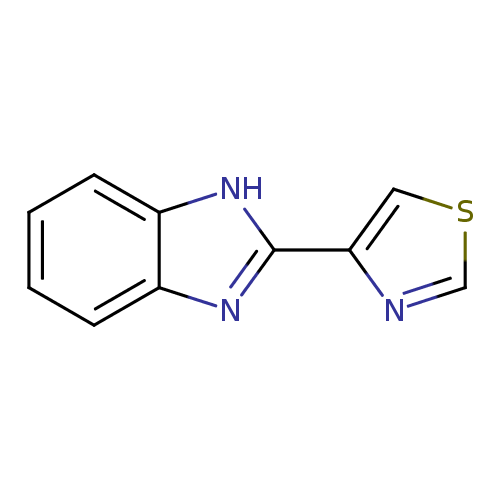
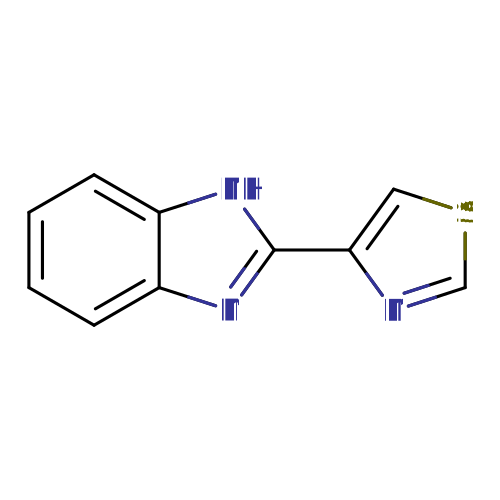
Chemical Structure
Thumb
Synonyms
ValueSource
2-(1,3-THIAZOL-4-yl)-1H-benzimidazoleChEBI
2-(1,3-Thiazol-4-yl)benzimidazoleChEBI
2-(4-Thiazolyl)-1H-benzimidazoleChEBI
2-(Thiazol-4-yl)benzimidazoleChEBI
4-(2-Benzimidazolyl)thiazoleChEBI
EquizoleChEBI
MintezolChEBI
MK 360ChEBI
TBZChEBI
ThibenzoleChEBI
TiabendazoleChEBI
1YvmHMDB
2-(4'-Thiazolyl)benzimidazoleHMDB
2-(4-Thiazolyl)-benzimidazoleHMDB
2-(4-Thiazolyl)benzimidazoleHMDB
2-Thiazol-4-yl-1H-benzoimidazoleHMDB
2-Thiazole-4-ylbenzimidazoleHMDB
2-[4-Thiazoly]benzimidazoleHMDB
5-(4-Thiazolyl)benzimidazoleHMDB
Apl-lusterHMDB
ArbotectHMDB
BiogardHMDB
BioguardHMDB
BovizoleHMDB
Captan tHMDB
Chemviron TK 100HMDB
CropasalHMDB
DrawipasHMDB
e-Z-ExHMDB
EprofilHMDB
Equivet TZHMDB
Equizole aHMDB
Helmindrax octelminHMDB
Hokustar HPHMDB
HymushHMDB
LombristopHMDB
MertecHMDB
MertectHMDB
Mertect 160HMDB
Mertect 340FHMDB
Mertect LSPHMDB
Metasol TK 10HMDB
Metasol TK 100HMDB
Metasol TK-100HMDB
MintesolHMDB
MintezoleHMDB
MinzolumHMDB
MycozolHMDB
NemacinHMDB
NemapanHMDB
OmnizoleHMDB
OrmogalHMDB
PitrizetHMDB
PolivalHMDB
RPHHMDB
Sanaizol 100HMDB
SistesanHMDB
StoriteHMDB
Syntol m100HMDB
TBDZHMDB
TBZ 6HMDB
TBZ 60WHMDB
TebuzateHMDB
TectoHMDB
Tecto 10PHMDB
Tecto 40FHMDB
Tecto 60HMDB
Tecto bHMDB
Tecto RPHHMDB
TestoHMDB
ThiabenHMDB
ThiabendazolHMDB
Thiabendazole(usan)HMDB
Thiabendazole, ban, bsi, iso, jmaf, usanHMDB
ThiabendazolumHMDB
ThiabendoleHMDB
ThiabenzazoleHMDB
ThiabenzoleHMDB
ThibendoleHMDB
ThibenzolHMDB
Thibenzole 200HMDB
Thibenzole attHMDB
ThiprazoleHMDB
TiabendaHMDB
TiabendazolHMDB
Tiabendazole, innHMDB
TiabendazolumHMDB
Tibimix 20HMDB
TMGHMDB
TobazHMDB
Top form wormerHMDB
TresadermHMDB
TriasoxHMDB
TubazoleHMDB
Chemical FormulaC10H7N3S
Average Molecular Mass201.248 g/mol
Monoisotopic Mass201.036 g/mol
CAS Registry Number148-79-8
IUPAC Name2-(1,3-thiazol-4-yl)-1H-1,3-benzodiazole
Traditional Nametesto
SMILESN1C2=CC=CC=C2N=C1C1=CSC=N1
InChI IdentifierInChI=1S/C10H7N3S/c1-2-4-8-7(3-1)12-10(13-8)9-5-14-6-11-9/h1-6H,(H,12,13)
InChI KeyWJCNZQLZVWNLKY-UHFFFAOYSA-N
Chemical Taxonomy
Description belongs to the class of organic compounds known as benzimidazoles. These are organic compounds containing a benzene ring fused to an imidazole ring (five member ring containing a nitrogen atom, 4 carbon atoms, and two double bonds).
KingdomOrganic compounds
Super ClassOrganoheterocyclic compounds
ClassBenzimidazoles
Sub ClassNot Available
Direct ParentBenzimidazoles
Alternative Parents
Substituents
  • Benzimidazole
  • Benzenoid
  • Heteroaromatic compound
  • Thiazole
  • Imidazole
  • Azole
  • Azacycle
  • Organic nitrogen compound
  • Organopnictogen compound
  • Hydrocarbon derivative
  • Organonitrogen compound
  • Aromatic heteropolycyclic compound
Molecular FrameworkAromatic heteropolycyclic compounds
External Descriptors
Biological Properties
StatusDetected and Not Quantified
OriginExogenous
Cellular Locations
  • Membrane
Biofluid LocationsNot Available
Tissue LocationsNot Available
PathwaysNot Available
Applications
Biological Roles
Chemical RolesNot Available
Physical Properties
StateSolid
AppearanceWhite powder.
Experimental Properties
PropertyValue
Melting Point300°C
Boiling PointNot Available
Solubility50 mg/L (at 25°C)
Predicted Properties
PropertyValueSource
Water Solubility0.14 g/LALOGPS
logP2.47ALOGPS
logP2.33ChemAxon
logS-3.2ALOGPS
pKa (Strongest Acidic)10.28ChemAxon
pKa (Strongest Basic)4.08ChemAxon
Physiological Charge0ChemAxon
Hydrogen Acceptor Count2ChemAxon
Hydrogen Donor Count1ChemAxon
Polar Surface Area41.57 ŲChemAxon
Rotatable Bond Count1ChemAxon
Refractivity64.91 m³·mol⁻¹ChemAxon
Polarizability21.02 ųChemAxon
Number of Rings3ChemAxon
Bioavailability1ChemAxon
Rule of FiveYesChemAxon
Ghose FilterYesChemAxon
Veber's RuleNoChemAxon
MDDR-like RuleNoChemAxon
Spectra
Spectra
Spectrum TypeDescriptionSplash KeyView
Predicted GC-MSPredicted GC-MS Spectrum - GC-MS (Non-derivatized) - 70eV, Positivesplash10-0udi-2960000000-2ff3925695a34ba92540Spectrum
Predicted GC-MSPredicted GC-MS Spectrum - GC-MS (Non-derivatized) - 70eV, PositiveNot AvailableSpectrum
LC-MS/MSLC-MS/MS Spectrum - LC-ESI-QTOF , negativesplash10-0fk9-0950000000-6e07d9ba69360948a837Spectrum
LC-MS/MSLC-MS/MS Spectrum - LC-ESI-QTOF , positivesplash10-0ufr-0690000000-b40f55bf077dd879267eSpectrum
LC-MS/MSLC-MS/MS Spectrum - LC-ESI-QTOF , positivesplash10-0059-0900000000-8eaacf527845d1846336Spectrum
LC-MS/MSLC-MS/MS Spectrum - LC-ESI-QTOF , positivesplash10-001i-0900000000-869b5011abd24f891c6fSpectrum
LC-MS/MSLC-MS/MS Spectrum - LC-ESI-QFT , positivesplash10-0udi-0090000000-9f0e2f0e1206b841ba24Spectrum
LC-MS/MSLC-MS/MS Spectrum - LC-ESI-QFT , positivesplash10-0udi-0090000000-0b0912c87b5641d927e6Spectrum
LC-MS/MSLC-MS/MS Spectrum - LC-ESI-QFT , positivesplash10-0udi-0090000000-79b8ef228f8ea67df5dfSpectrum
LC-MS/MSLC-MS/MS Spectrum - LC-ESI-QFT , positivesplash10-0ufr-0590000000-79f15636fdcbfb8f2fdeSpectrum
LC-MS/MSLC-MS/MS Spectrum - LC-ESI-QFT , positivesplash10-0fb9-0930000000-6c1cb6f8999732f4dfc8Spectrum
LC-MS/MSLC-MS/MS Spectrum - LC-ESI-QFT , positivesplash10-0059-1900000000-f8df5dacb9aa1e2f51d2Spectrum
LC-MS/MSLC-MS/MS Spectrum - LC-ESI-QQ , positivesplash10-0udi-0090000000-9815589c9344d01433c0Spectrum
LC-MS/MSLC-MS/MS Spectrum - LC-ESI-QQ , positivesplash10-0udi-0090000000-6ec36e16db37eb084c0bSpectrum
LC-MS/MSLC-MS/MS Spectrum - LC-ESI-QQ , positivesplash10-0udi-0490000000-80b3519b526efe662007Spectrum
LC-MS/MSLC-MS/MS Spectrum - LC-ESI-QQ , positivesplash10-0059-1910000000-679a1a2e18fa97997809Spectrum
LC-MS/MSLC-MS/MS Spectrum - LC-ESI-QQ , positivesplash10-001i-4900000000-a1599bcbfe1fe550efc3Spectrum
LC-MS/MSLC-MS/MS Spectrum - LC-ESI-IT , positivesplash10-0ufr-0960000000-5883b4d0eb99d9d44922Spectrum
LC-MS/MSLC-MS/MS Spectrum - LC-ESI-QTOF , positivesplash10-0ufr-1890000000-8fc66231bbe9a337b27bSpectrum
LC-MS/MSLC-MS/MS Spectrum - LC-ESI-QTOF , positivesplash10-003r-2900000000-74f0c0bb9208bc4125beSpectrum
LC-MS/MSLC-MS/MS Spectrum - LC-ESI-ITFT , positivesplash10-0udi-0190000000-89886baf5cc3c9c2ac6dSpectrum
Predicted LC-MS/MSPredicted LC-MS/MS Spectrum - 10V, Positivesplash10-0udi-0090000000-09b74319181743f81e3bSpectrum
Predicted LC-MS/MSPredicted LC-MS/MS Spectrum - 20V, Positivesplash10-0udi-0190000000-747f18d5dd6f577d5d27Spectrum
Predicted LC-MS/MSPredicted LC-MS/MS Spectrum - 40V, Positivesplash10-014i-5910000000-128ab42fa9c83e6149e1Spectrum
Predicted LC-MS/MSPredicted LC-MS/MS Spectrum - 10V, Negativesplash10-0udi-1190000000-3cc47f9b7fc5c9a8e33cSpectrum
Predicted LC-MS/MSPredicted LC-MS/MS Spectrum - 20V, Negativesplash10-00di-0920000000-0d74bf550932bc3dcca2Spectrum
Predicted LC-MS/MSPredicted LC-MS/MS Spectrum - 40V, Negativesplash10-05a6-4900000000-e8f5403d1791f37acebaSpectrum
MSMass Spectrum (Electron Ionization)splash10-0uk9-6960000000-9a4ba4c366b41681668eSpectrum
1D NMR13C NMR SpectrumNot AvailableSpectrum
Toxicity Profile
Route of ExposureRapidly absorbed and peak plasma concentration is reached within 1 to 2 hours after the oral administration of a suspension. Some systemic absorption may occur from topical preparations applied to the skin.
Mechanism of ToxicityThe precise mode of action of thiabendazole on the parasite is unknown, but it most likely inhibits the helminth-specific enzyme fumarate reductase.
MetabolismHepatic. Metabolized almost completely to the 5-hydroxy form which appears in the urine as glucuronide or sulfate conjugates. Route of Elimination: It is metabolized almost completely to the 5-hydroxy form which appears in the urine as glucuronide or sulfate conjugates. Half Life: The half-life for thiabendazole in both normal and anephric patients is 1.2 hours (range 0.9 to 2 hours). The half-life for the 5-hydroxythiabendazole metabolite in both normal and anephric patients is 1.7 hours (range 1.4 to 2 hours).
Toxicity ValuesThe oral LD 50 is 3.6 g/kg, 3.1 g/kg and 3.8 g/kg in the mouse, rat, and rabbit respectively.
Lethal DoseNot Available
Carcinogenicity (IARC Classification)No indication of carcinogenicity to humans (not listed by IARC).
Uses/SourcesFor the treatment of strongyloidiasis (threadworm), cutaneous larva migrans (creeping eruption), visceral larva migrans, and trichinosis.
Minimum Risk LevelNot Available
Health EffectsNot Available
SymptomsNot Available
TreatmentNot Available
Concentrations
Not Available
DrugBank IDDB00730
HMDB IDHMDB0014868
FooDB IDFDB000906
Phenol Explorer IDNot Available
KNApSAcK IDNot Available
BiGG IDNot Available
BioCyc IDTHIABENDAZOLE
METLIN IDNot Available
PDB IDTMG
Wikipedia LinkThiabendazole
Chemspider ID5237
ChEBI ID45979
PubChem Compound ID5430
Kegg Compound IDC07131
YMDB IDNot Available
ECMDB IDNot Available
References
Synthesis Reference

Lynn E. Applegate, Carl A. Renner, “Preparation of high purity thiabendazole.” U.S. Patent US5310923, issued October, 1977.

MSDSLink
General References
1. Gomaa AA: The effect of thiabendazole on pain threshold. Acta Pharmacol Toxicol (Copenh). 1985 Jul;57(1):18-22.
2. Miller GR, Rebell G, Magoon RC, Kulvin SM, Forster RK: Intravitreal antimycotic therapy and the cure of mycotic endophthalmitis caused by a Paecilomyces lilacinus contaminated pseudophakos. Ophthalmic Surg. 1978 Dec;9(6):54-63.
3. Schneider D, Gannon R, Sweeney K, Shore E: Theophylline and antiparasitic drug interactions. A case report and study of the influence of thiabendazole and mebendazole on theophylline pharmacokinetics in adults. Chest. 1990 Jan;97(1):84-7.
4. Yannai, Shmuel. (2004) Dictionary of food compounds with CD-ROM: Additives, flavors, and ingredients. Boca Raton: Chapman & Hall/CRC.
5. https://www.ncbi.nlm.nih.gov/pubmed/?term=11226373
6. https://www.ncbi.nlm.nih.gov/pubmed/?term=13900465
7. https://www.ncbi.nlm.nih.gov/pubmed/?term=23790859
8. https://www.ncbi.nlm.nih.gov/pubmed/?term=9009055