Record Information
Version1.0
Creation Date2010-05-21 14:46:10 UTC
Update Date2026-04-03 17:45:28 UTC
Accession NumberCHEM002735
Identification
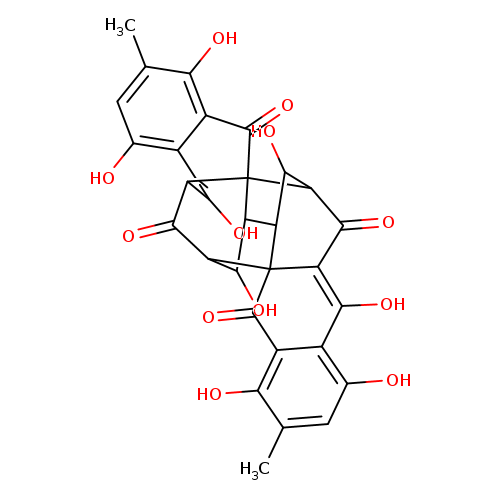
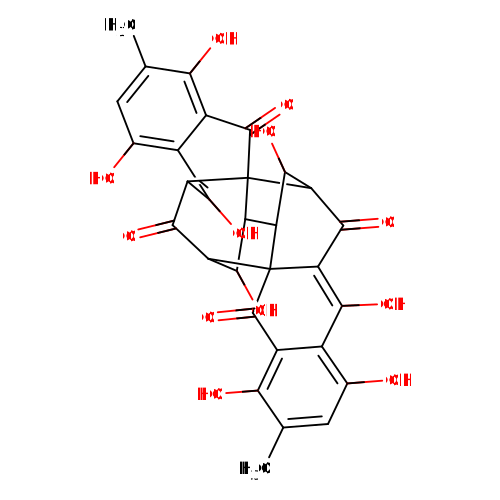
Common NameLuteoskyrin
ClassSmall Molecule
DescriptionLuteoskyrin is a mycotoxin produced by the fungus Penicillium islandicum. It is known to be a storage mold contaminant of rice and has been shown to be hepatotoxic and hepatocarcinogenic. (3, 4)
Contaminant Sources
  • IARC Carcinogens Group 3
  • T3DB toxins
Contaminant Type
  • Ester
  • Fungal Toxin
  • Mycotoxin
  • Natural Compound
  • Organic Compound
Chemical Structure
Thumb
SynonymsNot Available
Chemical FormulaC30H22O12
Average Molecular Mass574.489 g/mol
Monoisotopic Mass574.111 g/mol
CAS Registry Number21884-44-6
IUPAC Name5,8,10,14,20,23,25,28-octahydroxy-6,21-dimethyloctacyclo[14.11.1.0²,¹¹.0²,¹⁵.0⁴,⁹.0¹³,¹⁷.0¹⁷,²⁶.0¹⁹,²⁴]octacosa-4,6,8,10,19,21,23,25-octaene-3,12,18,27-tetrone
Traditional Name5,8,10,14,20,23,25,28-octahydroxy-6,21-dimethyloctacyclo[14.11.1.0²,¹¹.0²,¹⁵.0⁴,⁹.0¹³,¹⁷.0¹⁷,²⁶.0¹⁹,²⁴]octacosa-4,6,8,10,19,21,23,25-octaene-3,12,18,27-tetrone
SMILESCC1=CC(O)=C2C(O)=C3C(=O)C4C(O)C5C6C(O)C(C(=O)C7=C(O)C8=C(O)C=C(C)C(O)=C8C(=O)C467)C35C(=O)C2=C1O
InChI IdentifierInChI=1S/C30H22O12/c1-5-3-7(31)9-11(19(5)33)27(41)29-13-14-24(38)17(29)26(40)16-22(36)10-8(32)4-6(2)20(34)12(10)28(42)30(14,16)18(23(13)37)25(39)15(29)21(9)35/h3-4,13-14,17-18,23-24,31-38H,1-2H3
InChI KeyFAZDYVMEXQHRLI-UHFFFAOYSA-N
Chemical Taxonomy
Description belongs to the class of organic compounds known as naphthols and derivatives. These are naphthalene derivatives carrying one or more hydroxyl (-OH) groups at any ring position.
KingdomOrganic compounds
Super ClassBenzenoids
ClassNaphthalenes
Sub ClassNaphthols and derivatives
Direct ParentNaphthols and derivatives
Alternative Parents
Substituents
  • 1-naphthol
  • Aryl alkyl ketone
  • Aryl ketone
  • 1-hydroxy-2-unsubstituted benzenoid
  • Cyclic alcohol
  • Vinylogous acid
  • Ketone
  • Secondary alcohol
  • Enol
  • Polyol
  • Hydrocarbon derivative
  • Organic oxide
  • Alcohol
  • Organic oxygen compound
  • Carbonyl group
  • Organooxygen compound
  • Aromatic homopolycyclic compound
Molecular FrameworkAromatic homopolycyclic compounds
External DescriptorsNot Available
Biological Properties
StatusDetected and Not Quantified
OriginExogenous
Cellular Locations
  • Cytoplasm
  • Extracellular
Biofluid LocationsNot Available
Tissue LocationsNot Available
PathwaysNot Available
ApplicationsNot Available
Biological RolesNot Available
Chemical RolesNot Available
Physical Properties
StateSolid
AppearanceWhite powder.
Experimental Properties
PropertyValue
Melting PointNot Available
Boiling PointNot Available
SolubilityNot Available
Predicted Properties
PropertyValueSource
Water Solubility1.84 g/LALOGPS
logP1.74ALOGPS
logP1.11ChemAxon
logS-2.5ALOGPS
pKa (Strongest Acidic)5.57ChemAxon
pKa (Strongest Basic)-4.3ChemAxon
Physiological Charge-2ChemAxon
Hydrogen Acceptor Count12ChemAxon
Hydrogen Donor Count8ChemAxon
Polar Surface Area230.12 ŲChemAxon
Rotatable Bond Count0ChemAxon
Refractivity143.69 m³·mol⁻¹ChemAxon
Polarizability54.88 ųChemAxon
Number of Rings8ChemAxon
Bioavailability0ChemAxon
Rule of FiveNoChemAxon
Ghose FilterNoChemAxon
Veber's RuleNoChemAxon
MDDR-like RuleNoChemAxon
Spectra
Spectra
Spectrum TypeDescriptionSplash KeyView
Predicted GC-MSPredicted GC-MS Spectrum - GC-MS (TMS_1_1) - 70eV, PositiveNot AvailableSpectrum
Predicted GC-MSPredicted GC-MS Spectrum - GC-MS (TMS_1_2) - 70eV, PositiveNot AvailableSpectrum
Predicted GC-MSPredicted GC-MS Spectrum - GC-MS (TMS_1_3) - 70eV, PositiveNot AvailableSpectrum
Predicted GC-MSPredicted GC-MS Spectrum - GC-MS (TMS_1_4) - 70eV, PositiveNot AvailableSpectrum
Predicted GC-MSPredicted GC-MS Spectrum - GC-MS (TMS_1_5) - 70eV, PositiveNot AvailableSpectrum
Predicted GC-MSPredicted GC-MS Spectrum - GC-MS (TMS_2_1) - 70eV, PositiveNot AvailableSpectrum
Predicted GC-MSPredicted GC-MS Spectrum - GC-MS (TMS_2_2) - 70eV, PositiveNot AvailableSpectrum
Predicted GC-MSPredicted GC-MS Spectrum - GC-MS (TMS_2_3) - 70eV, PositiveNot AvailableSpectrum
Predicted GC-MSPredicted GC-MS Spectrum - GC-MS (TMS_2_4) - 70eV, PositiveNot AvailableSpectrum
Predicted GC-MSPredicted GC-MS Spectrum - GC-MS (TMS_2_5) - 70eV, PositiveNot AvailableSpectrum
Predicted GC-MSPredicted GC-MS Spectrum - GC-MS (TMS_2_6) - 70eV, PositiveNot AvailableSpectrum
Predicted GC-MSPredicted GC-MS Spectrum - GC-MS (TMS_2_7) - 70eV, PositiveNot AvailableSpectrum
Predicted GC-MSPredicted GC-MS Spectrum - GC-MS (TMS_2_8) - 70eV, PositiveNot AvailableSpectrum
Predicted GC-MSPredicted GC-MS Spectrum - GC-MS (TMS_2_9) - 70eV, PositiveNot AvailableSpectrum
Predicted GC-MSPredicted GC-MS Spectrum - GC-MS (TMS_2_10) - 70eV, PositiveNot AvailableSpectrum
Predicted GC-MSPredicted GC-MS Spectrum - GC-MS (TMS_2_11) - 70eV, PositiveNot AvailableSpectrum
Predicted GC-MSPredicted GC-MS Spectrum - GC-MS (TMS_2_12) - 70eV, PositiveNot AvailableSpectrum
Predicted GC-MSPredicted GC-MS Spectrum - GC-MS (TMS_2_13) - 70eV, PositiveNot AvailableSpectrum
Predicted GC-MSPredicted GC-MS Spectrum - GC-MS (TMS_2_14) - 70eV, PositiveNot AvailableSpectrum
Predicted GC-MSPredicted GC-MS Spectrum - GC-MS (TMS_2_15) - 70eV, PositiveNot AvailableSpectrum
Predicted GC-MSPredicted GC-MS Spectrum - GC-MS (TMS_2_16) - 70eV, PositiveNot AvailableSpectrum
Predicted GC-MSPredicted GC-MS Spectrum - GC-MS (TMS_2_17) - 70eV, PositiveNot AvailableSpectrum
Predicted GC-MSPredicted GC-MS Spectrum - GC-MS (TMS_2_18) - 70eV, PositiveNot AvailableSpectrum
Predicted GC-MSPredicted GC-MS Spectrum - GC-MS (TMS_2_19) - 70eV, PositiveNot AvailableSpectrum
Predicted GC-MSPredicted GC-MS Spectrum - GC-MS (TMS_2_20) - 70eV, PositiveNot AvailableSpectrum
Predicted LC-MS/MSPredicted LC-MS/MS Spectrum - 10V, Positivesplash10-0a70-0000090000-2802b1bfb3a08a9f9f92Spectrum
Predicted LC-MS/MSPredicted LC-MS/MS Spectrum - 20V, Positivesplash10-0pdr-0401690000-950a77ce1902c5fe5df9Spectrum
Predicted LC-MS/MSPredicted LC-MS/MS Spectrum - 40V, Positivesplash10-000i-0204590000-bfc526ba9b4e7659962dSpectrum
Predicted LC-MS/MSPredicted LC-MS/MS Spectrum - 10V, Negativesplash10-00di-0000090000-2adda3d26a159a3cf30fSpectrum
Predicted LC-MS/MSPredicted LC-MS/MS Spectrum - 20V, Negativesplash10-05fr-0000090000-8a1008a036e816f04acaSpectrum
Predicted LC-MS/MSPredicted LC-MS/MS Spectrum - 40V, Negativesplash10-0abc-6502590000-e7ca8c894d5cdc2fbcfbSpectrum
Predicted LC-MS/MSPredicted LC-MS/MS Spectrum - 10V, Positivesplash10-004i-0000090000-8c8d92232af9500789ceSpectrum
Predicted LC-MS/MSPredicted LC-MS/MS Spectrum - 20V, Positivesplash10-004i-0000090000-20978721d0c4f47f2169Spectrum
Predicted LC-MS/MSPredicted LC-MS/MS Spectrum - 40V, Positivesplash10-00ba-1200590000-171c06e8dc09c6a3c12dSpectrum
Predicted LC-MS/MSPredicted LC-MS/MS Spectrum - 10V, Negativesplash10-00di-0000090000-2f6d4dc81e5e1f72f718Spectrum
Predicted LC-MS/MSPredicted LC-MS/MS Spectrum - 20V, Negativesplash10-00di-0000090000-8d09ffbe7956495fbdc4Spectrum
Predicted LC-MS/MSPredicted LC-MS/MS Spectrum - 40V, Negativesplash10-00fr-0200590000-969c4740eb3e9fb1bf8fSpectrum
Toxicity Profile
Route of ExposureOral, dermal, inhalation, and parenteral (contaminated drugs). (7)
Mechanism of ToxicityLuteoskyrin is hepatotoxic. It is thought that this is a result of its metabolic reduction to the semiquinone radical catalyzed by NADPH-dependent cytochrome reductases in the liver, leading to the generation of active oxygen species in redox systems. This causes the induction of lipid peroxidation, hepatocellular membrane damage, and elevation of serum transaminase activities, resultin in liver injuries. Luteoskyrin is also hepatocarcinogenic, possibly a result of its ability to induce DNA fragmentation. It is able to bind to DNA, forming chelate-complexes with nucleic acids and select metal ions. Luteoskyrin inhibits the replication, transcription and repair of DNA, which is at least partially because it inhibits RNA polymerase and ribonuclease H. (1, 2, 4, 5, 6)
MetabolismLuteoskyrin accumulates selectively in the liver, with minor distribution to the serum and kidneys. In the liver it is reduced to its semiquinone radical by NADPH-dependent cytochrome reductases. (4, 5)
Toxicity ValuesNot Available
Lethal Dose145 mg/kg subcutaneously and 221 mg/kg orally in mice. (3)
Carcinogenicity (IARC Classification)3, not classifiable as to its carcinogenicity to humans. (8)
Uses/SourcesLuteoskyrin is a mycotoxin produced by the fungus Penicillium islandicum. It is known to be a storage mold contaminant of rice. (3)
Minimum Risk LevelNot Available
Health EffectsLuteoskyrin is hepatotoxic and hepatocarcinogenic, causing hepatic disorders such as liver cirrhosis and liver tumors. (3, 4)
SymptomsNot Available
TreatmentNot Available
Concentrations
Not Available
DrugBank IDNot Available
HMDB IDHMDB0254226
FooDB IDNot Available
Phenol Explorer IDNot Available
KNApSAcK IDNot Available
BiGG IDNot Available
BioCyc IDNot Available
METLIN IDNot Available
PDB IDNot Available
Wikipedia LinkLuteoskyrin
Chemspider ID28613
ChEBI IDNot Available
PubChem Compound ID30840
Kegg Compound IDNot Available
YMDB IDNot Available
ECMDB IDNot Available
References
Synthesis ReferenceNot Available
MSDSNot Available
General References
1. Barupal DK, Fiehn O: Generating the Blood Exposome Database Using a Comprehensive Text Mining and Database Fusion Approach. Environ Health Perspect. 2019 Sep;127(9):97008. doi: 10.1289/EHP4713. Epub 2019 Sep 26.