Record Information
Version1.0
Creation Date2009-08-12 21:34:05 UTC
Update Date2026-04-06 12:33:18 UTC
Accession NumberCHEM002566
Identification
Common Nameepsilon-Amanitin
ClassSmall Molecule
Descriptionepsilon-Amanitin is one of a group of at least eight Amatoxins found in several genera of poisonous mushrooms, most notably Amanita phalloides and several other members of the genus Amanita, as well as some Conocybe, Galerina and Lepiota mushroom species. (3)
Contaminant Sources
  • T3DB toxins
Contaminant Type
  • Amide
  • Amine
  • Fungal Toxin
  • Mycotoxin
  • Natural Compound
  • Organic Compound
Chemical Structure
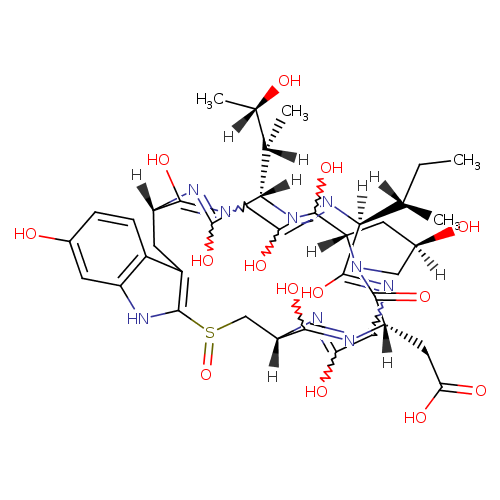
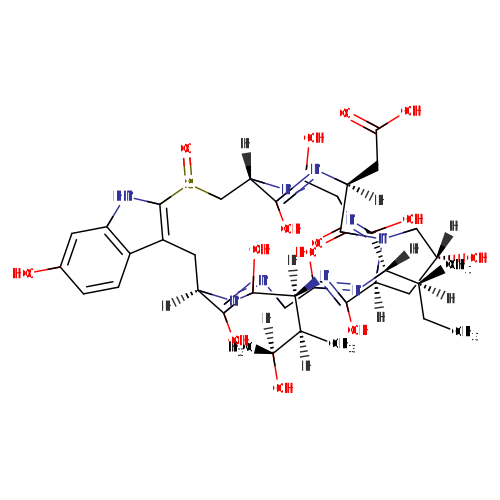
Thumb
Synonyms
ValueSource
2-[(1R,4S,8R,10S,13S,16S,34S)-34-[(2S)-Butan-2-yl]-2,8,11,14,22,30,33,36,39-nonahydroxy-13-[(2R,3S)-3-hydroxybutan-2-yl]-5,27-dioxo-27-thia-3,6,12,15,25,29,32,35,38-nonaazapentacyclo[14.12.11.0,.0,.0,]nonatriaconta-2,11,14,18(26),19(24),20,22,29,32,35,38-undecaen-4-yl]acetateGenerator
2-[(1R,4S,8R,10S,13S,16S,34S)-34-[(2S)-Butan-2-yl]-2,8,11,14,22,30,33,36,39-nonahydroxy-13-[(2R,3S)-3-hydroxybutan-2-yl]-5,27-dioxo-27λ⁴-thia-3,6,12,15,25,29,32,35,38-nonaazapentacyclo[14.12.11.0⁶,¹⁰.0¹⁸,²⁶.0¹⁹,²⁴]nonatriaconta-2,11,14,18(26),19(24),20,22,29,32,35,38-undecaen-4-yl]acetateGenerator
Chemical FormulaC39H53N9O14S
Average Molecular Mass903.960 g/mol
Monoisotopic Mass903.343 g/mol
CAS Registry Number21705-02-2
IUPAC Name2-[(1R,4S,8R,10S,13S,16R,34S)-34-[(2S)-butan-2-yl]-2,8,11,14,22,30,33,36,39-nonahydroxy-13-[(2R,3S)-3-hydroxybutan-2-yl]-5,27-dioxo-27λ⁴-thia-3,6,12,15,25,29,32,35,38-nonaazapentacyclo[14.12.11.0⁶,¹⁰.0¹⁸,²⁶.0¹⁹,²⁴]nonatriaconta-2,11,14,18(26),19(24),20,22,29,32,35,38-undecaen-4-yl]acetic acid
Traditional Name[(1R,4S,8R,10S,13S,16R,34S)-34-[(2S)-butan-2-yl]-2,8,11,14,22,30,33,36,39-nonahydroxy-13-[(2R,3S)-3-hydroxybutan-2-yl]-5,27-dioxo-27λ⁴-thia-3,6,12,15,25,29,32,35,38-nonaazapentacyclo[14.12.11.0⁶,¹⁰.0¹⁸,²⁶.0¹⁹,²⁴]nonatriaconta-2,11,14,18(26),19(24),20,22,29,32,35,38-undecaen-4-yl]acetic acid
SMILES[H][C@@](C)(O)[C@]([H])(C)[C@]1([H])N=C(O)[C@]2([H])C[C@@]([H])(O)CN2C(=O)[C@]([H])(CC(O)=O)N=C(O)[C@]2([H])CS(=O)C3=C(C[C@@]([H])(N=C1O)C(O)=NCC(O)=N[C@]([H])(C(O)=NCC(O)=N2)[C@@]([H])(C)CC)C1=C(N3)C=C(O)C=C1
InChI IdentifierInChI=1S/C39H53N9O14S/c1-5-16(2)31-36(59)41-12-28(52)42-26-15-63(62)38-22(21-7-6-19(50)8-23(21)45-38)10-24(33(56)40-13-29(53)46-31)43-37(60)32(17(3)18(4)49)47-35(58)27-9-20(51)14-48(27)39(61)25(11-30(54)55)44-34(26)57/h6-8,16-18,20,24-27,31-32,45,49-51H,5,9-15H2,1-4H3,(H,40,56)(H,41,59)(H,42,52)(H,43,60)(H,44,57)(H,46,53)(H,47,58)(H,54,55)/t16-,17-,18-,20+,24-,25-,26-,27-,31-,32-,63?/m0/s1
InChI KeyOFILNAORONITPV-ZUROAWGWSA-N
Chemical Taxonomy
Description belongs to the class of organic compounds known as amatoxins. These are cyclic peptides containing eight amino acid residues arranged in a macrobicyclic motif.
KingdomOrganic compounds
Super ClassOrganic acids and derivatives
ClassCarboxylic acids and derivatives
Sub ClassAmino acids, peptides, and analogues
Direct ParentAmatoxins
Alternative Parents
Substituents
  • Amatoxin skeleton
  • Alpha-oligopeptide
  • Hydroxyindole
  • 3-alkylindole
  • Alpha-amino acid or derivatives
  • Indole or derivatives
  • Indole
  • 1-hydroxy-2-unsubstituted benzenoid
  • Benzenoid
  • Heteroaromatic compound
  • Tertiary carboxylic acid amide
  • Pyrrolidine
  • Pyrrole
  • Sulfoxide
  • Secondary carboxylic acid amide
  • Secondary alcohol
  • Lactam
  • Carboxamide group
  • Azacycle
  • Organoheterocyclic compound
  • Sulfinyl compound
  • Monocarboxylic acid or derivatives
  • Carboxylic acid
  • Organic nitrogen compound
  • Organic oxygen compound
  • Organopnictogen compound
  • Organic oxide
  • Hydrocarbon derivative
  • Organooxygen compound
  • Organonitrogen compound
  • Carbonyl group
  • Alcohol
  • Aromatic heteropolycyclic compound
Molecular FrameworkAromatic heteropolycyclic compounds
External DescriptorsNot Available
Biological Properties
StatusDetected and Not Quantified
OriginExogenous
Cellular Locations
  • Cytoplasm
  • Extracellular
Biofluid LocationsNot Available
Tissue LocationsNot Available
Pathways
NameSMPDB LinkKEGG Link
Cell cycleNot Availablemap04110
ApplicationsNot Available
Biological RolesNot Available
Chemical RolesNot Available
Physical Properties
StateSolid
AppearanceWhite powder.
Experimental Properties
PropertyValue
Melting PointNot Available
Boiling PointNot Available
SolubilityNot Available
Predicted Properties
PropertyValueSource
Water Solubility1.3 g/LALOGPS
logP0.42ALOGPS
logP-0.07ChemAxon
logS-2.8ALOGPS
pKa (Strongest Acidic)2.64ChemAxon
Physiological Charge-1ChemAxon
Hydrogen Acceptor Count21ChemAxon
Hydrogen Donor Count12ChemAxon
Polar Surface Area379.29 ŲChemAxon
Rotatable Bond Count6ChemAxon
Refractivity221.59 m³·mol⁻¹ChemAxon
Polarizability88.63 ųChemAxon
Number of Rings5ChemAxon
Bioavailability0ChemAxon
Rule of FiveNoChemAxon
Ghose FilterNoChemAxon
Veber's RuleNoChemAxon
MDDR-like RuleYesChemAxon
Spectra
Spectra
Spectrum TypeDescriptionSplash KeyView
Predicted LC-MS/MSPredicted LC-MS/MS Spectrum - 10V, Positivesplash10-00kr-0000000091-c8898ec6b126b243ef98Spectrum
Predicted LC-MS/MSPredicted LC-MS/MS Spectrum - 20V, Positivesplash10-014r-0000000090-225c215aefb26502c160Spectrum
Predicted LC-MS/MSPredicted LC-MS/MS Spectrum - 40V, Positivesplash10-0ce9-9710111410-242855d67801912696e9Spectrum
Predicted LC-MS/MSPredicted LC-MS/MS Spectrum - 10V, Negativesplash10-0kai-0000000092-44a64f59925203d93c0aSpectrum
Predicted LC-MS/MSPredicted LC-MS/MS Spectrum - 20V, Negativesplash10-0006-2000000090-6946ebc2072fc353bdecSpectrum
Predicted LC-MS/MSPredicted LC-MS/MS Spectrum - 40V, Negativesplash10-0gvx-7941000010-8abdf86a621515746c35Spectrum
Toxicity Profile
Route of ExposureOral, dermal, inhalation, and parenteral (contaminated drugs). (1)
Mechanism of ToxicityThe major toxic mechanism of amatoxins is the inhibition of RNA polymerase II, a vital enzyme in the synthesis of messenger RNA (mRNA), microRNA, and small nuclear RNA (snRNA). Without mRNA, essential protein synthesis, and hence cell metabolism, grind to a halt and the cell dies. (3)
MetabolismNot Available
Toxicity ValuesLD50: 0.3-0.6 mg/kg (Mouse) (5)
Lethal Dose0.1 mg/kg for an adult human. (3)
Carcinogenicity (IARC Classification)No indication of carcinogenicity to humans (not listed by IARC).
Uses/SourcesAmatoxins are a subgroup of at least eight toxic compounds found in several genera of poisonous mushrooms, most notably Amanita phalloides and several other members of the genus Amanita, as well as some Conocybe, Galerina and Lepiota mushroom species. (3)
Minimum Risk LevelNot Available
Health EffectsAmatoxins cause liver damage. They may also affect the kidneys. The most severe effects are toxic hepatitis with centrolobular necrosis and hepatic steatosis, as well as acute tubulointerstitial nephropathy, which altogether induce a severe hepatorenal syndrome. (3)
SymptomsDiarrhea and cramps are the first symptoms. (2)
TreatmentTreatment involves high dose penicillin as well as supportive care in cases of hepatic and renal injury. Cautious attention is given to maintaining hemodynamic stability, although if hepatorenal syndrome has developed the prognosis is guarded at best. (3)

Concentrations
Not Available
DrugBank IDNot Available
HMDB IDNot Available
FooDB IDNot Available
Phenol Explorer IDNot Available
KNApSAcK IDNot Available
BiGG IDNot Available
BioCyc IDNot Available
METLIN IDNot Available
PDB IDNot Available
Wikipedia LinkNot Available
Chemspider IDNot Available
ChEBI IDNot Available
PubChem Compound ID57473119
Kegg Compound IDNot Available
YMDB IDNot Available
ECMDB IDNot Available
References
Synthesis ReferenceNot Available
MSDSNot Available
General ReferencesNot Available