Record Information
Version1.0
Creation Date2009-07-30 17:58:33 UTC
Update Date2016-11-09 01:08:52 UTC
Accession NumberCHEM002499
Identification
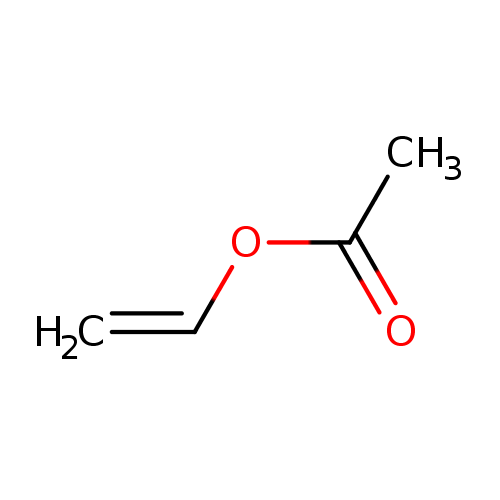
Common NameEthenyl acetate
ClassSmall Molecule
DescriptionPolyvinyl acetate is used as a food additive [EAFUS] (EAFUS: Everything Added to Food in the United States. [http://www.eafus.com/]). Ethenyl acetate belongs to the family of Carboxylic Acid Esters. These are carboxylic acid derivatives in which the carbo atom from the carbonyl group is atached to an alkyl or oaryl moiety through an oxygen atom (forming an ester group).
Contaminant Sources
  • Clean Air Act Chemicals
  • EAFUS Chemicals
  • FooDB Chemicals
  • HPV EPA Chemicals
  • IARC Carcinogens Group 2B
  • OECD HPV Chemicals
  • STOFF IDENT Compounds
  • T3DB toxins
  • Tobacco Smoke Compounds
  • ToxCast & Tox21 Chemicals
Contaminant Type
  • Cigarette Toxin
  • Ester
  • Food Toxin
  • Household Toxin
  • Industrial Precursor/Intermediate
  • Industrial/Workplace Toxin
  • Lachrymator
  • Metabolite
  • Organic Compound
  • Pollutant
  • Synthetic Compound
Chemical Structure
Thumb
Synonyms
ValueSource
1-AcetoxyethyleneChEBI
Acetic acid ethenyl esterChEBI
Acetic acid vinyl esterChEBI
AcetoxyetheneChEBI
EssigsaeurevinylesterChEBI
Ethenyl ethanoateChEBI
Vinyl ethanoateChEBI
VinylacetatChEBI
VinylazetatChEBI
Acetate ethenyl esterGenerator
Acetate vinyl esterGenerator
Ethenyl ethanoic acidGenerator
Vinyl ethanoic acidGenerator
Ethenyl acetic acidGenerator
CH3CO2CH=ch2HMDB
Ethenyl acetate, 9ciHMDB
Everflex 81lHMDB
Unocal 76 res 6206HMDB
Unocal 76 res S-55HMDB
VACHMDB
VinileHMDB
Vinnapas a 50HMDB
Vinyl acetateHMDB
Vinyl ester OF acetic acidHMDB
VinyleHMDB
Vinyl acetic acidGenerator
Polyvinyl acetic acidGenerator
Chemical FormulaC4H6O2
Average Molecular Mass86.089 g/mol
Monoisotopic Mass86.037 g/mol
CAS Registry Number108-05-4
IUPAC Nameethenyl acetate
Traditional Namevinyl acetate
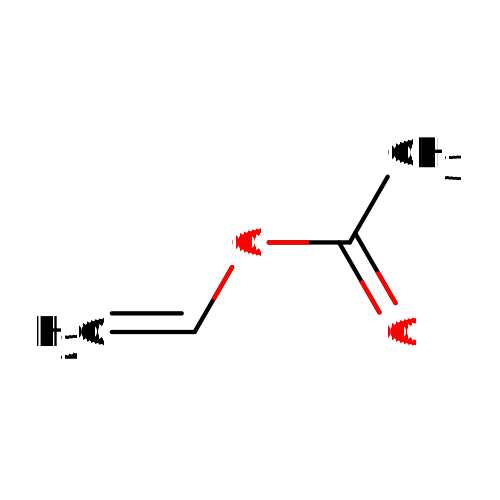
SMILESCC(=O)OC=C
InChI IdentifierInChI=1S/C4H6O2/c1-3-6-4(2)5/h3H,1H2,2H3
InChI KeyXTXRWKRVRITETP-UHFFFAOYSA-N
Chemical Taxonomy
Description belongs to the class of organic compounds known as enol esters. These are ester derivatives of enols. They have the general formula RC=COC(=O)R' where R, R' = H or organyl group.
KingdomOrganic compounds
Super ClassOrganic acids and derivatives
ClassCarboxylic acids and derivatives
Sub ClassCarboxylic acid derivatives
Direct ParentEnol esters
Alternative Parents
Substituents
  • Enol ester
  • Monocarboxylic acid or derivatives
  • Organic oxygen compound
  • Organic oxide
  • Hydrocarbon derivative
  • Organooxygen compound
  • Carbonyl group
  • Aliphatic acyclic compound
Molecular FrameworkAliphatic acyclic compounds
External Descriptors
Biological Properties
StatusDetected and Not Quantified
OriginExogenous
Cellular Locations
  • Cytoplasm
  • Extracellular
Biofluid LocationsNot Available
Tissue LocationsNot Available
PathwaysNot Available
ApplicationsNot Available
Biological RolesNot Available
Chemical RolesNot Available
Physical Properties
StateLiquid
AppearanceNot Available
Experimental Properties
PropertyValue
Melting Point-100°C
Boiling PointNot Available
Solubility20 mg/mL at 20°C
Predicted Properties
PropertyValueSource
Water Solubility65.3 g/LALOGPS
logP0.83ALOGPS
logP0.43ChemAxon
logS-0.12ALOGPS
pKa (Strongest Basic)-7.1ChemAxon
Physiological Charge0ChemAxon
Hydrogen Acceptor Count1ChemAxon
Hydrogen Donor Count0ChemAxon
Polar Surface Area26.3 ŲChemAxon
Rotatable Bond Count2ChemAxon
Refractivity21.1 m³·mol⁻¹ChemAxon
Polarizability8.57 ųChemAxon
Number of Rings0ChemAxon
Bioavailability1ChemAxon
Rule of FiveYesChemAxon
Ghose FilterNoChemAxon
Veber's RuleYesChemAxon
MDDR-like RuleNoChemAxon
Spectra
Spectra
Spectrum TypeDescriptionSplash KeyView
GC-MSGC-MS Spectrum - EI-B (Non-derivatized)splash10-0006-9000000000-822a98d017022e0d3838Spectrum
Predicted GC-MSPredicted GC-MS Spectrum - GC-MS (Non-derivatized) - 70eV, Positivesplash10-004l-9000000000-efacbe718d07a50f11e2Spectrum
Predicted GC-MSPredicted GC-MS Spectrum - GC-MS (Non-derivatized) - 70eV, PositiveNot AvailableSpectrum
Predicted LC-MS/MSPredicted LC-MS/MS Spectrum - 10V, Positivesplash10-000i-9000000000-d776c53a3326ee70036fSpectrum
Predicted LC-MS/MSPredicted LC-MS/MS Spectrum - 20V, Positivesplash10-000j-9000000000-4f9f09bebb037ead2596Spectrum
Predicted LC-MS/MSPredicted LC-MS/MS Spectrum - 40V, Positivesplash10-0006-9000000000-4857aaa8b1d954975761Spectrum
Predicted LC-MS/MSPredicted LC-MS/MS Spectrum - 10V, Negativesplash10-000i-9000000000-78aa34f58b412b0f8a68Spectrum
Predicted LC-MS/MSPredicted LC-MS/MS Spectrum - 20V, Negativesplash10-000l-9000000000-319f0beb68805dd151ceSpectrum
Predicted LC-MS/MSPredicted LC-MS/MS Spectrum - 40V, Negativesplash10-052f-9000000000-3f182f981ecef4fccacdSpectrum
Predicted LC-MS/MSPredicted LC-MS/MS Spectrum - 10V, Negativesplash10-052u-9000000000-55c887457fca16fe9537Spectrum
Predicted LC-MS/MSPredicted LC-MS/MS Spectrum - 20V, Negativesplash10-0a4i-9000000000-c01bbbf5bed889264ddbSpectrum
Predicted LC-MS/MSPredicted LC-MS/MS Spectrum - 40V, Negativesplash10-0a4l-9000000000-8dffcb2ec574f759bcccSpectrum
Predicted LC-MS/MSPredicted LC-MS/MS Spectrum - 10V, Positivesplash10-0007-9000000000-9db6245185c535efb6f9Spectrum
Predicted LC-MS/MSPredicted LC-MS/MS Spectrum - 20V, Positivesplash10-0006-9000000000-65cd2a9c556e657f8c10Spectrum
Predicted LC-MS/MSPredicted LC-MS/MS Spectrum - 40V, Positivesplash10-0006-9000000000-98a0bebf5c7f9fa794e2Spectrum
MSMass Spectrum (Electron Ionization)splash10-0006-9000000000-56392ad33ca543d33d88Spectrum
1D NMR1H NMR SpectrumNot AvailableSpectrum
1D NMR13C NMR SpectrumNot AvailableSpectrum
1D NMR1H NMR SpectrumNot AvailableSpectrum
1D NMR13C NMR SpectrumNot AvailableSpectrum
1D NMR1H NMR SpectrumNot AvailableSpectrum
1D NMR13C NMR SpectrumNot AvailableSpectrum
1D NMR1H NMR SpectrumNot AvailableSpectrum
1D NMR13C NMR SpectrumNot AvailableSpectrum
1D NMR1H NMR SpectrumNot AvailableSpectrum
1D NMR13C NMR SpectrumNot AvailableSpectrum
1D NMR1H NMR SpectrumNot AvailableSpectrum
1D NMR13C NMR SpectrumNot AvailableSpectrum
1D NMR1H NMR SpectrumNot AvailableSpectrum
1D NMR13C NMR SpectrumNot AvailableSpectrum
1D NMR1H NMR SpectrumNot AvailableSpectrum
1D NMR13C NMR SpectrumNot AvailableSpectrum
1D NMR1H NMR SpectrumNot AvailableSpectrum
1D NMR13C NMR SpectrumNot AvailableSpectrum
1D NMR1H NMR SpectrumNot AvailableSpectrum
1D NMR13C NMR SpectrumNot AvailableSpectrum
1D NMR1H NMR SpectrumNot AvailableSpectrum
Toxicity Profile
Route of ExposureOral (4) ; inhalation (4) ; dermal (4)
Mechanism of ToxicityOne of the metabolites of vinyl acetate, acetaldehyde, is a known animal carcinogen. Acetaldehyde can form adducts with DNA, causing damage such as cross-links. (6, 1)
MetabolismVinyl acetate may be absorbed following ingestion, inhalation, or dermal exposure, and distributes throughout the body. It is rapidly hydrolyzed by esterases in the blood to acetate and the unstable intermediate, vinyl alcohol. Vinyl alcohol is then rapidly converted to acetaldehyde, which in turn is metabolized to acetate in the liver. This in turn is incorporated into the "2 carbon pool" of normal body metabolism and eventually forms carbon dioxide as the major breakdown product, which is expired. (6)
Toxicity ValuesLD50: 2.92 g/kg (Oral, Rat) (8) LC50: 2511 ppm over 4 hours (Inhalation, Rabbit) (7)
Lethal DoseNot Available
Carcinogenicity (IARC Classification)2B, possibly carcinogenic to humans. (3)
Uses/SourcesVinyl acetate is used mainly for the production of other industrial chemicals, such as polyvinyl acetate, an important polymer for which it is the precursor. These chemicals are used mainly to make glues for the packaging and building industries. They are also used to make paints, textiles, and paper. Vinyl acetate is also used as a coating in plastic films for food packaging and as a modifier of food starch. (5, 6)
Minimum Risk LevelIntermediate Inhalation: 0.01 ppm (2)
Health EffectsVinyl acetate may affect the immune system. It may also be a carcinogen. (6)
SymptomsInhalation of vinyl acetate irritates the eyes, nose, and throat. Skin contact causes irritation and blisters. (6)
TreatmentNot Available
Concentrations
Not Available
DrugBank IDNot Available
HMDB IDHMDB0031209
FooDB IDFDB010112
Phenol Explorer IDNot Available
KNApSAcK IDNot Available
BiGG IDNot Available
BioCyc IDNot Available
METLIN IDNot Available
PDB IDNot Available
Wikipedia LinkVinyl acetate
Chemspider ID7616
ChEBI ID46916
PubChem Compound ID7904
Kegg Compound IDC19309
YMDB IDNot Available
ECMDB IDNot Available
References
Synthesis ReferenceNot Available
MSDSNot Available
General References
1. EAFUS: Everything Added to Food in the United States.