Record Information
Version1.0
Creation Date2009-07-23 18:26:07 UTC
Update Date2026-04-14 19:16:03 UTC
Accession NumberCHEM002418
Identification
Common Name(-)-Gossypol
ClassSmall Molecule
Description(-)-Gossypol is found in fats and oils. (-)-Gossypol is a constituent of Gossypium hirsutum (cotton). (-)-gossypol has been shown to exhibit anti-tumor, anti-cancer and anti-proliferative functions (1, 2, 3).
Contaminant Sources
  • FooDB Chemicals
  • HPV EPA Chemicals
  • IARC Carcinogens Group 2B
  • T3DB toxins
  • ToxCast & Tox21 Chemicals
Contaminant Type
  • Ester
  • Food Toxin
  • Metabolite
  • Natural Compound
  • Organic Compound
  • Plant Toxin
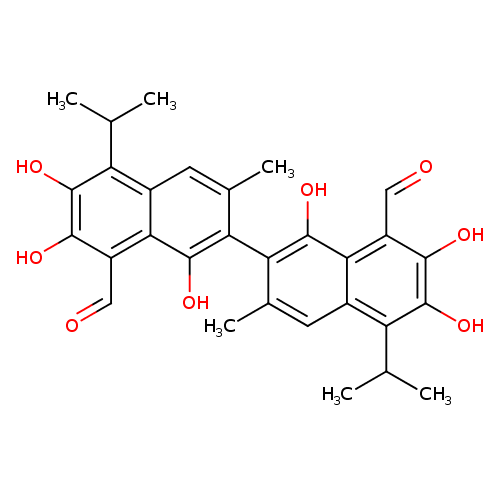
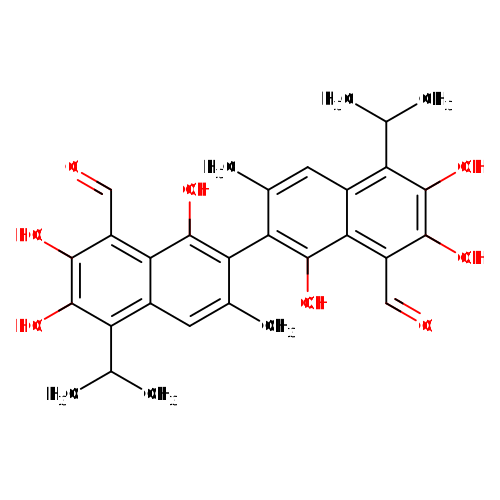
Chemical Structure
Thumb
Synonyms
ValueSource
(+)-GossypolHMDB
(+-)-GossypolHMDB
(+/-)-gossypolHMDB
(R)-(-)-GossypolHMDB
(R)-GossypolHMDB
Dipotassium salt, gossypolHMDB, MeSH
GossypolHMDB
Gossypol dipotassium saltHMDB, MeSH
Gossypol from cotton seedsHMDB
Gossypol sodium saltHMDB, MeSH
Gossypol, (+)-isomerHMDB, MeSH
Gossypol, (+-)-isomerHMDB, MeSH
Gossypol, (-)-isomerHMDB, MeSH
PogosinHMDB
Racemic-gossypolHMDB
Sodium salt, gossypolHMDB, MeSH
Tash 1HMDB
Chemical FormulaC30H30O8
Average Molecular Mass518.554 g/mol
Monoisotopic Mass518.194 g/mol
CAS Registry Number90141-22-3
IUPAC Name7-[8-formyl-1,6,7-trihydroxy-3-methyl-5-(propan-2-yl)naphthalen-2-yl]-2,3,8-trihydroxy-6-methyl-4-(propan-2-yl)naphthalene-1-carbaldehyde
Traditional Name(-)-gossypol
SMILESCC(C)C1=C2C=C(C)C(=C(O)C2=C(C=O)C(O)=C1O)C1=C(O)C2=C(C=O)C(O)=C(O)C(C(C)C)=C2C=C1C
InChI IdentifierInChI=1S/C30H30O8/c1-11(2)19-15-7-13(5)21(27(35)23(15)17(9-31)25(33)29(19)37)22-14(6)8-16-20(12(3)4)30(38)26(34)18(10-32)24(16)28(22)36/h7-12,33-38H,1-6H3
InChI KeyQBKSWRVVCFFDOT-UHFFFAOYSA-N
Chemical Taxonomy
Description belongs to the class of organic compounds known as sesquiterpenoids. These are terpenes with three consecutive isoprene units.
KingdomOrganic compounds
Super ClassLipids and lipid-like molecules
ClassPrenol lipids
Sub ClassSesquiterpenoids
Direct ParentSesquiterpenoids
Alternative Parents
Substituents
  • Cadinane sesquiterpenoid
  • Sesquiterpenoid
  • 2-naphthol
  • 1-naphthol
  • Naphthalene
  • Aryl-aldehyde
  • 1-hydroxy-4-unsubstituted benzenoid
  • Benzenoid
  • Vinylogous acid
  • Polyol
  • Organic oxygen compound
  • Organooxygen compound
  • Aldehyde
  • Hydrocarbon derivative
  • Organic oxide
  • Aromatic homopolycyclic compound
Molecular FrameworkAromatic homopolycyclic compounds
External Descriptors
Biological Properties
StatusDetected and Not Quantified
OriginExogenous
Cellular Locations
  • Membrane
Biofluid LocationsNot Available
Tissue LocationsNot Available
PathwaysNot Available
ApplicationsNot Available
Biological RolesNot Available
Chemical RolesNot Available
Physical Properties
StateSolid
AppearanceWhite powder.
Experimental Properties
PropertyValue
Melting Point178 - 183°C
Boiling PointNot Available
SolubilityNot Available
Predicted Properties
PropertyValueSource
Water Solubility0.0038 g/LALOGPS
logP4.49ALOGPS
logP8.02ChemAxon
logS-5.1ALOGPS
pKa (Strongest Acidic)7.8ChemAxon
pKa (Strongest Basic)-6.1ChemAxon
Physiological Charge0ChemAxon
Hydrogen Acceptor Count8ChemAxon
Hydrogen Donor Count6ChemAxon
Polar Surface Area155.52 ŲChemAxon
Rotatable Bond Count4ChemAxon
Refractivity147.61 m³·mol⁻¹ChemAxon
Polarizability55.95 ųChemAxon
Number of Rings4ChemAxon
Bioavailability0ChemAxon
Rule of FiveNoChemAxon
Ghose FilterNoChemAxon
Veber's RuleNoChemAxon
MDDR-like RuleNoChemAxon
Spectra
Spectra
Spectrum TypeDescriptionSplash KeyView
Predicted GC-MSPredicted GC-MS Spectrum - GC-MS (Non-derivatized) - 70eV, Positivesplash10-0udi-0000690000-9df7326dd4ce60b1088cSpectrum
Predicted GC-MSPredicted GC-MS Spectrum - GC-MS (2 TMS) - 70eV, Positivesplash10-0002-0000019000-f115e0a1dfade9af2f9bSpectrum
Predicted GC-MSPredicted GC-MS Spectrum - GC-MS (TMS_4_1) - 70eV, PositiveNot AvailableSpectrum
Predicted GC-MSPredicted GC-MS Spectrum - GC-MS (TMS_5_1) - 70eV, PositiveNot AvailableSpectrum
Predicted GC-MSPredicted GC-MS Spectrum - GC-MS (TMS_5_2) - 70eV, PositiveNot AvailableSpectrum
Predicted GC-MSPredicted GC-MS Spectrum - GC-MS ("(-)-Gossypol,4TMS,#1" TMS) - 70eV, PositiveNot AvailableSpectrum
Predicted LC-MS/MSPredicted LC-MS/MS Spectrum - 10V, Positivesplash10-014i-0000190000-afd3b7806ba77c385fc9Spectrum
Predicted LC-MS/MSPredicted LC-MS/MS Spectrum - 20V, Positivesplash10-016r-1030970000-364f0989158c0f867591Spectrum
Predicted LC-MS/MSPredicted LC-MS/MS Spectrum - 40V, Positivesplash10-0pb9-5030940000-cb58d99e7632b192bd4dSpectrum
Predicted LC-MS/MSPredicted LC-MS/MS Spectrum - 10V, Negativesplash10-014i-0000090000-55621847e31c93e5127fSpectrum
Predicted LC-MS/MSPredicted LC-MS/MS Spectrum - 20V, Negativesplash10-066r-0070390000-dda96ff17c65a2928ec9Spectrum
Predicted LC-MS/MSPredicted LC-MS/MS Spectrum - 40V, Negativesplash10-0a4u-1390300000-346fa91db1c09ffd5becSpectrum
Predicted LC-MS/MSPredicted LC-MS/MS Spectrum - 10V, Negativesplash10-014i-0000090000-fb746155c08fc8620398Spectrum
Predicted LC-MS/MSPredicted LC-MS/MS Spectrum - 20V, Negativesplash10-014r-0000950000-e97a10851934b81a7505Spectrum
Predicted LC-MS/MSPredicted LC-MS/MS Spectrum - 40V, Negativesplash10-03di-0000900000-5335728bfd7010097935Spectrum
Predicted LC-MS/MSPredicted LC-MS/MS Spectrum - 10V, Positivesplash10-014i-0000090000-4887f71c2e78af699141Spectrum
Predicted LC-MS/MSPredicted LC-MS/MS Spectrum - 20V, Positivesplash10-014i-0000390000-01a16a8a515827651a3eSpectrum
Predicted LC-MS/MSPredicted LC-MS/MS Spectrum - 40V, Positivesplash10-03di-0002910000-b9dfdfbb4b3c355cb8f0Spectrum
Toxicity Profile
Route of ExposureOral (ingestion) (5) ; dermal (5)
Mechanism of ToxicityGossypol may cause apoptosis via the regulation of Bax and Bcl-2 proteins. It is also an inhibitor of calcineurin and protein kinases C, and has been shown to bind calmodulin. (4)
MetabolismNot Available
Toxicity ValuesNot Available
Lethal DoseNot Available
Carcinogenicity (IARC Classification)No indication of carcinogenicity to humans (not listed by IARC).
Uses/SourcesGossypol is a plant toxin found in the cotton plant (genus Gossypium, family Malvaceae). Among other things, it has been tested as a male oral contraceptive in China. In addition to its contraceptive properties, gossypol has also long been known to possess anti-malarial properties. (4)
Minimum Risk LevelNot Available
Health EffectsGossypol may cause low potassium levels and thus causes temporary paralysis. (4)
SymptomsSymptoms of gossypol poisoning include fatigue, muscle weakness, and at its most extreme, paralysis. (4)
TreatmentNot Available
Concentrations
Not Available
DrugBank IDDB13044
HMDB IDHMDB0040723
FooDB IDFDB000742
Phenol Explorer IDNot Available
KNApSAcK IDC00003136
BiGG IDNot Available
BioCyc IDNot Available
METLIN IDNot Available
PDB IDNot Available
Wikipedia LinkNot Available
Chemspider ID3383
ChEBI IDNot Available
PubChem Compound ID3503
Kegg Compound IDC07667
YMDB IDNot Available
ECMDB IDNot Available
References
Synthesis ReferenceNot Available
MSDSNot Available
General References
1. Meng Y, Tang W, Dai Y, Wu X, Liu M, Ji Q, Ji M, Pienta K, Lawrence T, Xu L: Natural BH3 mimetic (-)-gossypol chemosensitizes human prostate cancer via Bcl-xL inhibition accompanied by increase of Puma and Noxa. Mol Cancer Ther. 2008 Jul;7(7):2192-202. doi: 10.1158/1535-7163.MCT-08-0333.
2. Zhang XQ, Huang XF, Mu SJ, An QX, Xia AJ, Chen R, Wu DC: Inhibition of proliferation of prostate cancer cell line, PC-3, in vitro and in vivo using (-)-gossypol. Asian J Androl. 2010 May;12(3):390-9. doi: 10.1038/aja.2009.87. Epub 2010 Jan 18.
3. Zhang Y, Kulp SK, Sugimoto Y, Brueggemeier RW, Lin YC: The (-)-enantiomer of gossypol inhibits proliferation of stromal cells derived from human breast adipose tissues by enhancing transforming growth factor beta1 production. Int J Oncol. 1998 Dec;13(6):1291-7.
4. Simons K, Toomre D: Lipid rafts and signal transduction. Nat Rev Mol Cell Biol. 2000 Oct;1(1):31-9.
5. Watson AD: Thematic review series: systems biology approaches to metabolic and cardiovascular disorders. Lipidomics: a global approach to lipid analysis in biological systems. J Lipid Res. 2006 Oct;47(10):2101-11. Epub 2006 Aug 10.
6. Sethi JK, Vidal-Puig AJ: Thematic review series: adipocyte biology. Adipose tissue function and plasticity orchestrate nutritional adaptation. J Lipid Res. 2007 Jun;48(6):1253-62. Epub 2007 Mar 20.
7. Lingwood D, Simons K: Lipid rafts as a membrane-organizing principle. Science. 2010 Jan 1;327(5961):46-50. doi: 10.1126/science.1174621.
8. Yannai, Shmuel. (2004) Dictionary of food compounds with CD-ROM: Additives, flavors, and ingredients. Boca Raton: Chapman & Hall/CRC.
9. The lipid handbook with CD-ROM