Record Information
Version1.0
Creation Date2009-07-21 20:28:47 UTC
Update Date2026-05-14 16:59:45 UTC
Accession NumberCHEM002391
Identification
Common NameHexobarbital
ClassSmall Molecule
DescriptionHexobarbital is only found in individuals that have used or taken this drug. It is a barbiturate that is effective as a hypnotic and sedative. [PubChem]Hexobarbital binds at a distinct binding site associated with a Cl- ionopore at the GABA-A receptor, increasing the duration of time for which the Cl- ionopore is open. The post-synaptic inhibitory effect of GABA in the thalamus is, therefore, prolonged.
Contaminant Sources
  • HMDB Contaminants - Urine
  • STOFF IDENT Compounds
  • T3DB toxins
  • ToxCast & Tox21 Chemicals
Contaminant Type
  • Adjuvant
  • Amide
  • Amine
  • Barbiturate
  • Drug
  • GABA Modulator
  • Hypnotic and Sedative
  • Metabolite
  • Organic Compound
  • Synthetic Compound
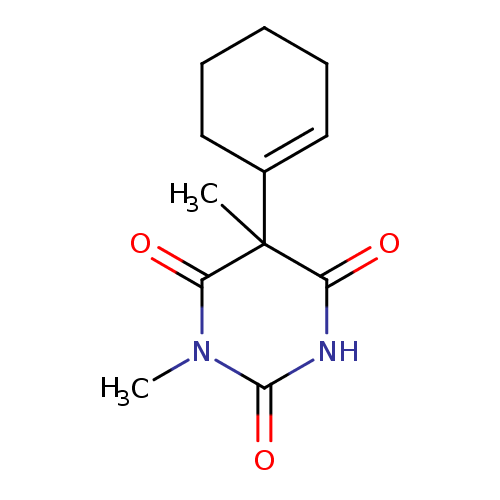
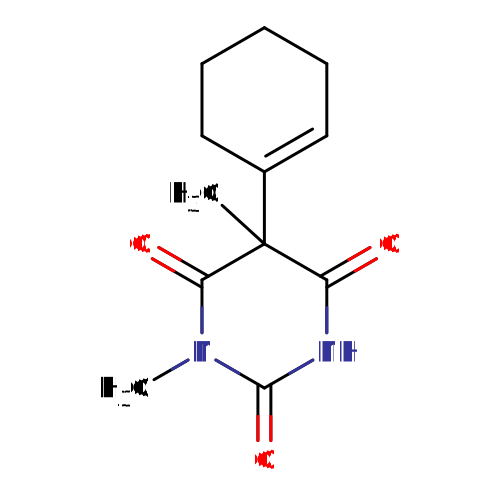
Chemical Structure
Thumb
Synonyms
ValueSource
5-(1-Cyclohexen-1-yl)-1,5-dimethyl-2,4,6(1H,3H,5H)-pyrimidinetrioneChEBI
5-(1-Cyclohexen-1-yl)-1,5-dimethylbarbituric acidChEBI
5-Cyclohex-1-enyl-1,5-dimethyl-pyrimidine-2,4,6-trioneChEBI
EvipanChEBI
HexobarbitoneChEBI
MethexenylChEBI
MethylhexabitalChEBI
5-(1-Cyclohexen-1-yl)-1,5-dimethylbarbitateGenerator
5-(1-Cyclohexen-1-yl)-1,5-dimethylbarbitic acidGenerator
HexenalMeSH, HMDB
Hexobarbital, sodiumMeSH, HMDB
Sodium hexobarbitalMeSH, HMDB
Chemical FormulaC12H16N2O3
Average Molecular Mass236.267 g/mol
Monoisotopic Mass236.116 g/mol
CAS Registry Number56-29-1
IUPAC Name5-(cyclohex-1-en-1-yl)-1,5-dimethyl-1,3-diazinane-2,4,6-trione
Traditional Namehexobarbital
SMILESCN1C(=O)NC(=O)C(C)(C1=O)C1=CCCCC1
InChI IdentifierInChI=1S/C12H16N2O3/c1-12(8-6-4-3-5-7-8)9(15)13-11(17)14(2)10(12)16/h6H,3-5,7H2,1-2H3,(H,13,15,17)
InChI KeyUYXAWHWODHRRMR-UHFFFAOYSA-N
Chemical Taxonomy
Description belongs to the class of organic compounds known as pyrimidones. Pyrimidones are compounds that contain a pyrimidine ring, which bears a ketone. Pyrimidine is a 6-membered ring consisting of four carbon atoms and two nitrogen centers at the 1- and 3- ring positions.
KingdomOrganic compounds
Super ClassOrganoheterocyclic compounds
ClassDiazines
Sub ClassPyrimidines and pyrimidine derivatives
Direct ParentPyrimidones
Alternative Parents
Substituents
  • Pyrimidone
  • Hydropyrimidine
  • 1,2,5,6-tetrahydropyrimidine
  • Dicarboximide
  • Carbonic acid derivative
  • Azacycle
  • Organic 1,3-dipolar compound
  • Propargyl-type 1,3-dipolar organic compound
  • Carboxylic acid derivative
  • Organic oxide
  • Hydrocarbon derivative
  • Organic nitrogen compound
  • Organooxygen compound
  • Organonitrogen compound
  • Carbonyl group
  • Organopnictogen compound
  • Organic oxygen compound
  • Aliphatic heteromonocyclic compound
Molecular FrameworkAliphatic heteromonocyclic compounds
External Descriptors
Biological Properties
StatusDetected and Not Quantified
OriginExogenous
Cellular Locations
  • Cytoplasm
  • Extracellular
  • Membrane
Biofluid LocationsNot Available
Tissue LocationsNot Available
PathwaysNot Available
ApplicationsNot Available
Biological RolesNot Available
Chemical RolesNot Available
Physical Properties
StateSolid
AppearanceWhite powder.
Experimental Properties
PropertyValue
Melting Point146.5°C
Boiling PointNot Available
Solubility435 mg/L (at 25°C)
Predicted Properties
PropertyValueSource
Water Solubility1.51 g/LALOGPS
logP1.8ALOGPS
logP1.25ChemAxon
logS-2.2ALOGPS
pKa (Strongest Acidic)7.41ChemAxon
Physiological Charge0ChemAxon
Hydrogen Acceptor Count3ChemAxon
Hydrogen Donor Count1ChemAxon
Polar Surface Area66.48 ŲChemAxon
Rotatable Bond Count1ChemAxon
Refractivity61.95 m³·mol⁻¹ChemAxon
Polarizability24.14 ųChemAxon
Number of Rings2ChemAxon
Bioavailability1ChemAxon
Rule of FiveYesChemAxon
Ghose FilterYesChemAxon
Veber's RuleNoChemAxon
MDDR-like RuleNoChemAxon
Spectra
Spectra
Spectrum TypeDescriptionSplash KeyView
GC-MSGC-MS Spectrum - EI-B (Non-derivatized)splash10-00gi-9420000000-001b8f1462933b4fb9c1Spectrum
Predicted GC-MSPredicted GC-MS Spectrum - GC-MS (Non-derivatized) - 70eV, Positivesplash10-004i-3940000000-827e61b1deec4916f579Spectrum
Predicted GC-MSPredicted GC-MS Spectrum - GC-MS (Non-derivatized) - 70eV, PositiveNot AvailableSpectrum
Predicted LC-MS/MSPredicted LC-MS/MS Spectrum - 10V, Positivesplash10-000i-1190000000-58f9b3cb0025cd8911aaSpectrum
Predicted LC-MS/MSPredicted LC-MS/MS Spectrum - 20V, Positivesplash10-014i-2920000000-e4d6ce12b6d33fff56d8Spectrum
Predicted LC-MS/MSPredicted LC-MS/MS Spectrum - 40V, Positivesplash10-0uxu-9100000000-55244be11c0d8667c413Spectrum
Predicted LC-MS/MSPredicted LC-MS/MS Spectrum - 10V, Negativesplash10-000f-7980000000-db4b09996693417c3e09Spectrum
Predicted LC-MS/MSPredicted LC-MS/MS Spectrum - 20V, Negativesplash10-0bt9-5900000000-3fac68a4cc2e19e26087Spectrum
Predicted LC-MS/MSPredicted LC-MS/MS Spectrum - 40V, Negativesplash10-0006-9200000000-8495751984d2901a8826Spectrum
Predicted LC-MS/MSPredicted LC-MS/MS Spectrum - 10V, Positivesplash10-000i-0390000000-d08c51477abaf85bbfa5Spectrum
Predicted LC-MS/MSPredicted LC-MS/MS Spectrum - 20V, Positivesplash10-0a4i-1930000000-cc97a14668452a4e91e1Spectrum
Predicted LC-MS/MSPredicted LC-MS/MS Spectrum - 40V, Positivesplash10-0a4i-6900000000-3951ea29d6dcc2dca21bSpectrum
Predicted LC-MS/MSPredicted LC-MS/MS Spectrum - 10V, Negativesplash10-000i-3490000000-509890f29192f5ebf006Spectrum
Predicted LC-MS/MSPredicted LC-MS/MS Spectrum - 20V, Negativesplash10-0a4l-5970000000-fb452294b839815fbe4bSpectrum
Predicted LC-MS/MSPredicted LC-MS/MS Spectrum - 40V, Negativesplash10-000x-9450000000-ae3101e9d97123ad0a93Spectrum
MSMass Spectrum (Electron Ionization)splash10-05cu-9310000000-eeec363075c613d35696Spectrum
1D NMR1H NMR SpectrumNot AvailableSpectrum
1D NMR13C NMR SpectrumNot AvailableSpectrum
Toxicity Profile
Route of ExposureOral
Mechanism of ToxicityHexobarbital binds at a distinct binding site associated with a Cl- ionopore at the GABA-A receptor, increasing the duration of time for which the Cl- ionopore is open. The post-synaptic inhibitory effect of GABA in the thalamus is, therefore, prolonged.
MetabolismHepatic.
Toxicity ValuesNot Available
Lethal DoseNot Available
Carcinogenicity (IARC Classification)No indication of carcinogenicity to humans (not listed by IARC).
Uses/SourcesFor the induction of anesthesia prior to the use of other general anesthetic agents and for induction of anesthesia for short surgical, diagnostic, or therapeutic procedures associated with minimal painful stimuli.
Minimum Risk LevelNot Available
Health EffectsThey cause slurred speech, disorientation and "drunken" behavior. They are physically and psychologically addictive. They cause slurred speech, disorientation and "drunken" behavior. They are physically and psychologically addictive.
SymptomsSymptoms of an overdose typically include sluggishness, incoordination, difficulty in thinking, slowness of speech, faulty judgment, drowsiness or coma, shallow breathing, staggering, and in severe cases coma and death.
TreatmentNot Available
Concentrations
Not Available
DrugBank IDNot Available
HMDB IDNot Available
FooDB IDNot Available
Phenol Explorer IDNot Available
KNApSAcK IDC00016768
BiGG IDNot Available
BioCyc IDNot Available
METLIN IDNot Available
PDB IDNot Available
Wikipedia LinkHexobarbital
Chemspider ID3482
ChEBI ID5706
PubChem Compound IDNot Available
Kegg Compound IDC11723
YMDB IDNot Available
ECMDB IDNot Available
References
Synthesis ReferenceNot Available
MSDSNot Available
General References
1. https://www.ncbi.nlm.nih.gov/pubmed/?term=10891117
2. https://www.ncbi.nlm.nih.gov/pubmed/?term=1153616
3. https://www.ncbi.nlm.nih.gov/pubmed/?term=15577260
4. https://www.ncbi.nlm.nih.gov/pubmed/?term=15857133
5. https://www.ncbi.nlm.nih.gov/pubmed/?term=1680178
6. https://www.ncbi.nlm.nih.gov/pubmed/?term=18870124
7. https://www.ncbi.nlm.nih.gov/pubmed/?term=19863908
8. https://www.ncbi.nlm.nih.gov/pubmed/?term=3654008
9. https://www.ncbi.nlm.nih.gov/pubmed/?term=6864729
10. https://www.ncbi.nlm.nih.gov/pubmed/?term=7614008
11. https://www.ncbi.nlm.nih.gov/pubmed/?term=8255925
12. https://www.ncbi.nlm.nih.gov/pubmed/?term=9586853