Record Information
Version1.0
Creation Date2009-07-21 20:28:33 UTC
Update Date2026-03-31 17:08:35 UTC
Accession NumberCHEM002366
Identification
Common NameChlormezanone
ClassSmall Molecule
DescriptionChlormezanone is only found in individuals that have used or taken this drug. It is a non-benzodiazepine that is used in the management of anxiety. It has been suggested for use in the treatment of muscle spasm. [PubChem]Chlormezanone binds to central benzodiazepine receptors which interact allosterically with GABA receptors. This potentiates the effects of the inhibitory neurotransmitter GABA, increasing the inhibition of the ascending reticular activating system and blocking the cortical and limbic arousal that occurs following stimulation of the reticular pathways.
Contaminant Sources
  • HMDB Contaminants - Urine
  • STOFF IDENT Compounds
  • T3DB toxins
  • ToxCast & Tox21 Chemicals
Contaminant Type
  • Amide
  • Amine
  • Anti-Anxiety Agent
  • Antipsychotic Agent
  • Benzodiazepine
  • Drug
  • Metabolite
  • Muscle Relaxant, Central
  • Organic Compound
  • Organochloride
  • Synthetic Compound
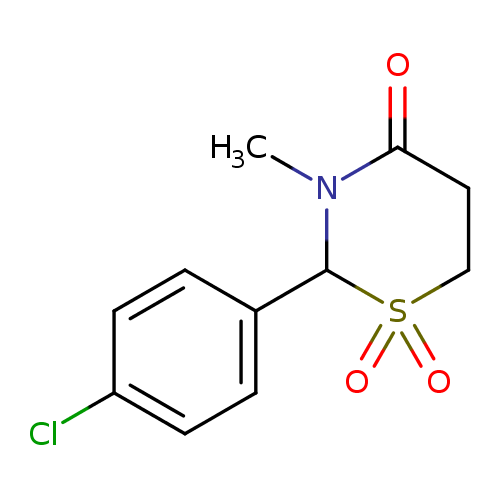
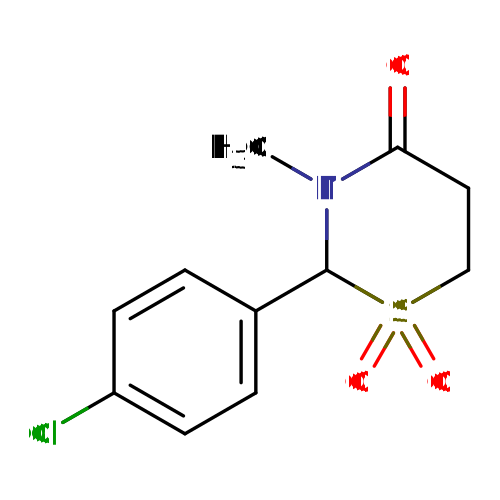
Chemical Structure
Thumb
Synonyms
ValueSource
(+-)-ChlormezanoneChEBI
2-(p-Chlorophenyl)tetrahydro-3-methyl-4H-1,3-thiazin-4-one 1,1-dioxideChEBI
2-(p-Chlorphenyl)-3-methyl-1,3-perhydrothiazin-4-on-1,1-dioxideChEBI
ChlormethazanoneChEBI
ChlormezanonaChEBI
ChlormezanonumChEBI
TrancopalKegg
ChlormethazoneHMDB
ChlormezanonHMDB
ClormetazanoneHMDB
ClormetazonHMDB
ClormezanoneHMDB
DichloromethazanoneHMDB
DichloromezanoneHMDB
DL-ChlormezanoneHMDB
Chemical FormulaC11H12ClNO3S
Average Molecular Mass273.736 g/mol
Monoisotopic Mass273.023 g/mol
CAS Registry Number80-77-3
IUPAC Name2-(4-chlorophenyl)-3-methyl-1lambda6,3-thiazinane-1,1,4-trione
Traditional Name2-(4-chlorophenyl)-3-methyl-1lambda6,3-thiazinane-1,1,4-trione
SMILESCN1C(C2=CC=C(Cl)C=C2)S(=O)(=O)CCC1=O
InChI IdentifierInChI=1S/C11H12ClNO3S/c1-13-10(14)6-7-17(15,16)11(13)8-2-4-9(12)5-3-8/h2-5,11H,6-7H2,1H3
InChI KeyWEQAYVWKMWHEJO-UHFFFAOYSA-N
Chemical Taxonomy
Description belongs to the class of organic compounds known as chlorobenzenes. Chlorobenzenes are compounds containing one or more chlorine atoms attached to a benzene moiety.
KingdomOrganic compounds
Super ClassBenzenoids
ClassBenzene and substituted derivatives
Sub ClassHalobenzenes
Direct ParentChlorobenzenes
Alternative Parents
Substituents
  • Chlorobenzene
  • Aryl chloride
  • Aryl halide
  • 1,3-thiazinane
  • Sulfone
  • Tertiary carboxylic acid amide
  • Carboxamide group
  • Lactam
  • Carboxylic acid derivative
  • Azacycle
  • Organoheterocyclic compound
  • Organonitrogen compound
  • Organochloride
  • Organohalogen compound
  • Hydrocarbon derivative
  • Organic oxide
  • Organopnictogen compound
  • Carbonyl group
  • Organooxygen compound
  • Organic nitrogen compound
  • Organic oxygen compound
  • Aromatic heteromonocyclic compound
Molecular FrameworkAromatic heteromonocyclic compounds
External Descriptors
Biological Properties
StatusDetected and Not Quantified
OriginExogenous
Cellular Locations
  • Cytoplasm
  • Extracellular
  • Membrane
Biofluid LocationsNot Available
Tissue LocationsNot Available
PathwaysNot Available
Applications
Biological RolesNot Available
Chemical RolesNot Available
Physical Properties
StateSolid
AppearanceWhite powder.
Experimental Properties
PropertyValue
Melting Point116.2-118.6°C
Boiling PointNot Available
Solubility2500 mg/L (at 25°C)
Predicted Properties
PropertyValueSource
Water Solubility1.61 g/LALOGPS
logP0.84ALOGPS
logP0.92ChemAxon
logS-2.2ALOGPS
pKa (Strongest Acidic)19.07ChemAxon
pKa (Strongest Basic)-2.4ChemAxon
Physiological Charge0ChemAxon
Hydrogen Acceptor Count3ChemAxon
Hydrogen Donor Count0ChemAxon
Polar Surface Area54.45 ŲChemAxon
Rotatable Bond Count1ChemAxon
Refractivity64.88 m³·mol⁻¹ChemAxon
Polarizability25.72 ųChemAxon
Number of Rings2ChemAxon
Bioavailability1ChemAxon
Rule of FiveYesChemAxon
Ghose FilterYesChemAxon
Veber's RuleNoChemAxon
MDDR-like RuleNoChemAxon
Spectra
Spectra
Spectrum TypeDescriptionSplash KeyView
Predicted GC-MSPredicted GC-MS Spectrum - GC-MS (Non-derivatized) - 70eV, Positivesplash10-0fi0-3900000000-5e5d0d06b736cd6e312dSpectrum
Predicted GC-MSPredicted GC-MS Spectrum - GC-MS (Non-derivatized) - 70eV, PositiveNot AvailableSpectrum
LC-MS/MSLC-MS/MS Spectrum - LC-ESI-qTof , Positivesplash10-0kmi-0690000000-1392c5b54088e4de1cdaSpectrum
LC-MS/MSLC-MS/MS Spectrum - , positivesplash10-0kmi-0690000000-1392c5b54088e4de1cdaSpectrum
LC-MS/MSLC-MS/MS Spectrum - 45V, Positivesplash10-00e9-9800000000-6a7c54ed417bbe3bf39cSpectrum
LC-MS/MSLC-MS/MS Spectrum - 15V, Negativesplash10-0a59-0980000000-f53a3c2f328bf92ecea2Spectrum
LC-MS/MSLC-MS/MS Spectrum - 30V, Negativesplash10-001i-3920000000-72d4eeb6dec00afcf714Spectrum
LC-MS/MSLC-MS/MS Spectrum - 60V, Negativesplash10-00di-9000000000-6d971fd886764cbe9edcSpectrum
LC-MS/MSLC-MS/MS Spectrum - 45V, Negativesplash10-00e9-9800000000-160e4ad7fa10bdfbce0eSpectrum
Predicted LC-MS/MSPredicted LC-MS/MS Spectrum - 10V, Positivesplash10-00di-1390000000-8bee31987cb996a6941dSpectrum
Predicted LC-MS/MSPredicted LC-MS/MS Spectrum - 20V, Positivesplash10-00di-3290000000-fe5427b04dacecf713b8Spectrum
Predicted LC-MS/MSPredicted LC-MS/MS Spectrum - 40V, Positivesplash10-0006-8900000000-d26b01b91b77c8ccf5ffSpectrum
Predicted LC-MS/MSPredicted LC-MS/MS Spectrum - 10V, Negativesplash10-00di-0290000000-13d72ad524b7d05b5dd4Spectrum
Predicted LC-MS/MSPredicted LC-MS/MS Spectrum - 20V, Negativesplash10-0udi-1920000000-f5d97bfa6c8356b4baf4Spectrum
Predicted LC-MS/MSPredicted LC-MS/MS Spectrum - 40V, Negativesplash10-0a4r-7900000000-66d56cc398b6ac3900a0Spectrum
Predicted LC-MS/MSPredicted LC-MS/MS Spectrum - 10V, Positivesplash10-00di-0090000000-fd587e06fea093c00217Spectrum
Predicted LC-MS/MSPredicted LC-MS/MS Spectrum - 20V, Positivesplash10-0ufr-0910000000-d1589364a7086eeb574dSpectrum
Predicted LC-MS/MSPredicted LC-MS/MS Spectrum - 40V, Positivesplash10-0uxr-2900000000-941a0471defcde1f16b6Spectrum
Predicted LC-MS/MSPredicted LC-MS/MS Spectrum - 10V, Negativesplash10-00di-0090000000-0ebbdf325da9547d6d6aSpectrum
Predicted LC-MS/MSPredicted LC-MS/MS Spectrum - 20V, Negativesplash10-03k9-1390000000-fb20b8fdbf901e9ead65Spectrum
Predicted LC-MS/MSPredicted LC-MS/MS Spectrum - 40V, Negativesplash10-01q9-9160000000-435ff6a491b5b8c51796Spectrum
MSMass Spectrum (Electron Ionization)splash10-0udi-7900000000-6c729f1a3c9cb4241b45Spectrum
1D NMR1H NMR SpectrumNot AvailableSpectrum
1D NMR13C NMR SpectrumNot AvailableSpectrum
Toxicity Profile
Route of ExposureNot Available
Mechanism of ToxicityChlormezanone binds to central benzodiazepine receptors which interact allosterically with GABA receptors. This potentiates the effects of the inhibitory neurotransmitter GABA, increasing the inhibition of the ascending reticular activating system and blocking the cortical and limbic arousal that occurs following stimulation of the reticular pathways.
MetabolismNot Available
Toxicity ValuesNot Available
Lethal DoseNot Available
Carcinogenicity (IARC Classification)No indication of carcinogenicity to humans (not listed by IARC).
Uses/SourcesUsed in the management of anxiety and in the treatment of muscle spasm.
Minimum Risk LevelNot Available
Health EffectsNot Available
SymptomsSymptoms of overdose include drowsiness, weakness, nausea, dizziness, abdominal pain, cerebral oedema and renal tubular necrosis, hyperglycaemia and hypoglycaemia, liver damage, encephalopathy, coma and death.
TreatmentNot Available
Concentrations
Not Available
DrugBank IDDB01178
HMDB IDHMDB0015309
FooDB IDNot Available
Phenol Explorer IDNot Available
KNApSAcK IDNot Available
BiGG IDNot Available
BioCyc IDNot Available
METLIN IDNot Available
PDB IDNot Available
Wikipedia LinkChlormezanone
Chemspider ID2616
ChEBI ID3619
PubChem Compound ID2717
Kegg Compound IDNot Available
YMDB IDNot Available
ECMDB IDNot Available
References
Synthesis ReferenceNot Available
MSDSNot Available
General References
1. https://www.ncbi.nlm.nih.gov/pubmed/?term=10191862
2. https://www.ncbi.nlm.nih.gov/pubmed/?term=10412893
3. https://www.ncbi.nlm.nih.gov/pubmed/?term=10798243
4. https://www.ncbi.nlm.nih.gov/pubmed/?term=15897685
5. https://www.ncbi.nlm.nih.gov/pubmed/?term=29438107
6. https://www.ncbi.nlm.nih.gov/pubmed/?term=3449070
7. https://www.ncbi.nlm.nih.gov/pubmed/?term=3720548
8. https://www.ncbi.nlm.nih.gov/pubmed/?term=3768082
9. https://www.ncbi.nlm.nih.gov/pubmed/?term=6403110
10. https://www.ncbi.nlm.nih.gov/pubmed/?term=7104168
11. https://www.ncbi.nlm.nih.gov/pubmed/?term=7758315
12. https://www.ncbi.nlm.nih.gov/pubmed/?term=9770210
13. Gautier V, Vincon G, Demotes-Mainard F, Albin H: [Pharmacokinetics of chlormezanone in healthy volunteers]. Therapie. 1990 Jul-Aug;45(4):315-9.
14. Oelschlager H, Klinger W, Rothley D, Seeling A, Bockhard H, Hofmann B, Machts H, Riederer H, Rackur H: [Cleavage and biotransformation of the central muscle relaxant chlormezanone]. Pharmazie. 1998 Sep;53(9):620-4.
15. Seeling A, Oelschlager H, Rothley D: [Important pharmaceutical-chemical characteristics of the central muscle relaxant chlormezanone]. Pharmazie. 2000 Apr;55(4):293-6.
16. Wollina U, Hipler UC, Seeling A, Oelschlager H: Investigations of interactions of chlormezanone racemate and its enantiomers on human keratinocytes and human leucoytes in vitro. Skin Pharmacol Physiol. 2005 May-Jun;18(3):132-8.