Record Information
Version1.0
Creation Date2009-07-21 20:28:23 UTC
Update Date2026-03-26 23:50:26 UTC
Accession NumberCHEM002348
Identification
Common NameMethyprylon
ClassSmall Molecule
DescriptionMethyprylon is a sedative of the piperidinedione derivative family. This medicine was used for treating insomnia, but is now rarely used as it has been replaced by newer drugs with less side effects, such as benzodiazepines. Methyprylon was withdrawn from the US market in June 1965 and the Canadian market in September 1990. [Wikipedia]
Contaminant Sources
  • HMDB Contaminants - Urine
  • STOFF IDENT Compounds
  • T3DB toxins
Contaminant Type
  • Amide
  • Amine
  • Drug
  • Hypnotic and Sedative
  • Metabolite
  • Organic Compound
  • Synthetic Compound
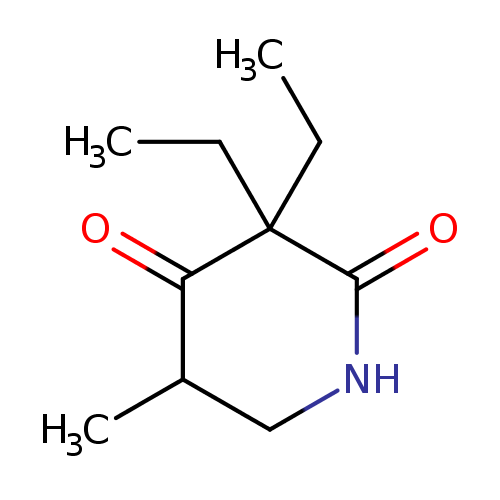
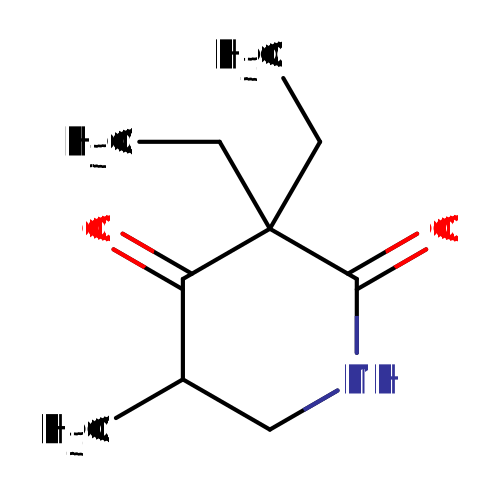
Chemical Structure
Thumb
Synonyms
ValueSource
NoludarKegg
Dea no. 2575HMDB
MethprylonHMDB, MeSH
MethyprolonHMDB
MetiprilonHMDB
MetipriloneHMDB
Chemical FormulaC10H17NO2
Average Molecular Mass183.248 g/mol
Monoisotopic Mass183.126 g/mol
CAS Registry Number125-64-4
IUPAC Name3,3-diethyl-5-methylpiperidine-2,4-dione
Traditional Namedimerin
SMILESCCC1(CC)C(=O)NCC(C)C1=O
InChI IdentifierInChI=1S/C10H17NO2/c1-4-10(5-2)8(12)7(3)6-11-9(10)13/h7H,4-6H2,1-3H3,(H,11,13)
InChI KeySIDLZWOQUZRBRU-UHFFFAOYSA-N
Chemical Taxonomy
Description belongs to the class of organic compounds known as piperidinediones. Piperidinediones are compounds containing a piperidine ring which bears two ketones.
KingdomOrganic compounds
Super ClassOrganoheterocyclic compounds
ClassPiperidines
Sub ClassPiperidinones
Direct ParentPiperidinediones
Alternative Parents
Substituents
  • Piperidinedione
  • Delta-lactam
  • Cyclic ketone
  • Secondary carboxylic acid amide
  • Lactam
  • Ketone
  • Carboxamide group
  • Azacycle
  • Carboxylic acid derivative
  • Organopnictogen compound
  • Organic oxide
  • Hydrocarbon derivative
  • Organic nitrogen compound
  • Organooxygen compound
  • Organonitrogen compound
  • Carbonyl group
  • Organic oxygen compound
  • Aliphatic heteromonocyclic compound
Molecular FrameworkAliphatic heteromonocyclic compounds
External DescriptorsNot Available
Biological Properties
StatusDetected and Not Quantified
OriginExogenous
Cellular Locations
  • Cytoplasm
  • Extracellular
  • Membrane
Biofluid LocationsNot Available
Tissue LocationsNot Available
PathwaysNot Available
ApplicationsNot Available
Biological RolesNot Available
Chemical RolesNot Available
Physical Properties
StateSolid
AppearanceWhite powder.
Experimental Properties
PropertyValue
Melting PointNot Available
Boiling PointNot Available
Solubility1.15E+004 mg/L
Predicted Properties
PropertyValueSource
Water Solubility11.3 g/LALOGPS
logP0.94ALOGPS
logP1.88ChemAxon
logS-1.2ALOGPS
pKa (Strongest Acidic)14.53ChemAxon
pKa (Strongest Basic)-3.1ChemAxon
Physiological Charge0ChemAxon
Hydrogen Acceptor Count2ChemAxon
Hydrogen Donor Count1ChemAxon
Polar Surface Area46.17 ŲChemAxon
Rotatable Bond Count2ChemAxon
Refractivity50.25 m³·mol⁻¹ChemAxon
Polarizability19.95 ųChemAxon
Number of Rings1ChemAxon
Bioavailability1ChemAxon
Rule of FiveYesChemAxon
Ghose FilterYesChemAxon
Veber's RuleNoChemAxon
MDDR-like RuleNoChemAxon
Spectra
Spectra
Spectrum TypeDescriptionSplash KeyView
GC-MSGC-MS Spectrum - EI-B (Non-derivatized)splash10-0a4l-6900000000-385d8cb9bf60082827acSpectrum
Predicted GC-MSPredicted GC-MS Spectrum - GC-MS (Non-derivatized) - 70eV, Positivesplash10-00ou-9400000000-8922f5aa566be569ccd1Spectrum
Predicted GC-MSPredicted GC-MS Spectrum - GC-MS (Non-derivatized) - 70eV, PositiveNot AvailableSpectrum
LC-MS/MSLC-MS/MS Spectrum - 35V, Positivesplash10-0a4i-9600000000-341c448eb86eb4376244Spectrum
Predicted LC-MS/MSPredicted LC-MS/MS Spectrum - 10V, Positivesplash10-001i-0900000000-c3c2c573bf22a9d36fe2Spectrum
Predicted LC-MS/MSPredicted LC-MS/MS Spectrum - 20V, Positivesplash10-001i-1900000000-88af5674e1a3672f546cSpectrum
Predicted LC-MS/MSPredicted LC-MS/MS Spectrum - 40V, Positivesplash10-014i-9000000000-c5f699a0695cb2c7ad04Spectrum
Predicted LC-MS/MSPredicted LC-MS/MS Spectrum - 10V, Negativesplash10-001i-3900000000-a0c53bfcdf202aa11f85Spectrum
Predicted LC-MS/MSPredicted LC-MS/MS Spectrum - 20V, Negativesplash10-000x-7900000000-85f7c4a5f9c06ad94287Spectrum
Predicted LC-MS/MSPredicted LC-MS/MS Spectrum - 40V, Negativesplash10-00kg-9100000000-3cd408992de5e0bc15c4Spectrum
Predicted LC-MS/MSPredicted LC-MS/MS Spectrum - 10V, Positivesplash10-001i-0900000000-ddf04ef739a42d036265Spectrum
Predicted LC-MS/MSPredicted LC-MS/MS Spectrum - 20V, Positivesplash10-05o0-3900000000-0afe8594dbb8ec23dd1aSpectrum
Predicted LC-MS/MSPredicted LC-MS/MS Spectrum - 40V, Positivesplash10-00r6-9100000000-d5fbb119c1322409e4e2Spectrum
Predicted LC-MS/MSPredicted LC-MS/MS Spectrum - 10V, Negativesplash10-001i-0900000000-302ec3e9dbef6a25a832Spectrum
Predicted LC-MS/MSPredicted LC-MS/MS Spectrum - 20V, Negativesplash10-001i-2900000000-87bc99139f5df17c1365Spectrum
Predicted LC-MS/MSPredicted LC-MS/MS Spectrum - 40V, Negativesplash10-0006-9300000000-a5b73de5d90252ae003fSpectrum
MSMass Spectrum (Electron Ionization)splash10-052f-9400000000-a2bf5474c5cd64d42619Spectrum
1D NMR1H NMR SpectrumNot AvailableSpectrum
1D NMR13C NMR SpectrumNot AvailableSpectrum
1D NMR1H NMR SpectrumNot AvailableSpectrum
1D NMR13C NMR SpectrumNot AvailableSpectrum
1D NMR1H NMR SpectrumNot AvailableSpectrum
1D NMR13C NMR SpectrumNot AvailableSpectrum
1D NMR1H NMR SpectrumNot AvailableSpectrum
1D NMR13C NMR SpectrumNot AvailableSpectrum
1D NMR1H NMR SpectrumNot AvailableSpectrum
1D NMR13C NMR SpectrumNot AvailableSpectrum
1D NMR1H NMR SpectrumNot AvailableSpectrum
1D NMR13C NMR SpectrumNot AvailableSpectrum
1D NMR1H NMR SpectrumNot AvailableSpectrum
1D NMR13C NMR SpectrumNot AvailableSpectrum
1D NMR1H NMR SpectrumNot AvailableSpectrum
1D NMR13C NMR SpectrumNot AvailableSpectrum
1D NMR1H NMR SpectrumNot AvailableSpectrum
1D NMR13C NMR SpectrumNot AvailableSpectrum
1D NMR1H NMR SpectrumNot AvailableSpectrum
1D NMR13C NMR SpectrumNot AvailableSpectrum
Toxicity Profile
Route of ExposureNot Available
Mechanism of ToxicityMethyprylon binds at a distinct binding site associated with a Cl- ionopore at the GABAA receptor, increasing the duration of time for which the Cl- ionopore is open. The post-synaptic inhibitory effect of GABA in the thalamus is, therefore, prolonged.
MetabolismHepatic. Methyprylon is almost completely metabolized. Half Life: 6-16 hours
Toxicity ValuesNot Available
Lethal DoseNot Available
Carcinogenicity (IARC Classification)No indication of carcinogenicity to humans (not listed by IARC).
Uses/SourcesFor the treatment of insomnia.
Minimum Risk LevelNot Available
Health EffectsThey cause slurred speech, disorientation and "drunken" behavior. They are physically and psychologically addictive.
SymptomsSymptoms of overdose include excitation and convulsions.
TreatmentNot Available
Concentrations
Not Available
DrugBank IDDB01107
HMDB IDHMDB0258070
FooDB IDNot Available
Phenol Explorer IDNot Available
KNApSAcK IDNot Available
BiGG IDNot Available
BioCyc IDNot Available
METLIN IDNot Available
PDB IDNot Available
Wikipedia LinkMethyprylon
Chemspider ID4018
ChEBI IDNot Available
PubChem Compound IDNot Available
Kegg Compound IDNot Available
YMDB IDNot Available
ECMDB IDNot Available
References
Synthesis ReferenceNot Available
MSDSNot Available
General ReferencesNot Available