Record Information
Version1.0
Creation Date2009-07-21 20:28:07 UTC
Update Date2026-03-31 18:20:43 UTC
Accession NumberCHEM002314
Identification
Common NameNeomycin
ClassSmall Molecule
DescriptionA component of neomycin that is produced by Streptomyces fradiae. On hydrolysis it yields neamine and neobiosamine B. (From Merck Index, 11th ed). Neomycin is a bactericidal aminoglycoside antibiotic that binds to the 30S ribosome of susceptible organisms. Binding interferes with mRNA binding and acceptor tRNA sites and results in the production of non-functional or toxic peptides.
Contaminant Sources
  • HMDB Contaminants - Urine
  • STOFF IDENT Compounds
  • T3DB toxins
Contaminant Type
  • Amine
  • Aminoglycoside
  • Anti-Bacterial Agent
  • Antibiotic
  • Drug
  • Metabolite
  • Organic Compound
  • Synthetic Compound
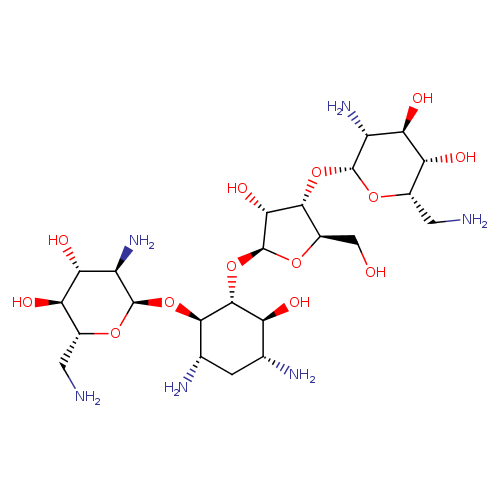
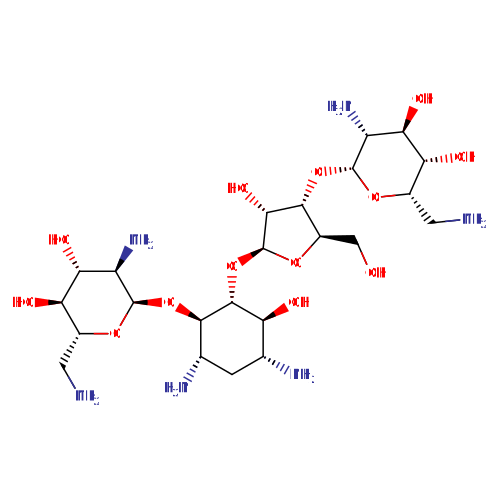
Chemical Structure
Thumb
Synonyms
ValueSource
Fradiomycin bChEBI
FramicetinaChEBI
FramycetineChEBI
FramycetinumChEBI
Neomycin bChEBI
FramycetinKegg
FRMKegg
Caswell no. 595HMDB
Neomycin b sulfateHMDB
Neomycin sulfateHMDB
Neomycin sulphateHMDB
USAF CB-19HMDB
Fradiomycin sulfateHMDB
Neomycin palmitateHMDB
Palmitate, neomycinHMDB
Sulfate, neomycinHMDB
Sulfate, fradiomycinHMDB
Antibiotic 10676HMDB
Sulfate, framycetinHMDB
SoframycinHMDB
Sulfate, neomycin bHMDB
Framycetin sulfateHMDB
Chemical FormulaC23H46N6O13
Average Molecular Mass614.644 g/mol
Monoisotopic Mass614.312 g/mol
CAS Registry Number1404-04-2
IUPAC Name(2S,3S,4R,5R,6R)-5-amino-2-(aminomethyl)-6-{[(2R,3S,4R,5S)-5-{[(1R,2R,3S,5R,6S)-3,5-diamino-2-{[(2R,3R,4R,5S,6R)-3-amino-6-(aminomethyl)-4,5-dihydroxyoxan-2-yl]oxy}-6-hydroxycyclohexyl]oxy}-4-hydroxy-2-(hydroxymethyl)oxolan-3-yl]oxy}oxane-3,4-diol
Traditional Nameneomycin
SMILESNC[C@@H]1O[C@H](O[C@@H]2[C@@H](CO)O[C@@H](O[C@@H]3[C@@H](O)[C@H](N)C[C@H](N)[C@H]3O[C@H]3O[C@H](CN)[C@@H](O)[C@H](O)[C@H]3N)[C@@H]2O)[C@H](N)[C@@H](O)[C@@H]1O
InChI IdentifierInChI=1S/C23H46N6O13/c24-2-7-13(32)15(34)10(28)21(37-7)40-18-6(27)1-5(26)12(31)20(18)42-23-17(36)19(9(4-30)39-23)41-22-11(29)16(35)14(33)8(3-25)38-22/h5-23,30-36H,1-4,24-29H2/t5-,6+,7-,8+,9-,10-,11-,12+,13-,14-,15-,16-,17-,18-,19-,20-,21-,22-,23+/m1/s1
InChI KeyPGBHMTALBVVCIT-VCIWKGPPSA-N
Chemical Taxonomy
Description belongs to the class of organic compounds known as 4,5-disubstituted 2-deoxystreptamines. These are 2-deoxystreptamine aminoglycosides that are glycosidically linked to a pyranose of furanose unit at the C4- and C5-positions.
KingdomOrganic compounds
Super ClassOrganic oxygen compounds
ClassOrganooxygen compounds
Sub ClassCarbohydrates and carbohydrate conjugates
Direct Parent4,5-disubstituted 2-deoxystreptamines
Alternative Parents
Substituents
  • 4,5-disubstituted 2-deoxystreptamine
  • Disaccharide
  • Glycosyl compound
  • O-glycosyl compound
  • Aminocyclitol or derivatives
  • Cyclohexanol
  • Cyclohexylamine
  • Cyclitol or derivatives
  • Oxane
  • Tetrahydrofuran
  • Cyclic alcohol
  • Secondary alcohol
  • 1,2-aminoalcohol
  • Acetal
  • Organoheterocyclic compound
  • Oxacycle
  • Primary alcohol
  • Hydrocarbon derivative
  • Organopnictogen compound
  • Primary aliphatic amine
  • Organonitrogen compound
  • Organic nitrogen compound
  • Amine
  • Alcohol
  • Primary amine
  • Aliphatic heteromonocyclic compound
Molecular FrameworkAliphatic heteromonocyclic compounds
External Descriptors
Biological Properties
StatusDetected and Not Quantified
OriginExogenous
Cellular Locations
  • Cytoplasm
  • Membrane
Biofluid LocationsNot Available
Tissue LocationsNot Available
Pathways
NameSMPDB LinkKEGG Link
Neomycin PathwayNot AvailableNot Available
ApplicationsNot Available
Biological RolesNot Available
Chemical RolesNot Available
Physical Properties
StateSolid
AppearanceWhite powder.
Experimental Properties
PropertyValue
Melting PointNot Available
Boiling PointNot Available
Solubility6.47e+01 g/L
Predicted Properties
PropertyValueSource
Water Solubility64.7 g/LALOGPS
logP-2.8ALOGPS
logP-8.4ChemAxon
logS-0.98ALOGPS
pKa (Strongest Acidic)12.29ChemAxon
pKa (Strongest Basic)9.97ChemAxon
Physiological Charge6ChemAxon
Hydrogen Acceptor Count19ChemAxon
Hydrogen Donor Count13ChemAxon
Polar Surface Area353.11 ŲChemAxon
Rotatable Bond Count9ChemAxon
Refractivity135.9 m³·mol⁻¹ChemAxon
Polarizability60.87 ųChemAxon
Number of Rings4ChemAxon
Bioavailability0ChemAxon
Rule of FiveNoChemAxon
Ghose FilterNoChemAxon
Veber's RuleNoChemAxon
MDDR-like RuleYesChemAxon
Spectra
Spectra
Spectrum TypeDescriptionSplash KeyView
Predicted GC-MSPredicted GC-MS Spectrum - GC-MS (Non-derivatized) - 70eV, Positivesplash10-001i-7141290000-1d118bea988327c31f82Spectrum
Predicted GC-MSPredicted GC-MS Spectrum - GC-MS (1 TMS) - 70eV, Positivesplash10-001i-9341105000-267bc688fe9cf91d65e8Spectrum
Predicted GC-MSPredicted GC-MS Spectrum - GC-MS (TMS_1_2) - 70eV, PositiveNot AvailableSpectrum
Predicted GC-MSPredicted GC-MS Spectrum - GC-MS (TMS_1_3) - 70eV, PositiveNot AvailableSpectrum
Predicted GC-MSPredicted GC-MS Spectrum - GC-MS (TMS_1_4) - 70eV, PositiveNot AvailableSpectrum
Predicted GC-MSPredicted GC-MS Spectrum - GC-MS (TMS_1_5) - 70eV, PositiveNot AvailableSpectrum
Predicted GC-MSPredicted GC-MS Spectrum - GC-MS (TMS_1_6) - 70eV, PositiveNot AvailableSpectrum
Predicted GC-MSPredicted GC-MS Spectrum - GC-MS (TMS_1_7) - 70eV, PositiveNot AvailableSpectrum
Predicted GC-MSPredicted GC-MS Spectrum - GC-MS (TMS_1_8) - 70eV, PositiveNot AvailableSpectrum
Predicted GC-MSPredicted GC-MS Spectrum - GC-MS (TMS_1_9) - 70eV, PositiveNot AvailableSpectrum
Predicted GC-MSPredicted GC-MS Spectrum - GC-MS (TMS_1_10) - 70eV, PositiveNot AvailableSpectrum
Predicted GC-MSPredicted GC-MS Spectrum - GC-MS (TMS_1_11) - 70eV, PositiveNot AvailableSpectrum
Predicted GC-MSPredicted GC-MS Spectrum - GC-MS (TMS_1_12) - 70eV, PositiveNot AvailableSpectrum
Predicted GC-MSPredicted GC-MS Spectrum - GC-MS (TMS_1_13) - 70eV, PositiveNot AvailableSpectrum
Predicted GC-MSPredicted GC-MS Spectrum - GC-MS (TMS_2_1) - 70eV, PositiveNot AvailableSpectrum
Predicted GC-MSPredicted GC-MS Spectrum - GC-MS (TMS_2_2) - 70eV, PositiveNot AvailableSpectrum
Predicted GC-MSPredicted GC-MS Spectrum - GC-MS (TMS_2_3) - 70eV, PositiveNot AvailableSpectrum
Predicted GC-MSPredicted GC-MS Spectrum - GC-MS (TMS_2_4) - 70eV, PositiveNot AvailableSpectrum
Predicted GC-MSPredicted GC-MS Spectrum - GC-MS (TMS_2_5) - 70eV, PositiveNot AvailableSpectrum
Predicted GC-MSPredicted GC-MS Spectrum - GC-MS (TMS_2_6) - 70eV, PositiveNot AvailableSpectrum
Predicted GC-MSPredicted GC-MS Spectrum - GC-MS (TMS_2_7) - 70eV, PositiveNot AvailableSpectrum
Predicted GC-MSPredicted GC-MS Spectrum - GC-MS (TMS_2_8) - 70eV, PositiveNot AvailableSpectrum
Predicted GC-MSPredicted GC-MS Spectrum - GC-MS (TMS_2_9) - 70eV, PositiveNot AvailableSpectrum
Predicted GC-MSPredicted GC-MS Spectrum - GC-MS (TMS_2_10) - 70eV, PositiveNot AvailableSpectrum
Predicted GC-MSPredicted GC-MS Spectrum - GC-MS (TMS_2_11) - 70eV, PositiveNot AvailableSpectrum
Predicted LC-MS/MSPredicted LC-MS/MS Spectrum - 10V, Positivesplash10-059t-0119482000-ffdc0e43566451df2770Spectrum
Predicted LC-MS/MSPredicted LC-MS/MS Spectrum - 20V, Positivesplash10-08mr-0928720000-996bb8f7855d3e85b860Spectrum
Predicted LC-MS/MSPredicted LC-MS/MS Spectrum - 40V, Positivesplash10-074j-4926000000-c31af30f83e2c83c73c8Spectrum
Predicted LC-MS/MSPredicted LC-MS/MS Spectrum - 10V, Negativesplash10-03ki-6015593000-b65aa1924d1108bbb4b5Spectrum
Predicted LC-MS/MSPredicted LC-MS/MS Spectrum - 20V, Negativesplash10-0fep-8628790000-7f5b87306932c4896d5fSpectrum
Predicted LC-MS/MSPredicted LC-MS/MS Spectrum - 40V, Negativesplash10-0fn9-3849010000-bab816a750f8a64740c6Spectrum
Predicted LC-MS/MSPredicted LC-MS/MS Spectrum - 10V, Positivesplash10-014l-0800339000-6b946842d215c555103fSpectrum
Predicted LC-MS/MSPredicted LC-MS/MS Spectrum - 20V, Positivesplash10-01ox-0900211000-595172ae6408734c4e48Spectrum
Predicted LC-MS/MSPredicted LC-MS/MS Spectrum - 40V, Positivesplash10-01ox-9511450000-c93dbeb27c933d5b5c00Spectrum
Predicted LC-MS/MSPredicted LC-MS/MS Spectrum - 10V, Negativesplash10-03di-0201219000-3f9668d26af13f0bfc8fSpectrum
Predicted LC-MS/MSPredicted LC-MS/MS Spectrum - 20V, Negativesplash10-03di-4424298000-6320ecb92950f4012b9eSpectrum
Predicted LC-MS/MSPredicted LC-MS/MS Spectrum - 40V, Negativesplash10-0fkc-4796600000-b980bdc4fed06048f4a4Spectrum
1D NMR1H NMR SpectrumNot AvailableSpectrum
1D NMR13C NMR SpectrumNot AvailableSpectrum
1D NMR1H NMR SpectrumNot AvailableSpectrum
1D NMR13C NMR SpectrumNot AvailableSpectrum
1D NMR1H NMR SpectrumNot AvailableSpectrum
1D NMR13C NMR SpectrumNot AvailableSpectrum
1D NMR1H NMR SpectrumNot AvailableSpectrum
1D NMR13C NMR SpectrumNot AvailableSpectrum
1D NMR1H NMR SpectrumNot AvailableSpectrum
1D NMR13C NMR SpectrumNot AvailableSpectrum
1D NMR1H NMR SpectrumNot AvailableSpectrum
1D NMR13C NMR SpectrumNot AvailableSpectrum
1D NMR1H NMR SpectrumNot AvailableSpectrum
1D NMR13C NMR SpectrumNot AvailableSpectrum
1D NMR1H NMR SpectrumNot AvailableSpectrum
1D NMR13C NMR SpectrumNot AvailableSpectrum
1D NMR1H NMR SpectrumNot AvailableSpectrum
1D NMR13C NMR SpectrumNot AvailableSpectrum
1D NMR1H NMR SpectrumNot AvailableSpectrum
1D NMR13C NMR SpectrumNot AvailableSpectrum
Toxicity Profile
Route of ExposureEye contact; topical (eye drops). Poorly absorbed from the normal gastrointestinal tract. Although only approximately 3% of neomycin is absorbed through intact intestinal mucosa, significant amounts may be absorbed through ulcerated or denuded mucosa or if inflammation is present.
Mechanism of ToxicityAminoglycosides like neomycin "irreversibly" bind to specific 30S-subunit proteins and 16S rRNA. Specifically neomycin binds to four nucleotides of 16S rRNA and a single amino acid of protein S12. This interferes with decoding site in the vicinity of nucleotide 1400 in 16S rRNA of 30S subunit. This region interacts with the wobble base in the anticodon of tRNA. This leads to interference with the initiation complex, misreading of mRNA so incorrect amino acids are inserted into the polypeptide leading to nonfunctional or toxic peptides and the breakup of polysomes into nonfunctional monosomes.
MetabolismNeomycin undergoes negligible biotransformation after parenteral administration. Route of Elimination: The small absorbed fraction is rapidly distributed in the tissues and is excreted by the kidney in keeping with the degree of kidney function. Half Life: 2 to 3 hours
Toxicity ValuesLD50: 200 mg/kg (Rat) (1)
Lethal DoseNot Available
Carcinogenicity (IARC Classification)No indication of carcinogenicity to humans (not listed by IARC).
Uses/SourcesTopical uses include treatment for superficial eye infections caused by susceptible bacteria (used in combination with other antiinfectives), treatment of otitis externa caused by susceptible bacteria, treatment or prevention of bacterial infections in skin lesions, and use as a continuous short-term irrigant or rinse to prevent bacteriuria and gram negative rod bacteremia in abacteriuric patients with indwelling catheters. May be used orally to treat hepatic encephalopathy, as a perioperative prophylactic agent, and as an adjunct to fluid and electrolyte replacement in the treatment of diarrhea caused to enteropathogenic E. coli (EPEC).
Minimum Risk LevelNot Available
Health EffectsAntibiotic resistance
SymptomsVestibular toxicity may result in vertigo, nausea and vomiting, dizziness and loss of balance.
TreatmentHemodialysis will remove neomycin sulfate from the blood. (3)
Concentrations
Not Available
DrugBank IDDB00452
HMDB IDHMDB0015129
FooDB IDNot Available
Phenol Explorer IDNot Available
KNApSAcK IDC00015577
BiGG IDNot Available
BioCyc IDCPD-14142
METLIN IDNot Available
PDB IDNot Available
Wikipedia LinkNeomycin
Chemspider ID8075
ChEBI ID7508
PubChem Compound ID8378
Kegg Compound IDC01737
YMDB IDNot Available
ECMDB IDNot Available
References
Synthesis Reference

Jaehoon Yu, Jongkook Lee, Miyun Kwon, Ae Pae, Hun Koh, “Heterodimeric conjugates of neomycin-oxazolidinone, their preparation and their use.” U.S. Patent US20050222055, issued October 06, 2005.

MSDSLink
General References
1. https://www.ncbi.nlm.nih.gov/pubmed/?term=25129497
2. https://www.ncbi.nlm.nih.gov/pubmed/?term=25230155
3. https://www.ncbi.nlm.nih.gov/pubmed/?term=25450807
4. https://www.ncbi.nlm.nih.gov/pubmed/?term=25588492
5. https://www.ncbi.nlm.nih.gov/pubmed/?term=8548964