Record Information
Version1.0
Creation Date2009-07-21 20:28:00 UTC
Update Date2026-03-31 19:04:29 UTC
Accession NumberCHEM002308
Identification
Common NameFelbamate
ClassSmall Molecule
DescriptionFelbamate is an anticonvulsant drug used in the treatment of epilepsy. It is used to treat partial seizures (with and without generalization) in adults and partial and generalized seizures associated with Lennox-Gastaut syndrome in children. It has a weak inhibitory effect on GABA receptor binding sites.
Contaminant Sources
  • HMDB Contaminants - Urine
  • STOFF IDENT Compounds
  • T3DB toxins
  • ToxCast & Tox21 Chemicals
Contaminant Type
  • Amine
  • Anticonvulsant
  • Antiepileptic Agent
  • Drug
  • Ester
  • Ether
  • Metabolite
  • Neuroprotective Agent
  • Organic Compound
  • Synthetic Compound
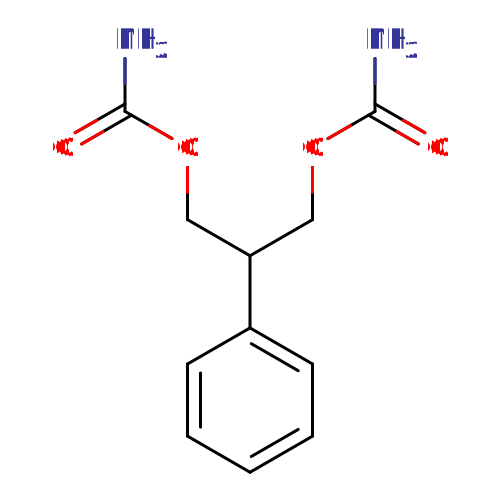
Chemical Structure
Thumb
Synonyms
ValueSource
2-Phenyl-1,3-propanediol dicarbamateChEBI
Carbamic acid 2-phenyltrimethylene esterChEBI
Carbamic acid 3-carbamoyloxy-2-phenyl-propyl esterChEBI
FelbamatoChEBI
FelbamatumChEBI
FelbatolKegg
2-Phenyl-1,3-propanediol dicarbamic acidGenerator
Carbamate 2-phenyltrimethylene esterGenerator
Carbamate 3-carbamoyloxy-2-phenyl-propyl esterGenerator
Felbamic acidGenerator
FelbamylHMDB
Wallace brand 1 OF felbamateHMDB
TaloxaHMDB
Wallace brand 2 OF felbamateHMDB
(3-Carbamoyloxy-2-phenyl-propyl) carbamateHMDB
2 Phenyl 1,3 propanediol dicarbamateHMDB
Chemical FormulaC11H14N2O4
Average Molecular Mass238.240 g/mol
Monoisotopic Mass238.095 g/mol
CAS Registry Number25451-15-4
IUPAC Name3-(carbamoyloxy)-2-phenylpropyl carbamate
Traditional Namefelbamate
SMILESNC(=O)OCC(COC(N)=O)C1=CC=CC=C1
InChI IdentifierInChI=1S/C11H14N2O4/c12-10(14)16-6-9(7-17-11(13)15)8-4-2-1-3-5-8/h1-5,9H,6-7H2,(H2,12,14)(H2,13,15)
InChI KeyWKGXYQFOCVYPAC-UHFFFAOYSA-N
Chemical Taxonomy
Description belongs to the class of organic compounds known as benzene and substituted derivatives. These are aromatic compounds containing one monocyclic ring system consisting of benzene.
KingdomOrganic compounds
Super ClassBenzenoids
ClassBenzene and substituted derivatives
Sub ClassNot Available
Direct ParentBenzene and substituted derivatives
Alternative Parents
Substituents
  • Monocyclic benzene moiety
  • Carbamic acid ester
  • Carbonic acid derivative
  • Organic nitrogen compound
  • Organic oxygen compound
  • Organopnictogen compound
  • Organic oxide
  • Hydrocarbon derivative
  • Organooxygen compound
  • Organonitrogen compound
  • Carbonyl group
  • Aromatic homomonocyclic compound
Molecular FrameworkAromatic homomonocyclic compounds
External Descriptors
Biological Properties
StatusDetected and Not Quantified
OriginExogenous
Cellular Locations
  • Membrane
Biofluid LocationsNot Available
Tissue LocationsNot Available
PathwaysNot Available
Applications
Biological RolesNot Available
Chemical RolesNot Available
Physical Properties
StateSolid
AppearanceWhite powder.
Experimental Properties
PropertyValue
Melting Point151.5°C
Boiling PointNot Available
SolubilitySlightly soluble in water
Predicted Properties
PropertyValueSource
Water Solubility0.74 g/LALOGPS
logP0.56ALOGPS
logP0.68ChemAxon
logS-2.5ALOGPS
pKa (Strongest Acidic)14.98ChemAxon
Physiological Charge0ChemAxon
Hydrogen Acceptor Count2ChemAxon
Hydrogen Donor Count2ChemAxon
Polar Surface Area104.64 ŲChemAxon
Rotatable Bond Count7ChemAxon
Refractivity59.59 m³·mol⁻¹ChemAxon
Polarizability23.52 ųChemAxon
Number of Rings1ChemAxon
Bioavailability1ChemAxon
Rule of FiveYesChemAxon
Ghose FilterYesChemAxon
Veber's RuleNoChemAxon
MDDR-like RuleNoChemAxon
Spectra
Spectra
Spectrum TypeDescriptionSplash KeyView
Predicted GC-MSPredicted GC-MS Spectrum - GC-MS (Non-derivatized) - 70eV, Positivesplash10-0fdo-6900000000-0f546bad5ba921f66b40Spectrum
Predicted GC-MSPredicted GC-MS Spectrum - GC-MS (Non-derivatized) - 70eV, PositiveNot AvailableSpectrum
LC-MS/MSLC-MS/MS Spectrum - LC-ESI-qTof , Positivesplash10-014i-2900000000-880b1fb1822a512a352cSpectrum
LC-MS/MSLC-MS/MS Spectrum - LC-ESI-qTof , Positivesplash10-016r-1900000000-f04127a0f39b9e0b001fSpectrum
LC-MS/MSLC-MS/MS Spectrum - , positivesplash10-014i-2900000000-880b1fb1822a512a352cSpectrum
LC-MS/MSLC-MS/MS Spectrum - , positivesplash10-016r-1900000000-f04127a0f39b9e0b001fSpectrum
LC-MS/MSLC-MS/MS Spectrum - 35V, Positivesplash10-014i-0900000000-edb979350df20b03f995Spectrum
Predicted LC-MS/MSPredicted LC-MS/MS Spectrum - 10V, Positivesplash10-000i-2390000000-02895c4e844f089545e6Spectrum
Predicted LC-MS/MSPredicted LC-MS/MS Spectrum - 20V, Positivesplash10-004i-3920000000-e7c2dfe58df4e1e34dccSpectrum
Predicted LC-MS/MSPredicted LC-MS/MS Spectrum - 40V, Positivesplash10-004l-9500000000-e824587a3374313f7cc4Spectrum
Predicted LC-MS/MSPredicted LC-MS/MS Spectrum - 10V, Negativesplash10-0006-9010000000-b6e0a295dcbb7a9c5266Spectrum
Predicted LC-MS/MSPredicted LC-MS/MS Spectrum - 20V, Negativesplash10-0006-9000000000-d549b5cb79133b3aa46eSpectrum
Predicted LC-MS/MSPredicted LC-MS/MS Spectrum - 40V, Negativesplash10-0006-9000000000-6a77d5d551bb1bd0c3a6Spectrum
Predicted LC-MS/MSPredicted LC-MS/MS Spectrum - 10V, Positivesplash10-014i-0900000000-de230d778fe1524d8977Spectrum
Predicted LC-MS/MSPredicted LC-MS/MS Spectrum - 20V, Positivesplash10-014i-0900000000-12a693a2773960f72de0Spectrum
Predicted LC-MS/MSPredicted LC-MS/MS Spectrum - 40V, Positivesplash10-014l-4900000000-bf2fec3e77955586472eSpectrum
Predicted LC-MS/MSPredicted LC-MS/MS Spectrum - 10V, Negativesplash10-0udi-3900000000-3ae60a2a1bad9c4de09bSpectrum
Predicted LC-MS/MSPredicted LC-MS/MS Spectrum - 20V, Negativesplash10-0006-9000000000-0ce4d922671bd2797d22Spectrum
Predicted LC-MS/MSPredicted LC-MS/MS Spectrum - 40V, Negativesplash10-0006-9000000000-94bb7174b97d6eefb992Spectrum
MSMass Spectrum (Electron Ionization)splash10-0udi-5900000000-673caaab3dded596924cSpectrum
Toxicity Profile
Route of ExposureOral. >90%
Mechanism of ToxicityThe mechanism by which felbamate exerts its anticonvulsant activity is unknown, but in animal test systems designed to detect anticonvulsant activity, felbamate has properties in common with other marketed anticonvulsants. In vitro receptor binding studies suggest that felbamate may be an antagonist at the strychnine-insensitive glycine-recognition site of the N-methyl-D-aspartate (NMDA) receptor-ionophore complex. Antagonism of the NMDA receptor glycine binding site may block the effects of the excitatory amino acids and suppress seizure activity. Animal studies indicate that felbamate may increase the seizure threshold and may decrease seizure spread. It is also indicated that felbamate has weak inhibitory effects on GABA-receptor binding, benzodiazepine receptor binding.
MetabolismHepatic Half Life: 20-23 hours
Toxicity ValuesLD50: 5000 mg/kg (Oral, Rat) (1)
Lethal DoseNot Available
Carcinogenicity (IARC Classification)No indication of carcinogenicity to humans (not listed by IARC).
Uses/SourcesFor use only in those patients who respond inadequately to alternative treatments and whose epilepsy is so severe that a substantial risk of aplastic anemia and/or liver failure is deemed acceptable in light of the benefits conferred by its use.
Minimum Risk LevelNot Available
Health EffectsMay cause a potentially dangerous rash that may develop into Stevens Johnson syndrome, an extremely rare but potentially fatal skin disease.
SymptomsNot Available
TreatmentGeneral supportive measures should be employed if overdosage occurs. It is not known if felbamate is dialyzable. (4)
Concentrations
Not Available
DrugBank IDDB00949
HMDB IDHMDB0015084
FooDB IDNot Available
Phenol Explorer IDNot Available
KNApSAcK IDNot Available
BiGG IDNot Available
BioCyc IDNot Available
METLIN IDNot Available
PDB IDNot Available
Wikipedia LinkFelbamate
Chemspider ID3214
ChEBI ID4995
PubChem Compound ID3331
Kegg Compound IDC07501
YMDB IDNot Available
ECMDB IDNot Available
References
Synthesis ReferenceNot Available
MSDSLink
General References
1. Leppik IE, Dreifuss FE, Pledger GW, Graves NM, Santilli N, Drury I, Tsay JY, Jacobs MP, Bertram E, Cereghino JJ, et al.: Felbamate for partial seizures: results of a controlled clinical trial. Neurology. 1991 Nov;41(11):1785-9.
2. https://www.ncbi.nlm.nih.gov/pubmed/?term=12825948
3. https://www.ncbi.nlm.nih.gov/pubmed/?term=12873507
4. https://www.ncbi.nlm.nih.gov/pubmed/?term=18311896