Record Information
Version1.0
Creation Date2009-07-21 20:27:54 UTC
Update Date2026-04-03 16:52:18 UTC
Accession NumberCHEM002296
Identification
Common NameMethdilazine
ClassSmall Molecule
DescriptionMethdilazine is only found in individuals that have used or taken this drug. It is a phenothiazine compound with antihistaminic activity. It is used in the treatment of various dermatoses to relieve pruritus.Methdilazine binds to the histamine H1 receptor. This blocks the action of endogenous histamine, which subsequently leads to temporary relief of the negative symptoms brought on by histamine.
Contaminant Sources
  • HMDB Contaminants - Urine
  • T3DB toxins
Contaminant Type
  • Amine
  • Drug
  • Ether
  • Histamine Antagonist
  • Metabolite
  • Organic Compound
  • Synthetic Compound
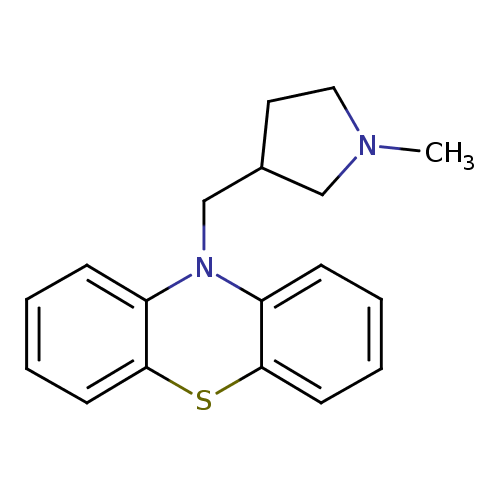
Chemical Structure
Thumb
Synonyms
ValueSource
10-[(1-Methyl-3-pyrrolidinyl)methyl]phenothiazineChEBI
DilosynChEBI
MetdilazinaChEBI
MethdilazinumChEBI
MJ 5022ChEBI
TacarylChEBI
TacazylChEBI
MDHMDB
Methdilazine monohydrochlorideHMDB
MethodilazineHMDB
Methdilazine hydrochlorideHMDB
Chemical FormulaC18H20N2S
Average Molecular Mass296.430 g/mol
Monoisotopic Mass296.135 g/mol
CAS Registry Number1982-37-2
IUPAC Name10-[(1-methylpyrrolidin-3-yl)methyl]-10H-phenothiazine
Traditional Namemethdilazine
SMILESCN1CCC(CN2C3=CC=CC=C3SC3=CC=CC=C23)C1
InChI IdentifierInChI=1S/C18H20N2S/c1-19-11-10-14(12-19)13-20-15-6-2-4-8-17(15)21-18-9-5-3-7-16(18)20/h2-9,14H,10-13H2,1H3
InChI KeyHTMIBDQKFHUPSX-UHFFFAOYSA-N
Chemical Taxonomy
Description belongs to the class of organic compounds known as phenothiazines. These are polycyclic aromatic compounds containing a phenothiazine moiety, which is a linear tricyclic system that consists of a two benzene rings joined by a para-thiazine ring.
KingdomOrganic compounds
Super ClassOrganoheterocyclic compounds
ClassBenzothiazines
Sub ClassPhenothiazines
Direct ParentPhenothiazines
Alternative Parents
Substituents
  • Phenothiazine
  • Alkyldiarylamine
  • Diarylthioether
  • Aryl thioether
  • Tertiary aliphatic/aromatic amine
  • Para-thiazine
  • Benzenoid
  • N-alkylpyrrolidine
  • Pyrrolidine
  • Tertiary aliphatic amine
  • Tertiary amine
  • Azacycle
  • Thioether
  • Hydrocarbon derivative
  • Organic nitrogen compound
  • Organonitrogen compound
  • Organopnictogen compound
  • Amine
  • Aromatic heteropolycyclic compound
Molecular FrameworkAromatic heteropolycyclic compounds
External Descriptors
Biological Properties
StatusDetected and Not Quantified
OriginExogenous
Cellular Locations
  • Membrane
Biofluid LocationsNot Available
Tissue LocationsNot Available
PathwaysNot Available
ApplicationsNot Available
Biological RolesNot Available
Chemical RolesNot Available
Physical Properties
StateSolid
AppearanceWhite powder.
Experimental Properties
PropertyValue
Melting Point87-88°C
Boiling PointNot Available
Solubility0.348 mg/L
Predicted Properties
PropertyValueSource
Water Solubility0.015 g/LALOGPS
logP4.56ALOGPS
logP3.94ChemAxon
logS-4.3ALOGPS
pKa (Strongest Basic)8.81ChemAxon
Physiological Charge1ChemAxon
Hydrogen Acceptor Count2ChemAxon
Hydrogen Donor Count0ChemAxon
Polar Surface Area6.48 ŲChemAxon
Rotatable Bond Count2ChemAxon
Refractivity91.64 m³·mol⁻¹ChemAxon
Polarizability33.37 ųChemAxon
Number of Rings4ChemAxon
Bioavailability1ChemAxon
Rule of FiveYesChemAxon
Ghose FilterYesChemAxon
Veber's RuleYesChemAxon
MDDR-like RuleNoChemAxon
Spectra
Spectra
Spectrum TypeDescriptionSplash KeyView
GC-MSGC-MS Spectrum - EI-B (Non-derivatized)splash10-0002-9310000000-08a0f77b83bac7e129eeSpectrum
Predicted GC-MSPredicted GC-MS Spectrum - GC-MS (Non-derivatized) - 70eV, Positivesplash10-03e9-3190000000-f46571c32392cef17825Spectrum
Predicted GC-MSPredicted GC-MS Spectrum - GC-MS (Non-derivatized) - 70eV, PositiveNot AvailableSpectrum
Predicted LC-MS/MSPredicted LC-MS/MS Spectrum - 10V, Positivesplash10-0002-4090000000-160b71afca5a22413d1bSpectrum
Predicted LC-MS/MSPredicted LC-MS/MS Spectrum - 20V, Positivesplash10-0002-9030000000-8d0d280a4305d9ee98b8Spectrum
Predicted LC-MS/MSPredicted LC-MS/MS Spectrum - 40V, Positivesplash10-0pwa-9000000000-9bf2c2541da751eb73d1Spectrum
Predicted LC-MS/MSPredicted LC-MS/MS Spectrum - 10V, Negativesplash10-0002-0090000000-1ab8cb488f1b6fbcfa89Spectrum
Predicted LC-MS/MSPredicted LC-MS/MS Spectrum - 20V, Negativesplash10-000b-0960000000-51823d86df854fd0b7c9Spectrum
Predicted LC-MS/MSPredicted LC-MS/MS Spectrum - 40V, Negativesplash10-0002-2910000000-35bf29f0bae2eb02a654Spectrum
Predicted LC-MS/MSPredicted LC-MS/MS Spectrum - 10V, Positivesplash10-0002-0090000000-9779fa04045a2c96d57fSpectrum
Predicted LC-MS/MSPredicted LC-MS/MS Spectrum - 20V, Positivesplash10-0002-1090000000-789730aa3b37623adfc1Spectrum
Predicted LC-MS/MSPredicted LC-MS/MS Spectrum - 40V, Positivesplash10-0002-9230000000-cd9ffb7dec63f7fe8d12Spectrum
Predicted LC-MS/MSPredicted LC-MS/MS Spectrum - 10V, Negativesplash10-0002-0090000000-908c3cef276d5324ab63Spectrum
Predicted LC-MS/MSPredicted LC-MS/MS Spectrum - 20V, Negativesplash10-0002-0190000000-840a23c528d53f2591f2Spectrum
Predicted LC-MS/MSPredicted LC-MS/MS Spectrum - 40V, Negativesplash10-0002-0930000000-e8e7355d83e44f37c46eSpectrum
MSMass Spectrum (Electron Ionization)splash10-0002-9630000000-8f3e969116ed3e70d7e5Spectrum
Toxicity Profile
Route of ExposureWell absorbed in the digestive tract.
Mechanism of ToxicityMethdilazine binds to the histamine H1 receptor. This blocks the action of endogenous histamine, which subsequently leads to temporary relief of the negative symptoms brought on by histamine.
MetabolismNot Available
Toxicity ValuesNot Available
Lethal DoseNot Available
Carcinogenicity (IARC Classification)No indication of carcinogenicity to humans (not listed by IARC).
Uses/SourcesUsed for the symptomatic relief of hypersensitivity reactions and particularly for the control of pruritic skin disorders
Minimum Risk LevelNot Available
Health EffectsNot Available
SymptomsSymptoms of overdose include clumsiness or unsteadiness, convulsions, drowsiness, dryness of mouth, nose, or throat, feeling faint, flushing or redness of face, hallucinations, muscle spasms (especially of neck and back), restlessness, shortness of breath or troubled breathing, shuffling walk, tic-like movements of head and face, trembling and shaking of hands, and trouble in sleeping.
TreatmentNot Available
Concentrations
Not Available
DrugBank IDDB00902
HMDB IDHMDB0015038
FooDB IDNot Available
Phenol Explorer IDNot Available
KNApSAcK IDNot Available
BiGG IDNot Available
BioCyc IDNot Available
METLIN IDNot Available
PDB IDNot Available
Wikipedia LinkMethdilazine
Chemspider ID14009
ChEBI ID774910
PubChem Compound ID14677
Kegg Compound IDC07175
YMDB IDNot Available
ECMDB IDNot Available
References
Synthesis ReferenceNot Available
MSDSNot Available
General References
1. Chattopadhyay D, Dastidar SG, Chakrabarty AN: Antimicrobial properties of methdilazine and its synergism with antibiotics and some chemotherapeutic agents. Arzneimittelforschung. 1988 Jul;38(7):869-72.
2. Chattopadhyay D, Mukherjee T, Pal P, Saha B, Bhadra R: Altered membrane permeability as the basis of bactericidal action of methdilazine. J Antimicrob Chemother. 1998 Jul;42(1):83-6.
3. Rani Basu L, Mazumdar K, Dutta NK, Karak P, Dastidar SG: Antibacterial property of the antipsychotic agent prochlorperazine, and its synergism with methdilazine. Microbiol Res. 2005;160(1):95-100.
4. https://www.ncbi.nlm.nih.gov/pubmed/?term=14080889
5. https://www.ncbi.nlm.nih.gov/pubmed/?term=14403486
6. https://www.ncbi.nlm.nih.gov/pubmed/?term=15782943
7. https://www.ncbi.nlm.nih.gov/pubmed/?term=19696152
8. https://www.ncbi.nlm.nih.gov/pubmed/?term=19790517
9. https://www.ncbi.nlm.nih.gov/pubmed/?term=2905130
10. https://www.ncbi.nlm.nih.gov/pubmed/?term=4381504
11. https://www.ncbi.nlm.nih.gov/pubmed/?term=8103345
12. https://www.ncbi.nlm.nih.gov/pubmed/?term=8975609
13. https://www.ncbi.nlm.nih.gov/pubmed/?term=9700532