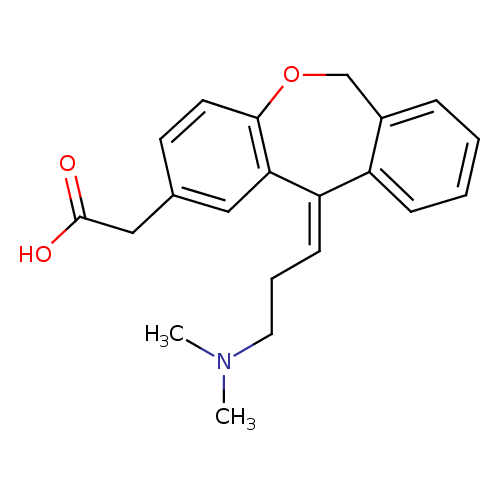
Record Information
Version1.0
Creation Date2009-07-21 20:27:37 UTC
Update Date2026-05-14 16:48:21 UTC
Accession NumberCHEM002269
Identification
Common NameOlopatadine
ClassSmall Molecule
DescriptionUsed to treat allergic conjunctivitis (itching eyes), olopatadine inhibits the release of histamine from mast cells. It is a relatively selective histamine H1 antagonist that inhibits the in vivo and in vitro type 1 immediate hypersensitivity reaction including inhibition of histamine induced effects on human conjunctival epithelial cells.
Contaminant Sources
  • HMDB Contaminants - Urine
  • STOFF IDENT Compounds
  • T3DB toxins
Contaminant Type
  • Amine
  • Anti-Allergic Agent
  • Anti-Inflammatory Agent, Non-Steroidal
  • Drug
  • Ether
  • Histamine Antagonist
  • Histamine H1 Antagonist
  • Histamine H1 Antagonist, Non-Sedating
  • Metabolite
  • Organic Compound
  • Synthetic Compound
Chemical Structure
Thumb
Synonyms
ValueSource
OpatanolHMDB
11-(3-(Dimethylamino)propylidene)-6,11-dihydrodibenz(b,e)oxepin-2-acetic acidHMDB
Hydrochloride, olopatadineHMDB
PatanolHMDB
Olopatadine hydrochlorideHMDB
Chemical FormulaC21H23NO3
Average Molecular Mass337.412 g/mol
Monoisotopic Mass337.168 g/mol
CAS Registry Number113806-05-6
IUPAC Name2-[(2Z)-2-[3-(dimethylamino)propylidene]-9-oxatricyclo[9.4.0.0^{3,8}]pentadeca-1(15),3(8),4,6,11,13-hexaen-5-yl]acetic acid
Traditional Namepatanol
SMILESCN(C)CC\C=C1\C2=CC=CC=C2COC2=C1C=C(CC(O)=O)C=C2
InChI IdentifierInChI=1S/C21H23NO3/c1-22(2)11-5-8-18-17-7-4-3-6-16(17)14-25-20-10-9-15(12-19(18)20)13-21(23)24/h3-4,6-10,12H,5,11,13-14H2,1-2H3,(H,23,24)/b18-8-
InChI KeyJBIMVDZLSHOPLA-LSCVHKIXSA-N
Chemical Taxonomy
Description belongs to the class of organic compounds known as dibenzoxepines. Dibenzoxepines are compounds containing a dibenzoxepine moiety, which consists of two benzene connected by an oxazepine ring.
KingdomOrganic compounds
Super ClassOrganoheterocyclic compounds
ClassBenzoxepines
Sub ClassDibenzoxepines
Direct ParentDibenzoxepines
Alternative Parents
Substituents
  • Dibenzoxepine
  • Alkyl aryl ether
  • Benzenoid
  • Amino acid or derivatives
  • Amino acid
  • Tertiary aliphatic amine
  • Tertiary amine
  • Carboxylic acid derivative
  • Carboxylic acid
  • Oxacycle
  • Ether
  • Monocarboxylic acid or derivatives
  • Organic nitrogen compound
  • Organonitrogen compound
  • Organooxygen compound
  • Hydrocarbon derivative
  • Organic oxide
  • Organopnictogen compound
  • Carbonyl group
  • Organic oxygen compound
  • Amine
  • Aromatic heteropolycyclic compound
Molecular FrameworkAromatic heteropolycyclic compounds
External DescriptorsNot Available
Biological Properties
StatusDetected and Not Quantified
OriginExogenous
Cellular Locations
  • Cytoplasm
  • Extracellular
  • Membrane
Biofluid LocationsNot Available
Tissue LocationsNot Available
PathwaysNot Available
ApplicationsNot Available
Biological RolesNot Available
Chemical RolesNot Available
Physical Properties
StateSolid
AppearanceWhite powder.
Experimental Properties
PropertyValue
Melting Point248°C
Boiling PointNot Available
SolubilitySoluble
Predicted Properties
PropertyValueSource
Water Solubility0.031 g/LALOGPS
logP3.99ALOGPS
logP0.75ChemAxon
logS-4ALOGPS
pKa (Strongest Acidic)3.78ChemAxon
pKa (Strongest Basic)9.76ChemAxon
Physiological Charge0ChemAxon
Hydrogen Acceptor Count4ChemAxon
Hydrogen Donor Count1ChemAxon
Polar Surface Area49.77 ŲChemAxon
Rotatable Bond Count5ChemAxon
Refractivity109.55 m³·mol⁻¹ChemAxon
Polarizability37.44 ųChemAxon
Number of Rings3ChemAxon
Bioavailability1ChemAxon
Rule of FiveYesChemAxon
Ghose FilterYesChemAxon
Veber's RuleNoChemAxon
MDDR-like RuleNoChemAxon
Spectra
Spectra
Spectrum TypeDescriptionSplash KeyView
Predicted GC-MSPredicted GC-MS Spectrum - GC-MS (Non-derivatized) - 70eV, Positivesplash10-0a4i-9041000000-136cb3971a95366a26d3Spectrum
Predicted GC-MSPredicted GC-MS Spectrum - GC-MS (1 TMS) - 70eV, Positivesplash10-0a4l-9013000000-f00dcdbf6710dd346917Spectrum
Predicted GC-MSPredicted GC-MS Spectrum - GC-MS (Non-derivatized) - 70eV, PositiveNot AvailableSpectrum
LC-MS/MSLC-MS/MS Spectrum - LC-ESI-QFT , negativesplash10-0006-0090000000-8e3ac3f01c9b0f33191fSpectrum
LC-MS/MSLC-MS/MS Spectrum - LC-ESI-QFT , negativesplash10-0007-0090000000-ff327751665292322357Spectrum
LC-MS/MSLC-MS/MS Spectrum - LC-ESI-QFT , negativesplash10-00ke-0190000000-4ee44c0a1808c8f38f5fSpectrum
LC-MS/MSLC-MS/MS Spectrum - LC-ESI-QFT , negativesplash10-014l-0490000000-af62db4d573fa623449bSpectrum
LC-MS/MSLC-MS/MS Spectrum - LC-ESI-QFT , negativesplash10-014l-0690000000-855734373da970ef9009Spectrum
LC-MS/MSLC-MS/MS Spectrum - LC-ESI-QFT , negativesplash10-014l-0970000000-10c3777ced99134b4960Spectrum
LC-MS/MSLC-MS/MS Spectrum - LC-ESI-QTOF , positivesplash10-000i-0009000000-edd957bf788fa0da1cd5Spectrum
LC-MS/MSLC-MS/MS Spectrum - LC-ESI-QTOF , positivesplash10-000i-0019000000-76019801740d70094185Spectrum
LC-MS/MSLC-MS/MS Spectrum - LC-ESI-QTOF , positivesplash10-00kk-0593000000-0fb46422a259d1710df5Spectrum
LC-MS/MSLC-MS/MS Spectrum - LC-ESI-QTOF , positivesplash10-016s-0690000000-d2686bcc07833ec6a7c5Spectrum
LC-MS/MSLC-MS/MS Spectrum - LC-ESI-QTOF , positivesplash10-0fw9-0690000000-20403692a9e2a6948063Spectrum
LC-MS/MSLC-MS/MS Spectrum - LC-ESI-QFT , positivesplash10-000i-0009000000-e2c029010aa3133274f8Spectrum
LC-MS/MSLC-MS/MS Spectrum - LC-ESI-QFT , positivesplash10-000i-1239000000-a4a1f419cb7782a025aeSpectrum
LC-MS/MSLC-MS/MS Spectrum - LC-ESI-QFT , positivesplash10-015a-4890000000-5408d5e1274f9ec8ab42Spectrum
LC-MS/MSLC-MS/MS Spectrum - LC-ESI-QFT , positivesplash10-00lu-4970000000-5d3cad1a8e8d0b931c62Spectrum
LC-MS/MSLC-MS/MS Spectrum - LC-ESI-QFT , positivesplash10-00lu-4960000000-d57d90bc4e9b3f57c2faSpectrum
LC-MS/MSLC-MS/MS Spectrum - LC-ESI-QFT , positivesplash10-0frx-5960000000-9b3e25cd1765878b5709Spectrum
LC-MS/MSLC-MS/MS Spectrum - , positivesplash10-000i-0469000000-a0b3c5cdd43e637acdecSpectrum
LC-MS/MSLC-MS/MS Spectrum - 50V, Positivesplash10-0fw9-0690000000-92c72fcd463bddb69fb7Spectrum
Predicted LC-MS/MSPredicted LC-MS/MS Spectrum - 10V, Positivesplash10-007c-0069000000-ad075b60f53c626584deSpectrum
Predicted LC-MS/MSPredicted LC-MS/MS Spectrum - 20V, Positivesplash10-0006-1092000000-e65d348c335d8045bdc4Spectrum
Predicted LC-MS/MSPredicted LC-MS/MS Spectrum - 40V, Positivesplash10-001i-5390000000-0f51723c50125d077c1aSpectrum
Predicted LC-MS/MSPredicted LC-MS/MS Spectrum - 10V, Negativesplash10-000l-0059000000-41a44e955bced08fbc6fSpectrum
Predicted LC-MS/MSPredicted LC-MS/MS Spectrum - 20V, Negativesplash10-000f-3098000000-a4e2e92bce8c77bb39a4Spectrum
Predicted LC-MS/MSPredicted LC-MS/MS Spectrum - 40V, Negativesplash10-0a4i-9372000000-9b0ceee49e3731053602Spectrum
Toxicity Profile
Route of ExposureOphthalmic use of olopatadine usually does not produce measurable plasma concentrations.
Mechanism of ToxicityOlopatadine is a selective histamine H1 antagonist that binds to the histamine H1 receptor. This blocks the action of endogenous histamine, which subsequently leads to temporary relief of the negative symptoms brought on by histamine. Olopatadine is devoid of effects on alpha-adrenergic, dopamine and muscarinic type 1 and 2 receptors.
MetabolismThe mono-desmethyl and the N-oxide metabolites have been detected at low concentrations in the urine. Route of Elimination: Elimination was predominantly through renal excretion. Half Life: 3 hours
Toxicity ValuesNot Available
Lethal DoseNot Available
Carcinogenicity (IARC Classification)No indication of carcinogenicity to humans (not listed by IARC).
Uses/SourcesFor the treatment of ocular itching associated with allergic conjunctivitis. Used as an antihistamine. [Wikipedia]
Minimum Risk LevelNot Available
Health EffectsNot Available
SymptomsIts side effects may include headaches (7% of occurrence) burning and stinging (5%), dry eye, foreign body sensation, hyperemia, keratitis, lid edema, pruritus, asthenia, cold syndrome, pharyngitis, rhinitis, sinusitis, and taste perversion. [Wikipedia]
TreatmentNot Available
Concentrations
Not Available
DrugBank IDDB00768
HMDB IDHMDB0014906
FooDB IDNot Available
Phenol Explorer IDNot Available
KNApSAcK IDNot Available
BiGG IDNot Available
BioCyc IDNot Available
METLIN IDNot Available
PDB IDNot Available
Wikipedia LinkOlopatadine
Chemspider ID4444528
ChEBI ID763382
PubChem Compound ID5281071
Kegg Compound IDC07789
YMDB IDNot Available
ECMDB IDNot Available
References
Synthesis Reference

Thomas Bader, Hans-Ulrich Bichsel, Bruno Gilomen, Imelda Meyer-Wilmes, Mark Sundermeier, “Polymorphic forms of olopatadine hydrochloride and methods for producing olopatadine and salts thereof.” U.S. Patent US20070232814, issued October 04, 2007.

MSDSLink
General References
1. Yanni JM, Stephens DJ, Miller ST, Weimer LK, Graff G, Parnell D, Lang LS, Spellman JM, Brady MT, Gamache DA: The in vitro and in vivo ocular pharmacology of olopatadine (AL-4943A), an effective anti-allergic/antihistaminic agent. J Ocul Pharmacol Ther. 1996 Winter;12(4):389-400.
2. Ohmori K, Ikemura T, Kobayashi H, Mukouyama A: [Pharmacological, pharmacokinetic and clinical properties of olopatadine hydrochloride' (olopatadine), an antiallergic drug]. Nihon Yakurigaku Zasshi. 2001 Jul;118(1):51-8.
3. Ohmori K, Hayashi K, Kaise T, Ohshima E, Kobayashi S, Yamazaki T, Mukouyama A: Pharmacological, pharmacokinetic and clinical properties of olopatadine hydrochloride, a new antiallergic drug. Jpn J Pharmacol. 2002 Apr;88(4):379-97.
4. Ohmori K, Hasegawa K, Tamura T, Miyake K, Matsubara M, Masaki S, Karasawa A, Urayama N, Horikoshi K, Kajita J, Hasegawa M, Taniguchi K, Komada T, Kawamoto Y: Properties of olopatadine hydrochloride, a new antiallergic/antihistaminic drug. Arzneimittelforschung. 2004;54(12):809-29.
5. Kaliner MA, Oppenheimer J, Farrar JR: Comprehensive review of olopatadine: the molecule and its clinical entities. Allergy Asthma Proc. 2010 Mar-Apr;31(2):112-9. doi: 10.2500/aap.2010.31.3317.