Record Information
Version1.0
Creation Date2009-07-21 20:27:35 UTC
Update Date2026-04-04 15:32:38 UTC
Accession NumberCHEM002267
Identification
Common NameEthotoin
ClassSmall Molecule
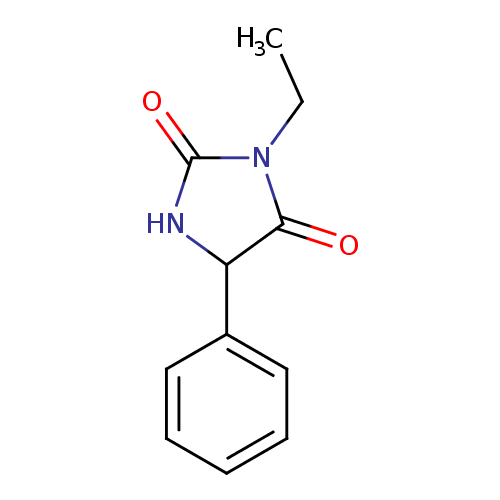
DescriptionEthotoin is a hydantoin derivative and anticonvulsant. Ethotoin exerts an antiepileptic effect without causing general central nervous system depression. The mechanism of action is probably very similar to that of phenytoin. The latter drug appears to stabilize rather than to raise the normal seizure threshold, and to prevent the spread of seizure activity rather than to abolish the primary focus of seizure discharges. Ethotoin is no longer commonly used.
Contaminant Sources
  • HMDB Contaminants - Urine
  • T3DB toxins
  • ToxCast & Tox21 Chemicals
Contaminant Type
  • Amide
  • Amine
  • Anticonvulsant
  • Drug
  • Metabolite
  • Organic Compound
  • Synthetic Compound
Chemical Structure
Thumb
Synonyms
ValueSource
(+-)-3-Ethyl-5-phenylhydantoinChEBI
1-Ethyl-2,5-dioxo-4-phenylimidazolidineChEBI
3-Ethyl-5-phenyl-2,4-imidazolidinedioneChEBI
3-Ethyl-5-phenyl-imidazolidine-2,4-dioneChEBI
3-Ethyl-5-phenylhydantoinChEBI
3-Ethyl-5-phenylimidazolidin-2,4-dioneChEBI
EthotoineChEBI
EthotoinumChEBI
EtotoinaChEBI
AccenonKegg
PeganoneKegg
Abbott brand OF ethotoinHMDB
Chemical FormulaC11H12N2O2
Average Molecular Mass204.225 g/mol
Monoisotopic Mass204.090 g/mol
CAS Registry Number86-35-1
IUPAC Name3-ethyl-5-phenylimidazolidine-2,4-dione
Traditional Nameethotoin
SMILESCCN1C(=O)NC(C1=O)C1=CC=CC=C1
InChI IdentifierInChI=1S/C11H12N2O2/c1-2-13-10(14)9(12-11(13)15)8-6-4-3-5-7-8/h3-7,9H,2H2,1H3,(H,12,15)
InChI KeySZQIFWWUIBRPBZ-UHFFFAOYSA-N
Chemical Taxonomy
Description belongs to the class of organic compounds known as phenylhydantoins. These are heterocyclic aromatic compounds containing an imiazolidinedione moiety substituted by a phenyl group.
KingdomOrganic compounds
Super ClassOrganoheterocyclic compounds
ClassAzolidines
Sub ClassImidazolidines
Direct ParentPhenylhydantoins
Alternative Parents
Substituents
  • 5-phenylhydantoin
  • Phenylimidazolidine
  • Alpha-amino acid or derivatives
  • N-acyl urea
  • Ureide
  • Monocyclic benzene moiety
  • Benzenoid
  • Dicarboximide
  • Urea
  • Carbonic acid derivative
  • Carboxylic acid derivative
  • Azacycle
  • Hydrocarbon derivative
  • Organic oxide
  • Organooxygen compound
  • Organonitrogen compound
  • Organopnictogen compound
  • Organic nitrogen compound
  • Carbonyl group
  • Organic oxygen compound
  • Aromatic heteromonocyclic compound
Molecular FrameworkAromatic heteromonocyclic compounds
External Descriptors
Biological Properties
StatusDetected and Not Quantified
OriginExogenous
Cellular Locations
  • Cytoplasm
  • Extracellular
  • Membrane
Biofluid LocationsNot Available
Tissue LocationsNot Available
PathwaysNot Available
Applications
Biological RolesNot Available
Chemical RolesNot Available
Physical Properties
StateSolid
AppearanceWhite powder.
Experimental Properties
PropertyValue
Melting Point94°C
Boiling PointNot Available
Solubility5280 mg/L
Predicted Properties
PropertyValueSource
Water Solubility2.38 g/LALOGPS
logP1.11ALOGPS
logP1.07ChemAxon
logS-1.9ALOGPS
pKa (Strongest Acidic)11.29ChemAxon
pKa (Strongest Basic)-8.4ChemAxon
Physiological Charge0ChemAxon
Hydrogen Acceptor Count2ChemAxon
Hydrogen Donor Count1ChemAxon
Polar Surface Area49.41 ŲChemAxon
Rotatable Bond Count2ChemAxon
Refractivity55.05 m³·mol⁻¹ChemAxon
Polarizability20.68 ųChemAxon
Number of Rings2ChemAxon
Bioavailability1ChemAxon
Rule of FiveYesChemAxon
Ghose FilterYesChemAxon
Veber's RuleNoChemAxon
MDDR-like RuleNoChemAxon
Spectra
Spectra
Spectrum TypeDescriptionSplash KeyView
GC-MSGC-MS Spectrum - EI-B (Non-derivatized)splash10-0udi-6980000000-86b5edde33787fa5b3d5Spectrum
GC-MSGC-MS Spectrum - EI-B (Non-derivatized)splash10-0zfr-4920000000-137fae4223f8b51dd5cdSpectrum
GC-MSGC-MS Spectrum - CI-B (Non-derivatized)splash10-0a4i-1190000000-3ade8f65bbabe08f852aSpectrum
GC-MSGC-MS Spectrum - CI-B (Non-derivatized)splash10-0udi-1190000000-56ad3615dcbc3fbecdbcSpectrum
GC-MSGC-MS Spectrum - EI-B (Non-derivatized)splash10-0udi-6980000000-86b5edde33787fa5b3d5Spectrum
GC-MSGC-MS Spectrum - EI-B (Non-derivatized)splash10-0zfr-4920000000-137fae4223f8b51dd5cdSpectrum
GC-MSGC-MS Spectrum - CI-B (Non-derivatized)splash10-0a4i-1190000000-3ade8f65bbabe08f852aSpectrum
GC-MSGC-MS Spectrum - CI-B (Non-derivatized)splash10-0udi-1190000000-56ad3615dcbc3fbecdbcSpectrum
Predicted GC-MSPredicted GC-MS Spectrum - GC-MS (Non-derivatized) - 70eV, Positivesplash10-053f-4900000000-890da1feecbdd89e1320Spectrum
Predicted GC-MSPredicted GC-MS Spectrum - GC-MS (Non-derivatized) - 70eV, PositiveNot AvailableSpectrum
LC-MS/MSLC-MS/MS Spectrum - LC-ESI-qTof , Positivesplash10-0a4i-1900000000-f71513d432cabc6ae596Spectrum
LC-MS/MSLC-MS/MS Spectrum - , positivesplash10-0a4i-1900000000-f71513d432cabc6ae596Spectrum
Predicted LC-MS/MSPredicted LC-MS/MS Spectrum - 10V, Positivesplash10-0a4i-0690000000-2b14fabe2a8a38bfd87aSpectrum
Predicted LC-MS/MSPredicted LC-MS/MS Spectrum - 20V, Positivesplash10-0zfr-2920000000-b4abc6e3540650b9fc2cSpectrum
Predicted LC-MS/MSPredicted LC-MS/MS Spectrum - 40V, Positivesplash10-0pb9-6900000000-ce4d6190e87bedc270a9Spectrum
Predicted LC-MS/MSPredicted LC-MS/MS Spectrum - 10V, Negativesplash10-0udi-0890000000-bc1ed1767185b47b35dbSpectrum
Predicted LC-MS/MSPredicted LC-MS/MS Spectrum - 20V, Negativesplash10-0ugi-6930000000-d8856c4e6ba455c06408Spectrum
Predicted LC-MS/MSPredicted LC-MS/MS Spectrum - 40V, Negativesplash10-0udi-8900000000-81cbbd6924131f65bccfSpectrum
Predicted LC-MS/MSPredicted LC-MS/MS Spectrum - 10V, Positivesplash10-0a4i-0390000000-d37f36d7d55fd839b005Spectrum
Predicted LC-MS/MSPredicted LC-MS/MS Spectrum - 20V, Positivesplash10-0apl-5930000000-d012a03e319c8a7a1e80Spectrum
Predicted LC-MS/MSPredicted LC-MS/MS Spectrum - 40V, Positivesplash10-0l06-9600000000-f553fba04ea2221422e6Spectrum
Predicted LC-MS/MSPredicted LC-MS/MS Spectrum - 10V, Negativesplash10-0udi-0290000000-0795d967a430c0f6e2aeSpectrum
Predicted LC-MS/MSPredicted LC-MS/MS Spectrum - 20V, Negativesplash10-0f96-8910000000-a36978bebfc33440a272Spectrum
Predicted LC-MS/MSPredicted LC-MS/MS Spectrum - 40V, Negativesplash10-0006-9400000000-f6e409587ccb41c14d58Spectrum
MSMass Spectrum (Electron Ionization)splash10-0udi-6920000000-01714c9dcd6c4cf02362Spectrum
1D NMR1H NMR SpectrumNot AvailableSpectrum
1D NMR13C NMR SpectrumNot AvailableSpectrum
1D NMR1H NMR SpectrumNot AvailableSpectrum
1D NMR13C NMR SpectrumNot AvailableSpectrum
1D NMR1H NMR SpectrumNot AvailableSpectrum
1D NMR13C NMR SpectrumNot AvailableSpectrum
1D NMR1H NMR SpectrumNot AvailableSpectrum
1D NMR13C NMR SpectrumNot AvailableSpectrum
1D NMR1H NMR SpectrumNot AvailableSpectrum
1D NMR13C NMR SpectrumNot AvailableSpectrum
1D NMR1H NMR SpectrumNot AvailableSpectrum
1D NMR13C NMR SpectrumNot AvailableSpectrum
1D NMR1H NMR SpectrumNot AvailableSpectrum
1D NMR13C NMR SpectrumNot AvailableSpectrum
1D NMR1H NMR SpectrumNot AvailableSpectrum
1D NMR13C NMR SpectrumNot AvailableSpectrum
1D NMR1H NMR SpectrumNot AvailableSpectrum
1D NMR13C NMR SpectrumNot AvailableSpectrum
1D NMR1H NMR SpectrumNot AvailableSpectrum
1D NMR13C NMR SpectrumNot AvailableSpectrum
Toxicity Profile
Route of ExposureFairly rapidly absorbed, however, the extent of oral absorption is not known.
Mechanism of ToxicityThe mechanism of action is probably very similar to that of phenytoin. The latter drug appears to stabilize rather than to raise the normal seizure threshold, and to prevent the spread of seizure activity rather than to abolish the primary focus of seizure discharges. Ethotoin inhibits nerve impulses in the motor cortex by lowering sodium ion influx, limiting tetanic stimulation.
MetabolismHepatic. The drug exhibits saturable metabolism with respect to the formation of N-deethyl and p-hydroxyl-ethotoin, the major metabolites. Half Life: 3 to 9 hours
Toxicity ValuesNot Available
Lethal DoseNot Available
Carcinogenicity (IARC Classification)No indication of carcinogenicity to humans (not listed by IARC).
Uses/SourcesFor the control of tonic-clonic (grand mal) and complex partial (psychomotor) seizures.
Minimum Risk LevelNot Available
Health EffectsMay cause a potentially dangerous rash that may develop into Stevens Johnson syndrome, an extremely rare but potentially fatal skin disease.
SymptomsSymptoms of overdose include drowsiness, loss of or impaired muscle coordination, nausea, visual disturbance, and, at very high doses, coma.
TreatmentTreatment should be begun by inducing emesis; gastric lavage may be considered as an alternative. General supportive measures will be necessary. A careful evaluation of blood-forming organs should be made following recovery. (2)
Concentrations
Not Available
DrugBank IDDB00754
HMDB IDHMDB0014892
FooDB IDNot Available
Phenol Explorer IDNot Available
KNApSAcK IDNot Available
BiGG IDNot Available
BioCyc IDNot Available
METLIN IDNot Available
PDB IDNot Available
Wikipedia LinkEthotoin
Chemspider ID3176
ChEBI ID4888
PubChem Compound ID3292
Kegg Compound IDC07839
YMDB IDNot Available
ECMDB IDNot Available
References
Synthesis Reference

Close, W.J.; U.S. Patent 2,793,157; May 21, 1957; assigned to Abbott Laboratories.

MSDSNot Available
General References
1. SCHWADE ED, RICHARDS RK, EVERETT GM: Peganone, a new antiepileptic drug. Dis Nerv Syst. 1956 May;17(5):155-8.
2. https://www.ncbi.nlm.nih.gov/pubmed/?term=1350205
3. https://www.ncbi.nlm.nih.gov/pubmed/?term=13553007
4. https://www.ncbi.nlm.nih.gov/pubmed/?term=6105055
5. https://www.ncbi.nlm.nih.gov/pubmed/?term=6145119