Record Information
Version1.0
Creation Date2009-07-21 20:26:37 UTC
Update Date2026-05-14 16:35:38 UTC
Accession NumberCHEM002172
Identification
Common NameIndomethacin
ClassSmall Molecule
DescriptionIndomethacin is a non-steroidal antiinflammatory agent (NSAIA) with antiinflammatory, analgesic and antipyretic activity. Its pharmacological effect is thought to be mediated through inhibition of the enzyme cyclooxygenase (COX), the enzyme responsible for catalyzes the rate-limiting step in prostaglandin synthesis via the arachidonic acid pathway.
Contaminant Sources
  • HMDB Contaminants - Urine
  • STOFF IDENT Compounds
  • Suspected Compounds - Waste Water
  • Suspected Compounds – Schymanski Project
  • T3DB toxins
  • ToxCast & Tox21 Chemicals
Contaminant Type
  • Amide
  • Amine
  • Anti-Inflammatory Agent
  • Anti-Inflammatory Agent, Non-Steroidal
  • Cardiovascular Agent
  • Cyclooxygenase Inhibitor
  • Drug
  • Ester
  • Ether
  • Gout Suppressant
  • Metabolite
  • Organic Compound
  • Organochloride
  • Synthetic Compound
  • Tocolytic Agent
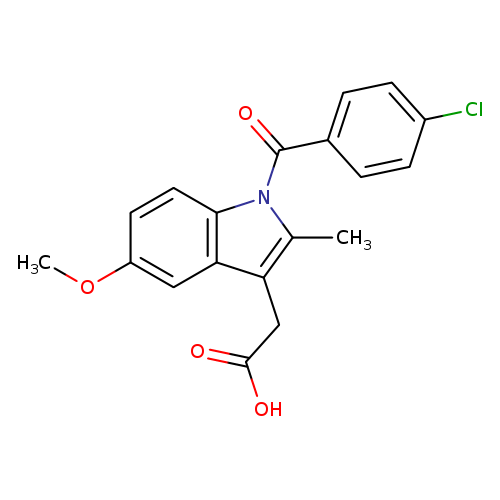
Chemical Structure
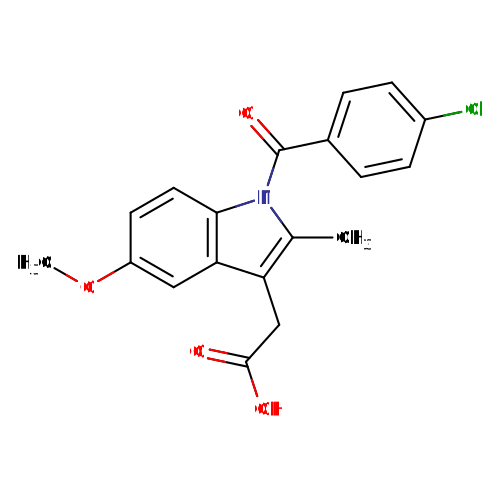
Thumb
Synonyms
ValueSource
1-(p-Chlorobenzoyl)-5-methoxy-2-methylindole-3-acetic acidChEBI
AconipChEBI
IndocinChEBI
IndometacinaChEBI
IndometacineChEBI
IndometacinumChEBI
{1-[(4-chlorophenyl)carbonyl]-5-methoxy-2-methyl-1H-indol-3-yl}acetic acidChEBI
IndometacinKegg
1-(p-Chlorobenzoyl)-5-methoxy-2-methylindole-3-acetateGenerator
{1-[(4-chlorophenyl)carbonyl]-5-methoxy-2-methyl-1H-indol-3-yl}acetateGenerator
IMNHMDB
IndometacynaHMDB
IndomethacineHMDB
IndomethacinumHMDB
IndomethancinHMDB
IndomethazineHMDB
IndomethineHMDB
IndometicinaHMDB
Hydrochloride, indomethacinHMDB
MetindolHMDB
OsmosinHMDB
AmunoHMDB
Indomet 140HMDB
Indomethacin hydrochlorideHMDB
IndocidHMDB
Chemical FormulaC19H16ClNO4
Average Molecular Mass357.788 g/mol
Monoisotopic Mass357.077 g/mol
CAS Registry Number53-86-1
IUPAC Name2-[1-(4-chlorobenzoyl)-5-methoxy-2-methyl-1H-indol-3-yl]acetic acid
Traditional Nameindomethacin
SMILESCOC1=CC2=C(C=C1)N(C(=O)C1=CC=C(Cl)C=C1)C(C)=C2CC(O)=O
InChI IdentifierInChI=1S/C19H16ClNO4/c1-11-15(10-18(22)23)16-9-14(25-2)7-8-17(16)21(11)19(24)12-3-5-13(20)6-4-12/h3-9H,10H2,1-2H3,(H,22,23)
InChI KeyCGIGDMFJXJATDK-UHFFFAOYSA-N
Chemical Taxonomy
Description belongs to the class of organic compounds known as benzoylindoles. These are organic compounds containing an indole attached to a benzoyl moiety through the acyl group.
KingdomOrganic compounds
Super ClassOrganoheterocyclic compounds
ClassIndoles and derivatives
Sub ClassBenzoylindoles
Direct ParentBenzoylindoles
Alternative Parents
Substituents
  • Benzoylindole
  • Indole-3-acetic acid derivative
  • Indolecarboxylic acid derivative
  • Indolyl carboxylic acid derivative
  • 4-halobenzoic acid or derivatives
  • Halobenzoic acid or derivatives
  • 3-alkylindole
  • Indole
  • Benzoic acid or derivatives
  • Anisole
  • Benzoyl
  • Chlorobenzene
  • Alkyl aryl ether
  • Halobenzene
  • Benzenoid
  • Substituted pyrrole
  • Aryl chloride
  • Aryl halide
  • Monocyclic benzene moiety
  • Heteroaromatic compound
  • Pyrrole
  • Carboxylic acid derivative
  • Carboxylic acid
  • Ether
  • Azacycle
  • Monocarboxylic acid or derivatives
  • Hydrocarbon derivative
  • Organic oxygen compound
  • Carbonyl group
  • Organic nitrogen compound
  • Organopnictogen compound
  • Organic oxide
  • Organohalogen compound
  • Organochloride
  • Organonitrogen compound
  • Organooxygen compound
  • Aromatic heteropolycyclic compound
Molecular FrameworkAromatic heteropolycyclic compounds
External Descriptors
Biological Properties
StatusDetected and Not Quantified
OriginExogenous
Cellular Locations
  • Cytoplasm
  • Extracellular
  • Membrane
Biofluid LocationsNot Available
Tissue LocationsNot Available
PathwaysNot Available
Applications
Biological Roles
Chemical Roles
Physical Properties
StateSolid
AppearanceWhite powder.
Experimental Properties
PropertyValue
Melting Point151°C
Boiling PointNot Available
Solubility0.937 mg/L (at 25°C)
Predicted Properties
PropertyValueSource
Water Solubility0.0024 g/LALOGPS
logP4.25ALOGPS
logP3.53ChemAxon
logS-5.2ALOGPS
pKa (Strongest Acidic)3.8ChemAxon
pKa (Strongest Basic)-2.3ChemAxon
Physiological Charge-1ChemAxon
Hydrogen Acceptor Count4ChemAxon
Hydrogen Donor Count1ChemAxon
Polar Surface Area68.53 ŲChemAxon
Rotatable Bond Count4ChemAxon
Refractivity94.81 m³·mol⁻¹ChemAxon
Polarizability36.64 ųChemAxon
Number of Rings3ChemAxon
Bioavailability1ChemAxon
Rule of FiveYesChemAxon
Ghose FilterYesChemAxon
Veber's RuleNoChemAxon
MDDR-like RuleNoChemAxon
Spectra
Spectra
Spectrum TypeDescriptionSplash KeyView
GC-MSGC-MS Spectrum - EI-B (Non-derivatized)splash10-002f-9100000000-2545b33ef519ca9557d7Spectrum
Predicted GC-MSPredicted GC-MS Spectrum - GC-MS (Non-derivatized) - 70eV, Positivesplash10-000i-0921000000-71472b2fb43c8acb2e55Spectrum
Predicted GC-MSPredicted GC-MS Spectrum - GC-MS (1 TMS) - 70eV, Positivesplash10-000i-4911000000-35eb3bff6897ef637c32Spectrum
Predicted GC-MSPredicted GC-MS Spectrum - GC-MS (Non-derivatized) - 70eV, PositiveNot AvailableSpectrum
LC-MS/MSLC-MS/MS Spectrum - LC-ESI-qTof , Positivesplash10-000i-2902000000-8effecdaf737eb86e781Spectrum
LC-MS/MSLC-MS/MS Spectrum - LC-ESI-qTof , Positivesplash10-000i-0901000000-aa0cdbd9e10c432d837cSpectrum
LC-MS/MSLC-MS/MS Spectrum - LC-ESI-qTof , Positivesplash10-014u-2900000000-3bf048feb0cc9b0867e8Spectrum
LC-MS/MSLC-MS/MS Spectrum - LC-ESI-ITFT , negativesplash10-03di-0009000000-5a4abda1542473813a5dSpectrum
LC-MS/MSLC-MS/MS Spectrum - LC-ESI-ITFT , negativesplash10-03di-0019000000-b80206e17a22fdf15299Spectrum
LC-MS/MSLC-MS/MS Spectrum - LC-ESI-ITFT , negativesplash10-0002-0093000000-4e04725a4a7ea8db1880Spectrum
LC-MS/MSLC-MS/MS Spectrum - LC-ESI-ITFT , negativesplash10-0bt9-0906000000-44825d096b6f8c6091abSpectrum
LC-MS/MSLC-MS/MS Spectrum - LC-ESI-ITFT , negativesplash10-053r-0890000000-e9f8e33084842b2a91e0Spectrum
LC-MS/MSLC-MS/MS Spectrum - LC-ESI-ITFT , negativesplash10-0a4i-0900000000-5aee2869a858e70aa8cbSpectrum
LC-MS/MSLC-MS/MS Spectrum - LC-ESI-ITFT , negativesplash10-03di-0019000000-b9916635c4db449698abSpectrum
LC-MS/MSLC-MS/MS Spectrum - LC-ESI-ITFT , negativesplash10-0002-0092000000-270cd44f32c881ded6aaSpectrum
LC-MS/MSLC-MS/MS Spectrum - LC-ESI-ITFT , negativesplash10-0a4j-0973000000-6e9ac766080e35c8b297Spectrum
LC-MS/MSLC-MS/MS Spectrum - LC-ESI-ITFT , negativesplash10-053r-0790000000-b0e6139fc1746c17ddb7Spectrum
LC-MS/MSLC-MS/MS Spectrum - LC-ESI-ITFT , negativesplash10-0a4i-0900000000-1df95eb7ff5058a870ccSpectrum
LC-MS/MSLC-MS/MS Spectrum - LC-ESI-ITFT , negativesplash10-03di-0009000000-6a65e96ca253d6a3dda0Spectrum
LC-MS/MSLC-MS/MS Spectrum - LC-ESI-QFT , negativesplash10-08gi-0195000000-7ea82149ddaa783e01dfSpectrum
LC-MS/MSLC-MS/MS Spectrum - LC-ESI-ITFT , positivesplash10-00di-0900000000-1208c0d5e605b8b69605Spectrum
LC-MS/MSLC-MS/MS Spectrum - LC-ESI-ITFT , positivesplash10-0a4r-0709000000-1814b324e15b59fa31a5Spectrum
Predicted LC-MS/MSPredicted LC-MS/MS Spectrum - 10V, Positivesplash10-0a4l-0009000000-2429b2c6a858186ce401Spectrum
Predicted LC-MS/MSPredicted LC-MS/MS Spectrum - 20V, Positivesplash10-03di-0009000000-93f3bd184f0f8af5030aSpectrum
Predicted LC-MS/MSPredicted LC-MS/MS Spectrum - 40V, Positivesplash10-03e9-2696000000-adec10da91c34dd6a1f0Spectrum
Predicted LC-MS/MSPredicted LC-MS/MS Spectrum - 10V, Negativesplash10-0a4i-0009000000-c5d3ca4cfffc61e97844Spectrum
Predicted LC-MS/MSPredicted LC-MS/MS Spectrum - 20V, Negativesplash10-0bt9-0039000000-108283a6771c753d8ab8Spectrum
Predicted LC-MS/MSPredicted LC-MS/MS Spectrum - 40V, Negativesplash10-03dm-0394000000-eb1ba613d190aeacba7fSpectrum
MSMass Spectrum (Electron Ionization)splash10-000i-1901000000-710010c41f0ded9b0f17Spectrum
1D NMR1H NMR SpectrumNot AvailableSpectrum
1D NMR13C NMR SpectrumNot AvailableSpectrum
Toxicity Profile
Route of ExposureParenteral(intravenous); enteral(rectal); oral. Bioavailability is approximately 100% following oral administration and 80-90% following rectal administration.
Mechanism of ToxicityAntiinflammatory effects of Indomethacin are believed to be due to inhibition of cylooxygenase in platelets which leads to the blockage of prostaglandin synthesis. Antipyretic effects may be due to action on the hypothalamus, resulting in an increased peripheral blood flow, vasodilation, and subsequent heat dissipation. Indomethacin is a prostaglandin G/H synthase (also known as cyclooxygenase or COX) inhibitor that acts on both prostaglandin G/H synthase 1 and 2 (COX-1 and -2). Prostaglandin G/H synthase catalyzes the conversion of arachidonic acid to a number of prostaglandins involved in fever, pain, swelling, inflammation, and platelet aggregation. Indomethacin antagonizes COX by binding to the upper portion of the active site, preventing its substrate, arachidonic acid, from entering the active site. Indomethacin, unlike other NSAIDs, also inhibits phospholipase A2, the enzyme responsible for releasing arachidonic acid from phospholipids. Indomethacin is more selective for COX-1 than COX-2, which accounts for its increased adverse gastric effects relative to other NSAIDs. COX-1 is required for maintaining the protective gastric mucosal layer. The analgesic, antipyretic and anti-inflammatory effects of indomethacin occur as a result of decreased prostaglandin synthesis. Its antipyretic effects may be due to action on the hypothalamus, resulting in an increased peripheral blood flow, vasodilation, and subsequent heat dissipation.
MetabolismHepatic. Route of Elimination: Indomethacin is eliminated via renal excretion, metabolism, and biliary excretion. Half Life: 4.5 hours
Toxicity ValuesLD50: 50 mg/kg (oral, mice) (based on 14 day mortality response) LD50: 12 mg/kg (oral, rat) (based on 14 day mortality response)
Lethal DoseNot Available
Carcinogenicity (IARC Classification)No indication of carcinogenicity to humans (not listed by IARC).
Uses/SourcesFor moderate to severe rheumatoid arthritis including acute flares of chronic disease, ankylosing spondylitis, osteoarthritis, acute painful shoulder (bursitis and/or tendinitis) and acute gouty arthritis.
Minimum Risk LevelNot Available
Health EffectsNot Available
SymptomsThe following symptoms may be observed following overdosage: nausea, vomiting, intense headache, dizziness, mental confusion, disorientation, or lethargy. There have been reports of paresthesias, numbness, and convulsions.
TreatmentTreatment is symptomatic and supportive. The stomach should be emptied as quickly as possible if the ingestion is recent. If vomiting has not occurred spontaneously, the patient should be induced to vomit with syrup of ipecac. If the patient is unable to vomit, gastric lavage should be performed. Once the stomach has been emptied, 25 or 50 g of activated charcoal may be given. Depending on the condition of the patient, close medical observation and nursing care may be required. The patient should be followed for several days because gastrointestinal ulceration and hemorrhage have been reported as adverse reactions of indomethacin. Use of antacids may be helpful. (8)
Concentrations
StatusValueUnitSample LocationReference
DrugBank IDDB00328
HMDB IDHMDB0014473
FooDB IDNot Available
Phenol Explorer IDNot Available
KNApSAcK IDC00030512
BiGG IDNot Available
BioCyc IDCPD-10545
METLIN IDNot Available
PDB IDIMN
Wikipedia LinkIndometacin
Chemspider ID3584
ChEBI ID49662
PubChem Compound ID3715
Kegg Compound IDC01926
YMDB IDNot Available
ECMDB IDNot Available
References
Synthesis Reference

Hubertus L. Regtop, John R. Biffin, “Preparation of divalent metal salts of indomethacin.” U.S. Patent US5310936, issued November, 1917.

MSDSLink
General References
1. https://www.ncbi.nlm.nih.gov/pubmed/?term=22931205
2. https://www.ncbi.nlm.nih.gov/pubmed/?term=23992308
3. https://www.ncbi.nlm.nih.gov/pubmed/?term=28166217
4. https://www.ncbi.nlm.nih.gov/pubmed/?term=5952296
5. https://www.ncbi.nlm.nih.gov/pubmed/?term=6039425
6. Lum GM, Aisenbrey GA, Dunn MJ, Berl T, Schrier RW, McDonald KM: In vivo effect of indomethacin to potentiate the renal medullary cyclic AMP response to vasopressin. J Clin Invest. 1977 Jan;59(1):8-13.
7. Ragheb M: The clinical significance of lithium-nonsteroidal anti-inflammatory drug interactions. J Clin Psychopharmacol. 1990 Oct;10(5):350-4.
8. Akbarpour F, Afrasiabi A, Vaziri ND: Severe hyperkalemia caused by indomethacin and potassium supplementation. South Med J. 1985 Jun;78(6):756-7.
9. HART FD, BOARDMAN PL: INDOMETHACIN: A NEW NON-STEROID ANTI-INFLAMMATORY AGENT. Br Med J. 1963 Oct 19;2(5363):965-70.
10. Phelan KM, Mosholder AD, Lu S: Lithium interaction with the cyclooxygenase 2 inhibitors rofecoxib and celecoxib and other nonsteroidal anti-inflammatory drugs. J Clin Psychiatry. 2003 Nov;64(11):1328-34.