Record Information
Version1.0
Creation Date2009-07-21 20:26:09 UTC
Update Date2026-04-06 04:27:18 UTC
Accession NumberCHEM002128
Identification
Common NameThiamine
ClassSmall Molecule
DescriptionThiamine or thiamin, also known as vitamin B1, is a colorless compound with the chemical formula C12H17N4OS. It is soluble in water and insoluble in alcohol. Thiamine decomposes if heated. Thiamine was first discovered by Umetaro Suzuki in Japan when researching how rice bran cured patients of Beriberi. Thiamine plays a key role in intracellular glucose metabolism and it is thought that thiamine inhibits the effect of glucose and insulin on arterial smooth muscle cell proliferation. Thiamine plays an important role in helping the body convert carbohydrates and fat into energy. It is essential for normal growth and development and helps to maintain proper functioning of the heart and the nervous and digestive systems. Thiamine cannot be stored in the body; however, once absorbed, the vitamin is concentrated in muscle tissue.
Contaminant Sources
  • Cosmetic Chemicals
  • EAFUS Chemicals
  • FooDB Chemicals
  • HMDB Contaminants - Urine
  • STOFF IDENT Compounds
  • T3DB toxins
Contaminant Type
  • Amine
  • Anti-Inflammatory Agent
  • Drug
  • Essential Vitamin
  • Food Toxin
  • Metabolite
  • Natural Compound
  • Nutraceutical
  • Organic Compound
  • Vitamin
  • Vitamin B Complex
Chemical Structure
Thumb
Synonyms
ValueSource
3-(4-AMINO-2-methyl-pyrimidin-5-ylmethyl)-5-(2-hydroxy-ethyl)-4-methyl-thiazol-3-iumChEBI
AneurinChEBI
Antiberiberi factorChEBI
ThiaminChEBI
Thiamine(1+) ionChEBI
ThiaminiumChEBI
Vitamin b1ChEBI
Apate dropsHMDB
BeatineHMDB
BedomeHMDB
BegiolanHMDB
BenervaHMDB
BequinHMDB
BerinHMDB
Betalin SHMDB
BetaxinHMDB
BethiazineHMDB
BeuionHMDB
BevitexHMDB
BevitineHMDB
BewonHMDB
BiamineHMDB
BithiaminHMDB
BiunoHMDB
BivatinHMDB
BivitaHMDB
Cernevit-12HMDB
ClotiaminaHMDB
EskapenHMDB
EskaphenHMDB
HybeeHMDB
Lixa-betaHMDB
MetabolinHMDB
SlowtenHMDB
THDHMDB
ThiadoxineHMDB
ThiaminalHMDB
ThiamolHMDB
ThiavitHMDB
TiamidonHMDB
TiaminalHMDB
TrophiteHMDB
Vetalin SHMDB
VIBHMDB
VinothiamHMDB
VitaneuronHMDB
Mononitrate, thiamineMeSH, HMDB
Thiamine mononitrateMeSH, HMDB
Vitamin b 1MeSH, HMDB
Chemical FormulaC12H17N4OS
Average Molecular Mass265.355 g/mol
Monoisotopic Mass265.112 g/mol
CAS Registry Number59-43-8
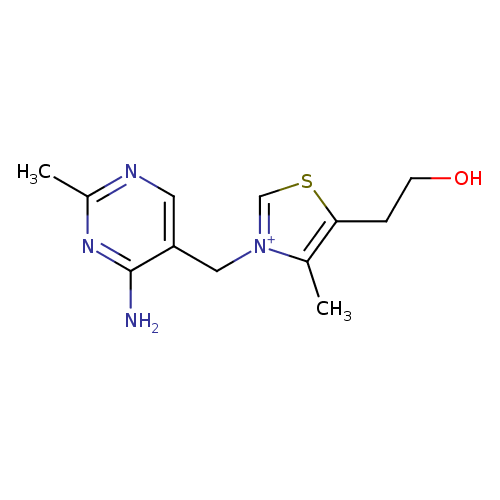
IUPAC Name3-[(4-amino-2-methylpyrimidin-5-yl)methyl]-5-(2-hydroxyethyl)-4-methyl-1,3-thiazol-3-ium
Traditional Namethiamine
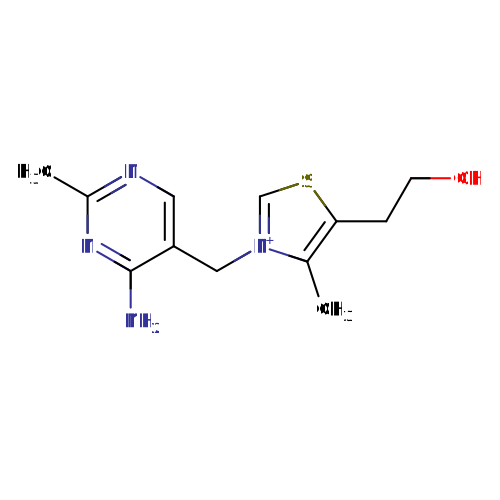
SMILESCC1=C(CCO)SC=[N+]1CC1=CN=C(C)N=C1N
InChI IdentifierInChI=1S/C12H17N4OS/c1-8-11(3-4-17)18-7-16(8)6-10-5-14-9(2)15-12(10)13/h5,7,17H,3-4,6H2,1-2H3,(H2,13,14,15)/q+1
InChI KeyJZRWCGZRTZMZEH-UHFFFAOYSA-N
Chemical Taxonomy
Description belongs to the class of organic compounds known as thiamines. Thiamines are compounds containing a thiamine moiety, which is structurally characterized by a 3-[(4-Amino-2-methyl-pyrimidin-5-yl)methyl]-4-methyl-thiazol-5-yl backbone.
KingdomOrganic compounds
Super ClassOrganoheterocyclic compounds
ClassDiazines
Sub ClassPyrimidines and pyrimidine derivatives
Direct ParentThiamines
Alternative Parents
Substituents
  • Thiamine
  • 4,5-disubstituted 1,3-thiazole
  • Aminopyrimidine
  • Imidolactam
  • Azole
  • Thiazole
  • Heteroaromatic compound
  • Azacycle
  • Alcohol
  • Organopnictogen compound
  • Primary amine
  • Primary alcohol
  • Organooxygen compound
  • Organonitrogen compound
  • Organic nitrogen compound
  • Organic oxygen compound
  • Hydrocarbon derivative
  • Amine
  • Organic cation
  • Aromatic heteromonocyclic compound
Molecular FrameworkAromatic heteromonocyclic compounds
External Descriptors
Biological Properties
StatusDetected and Not Quantified
OriginEndogenous
Cellular Locations
  • Extracellular
  • Membrane
  • Mitochondria
Biofluid LocationsNot Available
Tissue Locations
  • Adipose Tissue
  • Adrenal Gland
  • Brain
  • Erythrocyte
  • Fibroblasts
  • Intestine
  • Kidney
  • Liver
  • Muscle
  • Myelin
  • Placenta
  • Skeletal Muscle
  • Testes
Pathways
NameSMPDB LinkKEGG Link
Thiamine MetabolismSMP00076 map00730
ApplicationsNot Available
Biological Roles
Chemical RolesNot Available
Physical Properties
StateSolid
AppearanceWhite powder.
Experimental Properties
PropertyValue
Melting Point248 dec°C
Boiling PointNot Available
Solubility5E+005 mg/L
Predicted Properties
PropertyValueSource
Water Solubility0.015 g/LALOGPS
logP-2.1ALOGPS
logP-3.1ChemAxon
logS-4.3ALOGPS
pKa (Strongest Acidic)15.5ChemAxon
pKa (Strongest Basic)5.54ChemAxon
Physiological Charge1ChemAxon
Hydrogen Acceptor Count4ChemAxon
Hydrogen Donor Count2ChemAxon
Polar Surface Area75.91 ŲChemAxon
Rotatable Bond Count4ChemAxon
Refractivity73.4 m³·mol⁻¹ChemAxon
Polarizability28.14 ųChemAxon
Number of Rings2ChemAxon
Bioavailability1ChemAxon
Rule of FiveYesChemAxon
Ghose FilterNoChemAxon
Veber's RuleNoChemAxon
MDDR-like RuleNoChemAxon
Spectra
Spectra
Spectrum TypeDescriptionSplash KeyView
Predicted GC-MSPredicted GC-MS Spectrum - GC-MS (Non-derivatized) - 70eV, Positivesplash10-00e9-3890000000-9f8b525433ab279ad512Spectrum
Predicted GC-MSPredicted GC-MS Spectrum - GC-MS (1 TMS) - 70eV, Positivesplash10-00di-9442000000-05ab93d3afb7b6f538e9Spectrum
Predicted GC-MSPredicted GC-MS Spectrum - GC-MS (Non-derivatized) - 70eV, PositiveNot AvailableSpectrum
Predicted GC-MSPredicted GC-MS Spectrum - GC-MS (TMS_1_2) - 70eV, PositiveNot AvailableSpectrum
Predicted GC-MSPredicted GC-MS Spectrum - GC-MS (TBDMS_1_1) - 70eV, PositiveNot AvailableSpectrum
Predicted GC-MSPredicted GC-MS Spectrum - GC-MS (TBDMS_1_2) - 70eV, PositiveNot AvailableSpectrum
LC-MS/MSLC-MS/MS Spectrum - Quattro_QQQ 10V, N/A (Annotated)splash10-000i-0109000000-48864f31ba475645654bSpectrum
LC-MS/MSLC-MS/MS Spectrum - Quattro_QQQ 25V, N/A (Annotated)splash10-05o1-9200000000-2ec0f3e9e364cffde16eSpectrum
LC-MS/MSLC-MS/MS Spectrum - Quattro_QQQ 40V, N/A (Annotated)splash10-0aou-9000000000-0184506492d9f5b68b97Spectrum
LC-MS/MSLC-MS/MS Spectrum - LC-ESI-QQ (API3000, Applied Biosystems) 10V, Negativesplash10-03di-0090000000-872150be83cbd75d8ecfSpectrum
LC-MS/MSLC-MS/MS Spectrum - LC-ESI-QQ (API3000, Applied Biosystems) 20V, Negativesplash10-0002-0930000000-ecf71c75bdea859139d5Spectrum
LC-MS/MSLC-MS/MS Spectrum - LC-ESI-QQ (API3000, Applied Biosystems) 30V, Negativesplash10-0002-0900000000-4d9113fdc633fb1ccbb5Spectrum
LC-MS/MSLC-MS/MS Spectrum - LC-ESI-QQ (API3000, Applied Biosystems) 40V, Negativesplash10-0002-0900000000-4a8016299623af0c3027Spectrum
LC-MS/MSLC-MS/MS Spectrum - LC-ESI-QQ (API3000, Applied Biosystems) 50V, Negativesplash10-0002-1900000000-773912c9f325c419c77dSpectrum
LC-MS/MSLC-MS/MS Spectrum - LC-ESI-QQ (API3000, Applied Biosystems) 10V, Positivesplash10-014i-0390000000-95f3ca57c95542bdc7e7Spectrum
LC-MS/MSLC-MS/MS Spectrum - LC-ESI-QQ (API3000, Applied Biosystems) 20V, Positivesplash10-00di-0900000000-e079d1fc1e06396dc524Spectrum
LC-MS/MSLC-MS/MS Spectrum - LC-ESI-QQ (API3000, Applied Biosystems) 30V, Positivesplash10-00di-0900000000-ebb16d4f204f291b9a3aSpectrum
LC-MS/MSLC-MS/MS Spectrum - LC-ESI-QQ (API3000, Applied Biosystems) 40V, Positivesplash10-00e9-4900000000-ad4d4779d76b9edb7ec5Spectrum
LC-MS/MSLC-MS/MS Spectrum - LC-ESI-QQ (API3000, Applied Biosystems) 50V, Positivesplash10-001i-9600000000-b631eed5be831527fc17Spectrum
LC-MS/MSLC-MS/MS Spectrum - LC-ESI-IT (LC/MSD Trap XCT, Agilent Technologies) , Positivesplash10-00di-0900000000-50f2f613f576814eb627Spectrum
LC-MS/MSLC-MS/MS Spectrum - LC-ESI-IT (LC/MSD Trap XCT, Agilent Technologies) , Positivesplash10-002b-0900000000-2f184bbfec6bc0ef00c6Spectrum
LC-MS/MSLC-MS/MS Spectrum - LC-ESI-IT (LC/MSD Trap XCT, Agilent Technologies) , Positivesplash10-001i-9000000000-35bc744495a2570a565fSpectrum
LC-MS/MSLC-MS/MS Spectrum - LC-ESI-QTOF (UPLC Q-Tof Premier, Waters) , Positivesplash10-00di-1900000000-d8a7ac327273c32b4524Spectrum
LC-MS/MSLC-MS/MS Spectrum - LC-ESI-QTOF (UPLC Q-Tof Premier, Waters) , Negativesplash10-0002-0920000000-ca80ef6513c61be5b5e9Spectrum
LC-MS/MSLC-MS/MS Spectrum - LC-ESI-QQ , negativesplash10-03di-0090000000-872150be83cbd75d8ecfSpectrum
Predicted LC-MS/MSPredicted LC-MS/MS Spectrum - 10V, Positivesplash10-014i-0190000000-183af2449d1439af9825Spectrum
Predicted LC-MS/MSPredicted LC-MS/MS Spectrum - 20V, Positivesplash10-0a4i-0090000000-2230ebc7c6b73192c26fSpectrum
Predicted LC-MS/MSPredicted LC-MS/MS Spectrum - 40V, Positivesplash10-0002-7920000000-75670df9647a475ca92cSpectrum
Predicted LC-MS/MSPredicted LC-MS/MS Spectrum - 10V, Negativesplash10-03di-3090000000-d0ff9a733629a86b75c7Spectrum
Predicted LC-MS/MSPredicted LC-MS/MS Spectrum - 20V, Negativesplash10-03dj-3690000000-db3f204af490d7e1722eSpectrum
Predicted LC-MS/MSPredicted LC-MS/MS Spectrum - 40V, Negativesplash10-0005-9000000000-5196f2b4daab995967bfSpectrum
1D NMR13C NMR SpectrumNot AvailableSpectrum
1D NMR1H NMR SpectrumNot AvailableSpectrum
1D NMR13C NMR SpectrumNot AvailableSpectrum
1D NMR1H NMR SpectrumNot AvailableSpectrum
1D NMR13C NMR SpectrumNot AvailableSpectrum
1D NMR1H NMR SpectrumNot AvailableSpectrum
1D NMR13C NMR SpectrumNot AvailableSpectrum
1D NMR1H NMR SpectrumNot AvailableSpectrum
1D NMR13C NMR SpectrumNot AvailableSpectrum
1D NMR1H NMR SpectrumNot AvailableSpectrum
1D NMR13C NMR SpectrumNot AvailableSpectrum
1D NMR1H NMR SpectrumNot AvailableSpectrum
1D NMR13C NMR SpectrumNot AvailableSpectrum
1D NMR1H NMR SpectrumNot AvailableSpectrum
1D NMR13C NMR SpectrumNot AvailableSpectrum
1D NMR1H NMR SpectrumNot AvailableSpectrum
1D NMR13C NMR SpectrumNot AvailableSpectrum
1D NMR1H NMR SpectrumNot AvailableSpectrum
1D NMR13C NMR SpectrumNot AvailableSpectrum
1D NMR1H NMR SpectrumNot AvailableSpectrum
1D NMR13C NMR SpectrumNot AvailableSpectrum
1D NMR1H NMR SpectrumNot AvailableSpectrum
1D NMR13C NMR SpectrumNot AvailableSpectrum
2D NMR[1H,1H] 2D NMR SpectrumNot AvailableSpectrum
2D NMR[1H,13C] 2D NMR SpectrumNot AvailableSpectrum
Toxicity Profile
Route of ExposureOral; parenteral (intravenous, intramuscular). Absorbed mainly from duodenum, by both active and passive processes
Mechanism of ToxicityIt is thought that the mechanism of action of thiamine on endothelial cells is related to a reduction in intracellular protein glycation by redirecting the glycolytic flux. Thiamine is mainly the transport form of the vitamin, while the active forms are phosphorylated thiamine derivatives. There are five known natural thiamine phosphate derivatives: thiamine monophosphate (ThMP), thiamine diphosphate (ThDP), also sometimes called thiamine pyrophosphate (TPP), thiamine triphosphate (ThTP), and the recently discovered adenosine thiamine triphosphate (AThTP), and adenosine thiamine diphosphate. Each derivative has unique functions, however, most are involved as coenzymes.
MetabolismHepatic
Toxicity ValuesLD50: 8224 mg/kg (Oral, Mouse) (1) LD50: 3710 mg/kg (Oral, Rat) (1)
Lethal DoseNot Available
Carcinogenicity (IARC Classification)No indication of carcinogenicity to humans (not listed by IARC).
Uses/SourcesFor the treatment of thiamine and niacin deficiency states, Korsakov's alcoholic psychosis, Wernicke-Korsakov syndrome, delirium, and peripheral neuritis. Thiamine (hydrochloride) is a food additive used to add a brothy/meaty flavor to gravies or soups.
Minimum Risk LevelNot Available
Health EffectsThere are no reports available of adverse effects from consumption of excess thiamine by ingestion of food and supplements. [Wikipedia]
SymptomsNot Available
TreatmentNot Available
Concentrations
Not Available
DrugBank IDDB00152
HMDB IDHMDB0000235
FooDB IDFDB008424
Phenol Explorer IDNot Available
KNApSAcK IDC00000775
BiGG IDNot Available
BioCyc IDTHIAMINE
METLIN IDNot Available
PDB IDNot Available
Wikipedia LinkThiamine
Chemspider ID1098
ChEBI ID18385
PubChem Compound ID1130
Kegg Compound IDC00378
YMDB IDYMDB00220
ECMDB IDECMDB00235
References
Synthesis Reference

Nobuyuki Kitamori, Masaya Maeno, Seiji Izuhara, “Granules of thiamine salt and the production thereof.” U.S. Patent US4702919, issued July, 1974.

MSDSLink
General References
1. Sugimoto, Hirohiko; Ishiba, Teruyuki; Sato, Tomohiro; Nakai, Hiroshi; Hirai, Kentaro. Novel S-alkylation products from "isolated thiamin ylide" via thiaminium neothiaminthiolate ion pair. Journal of Organic Chemistry (1990), 55(2), 467-70.
2. Agostini TS, Scherer R, Godoy HT: Simultaneous determination of B-group vitamins in enriched Brazilian dairy products. Crit Rev Food Sci Nutr. 2007;47(5):435-9. doi: 10.1080/10408390600846309.
3. Gaucheron F: Milk and dairy products: a unique micronutrient combination. J Am Coll Nutr. 2011 Oct;30(5 Suppl 1):400S-9S.
4. Park, Y. W; Juárez, Manuela ; Ramos, M.; Haenlein, G. F. W.. Physico-chemical characteristics of goat and sheep milk. Small Ruminant Res.(2007) 68:88-113 doi: 10.1016/j.smallrumres.2006.09.013
5. A. Foroutan et al. The Chemical Composition of Commercial Cow's Milk (in preparation)
6. USDA Food Composition Databases: https://ndb.nal.usda.gov/ndb/
7. Sugimoto, Hirohiko; Ishiba, Teruyuki; Sato, Tomohiro; Nakai, Hiroshi; Hirai, Kentaro. Novel S-alkylation products from "isolated thiamin ylide" via thiaminium neothiaminthiolate ion pair. Journal of Organic Chemistry (1990), 55(2), 467-70.
8. Bellazzi R, Guglielmann R, Ironi L, Patrini C: A hybrid input-output approach to model metabolic systems: an application to intracellular thiamine kinetics. J Biomed Inform. 2001 Aug;34(4):221-48.
9. Pietrzak I, Baczyk K: Comparison of the thiamine level in blood and erythrocyte transketolase activity in hemodialyzed and nondialyzed patients during recombinant human erythropoietin therapy. Miner Electrolyte Metab. 1997;23(3-6):277-82.
10. Singleton CK, Martin PR: Molecular mechanisms of thiamine utilization. Curr Mol Med. 2001 May;1(2):197-207.
11. Sato Y, Nakagawa M, Higuchi I, Osame M, Naito E, Oizumi K: Mitochondrial myopathy and familial thiamine deficiency. Muscle Nerve. 2000 Jul;23(7):1069-75.
12. Mastrogiacoma F, Bettendorff L, Grisar T, Kish SJ: Brain thiamine, its phosphate esters, and its metabolizing enzymes in Alzheimer's disease. Ann Neurol. 1996 May;39(5):585-91.
13. Molina JA, Jimenez-Jimenez FJ, Hernanz A, Fernandez-Vivancos E, Medina S, de Bustos F, Gomez-Escalonilla C, Sayed Y: Cerebrospinal fluid levels of thiamine in patients with Alzheimer's disease. J Neural Transm (Vienna). 2002 Jul;109(7-8):1035-44.
14. Pietrzak I, Baczyk K, Kubiak W: Recombinant human erythropoietin administration improves thiamine content in blood and erythrocytes transketolase activity in pre-dialyzed patients. Ann Univ Mariae Curie Sklodowska Med. 1994;48 Suppl 3:29-37.
15. Valerio G, Franzese A, Poggi V, Patrini C, Laforenza U, Tenore A: Lipophilic thiamine treatment in long-standing insulin-dependent diabetes mellitus. Acta Diabetol. 1999 Jun;36(1-2):73-6.
16. Herve C, Beyne P, Delacoux E: Determination of thiamine and its phosphate esters in human erythrocytes by high-performance liquid chromatography with isocratic elution. J Chromatogr B Biomed Appl. 1994 Mar 4;653(2):217-20.
17. Losa R, Sierra MI, Fernandez A, Blanco D, Buesa JM: Determination of thiamine and its phosphorylated forms in human plasma, erythrocytes and urine by HPLC and fluorescence detection: a preliminary study on cancer patients. J Pharm Biomed Anal. 2005 Apr 29;37(5):1025-9.
18. Pietrzak I, Baczyk K, Mlynarczyk M: [The influence of intermittent peritoneal dialysis on free and total thiamine concentration in plasma and erythrocytes of patients with end stage renal disease]. Pol Arch Med Wewn. 1994;92 Spec No:31-6.
19. Dutta B, Huang W, Molero M, Kekuda R, Leibach FH, Devoe LD, Ganapathy V, Prasad PD: Cloning of the human thiamine transporter, a member of the folate transporter family. J Biol Chem. 1999 Nov 5;274(45):31925-9.
20. Pedraza OL, Botez MI: Thiamine status in inherited degenerative ataxias. J Neurol Neurosurg Psychiatry. 1992 Feb;55(2):136-7.
21. Vinogradov VV, Tarasov IuA, Tishin VS, Bogdanovich VI, Spas VV: [Thiamine prevention of the corticosteroid reaction afer surgery]. Probl Endokrinol (Mosk). 1981 May-Jun;27(3):11-6.
22. Tanaka T, Sohmiya K, Kono T, Terasaki F, Horie R, Ohkaru Y, Muramatsu M, Takai S, Miyazaki M, Kitaura Y: Thiamine attenuates the hypertension and metabolic abnormalities in CD36-defective SHR: uncoupling of glucose oxidation from cellular entry accompanied with enhanced protein O-GlcNAcylation in CD36 deficiency. Mol Cell Biochem. 2007 May;299(1-2):23-35.
23. Bettendorff L, Mastrogiacomo F, Kish SJ, Grisar T: Thiamine, thiamine phosphates, and their metabolizing enzymes in human brain. J Neurochem. 1996 Jan;66(1):250-8.
24. Lee DC, Chu J, Satz W, Silbergleit R: Low plasma thiamine levels in elder patients admitted through the emergency department. Acad Emerg Med. 2000 Oct;7(10):1156-9.
25. Shimon I, Almog S, Vered Z, Seligmann H, Shefi M, Peleg E, Rosenthal T, Motro M, Halkin H, Ezra D: Improved left ventricular function after thiamine supplementation in patients with congestive heart failure receiving long-term furosemide therapy. Am J Med. 1995 May;98(5):485-90.