Record Information
Version1.0
Creation Date2009-07-03 21:46:57 UTC
Update Date2026-04-06 12:09:49 UTC
Accession NumberCHEM002057
Identification
Common NamePhallacin
ClassSmall Molecule
DescriptionPhallacin is one of a group of toxins from the death cap (Amanita phalloides) known as phallotoxins. The phallotoxins consist of at least seven compounds, all of which have seven similar peptide rings, isolated from the death cap (Amanita phalloides). (4)
Contaminant Sources
  • T3DB toxins
Contaminant Type
  • Amide
  • Amine
  • Ether
  • Fungal Toxin
  • Mycotoxin
  • Natural Compound
  • Organic Compound
  • Phallotoxin
Chemical Structure
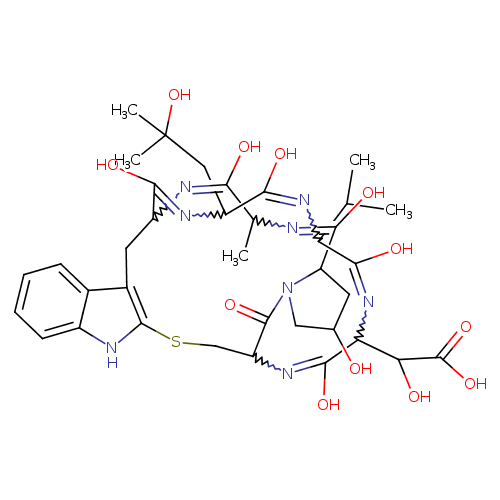
Thumb
SynonymsNot Available
Chemical FormulaC37H50N8O12S
Average Molecular Mass830.904 g/mol
Monoisotopic Mass830.327 g/mol
CAS Registry Number53568-40-4
IUPAC Name2-[18,21,24,26,29,32,35-heptahydroxy-28-(2-hydroxy-2-methylpropyl)-23-methyl-15-oxo-31-(propan-2-yl)-12-thia-10,16,22,25,27,30,33,36-octaazapentacyclo[12.11.11.0³,¹¹.0⁴,⁹.0¹⁶,²⁰]hexatriaconta-3(11),4,6,8,21,24,26,29,32,35-decaen-34-yl]-2-hydroxyacetic acid
Traditional Name[18,21,24,26,29,32,35-heptahydroxy-28-(2-hydroxy-2-methylpropyl)-31-isopropyl-23-methyl-15-oxo-12-thia-10,16,22,25,27,30,33,36-octaazapentacyclo[12.11.11.0³,¹¹.0⁴,⁹.0¹⁶,²⁰]hexatriaconta-3(11),4,6,8,21,24,26,29,32,35-decaen-34-yl](hydroxy)acetic acid
SMILESCC(C)C1N=C(O)C(CC(C)(C)O)N=C(O)C2CC3=C(NC4=CC=CC=C34)SCC(N=C(O)C(N=C1O)C(O)C(O)=O)C(=O)N1CC(O)CC1C(O)=NC(C)C(O)=N2
InChI IdentifierInChI=1S/C37H50N8O12S/c1-15(2)25-32(52)44-26(27(47)36(55)56)33(53)41-23-14-58-34-19(18-8-6-7-9-20(18)42-34)11-21(29(49)40-22(30(50)43-25)12-37(4,5)57)39-28(48)16(3)38-31(51)24-10-17(46)13-45(24)35(23)54/h6-9,15-17,21-27,42,46-47,57H,10-14H2,1-5H3,(H,38,51)(H,39,48)(H,40,49)(H,41,53)(H,43,50)(H,44,52)(H,55,56)
InChI KeyLAVFLHFIXHMDLZ-UHFFFAOYSA-N
Chemical Taxonomy
Description belongs to the class of organic compounds known as oligopeptides. These are organic compounds containing a sequence of between three and ten alpha-amino acids joined by peptide bonds.
KingdomOrganic compounds
Super ClassOrganic acids and derivatives
ClassCarboxylic acids and derivatives
Sub ClassAmino acids, peptides, and analogues
Direct ParentOligopeptides
Alternative Parents
Substituents
  • Alpha-oligopeptide
  • Cyclic alpha peptide
  • Macrolactam
  • 3-alkylindole
  • Alpha-amino acid or derivatives
  • Indole
  • Indole or derivatives
  • Aryl thioether
  • Alkylarylthioether
  • Hydroxy acid
  • Benzenoid
  • Alpha-hydroxy acid
  • Heteroaromatic compound
  • Tertiary alcohol
  • Pyrrolidine
  • Pyrrole
  • Tertiary carboxylic acid amide
  • Carboxamide group
  • Lactam
  • Secondary carboxylic acid amide
  • Secondary alcohol
  • Monocarboxylic acid or derivatives
  • Organoheterocyclic compound
  • Azacycle
  • Carboxylic acid
  • Thioether
  • Organonitrogen compound
  • Organic nitrogen compound
  • Hydrocarbon derivative
  • Organic oxide
  • Organopnictogen compound
  • Alcohol
  • Carbonyl group
  • Organooxygen compound
  • Organic oxygen compound
  • Aromatic heteropolycyclic compound
Molecular FrameworkAromatic heteropolycyclic compounds
External DescriptorsNot Available
Biological Properties
StatusDetected and Not Quantified
OriginExogenous
Cellular Locations
  • Cytoplasm
  • Extracellular
Biofluid LocationsNot Available
Tissue LocationsNot Available
PathwaysNot Available
ApplicationsNot Available
Biological RolesNot Available
Chemical RolesNot Available
Physical Properties
StateSolid
AppearanceWhite powder.
Experimental Properties
PropertyValue
Melting PointNot Available
Boiling PointNot Available
SolubilityNot Available
Predicted Properties
PropertyValueSource
Water Solubility0.15 g/LALOGPS
logP0.68ALOGPS
logP-0.76ChemAxon
logS-3.8ALOGPS
pKa (Strongest Acidic)2.33ChemAxon
pKa (Strongest Basic)5.45ChemAxon
Physiological Charge-1ChemAxon
Hydrogen Acceptor Count18ChemAxon
Hydrogen Donor Count11ChemAxon
Polar Surface Area329.63 ŲChemAxon
Rotatable Bond Count5ChemAxon
Refractivity206.26 m³·mol⁻¹ChemAxon
Polarizability82.56 ųChemAxon
Number of Rings5ChemAxon
Bioavailability0ChemAxon
Rule of FiveNoChemAxon
Ghose FilterNoChemAxon
Veber's RuleNoChemAxon
MDDR-like RuleNoChemAxon
Spectra
Spectra
Spectrum TypeDescriptionSplash KeyView
Predicted LC-MS/MSPredicted LC-MS/MS Spectrum - 10V, Positivesplash10-01ot-0000000980-37017a8bda5cc1d67e22Spectrum
Predicted LC-MS/MSPredicted LC-MS/MS Spectrum - 20V, Positivesplash10-000b-0000000910-93e3174118449fbecd7bSpectrum
Predicted LC-MS/MSPredicted LC-MS/MS Spectrum - 40V, Positivesplash10-0ff0-4914210100-de25311aafe70f7fb369Spectrum
Predicted LC-MS/MSPredicted LC-MS/MS Spectrum - 10V, Negativesplash10-02dr-0000000950-132e2f6ea6bb8bbbc5d3Spectrum
Predicted LC-MS/MSPredicted LC-MS/MS Spectrum - 20V, Negativesplash10-02ti-2000000910-c67a3b0700ad65ef0694Spectrum
Predicted LC-MS/MSPredicted LC-MS/MS Spectrum - 40V, Negativesplash10-006x-9701022100-4d5203c9d4cdb055563aSpectrum
Toxicity Profile
Route of ExposureOral, dermal, inhalation, and parenteral (contaminated drugs). (3)
Mechanism of ToxicityPhallotoxins bind actin, preventing its depolymerization and poisoning the cell. They bind specifically at the interface between F-actin subunits, locking adjacent subunits together. This leads to a decrease in the rate constant for the dissociation of actin subunits from filament ends, which essentially stabilizes actin filaments through the prevention of filament depolymerization. Moreover, they inhibit the ATP hydrolysis activity of F-actin. (6, 2)
MetabolismNot Available
Toxicity ValuesLD50: 1.5 mg/kg (Mouse) (9)
Lethal DoseNot Available
Carcinogenicity (IARC Classification)No indication of carcinogenicity to humans (not listed by IARC).
Uses/SourcesPhallacidin is one of a group of toxins from the death cap (Amanita phalloides) known as phallotoxins. (4)
Minimum Risk LevelNot Available
Health EffectsLiver lesions, tachycardia, hypoglycemia, hypotension and electrolyte imbalance with acid- base disturbance (5).
SymptomsHypovolemic shock; Gastrointestinal symptoms occur after a latent period and include abdominal pain, vomiting, and watery diarrhea. Neurologic symptoms are related to hepatic failure and may include encephalopathy, somnolence, confusion, coma and seizures (5).
TreatmentConsider gastric lavage and activated charcoal. (1)

Concentrations
Not Available
DrugBank IDNot Available
HMDB IDNot Available
FooDB IDNot Available
Phenol Explorer IDNot Available
KNApSAcK IDNot Available
BiGG IDNot Available
BioCyc IDNot Available
METLIN IDNot Available
PDB IDNot Available
Wikipedia LinkNot Available
Chemspider IDNot Available
ChEBI IDNot Available
PubChem Compound ID171277
Kegg Compound IDNot Available
YMDB IDNot Available
ECMDB IDNot Available
References
Synthesis ReferenceNot Available
MSDSNot Available
General ReferencesNot Available