Record Information
Version1.0
Creation Date2009-06-10 17:21:19 UTC
Update Date2026-04-06 02:22:41 UTC
Accession NumberCHEM000742
Identification
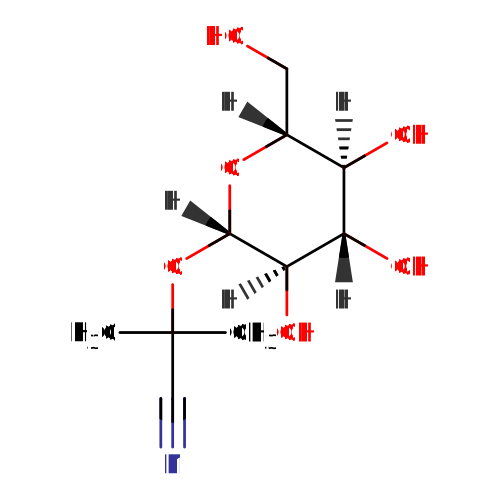
Common NameLinamarin
ClassSmall Molecule
DescriptionLinamarin is found in coffee and coffee products. Linamarin occurs in manioc (Manihot utilissimus), flax (Linum usitatissimum), Phaseolus lunatus (butter bean), Trifolium repens (white clover) and other plants. First isloated in 1830.
Contaminant Sources
  • FooDB Chemicals
  • T3DB toxins
Contaminant Type
  • Cyanide Compound
  • Cyanogenic Glycoside
  • Food Toxin
  • Metabolite
  • Natural Compound
  • Nitrile
  • Organic Compound
  • Plant Toxin
Chemical Structure
Thumb
Synonyms
ValueSource
1-Cyano-1-methylethyl beta-D-glucosideChEBI
PhaseolunatinChEBI
1-Cyano-1-methylethyl b-D-glucosideGenerator
1-Cyano-1-methylethyl β-D-glucosideGenerator
2-(b-D-Glucopyranosyloxy)-2-methylpropanenitrile, 9ciHMDB
2-(beta-D-Glucopyranosyloxy)-2-methyl-propanenitrileHMDB
2-(beta-D-Glucopyranosyloxy)-2-methylpropanenitrileHMDB
alpha-Hydroxyisobutyronitrile-beta-D-glucoseHMDB
ManihotoxinHMDB
Chemical FormulaC10H17NO6
Average Molecular Mass247.245 g/mol
Monoisotopic Mass247.106 g/mol
CAS Registry Number554-35-8
IUPAC Name2-methyl-2-{[(2S,3R,4S,5S,6R)-3,4,5-trihydroxy-6-(hydroxymethyl)oxan-2-yl]oxy}propanenitrile
Traditional Namelinamarin
SMILES[H][C@]1(O)[C@]([H])(O)[C@@]([H])(CO)O[C@@]([H])(OC(C)(C)C#N)[C@]1([H])O
InChI IdentifierInChI=1S/C10H17NO6/c1-10(2,4-11)17-9-8(15)7(14)6(13)5(3-12)16-9/h5-9,12-15H,3H2,1-2H3/t5-,6-,7+,8-,9+/m1/s1
InChI KeyQLTCHMYAEJEXBT-ZEBDFXRSSA-N
Chemical Taxonomy
Description belongs to the class of organic compounds known as cyanogenic glycosides. These are glycosides in which the aglycone moiety contains a cyanide group.
KingdomOrganic compounds
Super ClassOrganic oxygen compounds
ClassOrganooxygen compounds
Sub ClassCarbohydrates and carbohydrate conjugates
Direct ParentCyanogenic glycosides
Alternative Parents
Substituents
  • Cyanogenic glycoside
  • Hexose monosaccharide
  • O-glycosyl compound
  • Monosaccharide
  • Oxane
  • Secondary alcohol
  • Polyol
  • Organoheterocyclic compound
  • Oxacycle
  • Nitrile
  • Carbonitrile
  • Acetal
  • Primary alcohol
  • Organonitrogen compound
  • Hydrocarbon derivative
  • Organopnictogen compound
  • Organic nitrogen compound
  • Alcohol
  • Aliphatic heteromonocyclic compound
Molecular FrameworkAliphatic heteromonocyclic compounds
External Descriptors
  • beta-D-glucoside (CHEBI:16441 )
  • Cyanogenic glucosides derived from valine or isoleucine (C01594 )
Biological Properties
StatusDetected and Not Quantified
OriginExogenous
Cellular Locations
  • Cytoplasm
  • Extracellular
Biofluid LocationsNot Available
Tissue LocationsNot Available
PathwaysNot Available
ApplicationsNot Available
Biological RolesNot Available
Chemical RolesNot Available
Physical Properties
StateSolid
AppearanceWhite powder.
Experimental Properties
PropertyValue
Melting Point143 - 144°C
Boiling PointNot Available
SolubilityNot Available
Predicted Properties
PropertyValueSource
Water Solubility66.8 g/LALOGPS
logP-1.2ALOGPS
logP-1.8ChemAxon
logS-0.57ALOGPS
pKa (Strongest Acidic)12.21ChemAxon
pKa (Strongest Basic)-3ChemAxon
Physiological Charge0ChemAxon
Hydrogen Acceptor Count7ChemAxon
Hydrogen Donor Count4ChemAxon
Polar Surface Area123.17 ŲChemAxon
Rotatable Bond Count3ChemAxon
Refractivity54.95 m³·mol⁻¹ChemAxon
Polarizability23.34 ųChemAxon
Number of Rings1ChemAxon
Bioavailability1ChemAxon
Rule of FiveYesChemAxon
Ghose FilterNoChemAxon
Veber's RuleNoChemAxon
MDDR-like RuleNoChemAxon
Spectra
Spectra
Spectrum TypeDescriptionSplash KeyView
Predicted GC-MSPredicted GC-MS Spectrum - GC-MS (Non-derivatized) - 70eV, Positivesplash10-0bu0-9530000000-e58b8985888c18c2b644Spectrum
Predicted GC-MSPredicted GC-MS Spectrum - GC-MS (4 TMS) - 70eV, Positivesplash10-00di-3121490000-6e31a29cb4593bc0a0f1Spectrum
Predicted GC-MSPredicted GC-MS Spectrum - GC-MS (Non-derivatized) - 70eV, PositiveNot AvailableSpectrum
LC-MS/MSLC-MS/MS Spectrum - Linear Ion Trap , negativesplash10-014i-0940000000-bf243e2c29ff6b26fcf2Spectrum
LC-MS/MSLC-MS/MS Spectrum - Linear Ion Trap , negativesplash10-014i-0950000000-79243dda9f61101991c6Spectrum
LC-MS/MSLC-MS/MS Spectrum - Linear Ion Trap , positivesplash10-0udi-0910000000-1f3450a50f0470bcbca4Spectrum
LC-MS/MSLC-MS/MS Spectrum - Linear Ion Trap , positivesplash10-0udi-0910000000-a1faa4a6e57a8ab98259Spectrum
LC-MS/MSLC-MS/MS Spectrum - Linear Ion Trap , positivesplash10-0006-0390000000-dbccc3f4d1e4a414e258Spectrum
LC-MS/MSLC-MS/MS Spectrum - Linear Ion Trap , positivesplash10-0006-0390000000-790cec5ee5082b154919Spectrum
Predicted LC-MS/MSPredicted LC-MS/MS Spectrum - 10V, Positivesplash10-00ks-9150000000-21a7a562083ca747be69Spectrum
Predicted LC-MS/MSPredicted LC-MS/MS Spectrum - 20V, Positivesplash10-014r-9000000000-41f560bdd8b351dbae10Spectrum
Predicted LC-MS/MSPredicted LC-MS/MS Spectrum - 40V, Positivesplash10-014i-9000000000-218d76388b6e2adf862bSpectrum
Predicted LC-MS/MSPredicted LC-MS/MS Spectrum - 10V, Negativesplash10-00l2-9260000000-8d2767506ce49eb7251aSpectrum
Predicted LC-MS/MSPredicted LC-MS/MS Spectrum - 20V, Negativesplash10-001i-9110000000-036fd16f5b6281c51d5bSpectrum
Predicted LC-MS/MSPredicted LC-MS/MS Spectrum - 40V, Negativesplash10-00lr-9000000000-2ef6f32d0883a3ce35e2Spectrum
Predicted LC-MS/MSPredicted LC-MS/MS Spectrum - 10V, Negativesplash10-0002-0290000000-04e466e80fc34a31711fSpectrum
Predicted LC-MS/MSPredicted LC-MS/MS Spectrum - 20V, Negativesplash10-014j-9430000000-938a48430e27b76573bbSpectrum
Predicted LC-MS/MSPredicted LC-MS/MS Spectrum - 40V, Negativesplash10-0api-9000000000-13d670ae474f26ad1b06Spectrum
Predicted LC-MS/MSPredicted LC-MS/MS Spectrum - 10V, Positivesplash10-0002-1970000000-9f82b8d658576c297dd8Spectrum
Predicted LC-MS/MSPredicted LC-MS/MS Spectrum - 20V, Positivesplash10-014u-9400000000-bc1ee3aa7d00ae291fb1Spectrum
Predicted LC-MS/MSPredicted LC-MS/MS Spectrum - 40V, Positivesplash10-0uxu-9000000000-b040996bb0528ff70807Spectrum
1D NMR1H NMR SpectrumNot AvailableSpectrum
1D NMR13C NMR SpectrumNot AvailableSpectrum
1D NMR1H NMR SpectrumNot AvailableSpectrum
1D NMR13C NMR SpectrumNot AvailableSpectrum
1D NMR1H NMR SpectrumNot AvailableSpectrum
1D NMR13C NMR SpectrumNot AvailableSpectrum
1D NMR1H NMR SpectrumNot AvailableSpectrum
1D NMR13C NMR SpectrumNot AvailableSpectrum
1D NMR1H NMR SpectrumNot AvailableSpectrum
1D NMR13C NMR SpectrumNot AvailableSpectrum
1D NMR1H NMR SpectrumNot AvailableSpectrum
1D NMR13C NMR SpectrumNot AvailableSpectrum
1D NMR1H NMR SpectrumNot AvailableSpectrum
1D NMR13C NMR SpectrumNot AvailableSpectrum
1D NMR1H NMR SpectrumNot AvailableSpectrum
1D NMR13C NMR SpectrumNot AvailableSpectrum
1D NMR1H NMR SpectrumNot AvailableSpectrum
1D NMR13C NMR SpectrumNot AvailableSpectrum
1D NMR1H NMR SpectrumNot AvailableSpectrum
1D NMR13C NMR SpectrumNot AvailableSpectrum
Toxicity Profile
Route of ExposureOral
Mechanism of ToxicityOrganic nitriles decompose into cyanide ions both in vivo and in vitro. Consequently the primary mechanism of toxicity for organic nitriles is their production of toxic cyanide ions or hydrogen cyanide. Cyanide is an inhibitor of cytochrome c oxidase in the fourth complex of the electron transport chain (found in the membrane of the mitochondria of eukaryotic cells). It complexes with the ferric iron atom in this enzyme. The binding of cyanide to this cytochrome prevents transport of electrons from cytochrome c oxidase to oxygen. As a result, the electron transport chain is disrupted and the cell can no longer aerobically produce ATP for energy. Tissues that mainly depend on aerobic respiration, such as the central nervous system and the heart, are particularly affected. Cyanide is also known produce some of its toxic effects by binding to catalase, glutathione peroxidase, methemoglobin, hydroxocobalamin, phosphatase, tyrosinase, ascorbic acid oxidase, xanthine oxidase, succinic dehydrogenase, and Cu/Zn superoxide dismutase. Cyanide binds to the ferric ion of methemoglobin to form inactive cyanmethemoglobin. (2)
MetabolismUpon exposure to enzymes and gut flora in the human intestine, linamarin can decompose to the toxic chemical hydrogen cyanide. This occurs via the enzyme linamarase, which is found in the cell wall of the plant. Chewing of the plant allows the enzyme to contact the linamarin, converting it into acetone cyanohydrin, which then spontaneously decomposes to hydrogen cyanide. Ingested and absorbed linamarin is rapidly excreted in the urine and the glucoside itself does not appear to be acutely toxic. (3) Organic nitriles are converted into cyanide ions through the action of cytochrome P450 enzymes in the liver. Cyanide is rapidly absorbed and distributed throughout the body. Cyanide is mainly metabolized into thiocyanate by either rhodanese or 3-mercaptopyruvate sulfur transferase. Cyanide metabolites are excreted in the urine. (1)
Toxicity ValuesNot Available
Lethal DoseNot Available
Carcinogenicity (IARC Classification)No indication of carcinogenicity to humans (not listed by IARC).
Uses/SourcesLinamarin is a cyanogenic glucoside found in the leaves and roots of plants such as cassava, lima beans, and flax. (3)
Minimum Risk LevelNot Available
Health EffectsIngestion of food prepared from insufficiently processed cassava roots with high linamarin levels has been associated with dietary toxicity, particularly with the upper motor neuron disease known as konzo to the African populations. Dietary exposure to linamarin has also been reported as a risk factor in developing glucose intolerance and diabetes. (3)
SymptomsCyanide poisoning is identified by rapid, deep breathing and shortness of breath, general weakness, giddiness, headaches, vertigo, confusion, convulsions/seizures and eventually loss of consciousness. (1, 2)
TreatmentNot Available
Concentrations
Not Available
DrugBank IDNot Available
HMDB IDHMDB0033699
FooDB IDFDB011809
Phenol Explorer IDNot Available
KNApSAcK IDC00001446
BiGG IDNot Available
BioCyc IDNot Available
METLIN IDNot Available
PDB IDNot Available
Wikipedia LinkLinamarin
Chemspider ID10657
ChEBI ID16441
PubChem Compound ID11128
Kegg Compound IDC01594
YMDB IDNot Available
ECMDB IDM2MDB004454
References
Synthesis ReferenceNot Available
MSDSNot Available
General References
1. Yannai, Shmuel. (2004) Dictionary of food compounds with CD-ROM: Additives, flavors, and ingredients. Boca Raton: Chapman & Hall/CRC.