Record Information
Version1.0
Creation Date2009-06-05 16:50:55 UTC
Update Date2026-03-25 19:42:46 UTC
Accession NumberCHEM000722
Identification
Common NameAlachlor
ClassSmall Molecule
DescriptionSelective preemergent herbicide used on food crops. Alachlor belongs to the family of Anilides. These are organic compounds derived fromA oxoacidsA RkE(=O)l(OH)mA (lA a 0) by replacing anA OHA group by theA NHPh group or derivative formed by ring substitution.
Contaminant Sources
  • Clean Air Act Chemicals
  • FooDB Chemicals
  • HPV EPA Chemicals
  • My Exposome Chemicals
  • STOFF IDENT Compounds
  • T3DB toxins
  • ToxCast & Tox21 Chemicals
Contaminant Type
  • Amide
  • Amine
  • Aromatic Hydrocarbon
  • Chloroacetanilide
  • Ether
  • Food Toxin
  • Herbicide
  • Household Toxin
  • Metabolite
  • Organic Compound
  • Organochloride
  • Pesticide
  • Synthetic Compound
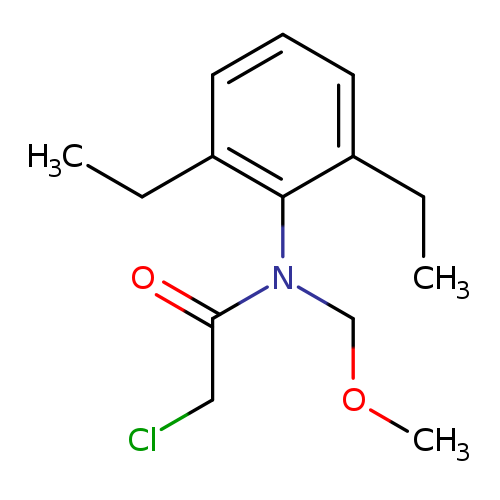
Chemical Structure
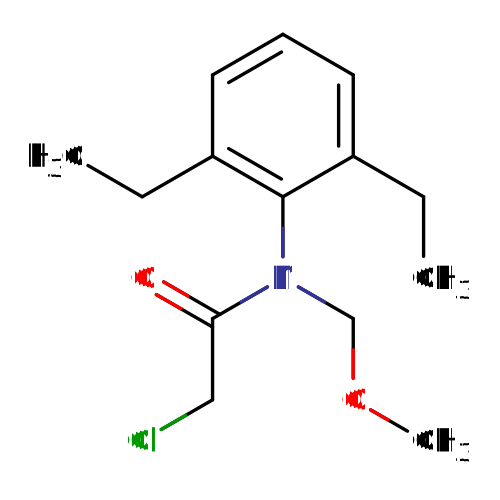
Thumb
Synonyms
ValueSource
2-Chloro-2',6'-diethyl-N-(methoxymethyl)acetanilideChEBI
AlachloreChEBI
Chloressigsaeure-N-(methoxymethyl)-2,6-diaethylanilidChEBI
2-Chloro-2',6'-diethyl-N-(methoxymethyl)-acetanildeHMDB
2-Chloro-2',6'-diethyl-N-(methoxymethyl)-acetanilideHMDB
2-Chloro-N-(2,6-diethyl)phenyl-N-methoxymethylacetamideHMDB
2-Chloro-N-(2,6-diethylphenyl)-N-(methoxymethyl)acetamideHMDB
2-Chloro-N-(2,6-diethylphenyl)-N-(methoxymethyl)acetamide, 9ciHMDB
Alachlor (pesticides mixture)HMDB
Alachlor technicalHMDB
Alachlor technical (90% or more)HMDB
Alachlor-atrazineHMDB
AlaganHMDB
AlanexHMDB
AlanoxHMDB
AlapazHMDB
AlatoxHMDB
Alatox 480HMDB
AlazineHMDB
AlochlorHMDB
alpha-Chloro-2',6'-diethyl-N-methoxymethylacetanilideHMDB
BulletHMDB
ChimiclorHMDB
LasagrinHMDB
LassoHMDB
Lasso micro-techHMDB
LAZOHMDB
MetachlorHMDB
MethachlorHMDB
N-(Methoxymethyl)-2,6-diethylchloroacetanilideHMDB
NitalaHMDB
PillarzoHMDB
RalchlorHMDB
SatochlorHMDB
Chemical FormulaC14H20ClNO2
Average Molecular Mass269.767 g/mol
Monoisotopic Mass269.118 g/mol
CAS Registry Number15972-60-8
IUPAC Name2-chloro-N-(2,6-diethylphenyl)-N-(methoxymethyl)acetamide
Traditional NameLAZO
SMILESCCC1=CC=CC(CC)=C1N(COC)C(=O)CCl
InChI IdentifierInChI=1S/C14H20ClNO2/c1-4-11-7-6-8-12(5-2)14(11)16(10-18-3)13(17)9-15/h6-8H,4-5,9-10H2,1-3H3
InChI KeyXCSGPAVHZFQHGE-UHFFFAOYSA-N
Chemical Taxonomy
Description belongs to the class of organic compounds known as anilides. These are organic heterocyclic compounds derived from oxoacids RkE(=O)l(OH)m (l not 0) by replacing an OH group by the NHPh group or derivative formed by ring substitution.
KingdomOrganic compounds
Super ClassBenzenoids
ClassBenzene and substituted derivatives
Sub ClassAnilides
Direct ParentAnilides
Alternative Parents
Substituents
  • Anilide
  • Tertiary carboxylic acid amide
  • Chloroacetamide
  • Carboxamide group
  • Carboxylic acid derivative
  • Alkyl chloride
  • Hydrocarbon derivative
  • Organic oxide
  • Organopnictogen compound
  • Organooxygen compound
  • Organonitrogen compound
  • Organochloride
  • Organohalogen compound
  • Organic oxygen compound
  • Organic nitrogen compound
  • Carbonyl group
  • Alkyl halide
  • Aromatic homomonocyclic compound
Molecular FrameworkAromatic homomonocyclic compounds
External Descriptors
Biological Properties
StatusDetected and Not Quantified
OriginExogenous
Cellular Locations
  • Membrane
Biofluid LocationsNot Available
Tissue LocationsNot Available
PathwaysNot Available
Applications
Biological RolesNot Available
Chemical RolesNot Available
Physical Properties
StateSolid
AppearanceWhite or cream, combustible crystalline solid without odour (5).
Experimental Properties
PropertyValue
Melting Point39.5 - 41.5°C
Boiling PointNot Available
Solubility0.24 mg/mL at 25°C
Predicted Properties
PropertyValueSource
Water Solubility0.21 g/LALOGPS
logP3.02ALOGPS
logP3.59ChemAxon
logS-3.1ALOGPS
pKa (Strongest Acidic)16.6ChemAxon
pKa (Strongest Basic)-4.2ChemAxon
Physiological Charge0ChemAxon
Hydrogen Acceptor Count2ChemAxon
Hydrogen Donor Count0ChemAxon
Polar Surface Area29.54 ŲChemAxon
Rotatable Bond Count6ChemAxon
Refractivity73.93 m³·mol⁻¹ChemAxon
Polarizability29.02 ųChemAxon
Number of Rings1ChemAxon
Bioavailability1ChemAxon
Rule of FiveYesChemAxon
Ghose FilterYesChemAxon
Veber's RuleYesChemAxon
MDDR-like RuleNoChemAxon
Spectra
Spectra
Spectrum TypeDescriptionSplash KeyView
GC-MSGC-MS Spectrum - GC-EI-Q (Non-derivatized)splash10-01ot-4910000000-ff5ad7c7837234075e25Spectrum
Predicted GC-MSPredicted GC-MS Spectrum - GC-MS (Non-derivatized) - 70eV, Positivesplash10-002e-2920000000-dc1318cf39b8cbc3d666Spectrum
Predicted GC-MSPredicted GC-MS Spectrum - GC-MS (Non-derivatized) - 70eV, PositiveNot AvailableSpectrum
LC-MS/MSLC-MS/MS Spectrum - LC-ESI-QTOF , positivesplash10-000i-0090000000-76b89888ca7d0dff5c1fSpectrum
LC-MS/MSLC-MS/MS Spectrum - LC-ESI-QTOF , positivesplash10-03dr-0980000000-72e2d13ea4c43a94533eSpectrum
LC-MS/MSLC-MS/MS Spectrum - LC-ESI-QTOF , positivesplash10-03di-0900000000-5c144b05f6018cf50939Spectrum
LC-MS/MSLC-MS/MS Spectrum - LC-ESI-QTOF , positivesplash10-000t-0900000000-56b06a1a995b2c236499Spectrum
LC-MS/MSLC-MS/MS Spectrum - LC-ESI-QTOF , positivesplash10-001j-0900000000-b98598f80d6ddd013591Spectrum
LC-MS/MSLC-MS/MS Spectrum - LC-ESI-ITFT , positivesplash10-000i-0090000000-e48533a29dd990b17755Spectrum
LC-MS/MSLC-MS/MS Spectrum - LC-ESI-ITFT , positivesplash10-0079-0090000000-be0d02d4b380f4f063dfSpectrum
LC-MS/MSLC-MS/MS Spectrum - LC-ESI-ITFT , positivesplash10-000i-0290000000-d7e61817ec9dfb84134eSpectrum
LC-MS/MSLC-MS/MS Spectrum - LC-ESI-ITFT , positivesplash10-03di-0930000000-85d33b07118012dc094fSpectrum
LC-MS/MSLC-MS/MS Spectrum - LC-ESI-ITFT , positivesplash10-03di-0900000000-b439203d9ae3a2a94832Spectrum
LC-MS/MSLC-MS/MS Spectrum - LC-ESI-ITFT , positivesplash10-01ot-0900000000-1600624b1a228581c9a0Spectrum
LC-MS/MSLC-MS/MS Spectrum - LC-ESI-ITFT , positivesplash10-000t-0900000000-3b284f85190209d4389bSpectrum
LC-MS/MSLC-MS/MS Spectrum - LC-ESI-ITFT , positivesplash10-0079-0090000000-80bab76e1cf9264266b6Spectrum
LC-MS/MSLC-MS/MS Spectrum - LC-ESI-ITFT , positivesplash10-000i-0290000000-2f3b95987691a2f9a12cSpectrum
LC-MS/MSLC-MS/MS Spectrum - LC-ESI-ITFT , positivesplash10-03di-0940000000-5490cf74e6d00907000aSpectrum
LC-MS/MSLC-MS/MS Spectrum - LC-ESI-ITFT , positivesplash10-03di-0900000000-94c892fa0e45237f0550Spectrum
LC-MS/MSLC-MS/MS Spectrum - LC-ESI-ITFT , positivesplash10-01ot-0900000000-0782fe7afd5462ce19dfSpectrum
LC-MS/MSLC-MS/MS Spectrum - LC-ESI-ITFT , positivesplash10-000t-0900000000-b2dc4713e5954edf161bSpectrum
LC-MS/MSLC-MS/MS Spectrum - LC-ESI-ITFT , positivesplash10-000i-0090000000-b8b7a2656098ef9720bbSpectrum
Predicted LC-MS/MSPredicted LC-MS/MS Spectrum - 10V, Positivesplash10-00di-0190000000-36c0adeceb429e1c87f0Spectrum
Predicted LC-MS/MSPredicted LC-MS/MS Spectrum - 20V, Positivesplash10-03ki-1970000000-00709cc03ab9293da23aSpectrum
Predicted LC-MS/MSPredicted LC-MS/MS Spectrum - 40V, Positivesplash10-003r-2900000000-18c9f8b1a32719243006Spectrum
Predicted LC-MS/MSPredicted LC-MS/MS Spectrum - 10V, Negativesplash10-014i-0190000000-0bfaa7611ca17634a1a7Spectrum
Predicted LC-MS/MSPredicted LC-MS/MS Spectrum - 20V, Negativesplash10-030c-3980000000-9c1c38c1a30035de4c0fSpectrum
Predicted LC-MS/MSPredicted LC-MS/MS Spectrum - 40V, Negativesplash10-076s-5910000000-d53d48694591a95583f2Spectrum
MSMass Spectrum (Electron Ionization)splash10-0002-8920000000-d26b3a61eea50f146512Spectrum
1D NMR1H NMR SpectrumNot AvailableSpectrum
1D NMR13C NMR SpectrumNot AvailableSpectrum
Toxicity Profile
Route of Exposureoral (5) ; dermal (5)
Mechanism of ToxicityIts mode of action is elongase inhibition, and inhibition of geranylgeranyl pyrophosphate (GGPP) cyclisation enzymes. It is also know to inhibit biosynthesis of fatty acids, lipids, protein, isoprenoids, flavonoids, and gibberellins. (4, 6).
MetabolismAlachlor is metabolized and eliminated as conjugates of mercapturic acid, glucuronic acid, and sulfate in the urine and feces (7).
Toxicity ValuesLD50: 930 - 1360 mg/kg (Oral, Rat) (5) LD50: 13 300 mg/kg (Dermal, Rabbit) (5)
Lethal DoseNot Available
Carcinogenicity (IARC Classification)No indication of carcinogenicity to humans (not listed by IARC).
Uses/SourcesIt is used mainly to control annual grasses and broadleaf weeds in corn (maize), soybeans, and peanuts (4).
Minimum Risk LevelNot Available
Health EffectsARDS/acute lung injury, burns of the esophagus or gastrointestinal tract can result from acetochlor poisoning (8).
SymptomsAlachlor is mildly irritating to the skin and eyes. Exposure to metalaxyl often results in such nonspecific symptoms as headache, dizziness, weakness, and nausea. Alachlor poisoning can produce an allergic hypersensitivity dermatitis or asthma with bronchospasm and wheezing with chronic exposure (8).
TreatmentNot Available
Concentrations
Not Available
DrugBank IDNot Available
HMDB IDHMDB0031766
FooDB IDFDB008439
Phenol Explorer IDNot Available
KNApSAcK IDNot Available
BiGG IDNot Available
BioCyc IDNot Available
METLIN IDNot Available
PDB IDNot Available
Wikipedia LinkAlachlor
Chemspider ID1994
ChEBI ID2533
PubChem Compound ID2078
Kegg Compound IDC10928
YMDB IDNot Available
ECMDB IDNot Available
References
Synthesis ReferenceNot Available
MSDSNot Available
General References
1. https://www.ncbi.nlm.nih.gov/pubmed/?term=11807927
2. https://www.ncbi.nlm.nih.gov/pubmed/?term=23599414
3. Yannai, Shmuel. (2004) Dictionary of food compounds with CD-ROM: Additives, flavors, and ingredients. Boca Raton: Chapman & Hall/CRC.