Record Information
Version1.0
Creation Date2009-03-27 01:47:29 UTC
Update Date2026-04-05 16:02:01 UTC
Accession NumberCHEM000671
Identification
Common NameZinc sulfate
ClassSmall Molecule
DescriptionZinc sulfate is used as a malting/fermenting aid and as a nutrient supplement Zinc sulfate (ZnSO4) is a colorless crystalline, water-soluble chemical compound. The hydrated form, ZnSO4*7H2O, the mineral goslarite, was historically known as white vitriol and can be prepared by reacting zinc with aqueous sulfuric acid. It may also be prepared by adding solid zinc to a copper(II) sulfate solution.
Zinc sulfate has been shown to exhibit antibiotic and anti-spectic functions (2, 3).
Zinc sulfate belongs to the family of Transition Metal Sulfates. These are inorganic compounds in which the largest oxoanion is sulfate, and in which the heaviest atom not in an oxoanion is a transition metal.
Contaminant Sources
  • Clean Air Act Chemicals
  • EAFUS Chemicals
  • FooDB Chemicals
  • HPV EPA Chemicals
  • OECD HPV Chemicals
  • T3DB toxins
Contaminant Type
  • Cosmetic Toxin
  • Food Toxin
  • Household Toxin
  • Industrial/Workplace Toxin
  • Inorganic Compound
  • Metabolite
  • Natural Compound
  • Zinc Compound
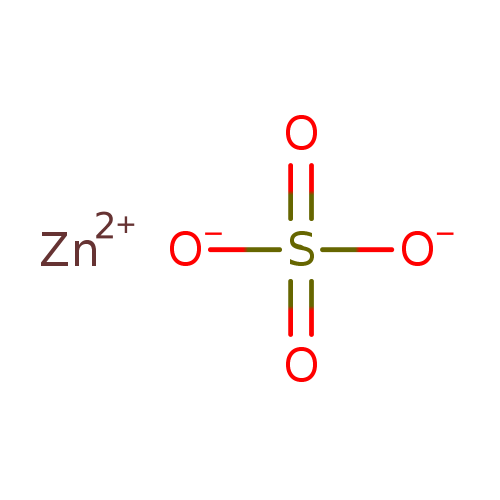
Chemical Structure
Thumb
Synonyms
ValueSource
Zinc sulfate (1:1)ChEBI
Zinc sulfate anhydrousChEBI
Zinc sulphateChEBI
Zinc(II) sulfateChEBI
Zinc(2+) sulfateChEBI
ZnSO4ChEBI
Zinc sulfuric acid (1:1)Generator
Zinc sulphate (1:1)Generator
Zinc sulphuric acid (1:1)Generator
Zinc sulfuric acid anhydrousGenerator
Zinc sulphate anhydrousGenerator
Zinc sulphuric acid anhydrousGenerator
Zinc sulfuric acidGenerator
Zinc sulphuric acidGenerator
Zinc(II) sulfuric acidGenerator
Zinc(II) sulphateGenerator
Zinc(II) sulphuric acidGenerator
Zinc(2+) sulfuric acidGenerator
Zinc(2+) sulphateGenerator
Zinc(2+) sulphuric acidGenerator
Zinc sulfate, heptahydrateMeSH
ZincteralMeSH
Sulfate, zincMeSH
Chemical FormulaO4SZn
Average Molecular Mass161.472 g/mol
Monoisotopic Mass159.881 g/mol
CAS Registry Number7733-02-0
IUPAC Namezinc(2+) ion sulfate
Traditional Namezinc(2+) ion sulfate
SMILES[Zn++].[O-]S([O-])(=O)=O
InChI IdentifierInChI=1S/H2O4S.Zn/c1-5(2,3)4;/h(H2,1,2,3,4);/q;+2/p-2
InChI KeyNWONKYPBYAMBJT-UHFFFAOYSA-L
Chemical Taxonomy
Description belongs to the class of inorganic compounds known as transition metal sulfates. These are inorganic compounds in which the largest oxoanion is sulfate, and in which the heaviest atom not in an oxoanion is a transition metal.
KingdomInorganic compounds
Super ClassMixed metal/non-metal compounds
ClassTransition metal oxoanionic compounds
Sub ClassTransition metal sulfates
Direct ParentTransition metal sulfates
Alternative Parents
Substituents
  • Transition metal sulfate
  • Inorganic oxide
  • Inorganic salt
Molecular FrameworkNot Available
External Descriptors
Biological Properties
StatusDetected and Not Quantified
OriginExogenous
Cellular Locations
  • Cytoplasm
  • Extracellular
Biofluid LocationsNot Available
Tissue LocationsNot Available
PathwaysNot Available
ApplicationsNot Available
Biological RolesNot Available
Chemical RolesNot Available
Physical Properties
StateSolid
AppearanceWhite powder.
Experimental Properties
PropertyValue
Melting Point680°C (decomp, anhydrous); 100°C (heptahydrate); 70°C (decomp, hexahydrate)
Boiling Point740°C
SolubilityNot Available
Predicted Properties
PropertyValueSource
logP-0.84ChemAxon
pKa (Strongest Acidic)-3ChemAxon
Physiological Charge-2ChemAxon
Hydrogen Acceptor Count4ChemAxon
Hydrogen Donor Count0ChemAxon
Polar Surface Area80.26 ŲChemAxon
Rotatable Bond Count0ChemAxon
Refractivity11.53 m³·mol⁻¹ChemAxon
Polarizability5.81 ųChemAxon
Number of Rings0ChemAxon
Bioavailability1ChemAxon
Rule of FiveYesChemAxon
Ghose FilterNoChemAxon
Veber's RuleNoChemAxon
MDDR-like RuleNoChemAxon
Spectra
Spectra
Spectrum TypeDescriptionSplash KeyView
Predicted GC-MSPredicted GC-MS Spectrum - GC-MS (Non-derivatized) - 70eV, Positivesplash10-08fr-0900000000-72ac9ed930d23dbb4017Spectrum
Predicted LC-MS/MSPredicted LC-MS/MS Spectrum - 10V, Positivesplash10-03di-0900000000-48775fcf40f0f842d523Spectrum
Predicted LC-MS/MSPredicted LC-MS/MS Spectrum - 20V, Positivesplash10-03di-0900000000-48775fcf40f0f842d523Spectrum
Predicted LC-MS/MSPredicted LC-MS/MS Spectrum - 40V, Positivesplash10-03di-0900000000-48775fcf40f0f842d523Spectrum
Predicted LC-MS/MSPredicted LC-MS/MS Spectrum - 10V, Negativesplash10-0a4i-0900000000-f97eaf04015541239a42Spectrum
Predicted LC-MS/MSPredicted LC-MS/MS Spectrum - 20V, Negativesplash10-0a4i-0900000000-f97eaf04015541239a42Spectrum
Predicted LC-MS/MSPredicted LC-MS/MS Spectrum - 40V, Negativesplash10-0a4i-0900000000-f97eaf04015541239a42Spectrum
Toxicity Profile
Route of ExposureInhalation (5) ; oral (5) ; dermal (5)
Mechanism of ToxicityAnaemia results from the excessive absorption of zinc suppressing copper and iron absorption, most likely through competitive binding of intestinal mucosal cells. Unbalanced levels of copper and zinc binding to Cu,Zn-superoxide dismutase has been linked to amyotrophic lateral sclerosis (ALS). Stomach acid dissolves metallic zinc to give corrosive zinc chloride, which can cause damage to the stomach lining. Metal fume fever is thought to be an immune response to inhaled zinc. (4, 5, 1)
MetabolismZinc can enter the body through the lungs, skin, and gastrointestinal tract. Intestinal absorption of zinc is controlled by zinc carrier protein CRIP. Zinc also binds to metallothioneins, which help prevent absorption of excess zinc. Zinc is widely distributed and found in all tissues and tissues fluids, concentrating in the liver, gastrointestinal tract, kidney, skin, lung, brain, heart, and pancreas. In the bloodstream zinc is found bound to carbonic anhydrase in erythrocytes, as well as bound to albumin, _2-macroglobulin, and amino acids in the the plasma. Albumin and amino acid bound zinc can diffuse across tissue membranes. Zinc is excreted in the urine and faeces. (5)
Toxicity ValuesLD50: 57 mg/kg (Oral, Mouse) (10) LD50: 71.7 mg/kg (Intraperitoneal, Mouse) (10) LD50: 40 mg/kg (Intravenous, Rat) (11)
Lethal Dose10 to 30 grams for and adult human. (9)
Carcinogenicity (IARC Classification)No indication of carcinogenicity to humans (not listed by IARC).
Uses/SourcesZinc sulfate is used in animal feeds, fertilizers, agricultural sprays, electrolytes for zinc plating, as a mordant in dyeing, as a preservative for skins and leather and in medicine as an astringent and emetic. (6)
Minimum Risk LevelIntermediate Oral: 0.3 mg/kg/day (8) Chronic Oral: 0.3 mg/kg/day (8)
Health EffectsChronic exposure to zinc causes anemia, atazia, lethargy, and decreases the level of good cholesterol in the body. It is also believed to cause pancreatic and reproductive damage. (5)
SymptomsIngestion of large doses of zinc causes stomach cramps, nausea, and vomiting. Acute inhalation of large amounts of zinc causes metal fume fever, which is characterized by chills, fever, headache, weakness, dryness of the nose and throat, chest pain, and coughing. Dermal contact with zinc results in skin irritation. (5)
TreatmentZinc poisoning is treated symptomatically, often by administering fluids such as water or milk, or with gastric lavage. (5)

Concentrations
Not Available
DrugBank IDDB09322
HMDB IDHMDB0034907
FooDB IDFDB013488
Phenol Explorer IDNot Available
KNApSAcK IDNot Available
BiGG IDNot Available
BioCyc IDNot Available
METLIN IDNot Available
PDB IDNot Available
Wikipedia LinkZinc_Sulfate
Chemspider IDNot Available
ChEBI ID35176
PubChem Compound ID24424
Kegg Compound IDNot Available
YMDB IDNot Available
ECMDB IDNot Available
References
Synthesis ReferenceNot Available
MSDSNot Available
General References
1. https://www.ncbi.nlm.nih.gov/pubmed/?term=10469300
2. https://www.ncbi.nlm.nih.gov/pubmed/?term=16792750
3. https://www.ncbi.nlm.nih.gov/pubmed/?term=23264166
4. https://www.ncbi.nlm.nih.gov/pubmed/?term=23271682
5. https://www.ncbi.nlm.nih.gov/pubmed/?term=23282999
6. https://www.ncbi.nlm.nih.gov/pubmed/?term=23356505
7. https://www.ncbi.nlm.nih.gov/pubmed/?term=23689708
8. https://www.ncbi.nlm.nih.gov/pubmed/?term=23720981
9. https://www.ncbi.nlm.nih.gov/pubmed/?term=8566016