Record Information
Version1.0
Creation Date2009-03-06 18:58:06 UTC
Update Date2026-03-26 18:41:19 UTC
Accession NumberCHEM000103
Identification
Common Namen-Nitrosodi-n-propylamine
ClassSmall Molecule
DescriptionN-Nitrosodi-n-propylamine is a chemical produced by industry in small amounts for research. Small amounts of n-nitrosodi-n-propylamine are also produced as a side reaction during some manufacturing processes, as a contaminant in some weed killers, and during the manufacture of some rubber products. It is one ingredient of cigarette. (4)
Contaminant Sources
  • Clean Air Act Chemicals
  • Disinfection Byproducts
  • HPV EPA Chemicals
  • IARC Carcinogens Group 2B
  • STOFF IDENT Compounds
  • T3DB toxins
  • Tobacco Smoke Compounds
  • ToxCast & Tox21 Chemicals
Contaminant Type
  • Amine
  • Cigarette Toxin
  • Industrial By-product/Pollutant
  • Industrial/Workplace Toxin
  • Nitrite
  • Organic Compound
  • Pollutant
  • Synthetic Compound
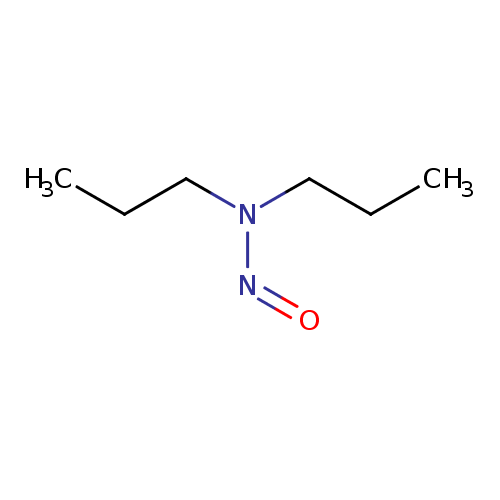
Chemical Structure
Thumb
Synonyms
ValueSource
N,N-DipropylnitrosamineMeSH
N-nitroso(Di-N-propyl)amineMeSH
DipropylnitrosamineMeSH
Chemical FormulaC6H14N2O
Average Molecular Mass130.188 g/mol
Monoisotopic Mass130.111 g/mol
CAS Registry Number621-64-7
IUPAC Namenitrosodipropylamine
Traditional NameN-nitrosodipropylamine
SMILESCCCN(CCC)N=O
InChI IdentifierInChI=1S/C6H14N2O/c1-3-5-8(7-9)6-4-2/h3-6H2,1-2H3
InChI KeyYLKFDHTUAUWZPQ-UHFFFAOYSA-N
Chemical Taxonomy
Description belongs to the class of organic compounds known as organic n-nitroso compounds. These are organic compounds containing a n-nitroso group -NN=O.
KingdomOrganic compounds
Super ClassOrganic nitrogen compounds
ClassOrganonitrogen compounds
Sub ClassOrganic nitroso compounds
Direct ParentOrganic N-nitroso compounds
Alternative Parents
Substituents
  • Organic n-nitroso compound
  • Organic oxygen compound
  • Organopnictogen compound
  • Organic oxide
  • Hydrocarbon derivative
  • Aliphatic acyclic compound
Molecular FrameworkAliphatic acyclic compounds
External Descriptors
Biological Properties
StatusDetected and Not Quantified
OriginExogenous
Cellular Locations
  • Cytoplasm
  • Extracellular
Biofluid LocationsNot Available
Tissue LocationsNot Available
PathwaysNot Available
ApplicationsNot Available
Biological RolesNot Available
Chemical RolesNot Available
Physical Properties
StateSolid
AppearanceYellow liquid.
Experimental Properties
PropertyValue
Melting PointNot Available
Boiling Point206 °C
Solubility13 mg/mL at 24 °C [MIRVISH,SS et al.(1976)]
Predicted Properties
PropertyValueSource
Water Solubility15.3 g/LALOGPS
logP1.57ALOGPS
logP1.8ChemAxon
logS-0.93ALOGPS
pKa (Strongest Basic)3.3ChemAxon
Physiological Charge0ChemAxon
Hydrogen Acceptor Count2ChemAxon
Hydrogen Donor Count0ChemAxon
Polar Surface Area32.67 ŲChemAxon
Rotatable Bond Count5ChemAxon
Refractivity38.6 m³·mol⁻¹ChemAxon
Polarizability15.02 ųChemAxon
Number of Rings0ChemAxon
Bioavailability1ChemAxon
Rule of FiveYesChemAxon
Ghose FilterNoChemAxon
Veber's RuleYesChemAxon
MDDR-like RuleNoChemAxon
Spectra
Spectra
Spectrum TypeDescriptionSplash KeyView
Predicted GC-MSPredicted GC-MS Spectrum - GC-MS (Non-derivatized) - 70eV, Positivesplash10-0f6x-9200000000-7a59226c684fdfa7f3f4Spectrum
Predicted GC-MSPredicted GC-MS Spectrum - GC-MS (Non-derivatized) - 70eV, PositiveNot AvailableSpectrum
LC-MS/MSLC-MS/MS Spectrum - 30V, Positivesplash10-0019-9500000000-0704dc1a231c669f02cbSpectrum
LC-MS/MSLC-MS/MS Spectrum - 45V, Positivesplash10-000i-9200000000-154023f596f82ff60612Spectrum
LC-MS/MSLC-MS/MS Spectrum - 75V, Positivesplash10-0udr-9000000000-cf38c049fad6b029abf9Spectrum
LC-MS/MSLC-MS/MS Spectrum - 60V, Positivesplash10-000i-9000000000-7f3e7dfc90998dac6805Spectrum
LC-MS/MSLC-MS/MS Spectrum - 90V, Positivesplash10-0udi-9000000000-7817e43d165c2c3db63aSpectrum
Predicted LC-MS/MSPredicted LC-MS/MS Spectrum - 10V, Positivesplash10-001i-3900000000-519b13d74f5fd41dae33Spectrum
Predicted LC-MS/MSPredicted LC-MS/MS Spectrum - 20V, Positivesplash10-0006-9200000000-ec2e51e590dd7bb0651dSpectrum
Predicted LC-MS/MSPredicted LC-MS/MS Spectrum - 40V, Positivesplash10-0006-9000000000-b184a59d7647d7a9126aSpectrum
Predicted LC-MS/MSPredicted LC-MS/MS Spectrum - 10V, Negativesplash10-004i-1900000000-de2892f0b560af379291Spectrum
Predicted LC-MS/MSPredicted LC-MS/MS Spectrum - 20V, Negativesplash10-01t9-4900000000-24bf802b1bb215f4745fSpectrum
Predicted LC-MS/MSPredicted LC-MS/MS Spectrum - 40V, Negativesplash10-0006-9000000000-d063bf39130b38e25ac9Spectrum
MSMass Spectrum (Electron Ionization)splash10-0006-9000000000-632355cddcea307ac9e7Spectrum
1D NMR13C NMR SpectrumNot AvailableSpectrum
1D NMR1H NMR SpectrumNot AvailableSpectrum
1D NMR13C NMR SpectrumNot AvailableSpectrum
1D NMR1H NMR SpectrumNot AvailableSpectrum
1D NMR13C NMR SpectrumNot AvailableSpectrum
1D NMR1H NMR SpectrumNot AvailableSpectrum
1D NMR13C NMR SpectrumNot AvailableSpectrum
1D NMR1H NMR SpectrumNot AvailableSpectrum
1D NMR13C NMR SpectrumNot AvailableSpectrum
1D NMR1H NMR SpectrumNot AvailableSpectrum
1D NMR13C NMR SpectrumNot AvailableSpectrum
1D NMR1H NMR SpectrumNot AvailableSpectrum
1D NMR13C NMR SpectrumNot AvailableSpectrum
1D NMR1H NMR SpectrumNot AvailableSpectrum
1D NMR13C NMR SpectrumNot AvailableSpectrum
1D NMR1H NMR SpectrumNot AvailableSpectrum
Toxicity Profile
Route of ExposureOral (4); inhalation (4) ; dermal (4).
Mechanism of ToxicityReactive metabolites of n-nitrosodi-n-propylamine are believed to form adducts with DNA, resulting in carcinogenic effects. (4)
Metabolismn-Nitrosodi-n-propylamine can be absorbed through oral, inhalation, or dermal routes. It is metabolized by cytochrome p-450 enzymes (mainly CYP 2E1) into its reactive metabolites via oxidation at the alpha, beta and gamma carbon positions. Alpha carbon oxidation is regarded as the primary pathway, resulting in formation of propionaldehyde, 1-propanol, and 2-propanol. The metabolites of n-nitrosodi-n-propylamine are excreted mainly in the urine. (4, 1)
Toxicity ValuesLD50: 480 mg/kg (Oral, Rat) (5) LD50: 487 mg/kg (Subcutaneous, Rat) (5)
Lethal DoseNot Available
Carcinogenicity (IARC Classification)2B, possibly carcinogenic to humans. (3)
Uses/SourcesSmall amounts of n-nitrosodi-n-propylamine are also produced as a side reaction during some manufacturing processes, as a contaminant in some weed killers, and during the manufacture of some rubber products. (4)
Minimum Risk LevelAcute Oral: 0.095 mg/kg/day (2)
Health EffectsHigh levels of n-nitrosodi-n-propylamine may damage the liver, lung, stomach, kidneys, and heart. n-Nitrosodi-n-propylamine is also a likely carcinogen. (4)
SymptomsNot Available
TreatmentNot Available
Concentrations
Not Available
DrugBank IDNot Available
HMDB IDNot Available
FooDB IDNot Available
Phenol Explorer IDNot Available
KNApSAcK IDNot Available
BiGG IDNot Available
BioCyc IDNot Available
METLIN IDNot Available
PDB IDNot Available
Wikipedia LinkNot Available
Chemspider IDNot Available
ChEBI IDNot Available
PubChem Compound IDNot Available
Kegg Compound IDC19279
YMDB IDNot Available
ECMDB IDNot Available
References
Synthesis ReferenceNot Available
MSDSNot Available
General ReferencesNot Available