| Record Information |
|---|
| Version | 1.0 |
|---|
| Creation Date | 2016-06-03 10:17:47 UTC |
|---|
| Update Date | 2016-11-09 01:22:48 UTC |
|---|
| Accession Number | CHEM042828 |
|---|
| Identification |
|---|
| Common Name | opipramol |
|---|
| Class | Small Molecule |
|---|
| Description | Opipramol has been used in trials studying the treatment of Dementia, Depression, Schizophrenia, Anxiety Disorders, and Psychosomatic Disorders. |
|---|
| Contaminant Sources | |
|---|
| Contaminant Type | Not Available |
|---|
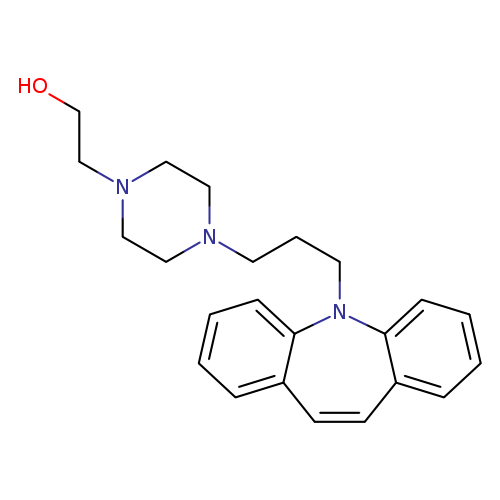
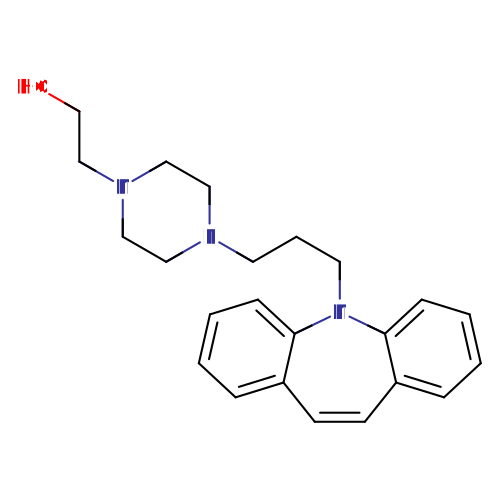
| Chemical Structure | |
|---|
| Synonyms | | Value | Source |
|---|
| Opipramol dura | Kegg | | Hydrochloride, opipramol | MeSH | | Opipramol hydrochloride | MeSH | | Insidon | MeSH |
|
|---|
| Chemical Formula | C23H29N3O |
|---|
| Average Molecular Mass | 363.505 g/mol |
|---|
| Monoisotopic Mass | 363.231 g/mol |
|---|
| CAS Registry Number | 315-72-0 |
|---|
| IUPAC Name | 2-[4-(3-{2-azatricyclo[9.4.0.0^{3,8}]pentadeca-1(15),3,5,7,9,11,13-heptaen-2-yl}propyl)piperazin-1-yl]ethan-1-ol |
|---|
| Traditional Name | 2-[4-(3-{2-azatricyclo[9.4.0.0^{3,8}]pentadeca-1(15),3,5,7,9,11,13-heptaen-2-yl}propyl)piperazin-1-yl]ethanol |
|---|
| SMILES | OCCN1CCN(CCCN2C3=CC=CC=C3C=CC3=CC=CC=C23)CC1 |
|---|
| InChI Identifier | InChI=1S/C23H29N3O/c27-19-18-25-16-14-24(15-17-25)12-5-13-26-22-8-3-1-6-20(22)10-11-21-7-2-4-9-23(21)26/h1-4,6-11,27H,5,12-19H2 |
|---|
| InChI Key | YNZFUWZUGRBMHL-UHFFFAOYSA-N |
|---|
| Chemical Taxonomy |
|---|
| Description | belongs to the class of organic compounds known as dibenzazepines. Dibenzazepines are compounds with two benzene rings connected by an azepine ring. Azepine is an unsaturated seven-member heterocycle with one nitrogen atom replacing a carbon atom. |
|---|
| Kingdom | Organic compounds |
|---|
| Super Class | Organoheterocyclic compounds |
|---|
| Class | Benzazepines |
|---|
| Sub Class | Dibenzazepines |
|---|
| Direct Parent | Dibenzazepines |
|---|
| Alternative Parents | |
|---|
| Substituents | - Dibenzazepine
- Alkyldiarylamine
- Tertiary aliphatic/aromatic amine
- Azepine
- N-alkylpiperazine
- 1,4-diazinane
- Piperazine
- Benzenoid
- Tertiary aliphatic amine
- Tertiary amine
- 1,2-aminoalcohol
- Alkanolamine
- Azacycle
- Organopnictogen compound
- Primary alcohol
- Alcohol
- Organooxygen compound
- Organonitrogen compound
- Organic oxygen compound
- Organic nitrogen compound
- Amine
- Hydrocarbon derivative
- Aromatic heteropolycyclic compound
|
|---|
| Molecular Framework | Aromatic heteropolycyclic compounds |
|---|
| External Descriptors | Not Available |
|---|
| Biological Properties |
|---|
| Status | Detected and Not Quantified |
|---|
| Origin | Not Available |
|---|
| Cellular Locations | Not Available |
|---|
| Biofluid Locations | Not Available |
|---|
| Tissue Locations | Not Available |
|---|
| Pathways | Not Available |
|---|
| Applications | Not Available |
|---|
| Biological Roles | Not Available |
|---|
| Chemical Roles | Not Available |
|---|
| Physical Properties |
|---|
| State | Not Available |
|---|
| Appearance | Not Available |
|---|
| Experimental Properties | | Property | Value |
|---|
| Melting Point | Not Available | | Boiling Point | Not Available | | Solubility | Not Available |
|
|---|
| Predicted Properties | |
|---|
| Spectra |
|---|
| Spectra | | Spectrum Type | Description | Splash Key | View |
|---|
| Predicted LC-MS/MS | Predicted LC-MS/MS Spectrum - 10V, Positive | splash10-03di-0109000000-502bb14660f810f6de9a | Spectrum | | Predicted LC-MS/MS | Predicted LC-MS/MS Spectrum - 20V, Positive | splash10-01wb-3938000000-818705e6b500a6ea0f63 | Spectrum | | Predicted LC-MS/MS | Predicted LC-MS/MS Spectrum - 40V, Positive | splash10-000x-8920000000-8e1c233d51a858d6c005 | Spectrum | | Predicted LC-MS/MS | Predicted LC-MS/MS Spectrum - 10V, Negative | splash10-03di-0009000000-2dadcefca998f3275d77 | Spectrum | | Predicted LC-MS/MS | Predicted LC-MS/MS Spectrum - 20V, Negative | splash10-01ox-0509000000-1adefeaac737dff198dc | Spectrum | | Predicted LC-MS/MS | Predicted LC-MS/MS Spectrum - 40V, Negative | splash10-0006-3900000000-203027a2cc32b9ac2852 | Spectrum |
|
|---|
| Toxicity Profile |
|---|
| Route of Exposure | Not Available |
|---|
| Mechanism of Toxicity | Not Available |
|---|
| Metabolism | Not Available |
|---|
| Toxicity Values | Not Available |
|---|
| Lethal Dose | Not Available |
|---|
| Carcinogenicity (IARC Classification) | Not Available |
|---|
| Uses/Sources | Not Available |
|---|
| Minimum Risk Level | Not Available |
|---|
| Health Effects | Not Available |
|---|
| Symptoms | Not Available |
|---|
| Treatment | Not Available |
|---|
| Concentrations |
|---|
| Not Available |
|---|
| External Links |
|---|
| DrugBank ID | DB12930 |
|---|
| HMDB ID | Not Available |
|---|
| FooDB ID | Not Available |
|---|
| Phenol Explorer ID | Not Available |
|---|
| KNApSAcK ID | Not Available |
|---|
| BiGG ID | Not Available |
|---|
| BioCyc ID | Not Available |
|---|
| METLIN ID | Not Available |
|---|
| PDB ID | Not Available |
|---|
| Wikipedia Link | Opipramol |
|---|
| Chemspider ID | Not Available |
|---|
| ChEBI ID | Not Available |
|---|
| PubChem Compound ID | 9417 |
|---|
| Kegg Compound ID | Not Available |
|---|
| YMDB ID | Not Available |
|---|
| ECMDB ID | Not Available |
|---|
| References |
|---|
| Synthesis Reference | Not Available |
|---|
| MSDS | Not Available |
|---|
| General References | Not Available |
|---|