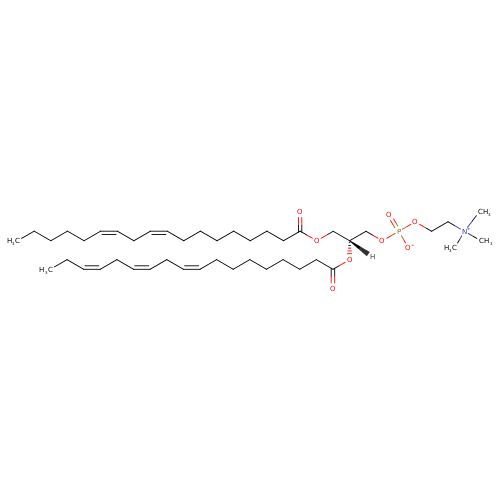
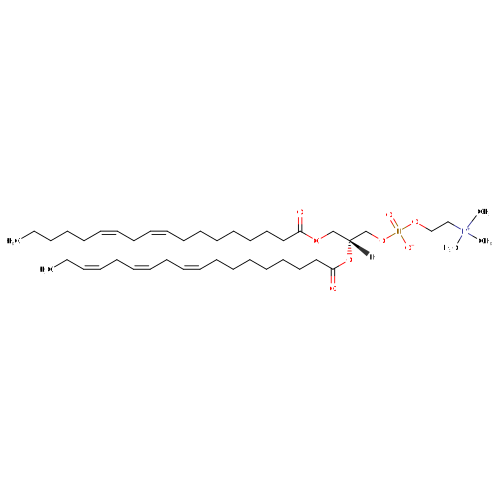
PC(18:2(9Z,12Z)/18:3(9Z,12Z,15Z)), also known as gpcho(36:5) or phosphatidylcholine(18:2/18:3), belongs to the class of organic compounds known as phosphatidylcholines. These are glycerophosphocholines in which the two free -OH are attached to one fatty acid each through an ester linkage. Thus, PC(18:2(9Z,12Z)/18:3(9Z,12Z,15Z)) is considered to be a glycerophosphocholine lipid molecule. PC(18:2(9Z,12Z)/18:3(9Z,12Z,15Z)) is a very hydrophobic molecule, practically insoluble (in water), and relatively neutral. PC(18:2(9Z,12Z)/18:3(9Z,12Z,15Z)) exists in all eukaryotes, ranging from yeast to humans. PC(18:2(9Z,12Z)/18:3(9Z,12Z,15Z)) participates in a number of enzymatic reactions, within cattle. In particular, S-Adenosylhomocysteine and PC(18:2(9Z,12Z)/18:3(9Z,12Z,15Z)) can be biosynthesized from S-adenosylmethionine and pe-nme2(18:2(9Z,12Z)/18:3(9Z,12Z,15Z)); which is catalyzed by the enzyme phosphatidylethanolamine N-methyltransferase. Furthermore, Cytidine monophosphate and PC(18:2(9Z,12Z)/18:3(9Z,12Z,15Z)) can be biosynthesized from CDP-choline and DG(18:2(9Z,12Z)/18:3(9Z,12Z,15Z)/0:0); which is catalyzed by the enzyme choline/ethanolaminephosphotransferase. Finally, PC(18:2(9Z,12Z)/18:3(9Z,12Z,15Z)) and L-serine can be converted into choline and PS(18:2(9Z,12Z)/18:3(9Z,12Z,15Z)) through its interaction with the enzyme phosphatidylserine synthase. In cattle, PC(18:2(9Z,12Z)/18:3(9Z,12Z,15Z)) is involved in a couple of metabolic pathways, which include phosphatidylcholine biosynthesis PC(18:2(9Z,12Z)/18:3(9Z,12Z,15Z)) pathway and phosphatidylethanolamine biosynthesis pe(18:2(9Z,12Z)/18:3(9Z,12Z,15Z)) pathway.
belongs to the class of organic compounds known as phosphatidylcholines. These are glycerophosphocholines in which the two free -OH are attached to one fatty acid each through an ester linkage.