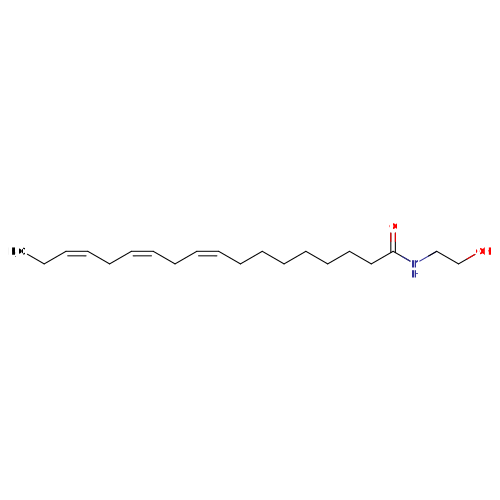
Record Information
Version1.0
Creation Date2016-05-27 01:26:31 UTC
Update Date2016-11-09 01:22:28 UTC
Accession NumberCHEM041389
Identification
Common Namealpha-Linolenoyl ethanolamide
ClassSmall Molecule
Descriptionalpha-Linolenoyl ethanolamide is a N-acylethanolamine. N-acylethanolamines (NAEs) constitute a class of lipid compounds naturally present in both animal and plant membranes as constituents of the membrane-bound phospholipid, N-acylphosphatidylethanolamine (NAPE). NAPE is composed of a third fatty acid moiety linked to the amino head group of the commonly occurring membrane phospholipid, phosphatidylethanolamine. NAEs are released from NAPE by phospholipase D-type hydrolases in response to a variety of stimuli. Transient NAE release and accumulation has been attributed a variety of biological activities, including neurotransmission, membrane protection, and immunomodulation in animals. N-oleoylethanolamine is an inhibitor of the sphingolipid signaling pathway, via specific ceramidase inhibition (ceramidase converts ceramide to sphingosine). N-oleoylethanolamine blocks the effects of TNF- and arachidonic acid on intracellular Ca concentration. (PMID: 12692337, 12056855, 12560208, 11997249).
Contaminant Sources
  • FooDB Chemicals
Contaminant TypeNot Available
Chemical Structure
Thumb
Synonyms
ValueSource
a-Linolenoyl ethanolamideGenerator
Α-linolenoyl ethanolamideGenerator
Linoleoyl ethanolamideChEMBL, HMDB
alpha-LEAHMDB
N-cis-9,12,15-OctadecatrienoylethanolamineHMDB
ALEA compoundMeSH, HMDB
alpha-Linolenoyl ethanolamideMeSH
Chemical FormulaC20H35NO2
Average Molecular Mass321.497 g/mol
Monoisotopic Mass321.267 g/mol
CAS Registry NumberNot Available
IUPAC Name(9Z,12Z,15Z)-N-(2-hydroxyethyl)octadeca-9,12,15-trienamide
Traditional Name(9Z,12Z,15Z)-N-(2-hydroxyethyl)octadeca-9,12,15-trienamide
SMILESCC\C=C/C\C=C/C\C=C/CCCCCCCC(=O)NCCO
InChI IdentifierInChI=1S/C20H35NO2/c1-2-3-4-5-6-7-8-9-10-11-12-13-14-15-16-17-20(23)21-18-19-22/h3-4,6-7,9-10,22H,2,5,8,11-19H2,1H3,(H,21,23)/b4-3-,7-6-,10-9-
InChI KeyHBJXRRXWHSHZPU-PDBXOOCHSA-N
Chemical Taxonomy
Description belongs to the class of organic compounds known as n-acylethanolamines. N-acylethanolamines are compounds containing an N-acyethanolamine moiety, which is characterized by an acyl group is linked to the nitrogen atom of ethanolamine.
KingdomOrganic compounds
Super ClassOrganic nitrogen compounds
ClassOrganonitrogen compounds
Sub ClassAmines
Direct ParentN-acylethanolamines
Alternative Parents
Substituents
  • N-acylethanolamine
  • Fatty amide
  • N-acyl-amine
  • Fatty acyl
  • Carboxamide group
  • Secondary carboxylic acid amide
  • Carboxylic acid derivative
  • Alcohol
  • Organooxygen compound
  • Primary alcohol
  • Hydrocarbon derivative
  • Organic oxide
  • Organopnictogen compound
  • Organic oxygen compound
  • Carbonyl group
  • Aliphatic acyclic compound
Molecular FrameworkAliphatic acyclic compounds
External Descriptors
Biological Properties
StatusDetected and Not Quantified
OriginNot Available
Cellular LocationsNot Available
Biofluid LocationsNot Available
Tissue LocationsNot Available
PathwaysNot Available
ApplicationsNot Available
Biological RolesNot Available
Chemical RolesNot Available
Physical Properties
StateNot Available
AppearanceNot Available
Experimental Properties
PropertyValue
Melting PointNot Available
Boiling PointNot Available
SolubilityNot Available
Predicted Properties
PropertyValueSource
Water Solubility0.001 g/LALOGPS
logP5.6ALOGPS
logP4.79ChemAxon
logS-5.5ALOGPS
pKa (Strongest Acidic)15.47ChemAxon
pKa (Strongest Basic)-0.33ChemAxon
Physiological Charge0ChemAxon
Hydrogen Acceptor Count2ChemAxon
Hydrogen Donor Count2ChemAxon
Polar Surface Area49.33 ŲChemAxon
Rotatable Bond Count15ChemAxon
Refractivity102.65 m³·mol⁻¹ChemAxon
Polarizability40.15 ųChemAxon
Number of Rings0ChemAxon
Bioavailability1ChemAxon
Rule of FiveYesChemAxon
Ghose FilterYesChemAxon
Veber's RuleNoChemAxon
MDDR-like RuleNoChemAxon
Spectra
Spectra
Spectrum TypeDescriptionSplash KeyView
Predicted GC-MSPredicted GC-MS Spectrum - GC-MS (Non-derivatized) - 70eV, Positivesplash10-01ot-3960000000-226ecbd1b70d86c5d3feSpectrum
Predicted GC-MSPredicted GC-MS Spectrum - GC-MS (1 TMS) - 70eV, Positivesplash10-00dj-9664000000-ad5a0bcf746ff0c9f253Spectrum
Predicted GC-MSPredicted GC-MS Spectrum - GC-MS (Non-derivatized) - 70eV, PositiveNot AvailableSpectrum
LC-MS/MSLC-MS/MS Spectrum - 10V, Positivesplash10-00di-0009000000-1e9fdf4410a883c28949Spectrum
LC-MS/MSLC-MS/MS Spectrum - 20V, Positivesplash10-0n9v-9644000000-a75202b20bb446a4cfdaSpectrum
LC-MS/MSLC-MS/MS Spectrum - 20V, Positivesplash10-0i7m-9644000000-f11332b1cc1fa38692faSpectrum
LC-MS/MSLC-MS/MS Spectrum - 40V, Positivesplash10-005c-9000000000-2c9af53cbc535abe705dSpectrum
Predicted LC-MS/MSPredicted LC-MS/MS Spectrum - 10V, Positivesplash10-0229-6159000000-94057d6cc19761ecbccdSpectrum
Predicted LC-MS/MSPredicted LC-MS/MS Spectrum - 20V, Positivesplash10-03dl-9120000000-9388d7c84f3083f8cd56Spectrum
Predicted LC-MS/MSPredicted LC-MS/MS Spectrum - 40V, Positivesplash10-03di-9210000000-119fd7ae8ce73abb4f88Spectrum
Predicted LC-MS/MSPredicted LC-MS/MS Spectrum - 10V, Negativesplash10-00di-0029000000-d0f5f7309a8af700f923Spectrum
Predicted LC-MS/MSPredicted LC-MS/MS Spectrum - 20V, Negativesplash10-0h93-8079000000-d6f0c40f18d74d1b3ef4Spectrum
Predicted LC-MS/MSPredicted LC-MS/MS Spectrum - 40V, Negativesplash10-0006-9010000000-eae31bc3ee94bdd98215Spectrum
Predicted LC-MS/MSPredicted LC-MS/MS Spectrum - 10V, Negativesplash10-00di-0019000000-60eaea70585d78109afbSpectrum
Predicted LC-MS/MSPredicted LC-MS/MS Spectrum - 20V, Negativesplash10-00di-5139000000-30c4ca9390a8dd057429Spectrum
Predicted LC-MS/MSPredicted LC-MS/MS Spectrum - 40V, Negativesplash10-052f-9010000000-3432f4d3ac3a1fc3def9Spectrum
Predicted LC-MS/MSPredicted LC-MS/MS Spectrum - 10V, Positivesplash10-0229-9127000000-65d40f108a9454c055f8Spectrum
Predicted LC-MS/MSPredicted LC-MS/MS Spectrum - 20V, Positivesplash10-03dl-9000000000-8f2f6fdda3afa6267e40Spectrum
Predicted LC-MS/MSPredicted LC-MS/MS Spectrum - 40V, Positivesplash10-01ox-9100000000-79e84dade50d1194d955Spectrum
Toxicity Profile
Route of ExposureNot Available
Mechanism of ToxicityNot Available
MetabolismNot Available
Toxicity ValuesNot Available
Lethal DoseNot Available
Carcinogenicity (IARC Classification)Not Available
Uses/SourcesNot Available
Minimum Risk LevelNot Available
Health EffectsNot Available
SymptomsNot Available
TreatmentNot Available
Concentrations
Not Available
DrugBank IDNot Available
HMDB IDHMDB0013624
FooDB IDFDB029601
Phenol Explorer IDNot Available
KNApSAcK IDNot Available
BiGG IDNot Available
BioCyc IDNot Available
METLIN IDNot Available
PDB IDNot Available
Wikipedia LinkNot Available
Chemspider ID4446569
ChEBI ID613508
PubChem Compound ID5283449
Kegg Compound IDC13828
YMDB IDNot Available
ECMDB IDNot Available
References
Synthesis ReferenceNot Available
MSDSNot Available
General References
1. Tripathy S, Kleppinger-Sparace K, Dixon RA, Chapman KD: N-acylethanolamine signaling in tobacco is mediated by a membrane-associated, high-affinity binding protein. Plant Physiol. 2003 Apr;131(4):1781-91.
2. Lecour S, Smith RM, Woodward B, Opie LH, Rochette L, Sack MN: Identification of a novel role for sphingolipid signaling in TNF alpha and ischemic preconditioning mediated cardioprotection. J Mol Cell Cardiol. 2002 May;34(5):509-18.
3. Hofmann U, Domeier E, Frantz S, Laser M, Weckler B, Kuhlencordt P, Heuer S, Keweloh B, Ertl G, Bonz AW: Increased myocardial oxygen consumption by TNF-alpha is mediated by a sphingosine signaling pathway. Am J Physiol Heart Circ Physiol. 2003 Jun;284(6):H2100-5. Epub 2003 Jan 30.
4. Amadou A, Nawrocki A, Best-Belpomme M, Pavoine C, Pecker F: Arachidonic acid mediates dual effect of TNF-alpha on Ca2+ transients and contraction of adult rat cardiomyocytes. Am J Physiol Cell Physiol. 2002 Jun;282(6):C1339-47.