Record Information
Version1.0
Creation Date2016-05-27 01:05:43 UTC
Update Date2016-11-09 01:22:22 UTC
Accession NumberCHEM040958
Identification
Common Name15-Epi-lipoxin A4
ClassSmall Molecule
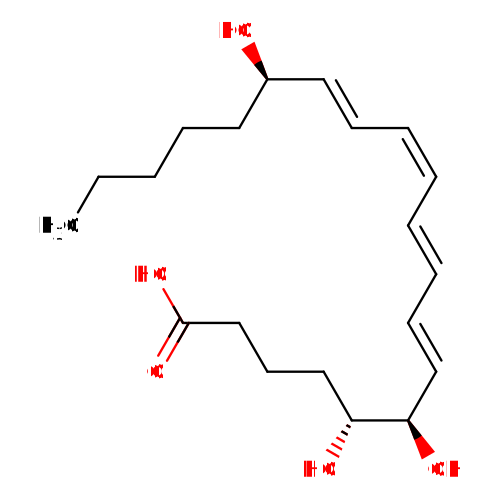
Description15-Epi-lipoxin A4 is a lipoxin derivative. Lipoxins (LXs) and aspirin-triggered Lipoxin (ATL) are trihydroxytetraene-containing eicosanoids generated from arachidonic acid that are distinct in structure, formation, and function from the many other proinflammatory lipid-derived mediators. These endogenous eicosanoids have now emerged as founding members of the first class of lipid/chemical mediators involved in the resolution of the inflammatory response. Lipoxin A4 (LXA4), ATL, and their metabolic stable analogs elicit cellular responses and regulate leukocyte trafficking in vivo by activating the specific receptor, ALX. Many of the eicosanoids derived from arachidonic acid (AA2), including prostaglandins (PGs) and leukotrienes (LTs), play important roles as local mediators exerting a wide range of actions relevant in immune hypersensitivity and inflammation. However, recent observations indicate that other agents derived from the lipoxygenase (LO) pathways are formed and play a key role in initiating the resolution of acute inflammation. This phenomenon is an active process that is governed by specific lipid mediators and involves a series of well-orchestrated temporal events. Thus, potent locally released mediators serve as checkpoint controllers of inflammation. In addition to the well-appreciated ability of aspirin to inhibit PGs, aspirin also acetylates cyclooxygenase (COX)-2, triggering the formation of a 15-epimeric form of lipoxins, termed aspirin-triggered LXA4 (ATL). These eicosanoids (i.e., LXA4 and ATL) with a unique trihydroxytetraene structure function as 'stop signals' in inflammation and actively participate in dampening host responses to bring the inflammation to a close, namely, resolution. LXA4 and ATL elicit the multicellular responses via a specific G protein-coupled receptor (GPCR) termed ALX that has been identified in human. (PMID: 16968948, 11478982).
Contaminant Sources
  • FooDB Chemicals
Contaminant TypeNot Available
Chemical Structure
Thumb
Synonyms
ValueSource
15-Epi-lxa(,4)HMDB
5(S),6(R),15(R)-Trihydroxy-7,9,13-trans-11-cis eicosatetraenoateHMDB
5(S),6(R),15(R)-Trihydroxy-7,9,13-trans-11-cis eicosatetraenoic acidHMDB
5(S),6(R),15(R)-Trihydroxy-7,9,13-trans-11-cis eicosatetraenoic acid anionHMDB
5(S),6(R),15(R)-Trihydroxy-7E,9E,11Z,13E-eicosatetraenoateHMDB
5(S),6(R),15(R)-Trihydroxy-7E,9E,11Z,13E-eicosatetraenoic acidHMDB
5(S),6(R),15(R)-Trihydroxy-7E,9E,11Z,13E-eicosatetraenoic acid anionHMDB
15-Epi-lxa4MeSH, HMDB
5,6,15-TriHETEMeSH, HMDB
5,6,15-Trihydroxy-7,9,11,13-eicosatetraenoic acidMeSH, HMDB
5,6,15-Tri-heteMeSH, HMDB
LXA4MeSH, HMDB
Lipoxin a4MeSH, HMDB
(5R,6R,7E,9E,11Z,15R)-5,6,15-Trihydroxyicosa-7,9,11,13-tetraenoateGenerator
Chemical FormulaC20H32O5
Average Molecular Mass352.465 g/mol
Monoisotopic Mass352.225 g/mol
CAS Registry NumberNot Available
IUPAC Name(5R,6R,7E,9E,11Z,13E,15R)-5,6,15-trihydroxyicosa-7,9,11,13-tetraenoic acid
Traditional Name(5R,6R,7E,9E,11Z,13E,15R)-5,6,15-trihydroxyicosa-7,9,11,13-tetraenoic acid
SMILESCCCCC[C@@H](O)\C=C\C=C/C=C/C=C/[C@@H](O)[C@H](O)CCCC(O)=O
InChI IdentifierInChI=1S/C20H32O5/c1-2-3-8-12-17(21)13-9-6-4-5-7-10-14-18(22)19(23)15-11-16-20(24)25/h4-7,9-10,13-14,17-19,21-23H,2-3,8,11-12,15-16H2,1H3,(H,24,25)/b6-4-,7-5+,13-9+,14-10+/t17-,18-,19-/m1/s1
InChI KeyIXAQOQZEOGMIQS-BZIKWXEGSA-N
Chemical Taxonomy
Description belongs to the class of organic compounds known as lipoxins. These are eicosanoids with a trihydroxyicosatetraenoic acid skeleton (a c20-fatty acid, with the chain bearing three hydroxyl groups and four double bonds). Lipoxins have four double bonds, which are all conjugated. In some cases a hydroxyl group is substituted by a C=O group.

KingdomOrganic compounds
Super ClassLipids and lipid-like molecules
ClassFatty Acyls
Sub ClassEicosanoids
Direct ParentLipoxins
Alternative Parents
Substituents
  • Lipoxin
  • Long-chain fatty acid
  • Hydroxy fatty acid
  • Fatty acid
  • Unsaturated fatty acid
  • Secondary alcohol
  • Carboxylic acid derivative
  • Carboxylic acid
  • Monocarboxylic acid or derivatives
  • Polyol
  • Organic oxide
  • Organic oxygen compound
  • Hydrocarbon derivative
  • Carbonyl group
  • Organooxygen compound
  • Alcohol
  • Aliphatic acyclic compound
Molecular FrameworkAliphatic acyclic compounds
External DescriptorsNot Available
Biological Properties
StatusDetected and Not Quantified
OriginNot Available
Cellular LocationsNot Available
Biofluid LocationsNot Available
Tissue LocationsNot Available
PathwaysNot Available
ApplicationsNot Available
Biological RolesNot Available
Chemical RolesNot Available
Physical Properties
StateNot Available
AppearanceNot Available
Experimental Properties
PropertyValue
Melting PointNot Available
Boiling PointNot Available
SolubilityNot Available
Predicted Properties
PropertyValueSource
Water Solubility0.044 g/LALOGPS
logP4.61ALOGPS
logP3.05ChemAxon
logS-3.9ALOGPS
pKa (Strongest Acidic)4.48ChemAxon
pKa (Strongest Basic)-1.6ChemAxon
Physiological Charge-1ChemAxon
Hydrogen Acceptor Count5ChemAxon
Hydrogen Donor Count4ChemAxon
Polar Surface Area97.99 ŲChemAxon
Rotatable Bond Count14ChemAxon
Refractivity104.35 m³·mol⁻¹ChemAxon
Polarizability41.17 ųChemAxon
Number of Rings0ChemAxon
Bioavailability1ChemAxon
Rule of FiveYesChemAxon
Ghose FilterYesChemAxon
Veber's RuleNoChemAxon
MDDR-like RuleNoChemAxon
Spectra
Spectra
Spectrum TypeDescriptionSplash KeyView
Predicted GC-MSPredicted GC-MS Spectrum - GC-MS (Non-derivatized) - 70eV, Positivesplash10-02ti-3942000000-539dee31c556f111beefSpectrum
Predicted GC-MSPredicted GC-MS Spectrum - GC-MS (4 TMS) - 70eV, Positivesplash10-004i-9023156000-8244ac03abe716c2ce53Spectrum
Predicted GC-MSPredicted GC-MS Spectrum - GC-MS (Non-derivatized) - 70eV, PositiveNot AvailableSpectrum
Predicted LC-MS/MSPredicted LC-MS/MS Spectrum - 10V, Positivesplash10-00kr-0019000000-19caadde5e524b5ae250Spectrum
Predicted LC-MS/MSPredicted LC-MS/MS Spectrum - 20V, Positivesplash10-00kr-9466000000-dc971dc55975b569912bSpectrum
Predicted LC-MS/MSPredicted LC-MS/MS Spectrum - 40V, Positivesplash10-000f-9430000000-bc82bb195c4947fa53cfSpectrum
Predicted LC-MS/MSPredicted LC-MS/MS Spectrum - 10V, Negativesplash10-0udi-0009000000-009f9c82d818546c6102Spectrum
Predicted LC-MS/MSPredicted LC-MS/MS Spectrum - 20V, Negativesplash10-0kai-4379000000-52c1e5333adc5555ffefSpectrum
Predicted LC-MS/MSPredicted LC-MS/MS Spectrum - 40V, Negativesplash10-0a4i-9340000000-ca0cb5410468b7dee5f8Spectrum
Predicted LC-MS/MSPredicted LC-MS/MS Spectrum - 10V, Negativesplash10-0ue9-0009000000-cb99b6286e5f411abaa3Spectrum
Predicted LC-MS/MSPredicted LC-MS/MS Spectrum - 20V, Negativesplash10-0gc0-4459000000-b29437cc7614015ca29bSpectrum
Predicted LC-MS/MSPredicted LC-MS/MS Spectrum - 40V, Negativesplash10-014j-9320000000-477457ab7d09daaade6bSpectrum
Predicted LC-MS/MSPredicted LC-MS/MS Spectrum - 10V, Positivesplash10-014r-0119000000-a8a3218eed37097e38daSpectrum
Predicted LC-MS/MSPredicted LC-MS/MS Spectrum - 20V, Positivesplash10-00kr-1936000000-0ece3e36fd898b1f9097Spectrum
Predicted LC-MS/MSPredicted LC-MS/MS Spectrum - 40V, Positivesplash10-059f-9600000000-18d8014a43feca3a38b6Spectrum
Toxicity Profile
Route of ExposureNot Available
Mechanism of ToxicityNot Available
MetabolismNot Available
Toxicity ValuesNot Available
Lethal DoseNot Available
Carcinogenicity (IARC Classification)Not Available
Uses/SourcesNot Available
Minimum Risk LevelNot Available
Health EffectsNot Available
SymptomsNot Available
TreatmentNot Available
Concentrations
Not Available
DrugBank IDNot Available
HMDB IDHMDB0012587
FooDB IDFDB029135
Phenol Explorer IDNot Available
KNApSAcK IDNot Available
BiGG IDNot Available
BioCyc IDNot Available
METLIN IDNot Available
PDB IDNot Available
Wikipedia LinkNot Available
Chemspider ID30776639
ChEBI IDNot Available
PubChem Compound ID52224362
Kegg Compound IDNot Available
YMDB IDNot Available
ECMDB IDNot Available
References
Synthesis ReferenceNot Available
MSDSNot Available
General References
1. Chiang N, Serhan CN, Dahlen SE, Drazen JM, Hay DW, Rovati GE, Shimizu T, Yokomizo T, Brink C: The lipoxin receptor ALX: potent ligand-specific and stereoselective actions in vivo. Pharmacol Rev. 2006 Sep;58(3):463-87.
2. McMahon B, Mitchell S, Brady HR, Godson C: Lipoxins: revelations on resolution. Trends Pharmacol Sci. 2001 Aug;22(8):391-5.
3. Simons K, Toomre D: Lipid rafts and signal transduction. Nat Rev Mol Cell Biol. 2000 Oct;1(1):31-9.
4. Watson AD: Thematic review series: systems biology approaches to metabolic and cardiovascular disorders. Lipidomics: a global approach to lipid analysis in biological systems. J Lipid Res. 2006 Oct;47(10):2101-11. Epub 2006 Aug 10.
5. Sethi JK, Vidal-Puig AJ: Thematic review series: adipocyte biology. Adipose tissue function and plasticity orchestrate nutritional adaptation. J Lipid Res. 2007 Jun;48(6):1253-62. Epub 2007 Mar 20.
6. Lingwood D, Simons K: Lipid rafts as a membrane-organizing principle. Science. 2010 Jan 1;327(5961):46-50. doi: 10.1126/science.1174621.
7. The lipid handbook with CD-ROM