Record Information
Version1.0
Creation Date2016-05-27 01:05:03 UTC
Update Date2016-11-09 01:22:21 UTC
Accession NumberCHEM040929
Identification
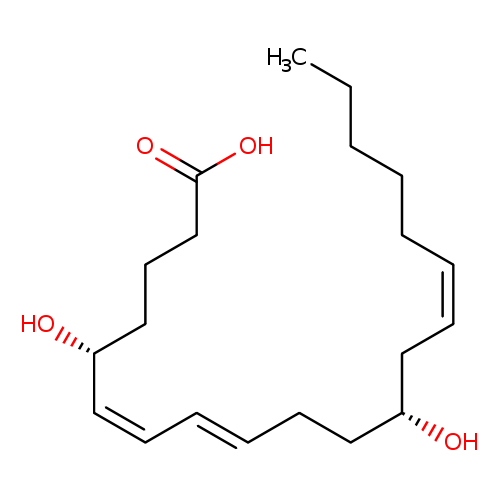
Common Name10,11-Dihydro-leukotriene B4
ClassSmall Molecule
Description10,11-dihydro-leukotriene B4 is the metabolite of lipid omega-oxidation of leukotriene B4 (LTB4). LTB4 is the major metabolite in neutrophil polymorphonuclear leukocytes. Omega-oxidation is the major pathway for the catabolism of leukotriene B4 in human polymorphonuclear leukocytes. Leukotrienes are metabolites of arachidonic acid derived from the action of 5-LO (5-lipoxygenase). The immediate product of 5-LO is LTA4 (leukotriene A4), which is enzymatically converted into either LTB4 (leukotriene B4) by LTA4 hydrolase or LTC4 (leukotriene C4) by LTC4 synthase. The regulation of leukotriene production occurs at various levels, including expression of 5-LO, translocation of 5-LO to the perinuclear region, and phosphorylation to either enhance or inhibit the activity of 5-LO. Biologically active LTB4 is metabolized by omega-oxidation carried out by specific cytochrome P450s (CYP4F) followed by beta-oxidation from the omega-carboxy position and after CoA ester formation (PMID: 7649996, 17623009, 2853166, 6088485). Leukotrienes are eicosanoids. The eicosanoids consist of the prostaglandins (PGs), thromboxanes (TXs), leukotrienes (LTs), and lipoxins (LXs). The PGs and TXs are collectively identified as prostanoids. Prostaglandins were originally shown to be synthesized in the prostate gland, thromboxanes from platelets (thrombocytes), and leukotrienes from leukocytes, hence the derivation of their names. All mammalian cells except erythrocytes synthesize eicosanoids. These molecules are extremely potent, able to cause profound physiological effects at very dilute concentrations. All eicosanoids function locally at the site of synthesis, through receptor-mediated G-protein linked signalling pathways.
Contaminant Sources
  • FooDB Chemicals
Contaminant TypeNot Available
Chemical Structure
Thumb
Synonyms
ValueSource
(5S,12R)-Dihydroxy-(6Z,8E,14Z)-eicosa-6,8,14-trienoateHMDB
(5S,12R)-Dihydroxy-(6Z,8E,14Z)-eicosa-6,8,14-trienoic acidHMDB
(5S,12R)-Dihydroxy-(6Z,8E,14Z)-eicosatrienoateHMDB
(5S,12R)-Dihydroxy-(6Z,8E,14Z)-eicosatrienoic acidHMDB
10,11-dihydro-LTB(,4)HMDB
DHLTB4HMDB
Chemical FormulaC20H34O4
Average Molecular Mass338.482 g/mol
Monoisotopic Mass338.246 g/mol
CAS Registry NumberNot Available
IUPAC Name(5R,6Z,8E,12R,14Z)-5,12-dihydroxyicosa-6,8,14-trienoic acid
Traditional Name(5R,6Z,8E,12R,14Z)-5,12-dihydroxyicosa-6,8,14-trienoic acid
SMILESCCCCC\C=C/C[C@H](O)CC\C=C\C=C/[C@H](O)CCCC(O)=O
InChI IdentifierInChI=1S/C20H34O4/c1-2-3-4-5-6-9-13-18(21)14-10-7-8-11-15-19(22)16-12-17-20(23)24/h6-9,11,15,18-19,21-22H,2-5,10,12-14,16-17H2,1H3,(H,23,24)/b8-7+,9-6-,15-11-/t18-,19-/m0/s1
InChI KeyNKUPFHTVILUPKF-RNEQFKNCSA-N
Chemical Taxonomy
Description belongs to the class of organic compounds known as hydroxyeicosatrienoic acids. These are eicosanoic acids with an attached hydroxyl group and three CC double bonds.

KingdomOrganic compounds
Super ClassLipids and lipid-like molecules
ClassFatty Acyls
Sub ClassEicosanoids
Direct ParentHydroxyeicosatrienoic acids
Alternative Parents
Substituents
  • Hydroxyeicosatrienoic acid
  • Long-chain fatty acid
  • Hydroxy fatty acid
  • Fatty acid
  • Unsaturated fatty acid
  • Secondary alcohol
  • Carboxylic acid derivative
  • Carboxylic acid
  • Monocarboxylic acid or derivatives
  • Organic oxide
  • Organic oxygen compound
  • Alcohol
  • Hydrocarbon derivative
  • Carbonyl group
  • Organooxygen compound
  • Aliphatic acyclic compound
Molecular FrameworkAliphatic acyclic compounds
External DescriptorsNot Available
Biological Properties
StatusDetected and Not Quantified
OriginNot Available
Cellular LocationsNot Available
Biofluid LocationsNot Available
Tissue LocationsNot Available
PathwaysNot Available
ApplicationsNot Available
Biological RolesNot Available
Chemical RolesNot Available
Physical Properties
StateNot Available
AppearanceNot Available
Experimental Properties
PropertyValue
Melting PointNot Available
Boiling PointNot Available
SolubilityNot Available
Predicted Properties
PropertyValueSource
Water Solubility0.012 g/LALOGPS
logP5.84ALOGPS
logP4.33ChemAxon
logS-4.5ALOGPS
pKa (Strongest Acidic)4.58ChemAxon
pKa (Strongest Basic)-1.1ChemAxon
Physiological Charge-1ChemAxon
Hydrogen Acceptor Count4ChemAxon
Hydrogen Donor Count3ChemAxon
Polar Surface Area77.76 ŲChemAxon
Rotatable Bond Count15ChemAxon
Refractivity102.02 m³·mol⁻¹ChemAxon
Polarizability40.21 ųChemAxon
Number of Rings0ChemAxon
Bioavailability1ChemAxon
Rule of FiveYesChemAxon
Ghose FilterYesChemAxon
Veber's RuleNoChemAxon
MDDR-like RuleNoChemAxon
Spectra
Spectra
Spectrum TypeDescriptionSplash KeyView
Predicted GC-MSPredicted GC-MS Spectrum - GC-MS (Non-derivatized) - 70eV, Positivesplash10-00dl-9887000000-690286bf648961968256Spectrum
Predicted GC-MSPredicted GC-MS Spectrum - GC-MS (3 TMS) - 70eV, Positivesplash10-00bm-9124640000-4783aa18d6e07934d465Spectrum
Predicted GC-MSPredicted GC-MS Spectrum - GC-MS (Non-derivatized) - 70eV, PositiveNot AvailableSpectrum
Predicted LC-MS/MSPredicted LC-MS/MS Spectrum - 10V, Positivesplash10-0fk9-0019000000-1d1e1cea32208dbe3634Spectrum
Predicted LC-MS/MSPredicted LC-MS/MS Spectrum - 20V, Positivesplash10-0wb9-5498000000-7741da59bcddc124a6c3Spectrum
Predicted LC-MS/MSPredicted LC-MS/MS Spectrum - 40V, Positivesplash10-000f-9450000000-de55909d83de13ce9f08Spectrum
Predicted LC-MS/MSPredicted LC-MS/MS Spectrum - 10V, Negativesplash10-00kr-0019000000-04ba161b7a53e2b655f2Spectrum
Predicted LC-MS/MSPredicted LC-MS/MS Spectrum - 20V, Negativesplash10-014r-1249000000-dfdb83af077f8dad3009Spectrum
Predicted LC-MS/MSPredicted LC-MS/MS Spectrum - 40V, Negativesplash10-0a4l-9350000000-7449096257f09b928abeSpectrum
Predicted LC-MS/MSPredicted LC-MS/MS Spectrum - 10V, Positivesplash10-0uk9-0019000000-f332f84891bf6e914004Spectrum
Predicted LC-MS/MSPredicted LC-MS/MS Spectrum - 20V, Positivesplash10-0uk9-2239000000-cc673b4c586984efdf86Spectrum
Predicted LC-MS/MSPredicted LC-MS/MS Spectrum - 40V, Positivesplash10-0aor-9300000000-ae2ee2279a8c0a058750Spectrum
Predicted LC-MS/MSPredicted LC-MS/MS Spectrum - 10V, Negativesplash10-000i-0009000000-42bc55e4154316e37496Spectrum
Predicted LC-MS/MSPredicted LC-MS/MS Spectrum - 20V, Negativesplash10-00kr-3349000000-0551b9e6c344eea69236Spectrum
Predicted LC-MS/MSPredicted LC-MS/MS Spectrum - 40V, Negativesplash10-0k96-8394000000-9132c6710a7579726f96Spectrum
Toxicity Profile
Route of ExposureNot Available
Mechanism of ToxicityNot Available
MetabolismNot Available
Toxicity ValuesNot Available
Lethal DoseNot Available
Carcinogenicity (IARC Classification)Not Available
Uses/SourcesNot Available
Minimum Risk LevelNot Available
Health EffectsNot Available
SymptomsNot Available
TreatmentNot Available
Concentrations
Not Available
DrugBank IDNot Available
HMDB IDHMDB0012504
FooDB IDFDB029106
Phenol Explorer IDNot Available
KNApSAcK IDNot Available
BiGG IDNot Available
BioCyc IDNot Available
METLIN IDNot Available
PDB IDNot Available
Wikipedia LinkNot Available
Chemspider ID30776625
ChEBI IDNot Available
PubChem Compound ID53481449
Kegg Compound IDNot Available
YMDB IDNot Available
ECMDB IDNot Available
References
Synthesis ReferenceNot Available
MSDSNot Available
General References
1. Wheelan P, Murphy RC: Metabolism of 6-trans-isomers of leukotriene B4 in cultured hepatoma cells and in human polymorphonuclear leukocytes. Identification of a delta 6-reductase metabolic pathway. J Biol Chem. 1995 Aug 25;270(34):19845-52.
2. Murphy RC, Gijon MA: Biosynthesis and metabolism of leukotrienes. Biochem J. 2007 Aug 1;405(3):379-95.
3. Mita H, Yui Y, Yasueda H, Shida T: Isocratic determination of arachidonic acid 5-lipoxygenase products in human neutrophils by high-performance liquid chromatography. J Chromatogr. 1988 Sep 9;430(2):299-308.
4. Shak S, Goldstein IM: Omega-oxidation is the major pathway for the catabolism of leukotriene B4 in human polymorphonuclear leukocytes. J Biol Chem. 1984 Aug 25;259(16):10181-7.
5. Simons K, Toomre D: Lipid rafts and signal transduction. Nat Rev Mol Cell Biol. 2000 Oct;1(1):31-9.
6. Watson AD: Thematic review series: systems biology approaches to metabolic and cardiovascular disorders. Lipidomics: a global approach to lipid analysis in biological systems. J Lipid Res. 2006 Oct;47(10):2101-11. Epub 2006 Aug 10.
7. Sethi JK, Vidal-Puig AJ: Thematic review series: adipocyte biology. Adipose tissue function and plasticity orchestrate nutritional adaptation. J Lipid Res. 2007 Jun;48(6):1253-62. Epub 2007 Mar 20.
8. Lingwood D, Simons K: Lipid rafts as a membrane-organizing principle. Science. 2010 Jan 1;327(5961):46-50. doi: 10.1126/science.1174621.
9. The lipid handbook with CD-ROM