Record Information
Version1.0
Creation Date2016-05-26 21:48:06 UTC
Update Date2016-11-09 01:22:17 UTC
Accession NumberCHEM040583
Identification
Common NameGanglioside GM3 (d18:0/18:0)
ClassSmall Molecule
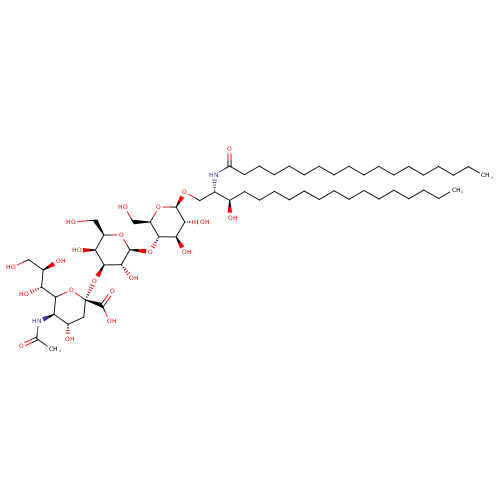
DescriptionGanglioside GM3 (d18:0/18:0) is a ganglioside. A ganglioside is a compound composed of a glycosphingolipid (ceramide and oligosaccharide) with one or more sialic acids (AKA n-acetylneuraminic acid, NANA) linked on the sugar chain. The 60+ known gangliosides differ mainly in the position and number of NANA residues. It is a component of the cell plasma membrane that modulates cell signal transduction events. It appears that they concentrate in lipid rafts. They have recently been found to be highly important in immunology. Natural and semisynthetic gangliosides are considered possible therapeutics for neurodegenerative disorders. Gangliosides are more complex glycosphingolipids in which oligosaccharide chains containing N-acetylneuraminic acid (NeuNAc) are attached to a ceramide. NeuNAc, an acetylated derivative of the carbohydrate sialic acid, makes the head groups of Gangliosides anionic. NB: the M in GM2 stands for monosialo, i.e., one NeuNAc residue. GM2 is the second monosialo ganglioside characterized, thus the subscript 2. Their structural diversity results from variation in the composition and sequence of the sugar residues. In all Gangliosides, the ceramide is linked through its C-1 to a beta-glucosyl residue, which, in turn, is bound to a beta-galactosyl residue. (Wikipedia) Particularly, Ganglioside GM3 (d18:0/18:0) is a GM3 ganglioside. A glycosphingolipid (ceramide and oligosaccharide) or oligoglycosylceramide with one or more sialic acids (i.e. n-acetylneuraminic acid) linked on the sugar chain. It is a component the cell plasma membrane which modulates cell signal transduction events. Gangliosides have been found to be highly important in immunology. Ganglioside GM3 carries a net-negative charge at pH 7.0 and is acidic. Gangliosides can amount to 6% of the weight of lipids from brain, but they are found at low levels in all animal tissues. Gangliosides are glycosphingolipids. There are four types of glycosphingolipids, the cerebrosides, sulfatides, globosides and gangliosides. Gangliosides are very similar to globosides except that they also contain N-acetyl neuraminic acid (NANA) in varying amounts. The specific names for the gangliosides provide information about their structure. The letter G refers to ganglioside, and the subscripts M, D, T and Q indicate that the molecule contains mono-, di-, tri and quatra-sialic acid. The numbered subscripts 1, 2 and 3 refer to the carbohydrate sequence that is attached to the ceramide. In particular, 1 stands for GalGalNAcGalGlc-ceramide, 2 stands for GalNAcGalGlc-ceramide and 3 stands for GalGlc-ceramide. Deficiencies in lysosomal enzymes that degrade the carbohydrate portions of various gangliosides are responsible for a number of lysosomal storage diseases such as Tay-Sachs disease, Sandhoff disease, and GM1 gangliosidosis. The carbohydrate portion of the ganglioside GM1 is the site of attachment of cholera toxin, the protein secreted by Vibrio cholerae.
Contaminant Sources
  • FooDB Chemicals
Contaminant TypeNot Available
Chemical Structure
Thumb
Synonyms
ValueSource
(2S,4S,5R)-2-{[(2S,3R,4S,5S,6R)-2-{[(2R,3S,4R,5R,6R)-4,5-dihydroxy-6-{[(2S,3R)-3-hydroxy-2-[(1-hydroxyoctadecylidene)amino]octadecyl]oxy}-2-(hydroxymethyl)oxan-3-yl]oxy}-3,5-dihydroxy-6-(hydroxymethyl)oxan-4-yl]oxy}-4-hydroxy-5-[(1-hydroxyethylidene)amino]-6-[(1R,2R)-1,2,3-trihydroxypropyl]oxane-2-carboxylateGenerator, HMDB
Chemical FormulaC59H110N2O21
Average Molecular Mass1183.506 g/mol
Monoisotopic Mass1182.760 g/mol
CAS Registry NumberNot Available
IUPAC Name(2S,4S,5R)-2-{[(2S,3R,4S,5S,6R)-2-{[(2R,3S,4R,5R,6R)-4,5-dihydroxy-6-{[(2S,3R)-3-hydroxy-2-octadecanamidooctadecyl]oxy}-2-(hydroxymethyl)oxan-3-yl]oxy}-3,5-dihydroxy-6-(hydroxymethyl)oxan-4-yl]oxy}-5-acetamido-4-hydroxy-6-[(1R,2R)-1,2,3-trihydroxypropyl]oxane-2-carboxylic acid
Traditional Name(2S,4S,5R)-2-{[(2S,3R,4S,5S,6R)-2-{[(2R,3S,4R,5R,6R)-4,5-dihydroxy-6-{[(2S,3R)-3-hydroxy-2-octadecanamidooctadecyl]oxy}-2-(hydroxymethyl)oxan-3-yl]oxy}-3,5-dihydroxy-6-(hydroxymethyl)oxan-4-yl]oxy}-5-acetamido-4-hydroxy-6-[(1R,2R)-1,2,3-trihydroxypropyl]oxane-2-carboxylic acid
SMILESCCCCCCCCCCCCCCCCCC(=O)N[C@@H](CO[C@@H]1O[C@H](CO)[C@@H](O[C@@H]2O[C@H](CO)[C@H](O)[C@H](O[C@@]3(C[C@H](O)[C@@H](NC(C)=O)C(O3)[C@H](O)[C@H](O)CO)C(O)=O)[C@H]2O)[C@H](O)[C@H]1O)[C@H](O)CCCCCCCCCCCCCCC
InChI IdentifierInChI=1S/C59H110N2O21/c1-4-6-8-10-12-14-16-18-19-21-23-25-27-29-31-33-46(69)61-40(41(66)32-30-28-26-24-22-20-17-15-13-11-9-7-5-2)38-77-56-51(73)50(72)53(45(37-64)79-56)80-57-52(74)55(49(71)44(36-63)78-57)82-59(58(75)76)34-42(67)47(60-39(3)65)54(81-59)48(70)43(68)35-62/h40-45,47-57,62-64,66-68,70-74H,4-38H2,1-3H3,(H,60,65)(H,61,69)(H,75,76)/t40-,41+,42-,43+,44+,45+,47+,48+,49-,50+,51+,52+,53+,54?,55-,56+,57-,59-/m0/s1
InChI KeyCFCULLUWKLQKFQ-SSYCJGENSA-N
Chemical Taxonomy
Description belongs to the class of organic compounds known as glycosphingolipids. These are sphingolipids containing a saccharide moiety glycosidically attached to the sphingoid base. Although saccharide moieties are mostly O-glycosidically linked to the ceramide moiety, other sphingolipids with glycosidic bonds of other types (e.g. S-,C-, or N-type) has been reported.

KingdomOrganic compounds
Super ClassLipids and lipid-like molecules
ClassSphingolipids
Sub ClassGlycosphingolipids
Direct ParentGlycosphingolipids
Alternative Parents
Substituents
  • Glycosphingolipid
  • Oligosaccharide
  • N-acylneuraminic acid
  • N-acylneuraminic acid or derivatives
  • Neuraminic acid
  • Fatty acyl glycoside
  • C-glucuronide
  • Alkyl glycoside
  • Glycosyl compound
  • C-glycosyl compound
  • O-glycosyl compound
  • Ketal
  • Fatty amide
  • Fatty acyl
  • Pyran
  • N-acyl-amine
  • Oxane
  • Acetamide
  • Carboxamide group
  • Secondary carboxylic acid amide
  • Secondary alcohol
  • Acetal
  • Carboxylic acid derivative
  • Carboxylic acid
  • Oxacycle
  • Organoheterocyclic compound
  • Monocarboxylic acid or derivatives
  • Polyol
  • Hydrocarbon derivative
  • Alcohol
  • Organic oxide
  • Organic nitrogen compound
  • Organic oxygen compound
  • Organopnictogen compound
  • Primary alcohol
  • Carbonyl group
  • Organooxygen compound
  • Organonitrogen compound
  • Aliphatic heteromonocyclic compound
Molecular FrameworkAliphatic heteromonocyclic compounds
External DescriptorsNot Available
Biological Properties
StatusDetected and Not Quantified
OriginNot Available
Cellular LocationsNot Available
Biofluid LocationsNot Available
Tissue LocationsNot Available
PathwaysNot Available
ApplicationsNot Available
Biological RolesNot Available
Chemical RolesNot Available
Physical Properties
StateNot Available
AppearanceNot Available
Experimental Properties
PropertyValue
Melting PointNot Available
Boiling PointNot Available
SolubilityNot Available
Predicted Properties
PropertyValueSource
Water Solubility0.031 g/LALOGPS
logP3.99ALOGPS
logP6.02ChemAxon
logS-4.6ALOGPS
pKa (Strongest Acidic)2.84ChemAxon
pKa (Strongest Basic)-3.5ChemAxon
Physiological Charge-1ChemAxon
Hydrogen Acceptor Count21ChemAxon
Hydrogen Donor Count14ChemAxon
Polar Surface Area373.41 ŲChemAxon
Rotatable Bond Count46ChemAxon
Refractivity299.11 m³·mol⁻¹ChemAxon
Polarizability137.35 ųChemAxon
Number of Rings3ChemAxon
Bioavailability0ChemAxon
Rule of FiveNoChemAxon
Ghose FilterNoChemAxon
Veber's RuleNoChemAxon
MDDR-like RuleYesChemAxon
Spectra
Spectra
Spectrum TypeDescriptionSplash KeyView
Predicted LC-MS/MSPredicted LC-MS/MS Spectrum - 10V, Positivesplash10-0fsi-2900560110-15395260c05fbe8ed605Spectrum
Predicted LC-MS/MSPredicted LC-MS/MS Spectrum - 20V, Positivesplash10-0w9r-2601940710-c2d81fb64d08d7ba38a3Spectrum
Predicted LC-MS/MSPredicted LC-MS/MS Spectrum - 40V, Positivesplash10-001i-9331430001-ceb9bad09d06d6413472Spectrum
Predicted LC-MS/MSPredicted LC-MS/MS Spectrum - 10V, Negativesplash10-001i-9740000100-2bedefb115b2fdcd59d3Spectrum
Predicted LC-MS/MSPredicted LC-MS/MS Spectrum - 20V, Negativesplash10-001i-4970301200-673878724bcf9fce4124Spectrum
Predicted LC-MS/MSPredicted LC-MS/MS Spectrum - 40V, Negativesplash10-054x-9632280410-bfb94c12751d754357bcSpectrum
Toxicity Profile
Route of ExposureNot Available
Mechanism of ToxicityNot Available
MetabolismNot Available
Toxicity ValuesNot Available
Lethal DoseNot Available
Carcinogenicity (IARC Classification)Not Available
Uses/SourcesNot Available
Minimum Risk LevelNot Available
Health EffectsNot Available
SymptomsNot Available
TreatmentNot Available
Concentrations
Not Available
DrugBank IDNot Available
HMDB IDHMDB0011916
FooDB IDFDB028585
Phenol Explorer IDNot Available
KNApSAcK IDNot Available
BiGG IDNot Available
BioCyc IDNot Available
METLIN IDNot Available
PDB IDNot Available
Wikipedia LinkNot Available
Chemspider ID35032231
ChEBI IDNot Available
PubChem Compound ID53481192
Kegg Compound IDNot Available
YMDB IDNot Available
ECMDB IDNot Available
References
Synthesis ReferenceNot Available
MSDSNot Available
General References
1. Simons K, Toomre D: Lipid rafts and signal transduction. Nat Rev Mol Cell Biol. 2000 Oct;1(1):31-9.
2. Watson AD: Thematic review series: systems biology approaches to metabolic and cardiovascular disorders. Lipidomics: a global approach to lipid analysis in biological systems. J Lipid Res. 2006 Oct;47(10):2101-11. Epub 2006 Aug 10.
3. Sethi JK, Vidal-Puig AJ: Thematic review series: adipocyte biology. Adipose tissue function and plasticity orchestrate nutritional adaptation. J Lipid Res. 2007 Jun;48(6):1253-62. Epub 2007 Mar 20.
4. Lingwood D, Simons K: Lipid rafts as a membrane-organizing principle. Science. 2010 Jan 1;327(5961):46-50. doi: 10.1126/science.1174621.
5. Divecha N, Irvine RF: Phospholipid signaling. Cell. 1995 Jan 27;80(2):269-78.
6. Ghosh S, Strum JC, Bell RM: Lipid biochemistry: functions of glycerolipids and sphingolipids in cellular signaling. FASEB J. 1997 Jan;11(1):45-50.
7. Phospholipids Handbook
8. The lipid handbook with CD-ROM