Record Information
Version1.0
Creation Date2016-05-26 20:39:12 UTC
Update Date2016-11-09 01:22:15 UTC
Accession NumberCHEM040461
Identification
Common NameCer(d18:0/20:0)
ClassSmall Molecule
DescriptionCeramides (N-acylsphingosine) are one of the hydrolysis byproducts of sphingomyelin by the enzyme sphingomyelinase (sphingomyelin phosphorylcholine phosphohydrolase E.C.3.1.4.12) which has been identified in the subcellular fractions of human epidermis (PMID 25935) and many other tissues. They can also be synthesized from serine and palmitate in a de novo pathway and are regarded as important cellular signals for inducing apoptosis (PMID 14998372). Is key in the biosynthesis of glycosphingolipids and gangliosides.
Contaminant Sources
  • FooDB Chemicals
Contaminant TypeNot Available
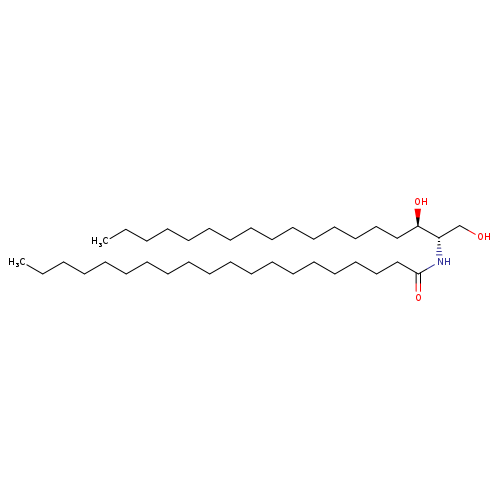
Chemical Structure
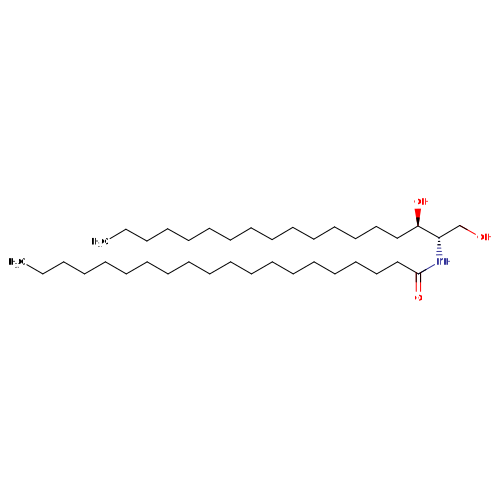
Thumb
Synonyms
ValueSource
C20DH CerChEBI
DHC-a 18:0/20:0ChEBI
N-(Eicosanoyl)-dihydroceramideChEBI
N-(Eicosanoyl)-sphinganineChEBI
N-[(2S,3R)-1,3-Dihydroxyoctadecan-2-yl]eicosanamideChEBI
N-EicosanoyldihydroceramideChEBI
N-EicosanoyldihydrosphingosineChEBI
N-IcosanoyldihydroceramideChEBI
N-IcosanoyldihydrosphingosineChEBI
N-IcosanoylsphinganineChEBI
CeramideMetBuilder
Ceramide(D18:0/20:0)MetBuilder
N-(Eicosanoyl)-dihydrosphingosineMetBuilder
N-(Eicosanoyl)-D-erythro-sphinganineMetBuilder
Chemical FormulaC38H77NO3
Average Molecular Mass596.023 g/mol
Monoisotopic Mass595.590 g/mol
CAS Registry NumberNot Available
IUPAC NameN-[(2S,3R)-1,3-dihydroxyoctadecan-2-yl]icosanamide
Traditional NameC20DH cer
SMILESCCCCCCCCCCCCCCCCCCCC(=O)N[C@@H](CO)[C@H](O)CCCCCCCCCCCCCCC
InChI IdentifierInChI=1S/C38H77NO3/c1-3-5-7-9-11-13-15-17-18-19-20-22-24-26-28-30-32-34-38(42)39-36(35-40)37(41)33-31-29-27-25-23-21-16-14-12-10-8-6-4-2/h36-37,40-41H,3-35H2,1-2H3,(H,39,42)/t36-,37+/m0/s1
InChI KeyZWAUSWHRQBSECP-PQQNNWGCSA-N
Chemical Taxonomy
Description belongs to the class of organic compounds known as long-chain ceramides. These are ceramides bearing a long chain fatty acid.
KingdomOrganic compounds
Super ClassLipids and lipid-like molecules
ClassSphingolipids
Sub ClassCeramides
Direct ParentLong-chain ceramides
Alternative Parents
Substituents
  • Long-chain ceramide
  • Fatty amide
  • N-acyl-amine
  • Fatty acyl
  • Carboxamide group
  • Secondary alcohol
  • Secondary carboxylic acid amide
  • Carboxylic acid derivative
  • Primary alcohol
  • Organooxygen compound
  • Organonitrogen compound
  • Organic oxide
  • Organopnictogen compound
  • Organic oxygen compound
  • Alcohol
  • Organic nitrogen compound
  • Carbonyl group
  • Hydrocarbon derivative
  • Aliphatic acyclic compound
Molecular FrameworkAliphatic acyclic compounds
External Descriptors
Biological Properties
StatusDetected and Not Quantified
OriginNot Available
Cellular LocationsNot Available
Biofluid LocationsNot Available
Tissue LocationsNot Available
PathwaysNot Available
ApplicationsNot Available
Biological RolesNot Available
Chemical RolesNot Available
Physical Properties
StateNot Available
AppearanceNot Available
Experimental Properties
PropertyValue
Melting PointNot Available
Boiling PointNot Available
SolubilityNot Available
Predicted Properties
PropertyValueSource
Water Solubility2.6e-05 g/LALOGPS
logP9.94ALOGPS
logP12.85ChemAxon
logS-7.4ALOGPS
pKa (Strongest Acidic)13.83ChemAxon
pKa (Strongest Basic)0.034ChemAxon
Physiological Charge0ChemAxon
Hydrogen Acceptor Count3ChemAxon
Hydrogen Donor Count3ChemAxon
Polar Surface Area69.56 ŲChemAxon
Rotatable Bond Count35ChemAxon
Refractivity183.22 m³·mol⁻¹ChemAxon
Polarizability82.32 ųChemAxon
Number of Rings0ChemAxon
Bioavailability0ChemAxon
Rule of FiveNoChemAxon
Ghose FilterNoChemAxon
Veber's RuleNoChemAxon
MDDR-like RuleNoChemAxon
Spectra
Spectra
Spectrum TypeDescriptionSplash KeyView
Predicted GC-MSPredicted GC-MS Spectrum - GC-MS (1 TMS) - 70eV, Positivesplash10-0zg0-5034879000-afbd073f013e0f7aa68eSpectrum
Predicted GC-MSPredicted GC-MS Spectrum - GC-MS ("Cer(d18:0/20:0),1TMS,#1" TMS) - 70eV, PositiveNot AvailableSpectrum
Predicted GC-MSPredicted GC-MS Spectrum - GC-MS (TMS_1_2) - 70eV, PositiveNot AvailableSpectrum
Predicted GC-MSPredicted GC-MS Spectrum - GC-MS (TMS_1_3) - 70eV, PositiveNot AvailableSpectrum
Predicted GC-MSPredicted GC-MS Spectrum - GC-MS (TMS_2_1) - 70eV, PositiveNot AvailableSpectrum
Predicted GC-MSPredicted GC-MS Spectrum - GC-MS (TMS_2_2) - 70eV, PositiveNot AvailableSpectrum
Predicted GC-MSPredicted GC-MS Spectrum - GC-MS (TMS_2_3) - 70eV, PositiveNot AvailableSpectrum
Predicted GC-MSPredicted GC-MS Spectrum - GC-MS (TBDMS_1_1) - 70eV, PositiveNot AvailableSpectrum
Predicted GC-MSPredicted GC-MS Spectrum - GC-MS (TBDMS_1_2) - 70eV, PositiveNot AvailableSpectrum
Predicted GC-MSPredicted GC-MS Spectrum - GC-MS (TBDMS_1_3) - 70eV, PositiveNot AvailableSpectrum
Predicted GC-MSPredicted GC-MS Spectrum - GC-MS (TBDMS_2_1) - 70eV, PositiveNot AvailableSpectrum
Predicted GC-MSPredicted GC-MS Spectrum - GC-MS (TBDMS_2_2) - 70eV, PositiveNot AvailableSpectrum
Predicted GC-MSPredicted GC-MS Spectrum - GC-MS (TBDMS_2_3) - 70eV, PositiveNot AvailableSpectrum
Predicted LC-MS/MSPredicted LC-MS/MS Spectrum - 10V, Positivesplash10-0002-0000090000-27fa7157e2d7117463bdSpectrum
Predicted LC-MS/MSPredicted LC-MS/MS Spectrum - 20V, Positivesplash10-00kb-0050090000-3a89ea12e565b5a87c00Spectrum
Predicted LC-MS/MSPredicted LC-MS/MS Spectrum - 40V, Positivesplash10-017i-0090050000-cf2483328fb1d9aa0f58Spectrum
Predicted LC-MS/MSPredicted LC-MS/MS Spectrum - 10V, Positivesplash10-0udi-0000009000-773a56d432b1704f630dSpectrum
Predicted LC-MS/MSPredicted LC-MS/MS Spectrum - 20V, Positivesplash10-0udi-0000009000-773a56d432b1704f630dSpectrum
Predicted LC-MS/MSPredicted LC-MS/MS Spectrum - 40V, Positivesplash10-001i-0000091000-201167f6d50fdf029c37Spectrum
Predicted LC-MS/MSPredicted LC-MS/MS Spectrum - 10V, Positivesplash10-0002-0000090000-9127dcf3624cc503b5ccSpectrum
Predicted LC-MS/MSPredicted LC-MS/MS Spectrum - 20V, Positivesplash10-00kb-0050090000-0cb8327725944c036296Spectrum
Predicted LC-MS/MSPredicted LC-MS/MS Spectrum - 40V, Positivesplash10-017i-0090050000-d205bae079950348612bSpectrum
Predicted LC-MS/MSPredicted LC-MS/MS Spectrum - 10V, Negativesplash10-0006-0000090000-fd1c1b49795e23e66d9dSpectrum
Predicted LC-MS/MSPredicted LC-MS/MS Spectrum - 20V, Negativesplash10-0006-0010090000-5693affe4dad5df502eeSpectrum
Predicted LC-MS/MSPredicted LC-MS/MS Spectrum - 40V, Negativesplash10-03do-0031090000-536bb488e412cfa71de9Spectrum
Toxicity Profile
Route of ExposureNot Available
Mechanism of ToxicityNot Available
MetabolismNot Available
Toxicity ValuesNot Available
Lethal DoseNot Available
Carcinogenicity (IARC Classification)Not Available
Uses/SourcesNot Available
Minimum Risk LevelNot Available
Health EffectsNot Available
SymptomsNot Available
TreatmentNot Available
Concentrations
Not Available
DrugBank IDNot Available
HMDB IDHMDB0011764
FooDB IDFDB028434
Phenol Explorer IDNot Available
KNApSAcK IDNot Available
BiGG IDNot Available
BioCyc IDNot Available
METLIN IDNot Available
PDB IDNot Available
Wikipedia LinkNot Available
Chemspider ID4446687
ChEBI ID67027
PubChem Compound ID5283574
Kegg Compound IDNot Available
YMDB IDNot Available
ECMDB IDNot Available
References
Synthesis ReferenceNot Available
MSDSNot Available
General References
1. Bowser PA, Gray GM: Sphingomyelinase in pig and human epidermis. J Invest Dermatol. 1978 Jun;70(6):331-5.
2. Tserng KY, Griffin RL: Ceramide metabolite, not intact ceramide molecule, may be responsible for cellular toxicity. Biochem J. 2004 Jun 15;380(Pt 3):715-22.
3. Simons K, Toomre D: Lipid rafts and signal transduction. Nat Rev Mol Cell Biol. 2000 Oct;1(1):31-9.
4. Watson AD: Thematic review series: systems biology approaches to metabolic and cardiovascular disorders. Lipidomics: a global approach to lipid analysis in biological systems. J Lipid Res. 2006 Oct;47(10):2101-11. Epub 2006 Aug 10.
5. Sethi JK, Vidal-Puig AJ: Thematic review series: adipocyte biology. Adipose tissue function and plasticity orchestrate nutritional adaptation. J Lipid Res. 2007 Jun;48(6):1253-62. Epub 2007 Mar 20.
6. Lingwood D, Simons K: Lipid rafts as a membrane-organizing principle. Science. 2010 Jan 1;327(5961):46-50. doi: 10.1126/science.1174621.
7. Divecha N, Irvine RF: Phospholipid signaling. Cell. 1995 Jan 27;80(2):269-78.
8. Ghosh S, Strum JC, Bell RM: Lipid biochemistry: functions of glycerolipids and sphingolipids in cellular signaling. FASEB J. 1997 Jan;11(1):45-50.
9. Pruett ST, Bushnev A, Hagedorn K, Adiga M, Haynes CA, Sullards MC, Liotta DC, Merrill AH Jr: Biodiversity of sphingoid bases ("sphingosines") and related amino alcohols. J Lipid Res. 2008 Aug;49(8):1621-39. doi: 10.1194/jlr.R800012-JLR200. Epub 2008 May 21.
10. Hannun YA, Obeid LM: Ceramide: an intracellular signal for apoptosis. Trends Biochem Sci. 1995 Feb;20(2):73-7.
11. Phospholipids Handbook
12. The lipid handbook with CD-ROM