Record Information
Version1.0
Creation Date2016-05-26 20:35:21 UTC
Update Date2016-11-09 01:22:15 UTC
Accession NumberCHEM040382
Identification
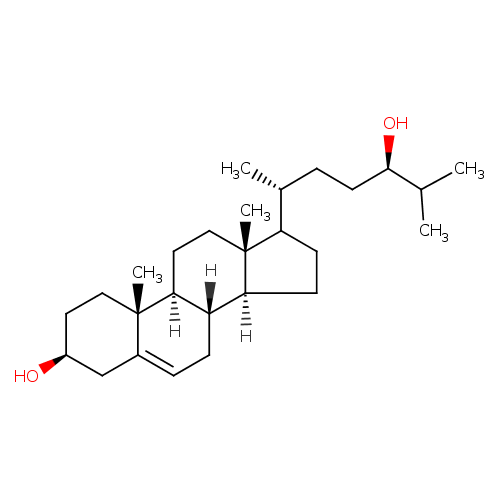
Common Name(24R)-Cholest-5-ene-3-beta,24-diol
ClassSmall Molecule
Description(24R)-Cholest-5-ene-3-beta,24-diol or 24(R)-Hydroxycholesterol is a hydroxysterol. It is a substrate for Cytochrome P450 39A1 (EC 1.14.13.99), which is primarily a liver-specific enzyme. It is involved in the following reaction: (24R)-cholest-5-ene-3-beta,24-diol + NADPH + O(2) = (24R)-cholest-5-ene-3-beta,7-alpha,24-triol + NADP(+) + H(2)O. 24(R)-Hydroxycholesterol is an intermediate in bile acid metabolism. The majority of circulating 24-hydroxycholesterol in humans is made in the brain and is increased in serum of Alzheimer patients. 24(S)-Hydroxycholesterol is generally more abundant in human tissues than 24(R)-Hydroxycholesterol. It has also been shown that 24(R) and 24(S)-Hydroxycholesterols are substrates for hepatic cholesterol 7-a hydroxylase (CYP7A), leading to the production of 7-alpha hydroxylated bile acids.
Contaminant Sources
  • FooDB Chemicals
Contaminant TypeNot Available
Chemical Structure
Thumb
Synonyms
ValueSource
(24R)-Cholest-5-ene-3-b,24-diolGenerator
(24R)-Cholest-5-ene-3-β,24-diolGenerator
(24R)-24-HydroxycholesterolHMDB
24(R)-HydoxycholesterolHMDB
5-Cholesten-3-beta,24(R)-diolHMDB
Cholest-5-ene-3,24-diolHMDB
Cholest-5-ene-3-beta,24-diolHMDB
Cholest-5-ene-3b,24-diolHMDB
(24R)-HydroxycholesterolChEBI
(3beta,24R)-Cholest-5-ene-3,24-diolChEBI
24(R)-HydroxycholesterolChEBI
24-EpicerebrosterolChEBI
24R-HydroxycholesterolChEBI
Cholest-5-ene-3beta,24R-diolChEBI
(3b,24R)-Cholest-5-ene-3,24-diolGenerator
(3Β,24R)-cholest-5-ene-3,24-diolGenerator
Cholest-5-ene-3b,24R-diolGenerator
Cholest-5-ene-3β,24R-diolGenerator
Chemical FormulaC27H46O2
Average Molecular Mass402.653 g/mol
Monoisotopic Mass402.350 g/mol
CAS Registry NumberNot Available
IUPAC Name(1S,2R,5S,10S,11S,15R)-14-[(2R,5R)-5-hydroxy-6-methylheptan-2-yl]-2,15-dimethyltetracyclo[8.7.0.0²,⁷.0¹¹,¹⁵]heptadec-7-en-5-ol
Traditional Name(1S,2R,5S,10S,11S,15R)-14-[(2R,5R)-5-hydroxy-6-methylheptan-2-yl]-2,15-dimethyltetracyclo[8.7.0.0²,⁷.0¹¹,¹⁵]heptadec-7-en-5-ol
SMILES[H][C@@]12CCC([C@H](C)CC[C@@H](O)C(C)C)[C@@]1(C)CC[C@@]1([H])[C@@]2([H])CC=C2C[C@@H](O)CC[C@]12C
InChI IdentifierInChI=1S/C27H46O2/c1-17(2)25(29)11-6-18(3)22-9-10-23-21-8-7-19-16-20(28)12-14-26(19,4)24(21)13-15-27(22,23)5/h7,17-18,20-25,28-29H,6,8-16H2,1-5H3/t18-,20+,21+,22?,23+,24+,25-,26+,27-/m1/s1
InChI KeyIOWMKBFJCNLRTC-BPWUYGJYSA-N
Chemical Taxonomy
Description belongs to the class of organic compounds known as dihydroxy bile acids, alcohols and derivatives. Dihydroxy bile acids, alcohols and derivatives are compounds containing or derived from a bile acid or alcohol, and which bears exactly two carboxylic acid groups.

KingdomOrganic compounds
Super ClassLipids and lipid-like molecules
ClassSteroids and steroid derivatives
Sub ClassBile acids, alcohols and derivatives
Direct ParentDihydroxy bile acids, alcohols and derivatives
Alternative Parents
Substituents
  • 24-hydroxysteroid
  • Dihydroxy bile acid, alcohol, or derivatives
  • 3-beta-hydroxysteroid
  • 3-beta-hydroxy-delta-5-steroid
  • Hydroxysteroid
  • 3-hydroxysteroid
  • 3-hydroxy-delta-5-steroid
  • Delta-5-steroid
  • Cyclic alcohol
  • Secondary alcohol
  • Organic oxygen compound
  • Hydrocarbon derivative
  • Organooxygen compound
  • Alcohol
  • Aliphatic homopolycyclic compound
Molecular FrameworkAliphatic homopolycyclic compounds
External DescriptorsNot Available
Biological Properties
StatusDetected and Not Quantified
OriginNot Available
Cellular LocationsNot Available
Biofluid LocationsNot Available
Tissue LocationsNot Available
PathwaysNot Available
ApplicationsNot Available
Biological RolesNot Available
Chemical RolesNot Available
Physical Properties
StateNot Available
AppearanceNot Available
Experimental Properties
PropertyValue
Melting PointNot Available
Boiling PointNot Available
SolubilityNot Available
Predicted Properties
PropertyValueSource
Water Solubility0.0004 g/LALOGPS
logP5.7ALOGPS
logP5.8ChemAxon
logS-6ALOGPS
pKa (Strongest Acidic)18.2ChemAxon
pKa (Strongest Basic)-0.95ChemAxon
Physiological Charge0ChemAxon
Hydrogen Acceptor Count2ChemAxon
Hydrogen Donor Count2ChemAxon
Polar Surface Area40.46 ŲChemAxon
Rotatable Bond Count5ChemAxon
Refractivity122.21 m³·mol⁻¹ChemAxon
Polarizability50.94 ųChemAxon
Number of Rings4ChemAxon
Bioavailability1ChemAxon
Rule of FiveNoChemAxon
Ghose FilterNoChemAxon
Veber's RuleNoChemAxon
MDDR-like RuleNoChemAxon
Spectra
Spectra
Spectrum TypeDescriptionSplash KeyView
Predicted GC-MSPredicted GC-MS Spectrum - GC-MS (Non-derivatized) - 70eV, Positivesplash10-0076-1009000000-918c634f2e40ac4fb8c3Spectrum
Predicted GC-MSPredicted GC-MS Spectrum - GC-MS (2 TMS) - 70eV, Positivesplash10-001i-2111290000-94668570804377216a37Spectrum
Predicted GC-MSPredicted GC-MS Spectrum - GC-MS (Non-derivatized) - 70eV, PositiveNot AvailableSpectrum
Predicted LC-MS/MSPredicted LC-MS/MS Spectrum - 10V, Positivesplash10-0f79-0009200000-0f92e092c978feb7ef4aSpectrum
Predicted LC-MS/MSPredicted LC-MS/MS Spectrum - 20V, Positivesplash10-00kr-4119100000-6a8569b9873ebded521aSpectrum
Predicted LC-MS/MSPredicted LC-MS/MS Spectrum - 40V, Positivesplash10-0c01-5049000000-3466fdb5c0a23399bea3Spectrum
Predicted LC-MS/MSPredicted LC-MS/MS Spectrum - 10V, Negativesplash10-0udi-0003900000-db2e1b276e6052150b6fSpectrum
Predicted LC-MS/MSPredicted LC-MS/MS Spectrum - 20V, Negativesplash10-0ue9-0009700000-55fe1a48489ad8aa8bb6Spectrum
Predicted LC-MS/MSPredicted LC-MS/MS Spectrum - 40V, Negativesplash10-00ri-7009000000-7a2a5d9fa1c30ba0c55bSpectrum
Predicted LC-MS/MSPredicted LC-MS/MS Spectrum - 10V, Positivesplash10-00kr-0209100000-bfa601e19f304e87cbf0Spectrum
Predicted LC-MS/MSPredicted LC-MS/MS Spectrum - 20V, Positivesplash10-07vu-4559000000-a66619fe39b0d508ca4cSpectrum
Predicted LC-MS/MSPredicted LC-MS/MS Spectrum - 40V, Positivesplash10-0a4i-5962000000-9419106f12041db2bda5Spectrum
Predicted LC-MS/MSPredicted LC-MS/MS Spectrum - 10V, Negativesplash10-0udi-0000900000-079f76b4d985e4b92c9dSpectrum
Predicted LC-MS/MSPredicted LC-MS/MS Spectrum - 20V, Negativesplash10-0udi-2002900000-8f2c13356a2deb497dc5Spectrum
Predicted LC-MS/MSPredicted LC-MS/MS Spectrum - 40V, Negativesplash10-0fr2-3019200000-8713943f0050708c3c27Spectrum
Toxicity Profile
Route of ExposureNot Available
Mechanism of ToxicityNot Available
MetabolismNot Available
Toxicity ValuesNot Available
Lethal DoseNot Available
Carcinogenicity (IARC Classification)Not Available
Uses/SourcesNot Available
Minimum Risk LevelNot Available
Health EffectsNot Available
SymptomsNot Available
TreatmentNot Available
Concentrations
Not Available
DrugBank IDNot Available
HMDB IDHMDB0011643
FooDB IDFDB028339
Phenol Explorer IDNot Available
KNApSAcK IDNot Available
BiGG IDNot Available
BioCyc IDCPD-7229
METLIN IDNot Available
PDB IDNot Available
Wikipedia LinkNot Available
Chemspider ID9681931
ChEBI ID55458
PubChem Compound ID53481009
Kegg Compound IDC15497
YMDB IDNot Available
ECMDB IDNot Available
References
Synthesis ReferenceNot Available
MSDSNot Available
General References
1. Simons K, Toomre D: Lipid rafts and signal transduction. Nat Rev Mol Cell Biol. 2000 Oct;1(1):31-9.
2. Watson AD: Thematic review series: systems biology approaches to metabolic and cardiovascular disorders. Lipidomics: a global approach to lipid analysis in biological systems. J Lipid Res. 2006 Oct;47(10):2101-11. Epub 2006 Aug 10.
3. Sethi JK, Vidal-Puig AJ: Thematic review series: adipocyte biology. Adipose tissue function and plasticity orchestrate nutritional adaptation. J Lipid Res. 2007 Jun;48(6):1253-62. Epub 2007 Mar 20.
4. Lingwood D, Simons K: Lipid rafts as a membrane-organizing principle. Science. 2010 Jan 1;327(5961):46-50. doi: 10.1126/science.1174621.
5. The lipid handbook with CD-ROM