Record Information
Version1.0
Creation Date2016-05-26 19:25:55 UTC
Update Date2026-04-05 14:31:45 UTC
Accession NumberCHEM039980
Identification
Common NameLysoPC(O-18:0)
ClassSmall Molecule
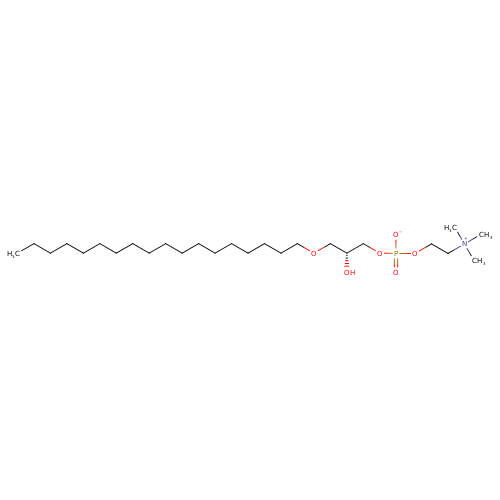
DescriptionLysoPC(O-18:0/0:0) is an intermediate in the ether lipid metabolism pathway. LysoPC(O-18:0/0:0) is irreversibly produced from 2-acetyl-1-(9Z-octadecenyl)-sn-glycero-3-phosphocholine via the enzyme 1-alkyl-2-acetylglycerophosphocholine esterase (EC 3.1.1.47). LysoPC(O-18:0/0:0) is an ether phospho-ether lipid. Ether lipids are lipids in which one or more of the carbon atoms on glycerol are bonded to an alkyl chain via an ether linkage, as opposed to the usual ester linkage. Plasmalogens are glycerol ether phospholipids. They are of two types, alkyl ether (-O-CH2-) and alkenyl ether (-O-CH=CH-). Dihydroxyacetone phosphate (DHAP) serves as the glycerol precursor for the synthesis of plasmalogens. Three major classes of plasmalogens have been identified: choline, ethanolamine and serine derivatives. Ethanolamine plasmalogen is prevalent in myelin. Choline plasmalogen is abundant in cardiac tissue. Usually, the highest proportion of the plasmalogen form is in the ethanolamine class with rather less in choline, and commonly little or none in other phospholipids such as phosphatidylinositol. In choline plasmalogens of most tissues, a higher proportion is often of the O-alkyl rather than the O-alkenyl form, but the reverse tends to be true in heart lipids. In animal tissues, the alkyl and alkenyl moieties in both non-polar and phospholipids tend to be rather simple in composition with 16:0, 18:0 and 18:1 (double bond in position 9) predominating. Ether analogues of triacylglycerols, i.e. 1-alkyldiacyl-sn-glycerols, are present at trace levels only if at all in most animal tissues, but they can be major components of some marine lipids.
Contaminant Sources
  • FooDB Chemicals
Contaminant TypeNot Available
Chemical Structure
Thumb
Synonyms
ValueSource
1-O-Octadecylglycerol-3-phosphatidylcholineHMDB
1-Octadecyl-sn-glycero-3-phosphocholineHMDB
1-Stearyl-GPCHMDB
1-Stearyl-GPC (O-18:0)HMDB
GPC(O-18:0)HMDB
GPC(O-18:0/0:0)HMDB
LPC (O-18:0)HMDB
LysoPC(18:0E/0:0)HMDB
LysoPC(O-18:0)HMDB
PC(O-18:0/0:0)HMDB
LysoPC(DM18:0)HMDB
1-O-Octadecyl-sn-glycero-3-phosphocholineHMDB
1-O-Octadecyl-sn-glyceryl-3-phosphorylcholineHMDB
1-Octadecyl-GPCHMDB
1-Octadecyl-lysophosphatidylcholineHMDB
1-Octadecylglycero-3-phosphocholineHMDB
GPC(18:0)HMDB
GPC(18:0/0:0)HMDB
LPC(18:0)HMDB
LPC(18:0/0:0)HMDB
LPC(O-18:0)HMDB
LPC(O-18:0/0:0)HMDB
Lyso-platelet-activating factorHMDB
LysoPC(18:0)HMDB
LysoPC(18:0/0:0)HMDB
Lysophosphatidylcholine(18:0)HMDB
Lysophosphatidylcholine(18:0/0:0)HMDB
Lysophosphatidylcholine(O-18:0)HMDB
Lysophosphatidylcholine(O-18:0/0:0)HMDB
LysoPC(O-18:0/0:0)HMDB
Chemical FormulaC26H56NO6P
Average Molecular Mass509.700 g/mol
Monoisotopic Mass509.385 g/mol
CAS Registry NumberNot Available
IUPAC Name(2-{[(2R)-2-hydroxy-3-(octadecyloxy)propyl phosphono]oxy}ethyl)trimethylazanium
Traditional Name(2-{[(2R)-2-hydroxy-3-(octadecyloxy)propyl phosphono]oxy}ethyl)trimethylazanium
SMILES[H][C@@](O)(COCCCCCCCCCCCCCCCCCC)COP([O-])(=O)OCC[N+](C)(C)C
InChI IdentifierInChI=1S/C26H56NO6P/c1-5-6-7-8-9-10-11-12-13-14-15-16-17-18-19-20-22-31-24-26(28)25-33-34(29,30)32-23-21-27(2,3)4/h26,28H,5-25H2,1-4H3/t26-/m1/s1
InChI KeyXKBJVQHMEXMFDZ-AREMUKBSSA-N
Chemical Taxonomy
Description belongs to the class of organic compounds known as monoalkylglycerophosphocholines. Monoalkylglycerophosphocholines are compounds containing glycerophosphocholine moiety attached to an fatty acyl chain through an ether bond.
KingdomOrganic compounds
Super ClassLipids and lipid-like molecules
ClassGlycerophospholipids
Sub ClassGlycerophosphocholines
Direct ParentMonoalkylglycerophosphocholines
Alternative Parents
Substituents
  • Monoalkylglycerophosphocholine
  • Phosphocholine
  • Glycerol ether
  • Dialkyl phosphate
  • Organic phosphoric acid derivative
  • Phosphoric acid ester
  • Alkyl phosphate
  • Quaternary ammonium salt
  • Tetraalkylammonium salt
  • Secondary alcohol
  • Ether
  • Dialkyl ether
  • Hydrocarbon derivative
  • Alcohol
  • Organic oxide
  • Organopnictogen compound
  • Organic oxygen compound
  • Organooxygen compound
  • Organonitrogen compound
  • Organic nitrogen compound
  • Amine
  • Organic salt
  • Aliphatic acyclic compound
Molecular FrameworkAliphatic acyclic compounds
External Descriptors
Biological Properties
StatusDetected and Not Quantified
OriginNot Available
Cellular LocationsNot Available
Biofluid LocationsNot Available
Tissue LocationsNot Available
PathwaysNot Available
ApplicationsNot Available
Biological RolesNot Available
Chemical RolesNot Available
Physical Properties
StateNot Available
AppearanceNot Available
Experimental Properties
PropertyValue
Melting PointNot Available
Boiling PointNot Available
SolubilityNot Available
Predicted Properties
PropertyValueSource
Water Solubility0.00027 g/LALOGPS
logP2.98ALOGPS
logP2.46ChemAxon
logS-6.3ALOGPS
pKa (Strongest Acidic)1.86ChemAxon
pKa (Strongest Basic)-3.4ChemAxon
Physiological Charge0ChemAxon
Hydrogen Acceptor Count4ChemAxon
Hydrogen Donor Count1ChemAxon
Polar Surface Area88.05 ŲChemAxon
Rotatable Bond Count26ChemAxon
Refractivity151.72 m³·mol⁻¹ChemAxon
Polarizability62.7 ųChemAxon
Number of Rings0ChemAxon
Bioavailability0ChemAxon
Rule of FiveNoChemAxon
Ghose FilterNoChemAxon
Veber's RuleNoChemAxon
MDDR-like RuleNoChemAxon
Spectra
Spectra
Spectrum TypeDescriptionSplash KeyView
Predicted GC-MSPredicted GC-MS Spectrum - GC-MS (Non-derivatized) - 70eV, Positivesplash10-000t-5930000000-c002f9346ff27ec388a3Spectrum
Predicted GC-MSPredicted GC-MS Spectrum - GC-MS (1 TMS) - 70eV, Positivesplash10-0002-9460000000-f8bf856a15fd2cd2fa22Spectrum
Predicted LC-MS/MSPredicted LC-MS/MS Spectrum - 10V, Positivesplash10-01p9-9123230000-9e5018d60ea3b2b28b32Spectrum
Predicted LC-MS/MSPredicted LC-MS/MS Spectrum - 20V, Positivesplash10-0ugr-9455200000-0c72dc03f55ca1a4599eSpectrum
Predicted LC-MS/MSPredicted LC-MS/MS Spectrum - 40V, Positivesplash10-0f79-9231000000-adbce76401a5b20f74d5Spectrum
Predicted LC-MS/MSPredicted LC-MS/MS Spectrum - 10V, Negativesplash10-0a4i-0010490000-78228db3f0e06f9d298cSpectrum
Predicted LC-MS/MSPredicted LC-MS/MS Spectrum - 20V, Negativesplash10-0ar0-2160920000-56a3704799b8868294e2Spectrum
Predicted LC-MS/MSPredicted LC-MS/MS Spectrum - 40V, Negativesplash10-00or-9280000000-a127711d12f38e903413Spectrum
Predicted LC-MS/MSPredicted LC-MS/MS Spectrum - 10V, Positivesplash10-001i-0000090000-92389686f000bb55e113Spectrum
Predicted LC-MS/MSPredicted LC-MS/MS Spectrum - 20V, Positivesplash10-001i-0000090000-92389686f000bb55e113Spectrum
Predicted LC-MS/MSPredicted LC-MS/MS Spectrum - 40V, Positivesplash10-00di-0000930000-3fa7cb0f3d40c52c6b6aSpectrum
Predicted LC-MS/MSPredicted LC-MS/MS Spectrum - 10V, Negativesplash10-0a4i-0000090000-0092c5cfc59f1e835b62Spectrum
Predicted LC-MS/MSPredicted LC-MS/MS Spectrum - 20V, Negativesplash10-0a4i-0020290000-1cacf188cd006762529aSpectrum
Predicted LC-MS/MSPredicted LC-MS/MS Spectrum - 40V, Negativesplash10-004i-9210100000-3e2f6987fc891e79e2c0Spectrum
Predicted LC-MS/MSPredicted LC-MS/MS Spectrum - 10V, Negativesplash10-0006-0000090000-ac3949a1bc7527be80e6Spectrum
Predicted LC-MS/MSPredicted LC-MS/MS Spectrum - 20V, Negativesplash10-0006-0110690000-b1a4faf5ff77d30fbafcSpectrum
Predicted LC-MS/MSPredicted LC-MS/MS Spectrum - 40V, Negativesplash10-0006-0110910000-2f268286db3bc04e9cecSpectrum
Predicted LC-MS/MSPredicted LC-MS/MS Spectrum - 10V, Positivesplash10-0il0-1900160000-4dc04f9d727b989bed34Spectrum
Predicted LC-MS/MSPredicted LC-MS/MS Spectrum - 20V, Positivesplash10-0ik9-1710190000-87893f3898856e238cebSpectrum
Predicted LC-MS/MSPredicted LC-MS/MS Spectrum - 40V, Positivesplash10-0ik9-0710190000-487f87885e45a61ac64dSpectrum
Toxicity Profile
Route of ExposureNot Available
Mechanism of ToxicityNot Available
MetabolismNot Available
Toxicity ValuesNot Available
Lethal DoseNot Available
Carcinogenicity (IARC Classification)Not Available
Uses/SourcesNot Available
Minimum Risk LevelNot Available
Health EffectsNot Available
SymptomsNot Available
TreatmentNot Available
Concentrations
Not Available
DrugBank IDNot Available
HMDB IDHMDB0011149
FooDB IDFDB027924
Phenol Explorer IDNot Available
KNApSAcK IDNot Available
BiGG IDNot Available
BioCyc IDNot Available
METLIN IDNot Available
PDB IDNot Available
Wikipedia LinkNot Available
Chemspider ID2015318
ChEBI ID75216
PubChem Compound ID2733532
Kegg Compound IDC04317
YMDB IDNot Available
ECMDB IDNot Available
References
Synthesis ReferenceNot Available
MSDSNot Available
General References
1. Divecha N, Irvine RF: Phospholipid signaling. Cell. 1995 Jan 27;80(2):269-78.
2. Simons K, Toomre D: Lipid rafts and signal transduction. Nat Rev Mol Cell Biol. 2000 Oct;1(1):31-9.
3. Watson AD: Thematic review series: systems biology approaches to metabolic and cardiovascular disorders. Lipidomics: a global approach to lipid analysis in biological systems. J Lipid Res. 2006 Oct;47(10):2101-11. Epub 2006 Aug 10.
4. Sethi JK, Vidal-Puig AJ: Thematic review series: adipocyte biology. Adipose tissue function and plasticity orchestrate nutritional adaptation. J Lipid Res. 2007 Jun;48(6):1253-62. Epub 2007 Mar 20.
5. Lingwood D, Simons K: Lipid rafts as a membrane-organizing principle. Science. 2010 Jan 1;327(5961):46-50. doi: 10.1126/science.1174621.
6. Phospholipids Handbook
7. The lipid handbook with CD-ROM