Record Information
Version1.0
Creation Date2016-05-26 19:25:42 UTC
Update Date2016-11-09 01:22:10 UTC
Accession NumberCHEM039974
Identification
Common NameMG(18:0e/0:0/0:0)
ClassSmall Molecule
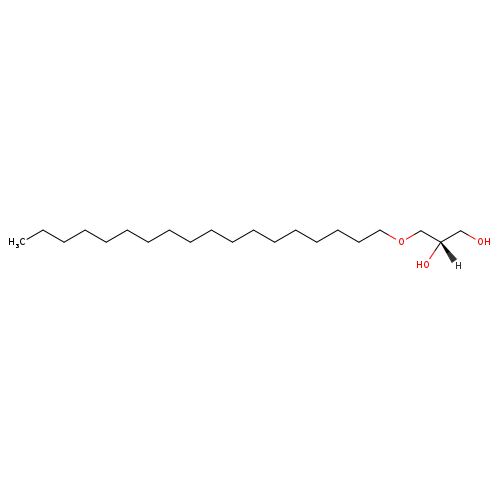
DescriptionA 1-O-alkyl-sn-glycerol that has octadecyl as the alkyl group. The S enantiomer of batilol.
Contaminant Sources
  • FooDB Chemicals
Contaminant TypeNot Available
Chemical Structure
Thumb
Synonyms
ValueSource
(S)-1-O-OctadecylglycerolChEBI
(S)-3-(Octadecyloxy)-1,2-propanediolChEBI
(S)-Batyl alcoholChEBI
(S)-OctadecylglycerolChEBI
Batyl alcoholChEBI
LysoMG(18:0E)ChEBI
LysoMG(O-18:0)ChEBI
MAG(O-18:0/0:0/0:0)ChEBI
MG(18:0E/0:0/0:0)ChEBI
(2S)-3-Octadecoxypropane-1,2-diolHMDB
1-Octadecyl-sn-glycerolHMDB
Chemical FormulaC21H44O3
Average Molecular Mass344.572 g/mol
Monoisotopic Mass344.329 g/mol
CAS Registry NumberNot Available
IUPAC Name(2S)-3-(octadecyloxy)propane-1,2-diol
Traditional Name1-O-octadecyl-sn-glycerol
SMILES[H][C@](O)(CO)COCCCCCCCCCCCCCCCCCC
InChI IdentifierInChI=1S/C21H44O3/c1-2-3-4-5-6-7-8-9-10-11-12-13-14-15-16-17-18-24-20-21(23)19-22/h21-23H,2-20H2,1H3/t21-/m0/s1
InChI KeyOGBUMNBNEWYMNJ-NRFANRHFSA-N
Chemical Taxonomy
Description belongs to the class of organic compounds known as monoalkylglycerols. These are glycerolipids containing exactly one aliphatic chain linked to the glycerol moiety. This chain is the only one linked to the glycerol.
KingdomOrganic compounds
Super ClassLipids and lipid-like molecules
ClassGlycerolipids
Sub ClassMonoradylglycerols
Direct ParentMonoalkylglycerols
Alternative Parents
Substituents
  • Monoalkylglycerol
  • 1-o-alkylglycerol
  • Glycerol ether
  • Secondary alcohol
  • 1,2-diol
  • Ether
  • Dialkyl ether
  • Organic oxygen compound
  • Hydrocarbon derivative
  • Primary alcohol
  • Organooxygen compound
  • Alcohol
  • Aliphatic acyclic compound
Molecular FrameworkAliphatic acyclic compounds
External Descriptors
Biological Properties
StatusDetected and Not Quantified
OriginNot Available
Cellular LocationsNot Available
Biofluid LocationsNot Available
Tissue LocationsNot Available
PathwaysNot Available
ApplicationsNot Available
Biological RolesNot Available
Chemical RolesNot Available
Physical Properties
StateNot Available
AppearanceNot Available
Experimental Properties
PropertyValue
Melting PointNot Available
Boiling PointNot Available
SolubilityNot Available
Predicted Properties
PropertyValueSource
Water Solubility0.0005 g/LALOGPS
logP7.21ALOGPS
logP6.35ChemAxon
logS-5.8ALOGPS
pKa (Strongest Acidic)13.64ChemAxon
pKa (Strongest Basic)-3ChemAxon
Physiological Charge0ChemAxon
Hydrogen Acceptor Count3ChemAxon
Hydrogen Donor Count2ChemAxon
Polar Surface Area49.69 ŲChemAxon
Rotatable Bond Count20ChemAxon
Refractivity103.55 m³·mol⁻¹ChemAxon
Polarizability46.95 ųChemAxon
Number of Rings0ChemAxon
Bioavailability0ChemAxon
Rule of FiveNoChemAxon
Ghose FilterNoChemAxon
Veber's RuleNoChemAxon
MDDR-like RuleNoChemAxon
Spectra
Spectra
Spectrum TypeDescriptionSplash KeyView
Predicted GC-MSPredicted GC-MS Spectrum - GC-MS (Non-derivatized) - 70eV, Positivesplash10-03e9-9332000000-816d992a4585fb495ecbSpectrum
Predicted GC-MSPredicted GC-MS Spectrum - GC-MS (2 TMS) - 70eV, Positivesplash10-0pi0-4490200000-317ff53123b23e43bb8eSpectrum
Predicted GC-MSPredicted GC-MS Spectrum - GC-MS (Non-derivatized) - 70eV, PositiveNot AvailableSpectrum
Predicted LC-MS/MSPredicted LC-MS/MS Spectrum - 10V, Positivesplash10-0002-1029000000-f45dd58347d3798eed4eSpectrum
Predicted LC-MS/MSPredicted LC-MS/MS Spectrum - 20V, Positivesplash10-0fb9-9486000000-48fa0475e0adce8d7a68Spectrum
Predicted LC-MS/MSPredicted LC-MS/MS Spectrum - 40V, Positivesplash10-0zi3-9560000000-eb596cfd1c06b7f97023Spectrum
Predicted LC-MS/MSPredicted LC-MS/MS Spectrum - 10V, Negativesplash10-0006-1019000000-4cf48610ee70a052456dSpectrum
Predicted LC-MS/MSPredicted LC-MS/MS Spectrum - 20V, Negativesplash10-0296-9078000000-3b06bb81b0e124469afdSpectrum
Predicted LC-MS/MSPredicted LC-MS/MS Spectrum - 40V, Negativesplash10-0abc-9040000000-8e0e6eb9bcea0d2f2f19Spectrum
Predicted LC-MS/MSPredicted LC-MS/MS Spectrum - 10V, Positivesplash10-004i-9023000000-6fdbc4f6baf48c555af5Spectrum
Predicted LC-MS/MSPredicted LC-MS/MS Spectrum - 20V, Positivesplash10-056r-9021000000-7ce1ed46f0d182d2c6beSpectrum
Predicted LC-MS/MSPredicted LC-MS/MS Spectrum - 40V, Positivesplash10-0a6r-9000000000-520904587a2ebdb09a86Spectrum
Predicted LC-MS/MSPredicted LC-MS/MS Spectrum - 10V, Negativesplash10-0006-9038000000-cbf3a2c85bd3f1a9ffb9Spectrum
Predicted LC-MS/MSPredicted LC-MS/MS Spectrum - 20V, Negativesplash10-05tf-9041000000-37e13bdb772a8e89c86aSpectrum
Predicted LC-MS/MSPredicted LC-MS/MS Spectrum - 40V, Negativesplash10-0aou-9150000000-38dd22397e646252e1b6Spectrum
Toxicity Profile
Route of ExposureNot Available
Mechanism of ToxicityNot Available
MetabolismNot Available
Toxicity ValuesNot Available
Lethal DoseNot Available
Carcinogenicity (IARC Classification)Not Available
Uses/SourcesNot Available
Minimum Risk LevelNot Available
Health EffectsNot Available
SymptomsNot Available
TreatmentNot Available
Concentrations
Not Available
DrugBank IDNot Available
HMDB IDHMDB0011143
FooDB IDFDB027918
Phenol Explorer IDNot Available
KNApSAcK IDNot Available
BiGG IDNot Available
BioCyc IDNot Available
METLIN IDNot Available
PDB IDNot Available
Wikipedia LinkNot Available
Chemspider ID9036166
ChEBI ID74001
PubChem Compound ID10860876
Kegg Compound IDNot Available
YMDB IDNot Available
ECMDB IDNot Available
References
Synthesis ReferenceNot Available
MSDSNot Available
General References
1. https://www.ncbi.nlm.nih.gov/pubmed/?term=1511492
2. https://www.ncbi.nlm.nih.gov/pubmed/?term=1630273
3. https://www.ncbi.nlm.nih.gov/pubmed/?term=21635876
4. https://www.ncbi.nlm.nih.gov/pubmed/?term=8793009
5. Hostetler KY, Hammond JL, Kini GD, Hostetler SE, Beadle JR, Aldern KA, Chou TC, Richman DD, Mellors JW: In vitro anti-HIV-1 activity of sn-2-substituted 1-O-octadecyl-sn-glycero-3-phosphonoformate analogues and synergy with zidovudine. Antivir Chem Chemother. 2000 May;11(3):213-9.
6. Herrmann HO, Hintze U, Gercken G: Ether lipid synthesis from enantiomeric medium-chain and long-chain O-alkyl-sn-glycerols in Leishmania donovani promastigotes. Mol Biochem Parasitol. 1981 Sep;3(5):319-25.
7. Das AK, Holmes RD, Wilson GN, Hajra AK: Dietary ether lipid incorporation into tissue plasmalogens of humans and rodents. Lipids. 1992 Jun;27(6):401-5.
8. Meusel D, Weber N, Mukherjee KD: Stereoselectivity of lipases: esterification reactions of octadecylglycerol. Chem Phys Lipids. 1992 Apr;61(2):193-8.
9. Cheng L, Hostetler KY, Gardner MF, Avila CP Jr, Bergeron-Lynn G, Keefe KS, Wiley CA, Freeman WR: Intravitreal toxicology in rabbits of two preparations of 1-O-octadecyl-sn-glycerol-3-phosphonoformate, a sustained-delivery anti-CMV drug. Invest Ophthalmol Vis Sci. 1999 Jun;40(7):1487-95.
10. Ghosh S, Strum JC, Bell RM: Lipid biochemistry: functions of glycerolipids and sphingolipids in cellular signaling. FASEB J. 1997 Jan;11(1):45-50.
11. Simons K, Toomre D: Lipid rafts and signal transduction. Nat Rev Mol Cell Biol. 2000 Oct;1(1):31-9.
12. Watson AD: Thematic review series: systems biology approaches to metabolic and cardiovascular disorders. Lipidomics: a global approach to lipid analysis in biological systems. J Lipid Res. 2006 Oct;47(10):2101-11. Epub 2006 Aug 10.
13. Sethi JK, Vidal-Puig AJ: Thematic review series: adipocyte biology. Adipose tissue function and plasticity orchestrate nutritional adaptation. J Lipid Res. 2007 Jun;48(6):1253-62. Epub 2007 Mar 20.
14. Lingwood D, Simons K: Lipid rafts as a membrane-organizing principle. Science. 2010 Jan 1;327(5961):46-50. doi: 10.1126/science.1174621.
15. The lipid handbook with CD-ROM