| Record Information |
|---|
| Version | 1.0 |
|---|
| Creation Date | 2016-05-26 19:25:24 UTC |
|---|
| Update Date | 2016-11-09 01:22:10 UTC |
|---|
| Accession Number | CHEM039967 |
|---|
| Identification |
|---|
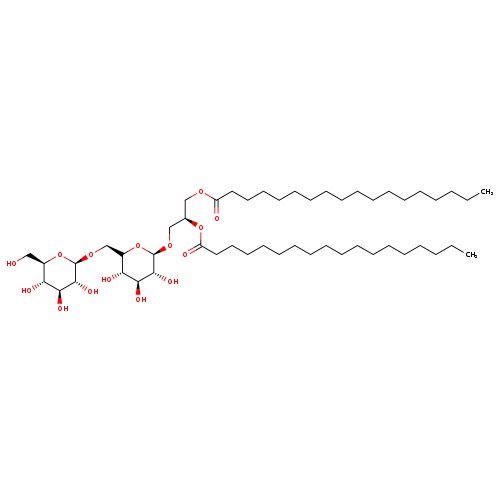
| Common Name | 1,2-Dioctadecanoyl-3-(galactosyl-beta-1->6-galactosyl-beta-1)-glycerol |
|---|
| Class | Small Molecule |
|---|
| Description | Digalactosyldiacylglycerol (DGDG) is an intermediate in glycerolipid metabolism. Digalactosyl-diacylglycerol is irreversibly converted to monogalactosyl-diacylglycerol via the enzyme alpha-galactosidase (EC:3.2.1.22). |
|---|
| Contaminant Sources | |
|---|
| Contaminant Type | Not Available |
|---|
| Chemical Structure | |
|---|
| Synonyms | | Value | Source |
|---|
| 1,2-Dioctadecanoyl-3-(GLCB1-6GLCB1)-sn-glycerol | HMDB | | DGDG | HMDB | | Digalactosyl diacyl glycerol | HMDB | | [(2S)-1-Octadecanoyloxy-3-[(2R,3S,4S,5R,6S)-3,4,5-trihydroxy-6-[[(2S,3R,4S,5R,6S)-3,4,5-trihydroxy-6-(hydroxymethyl)oxan-2-yl]oxymethyl]oxan-2-yl]oxypropan-2-yl] octadecanoate | HMDB | | [(2S)-1-Octadecanoyloxy-3-[(2R,3S,4S,5R,6S)-3,4,5-trihydroxy-6-[[(2S,3R,4S,5R,6S)-3,4,5-trihydroxy-6-(hydroxymethyl)oxan-2-yl]oxymethyl]oxan-2-yl]oxypropan-2-yl] octadecanoic acid | HMDB | | [1-(Octadecanoyloxymethyl)-2-[3,4,5-trihydroxy-6-[[3,4,5-trihydroxy-6-(hydroxymethyl)tetrahydropyran-2-yl]oxymethyl]tetrahydropyran-2-yl]oxy-ethyl] octadecanoate | HMDB | | [1-(Octadecanoyloxymethyl)-2-[3,4,5-trihydroxy-6-[[3,4,5-trihydroxy-6-(hydroxymethyl)tetrahydropyran-2-yl]oxymethyl]tetrahydropyran-2-yl]oxy-ethyl] octadecanoic acid | HMDB | | (2S)-1-(Octadecanoyloxy)-3-{[(2R,3R,4S,5S)-3,4,5-trihydroxy-6-({[(2R,3R,4S,5S,6R)-3,4,5-trihydroxy-6-(hydroxymethyl)oxan-2-yl]oxy}methyl)oxan-2-yl]oxy}propan-2-yl octadecanoic acid | Generator | | 1,2-Dioctadecanoyl-3-(galactosyl-b-1->6-galactosyl-b-1)-glycerol | Generator | | 1,2-Dioctadecanoyl-3-(galactosyl-β-1->6-galactosyl-β-1)-glycerol | Generator |
|
|---|
| Chemical Formula | C51H96O15 |
|---|
| Average Molecular Mass | 949.299 g/mol |
|---|
| Monoisotopic Mass | 948.675 g/mol |
|---|
| CAS Registry Number | Not Available |
|---|
| IUPAC Name | (2S)-1-(octadecanoyloxy)-3-{[(2R,3R,4S,5S)-3,4,5-trihydroxy-6-({[(2R,3R,4S,5S,6R)-3,4,5-trihydroxy-6-(hydroxymethyl)oxan-2-yl]oxy}methyl)oxan-2-yl]oxy}propan-2-yl octadecanoate |
|---|
| Traditional Name | (2S)-1-(octadecanoyloxy)-3-{[(2R,3R,4S,5S)-3,4,5-trihydroxy-6-({[(2R,3R,4S,5S,6R)-3,4,5-trihydroxy-6-(hydroxymethyl)oxan-2-yl]oxy}methyl)oxan-2-yl]oxy}propan-2-yl octadecanoate |
|---|
| SMILES | CCCCCCCCCCCCCCCCCC(=O)OC[C@H](CO[C@@H]1OC(CO[C@@H]2O[C@H](CO)[C@@H](O)[C@H](O)[C@H]2O)[C@@H](O)[C@H](O)[C@H]1O)OC(=O)CCCCCCCCCCCCCCCCC |
|---|
| InChI Identifier | InChI=1S/C51H96O15/c1-3-5-7-9-11-13-15-17-19-21-23-25-27-29-31-33-42(53)61-36-39(64-43(54)34-32-30-28-26-24-22-20-18-16-14-12-10-8-6-4-2)37-62-50-49(60)47(58)45(56)41(66-50)38-63-51-48(59)46(57)44(55)40(35-52)65-51/h39-41,44-52,55-60H,3-38H2,1-2H3/t39-,40-,41?,44-,45-,46+,47+,48-,49-,50-,51-/m1/s1 |
|---|
| InChI Key | LDQFLSUQYHBXSX-HPPMYKKZSA-N |
|---|
| Chemical Taxonomy |
|---|
| Description | belongs to the class of organic compounds known as glycosyldiacylglycerols. These are diacylglycerols that carry a saccharide moiety linked to the glycerol. |
|---|
| Kingdom | Organic compounds |
|---|
| Super Class | Lipids and lipid-like molecules |
|---|
| Class | Glycerolipids |
|---|
| Sub Class | Glycosylglycerols |
|---|
| Direct Parent | Glycosyldiacylglycerols |
|---|
| Alternative Parents | |
|---|
| Substituents | - Glycosyldiacylglycerol
- Fatty acyl glycoside
- Fatty acyl glycoside of mono- or disaccharide
- Disaccharide
- Glycosyl compound
- O-glycosyl compound
- Fatty acid ester
- Fatty acyl
- Oxane
- Dicarboxylic acid or derivatives
- Secondary alcohol
- Carboxylic acid ester
- Oxacycle
- Polyol
- Organoheterocyclic compound
- Carboxylic acid derivative
- Acetal
- Hydrocarbon derivative
- Organic oxygen compound
- Organic oxide
- Alcohol
- Carbonyl group
- Organooxygen compound
- Primary alcohol
- Aliphatic heteromonocyclic compound
|
|---|
| Molecular Framework | Aliphatic heteromonocyclic compounds |
|---|
| External Descriptors | Not Available |
|---|
| Biological Properties |
|---|
| Status | Detected and Not Quantified |
|---|
| Origin | Not Available |
|---|
| Cellular Locations | Not Available |
|---|
| Biofluid Locations | Not Available |
|---|
| Tissue Locations | Not Available |
|---|
| Pathways | Not Available |
|---|
| Applications | Not Available |
|---|
| Biological Roles | Not Available |
|---|
| Chemical Roles | Not Available |
|---|
| Physical Properties |
|---|
| State | Not Available |
|---|
| Appearance | Not Available |
|---|
| Experimental Properties | | Property | Value |
|---|
| Melting Point | Not Available | | Boiling Point | Not Available | | Solubility | Not Available |
|
|---|
| Predicted Properties | |
|---|
| Spectra |
|---|
| Spectra | | Spectrum Type | Description | Splash Key | View |
|---|
| Predicted LC-MS/MS | Predicted LC-MS/MS Spectrum - 10V, Positive | splash10-015a-0142009108-15878d0d87479d40aa8c | Spectrum | | Predicted LC-MS/MS | Predicted LC-MS/MS Spectrum - 20V, Positive | splash10-014i-0267039302-d80320d9f1b08602e21d | Spectrum | | Predicted LC-MS/MS | Predicted LC-MS/MS Spectrum - 40V, Positive | splash10-016r-1597135462-a199496a73bcc29a4623 | Spectrum | | Predicted LC-MS/MS | Predicted LC-MS/MS Spectrum - 10V, Negative | splash10-00o0-1292013104-f3042ac22e42d492a906 | Spectrum | | Predicted LC-MS/MS | Predicted LC-MS/MS Spectrum - 20V, Negative | splash10-02cr-2492002002-8bcd4ed278a6c649f565 | Spectrum | | Predicted LC-MS/MS | Predicted LC-MS/MS Spectrum - 40V, Negative | splash10-001i-4391000100-d59b61af5f197bdc6ac0 | Spectrum | | Predicted LC-MS/MS | Predicted LC-MS/MS Spectrum - 10V, Negative | splash10-001i-0094003003-e5f97d726399d4481156 | Spectrum | | Predicted LC-MS/MS | Predicted LC-MS/MS Spectrum - 20V, Negative | splash10-067r-7359017261-dc6519abf0d56894140e | Spectrum | | Predicted LC-MS/MS | Predicted LC-MS/MS Spectrum - 40V, Negative | splash10-0a59-9166000000-f2609c1c23cfb48d2ebc | Spectrum | | Predicted LC-MS/MS | Predicted LC-MS/MS Spectrum - 10V, Positive | splash10-0012-7102014219-5c22e98057afa40619c6 | Spectrum | | Predicted LC-MS/MS | Predicted LC-MS/MS Spectrum - 20V, Positive | splash10-0015-9222000103-f5297be5abcaad28ec4f | Spectrum | | Predicted LC-MS/MS | Predicted LC-MS/MS Spectrum - 40V, Positive | splash10-0006-9001000000-098dbc0e0bf5562f85e0 | Spectrum |
|
|---|
| Toxicity Profile |
|---|
| Route of Exposure | Not Available |
|---|
| Mechanism of Toxicity | Not Available |
|---|
| Metabolism | Not Available |
|---|
| Toxicity Values | Not Available |
|---|
| Lethal Dose | Not Available |
|---|
| Carcinogenicity (IARC Classification) | Not Available |
|---|
| Uses/Sources | Not Available |
|---|
| Minimum Risk Level | Not Available |
|---|
| Health Effects | Not Available |
|---|
| Symptoms | Not Available |
|---|
| Treatment | Not Available |
|---|
| Concentrations |
|---|
| Not Available |
|---|
| External Links |
|---|
| DrugBank ID | Not Available |
|---|
| HMDB ID | HMDB0011132 |
|---|
| FooDB ID | FDB027911 |
|---|
| Phenol Explorer ID | Not Available |
|---|
| KNApSAcK ID | Not Available |
|---|
| BiGG ID | Not Available |
|---|
| BioCyc ID | Not Available |
|---|
| METLIN ID | Not Available |
|---|
| PDB ID | Not Available |
|---|
| Wikipedia Link | Not Available |
|---|
| Chemspider ID | Not Available |
|---|
| ChEBI ID | Not Available |
|---|
| PubChem Compound ID | 53480668 |
|---|
| Kegg Compound ID | Not Available |
|---|
| YMDB ID | Not Available |
|---|
| ECMDB ID | Not Available |
|---|
| References |
|---|
| Synthesis Reference | Not Available |
|---|
| MSDS | Not Available |
|---|
| General References | |
|---|