| Record Information |
|---|
| Version | 1.0 |
|---|
| Creation Date | 2016-05-26 07:25:41 UTC |
|---|
| Update Date | 2016-11-09 01:21:29 UTC |
|---|
| Accession Number | CHEM036370 |
|---|
| Identification |
|---|
| Common Name | DG(14:0/20:0/0:0) |
|---|
| Class | Small Molecule |
|---|
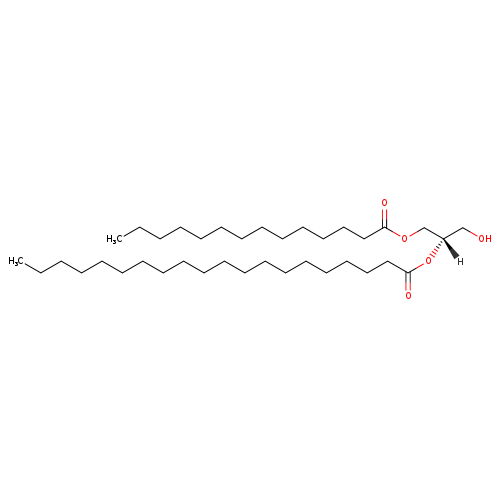
| Description | DG(14:0/20:0/0:0) is a diglyceride, or a diacylglycerol (DAG). It is a glyceride consisting of two fatty acid chains covalently bonded to a glycerol molecule through ester linkages. Diacylglycerols can have many different combinations of fatty acids attached at both the C-1 and C-2 positions. DG(14:0/20:0/0:0), in particular, consists of one chain of myristic acid at the C-1 position and one chain of arachidic acid at the C-2 position. The myristic acid moiety is derived from nutmeg and butter, while the arachidic acid moiety is derived from peanut oil. Mono- and diacylglycerols are common food additives used to blend together certain ingredients, such as oil and water, which would not otherwise blend well. Dacylglycerols are often found in bakery products, beverages, ice cream, chewing gum, shortening, whipped toppings, margarine, and confections. Synthesis of diacylglycerol begins with glycerol-3-phosphate, which is derived primarily from dihydroxyacetone phosphate, a product of glycolysis (usually in the cytoplasm of liver or adipose tissue cells). Glycerol-3-phosphate is first acylated with acyl-coenzyme A (acyl-CoA) to form lysophosphatidic acid, which is then acylated with another molecule of acyl-CoA to yield phosphatidic acid. Phosphatidic acid is then de-phosphorylated to form diacylglycerol. Diacylglycerols are precursors to triacylglycerols (triglyceride), which are formed by the addition of a third fatty acid to the diacylglycerol under the catalysis of diglyceride acyltransferase. Since diacylglycerols are synthesized via phosphatidic acid, they will usually contain a saturated fatty acid at the C-1 position on the glycerol moiety and an unsaturated fatty acid at the C-2 position. |
|---|
| Contaminant Sources | |
|---|
| Contaminant Type | Not Available |
|---|
| Chemical Structure | |
|---|
| Synonyms | | Value | Source |
|---|
| DAG(14:0/20:0) | Lipid Annotator, HMDB | | DG(14:0/20:0) | Lipid Annotator, HMDB | | Diacylglycerol(14:0/20:0) | Lipid Annotator, HMDB | | Diglyceride | Lipid Annotator, HMDB | | DG(14:0/20:0/0:0) | Lipid Annotator | | Diacylglycerol | Lipid Annotator, HMDB | | Diacylglycerol(34:0) | Lipid Annotator, HMDB | | DAG(34:0) | Lipid Annotator, HMDB | | DG(34:0) | Lipid Annotator, HMDB | | 1-tetradecanoyl-2-eicosanoyl-sn-glycerol | Lipid Annotator, HMDB | | 1-myristoyl-2-arachidonyl-sn-glycerol | Lipid Annotator, HMDB |
|
|---|
| Chemical Formula | C37H72O5 |
|---|
| Average Molecular Mass | 596.965 g/mol |
|---|
| Monoisotopic Mass | 596.538 g/mol |
|---|
| CAS Registry Number | Not Available |
|---|
| IUPAC Name | (2S)-1-hydroxy-3-(tetradecanoyloxy)propan-2-yl icosanoate |
|---|
| Traditional Name | (2S)-1-hydroxy-3-(tetradecanoyloxy)propan-2-yl icosanoate |
|---|
| SMILES | [H][C@](CO)(COC(=O)CCCCCCCCCCCCC)OC(=O)CCCCCCCCCCCCCCCCCCC |
|---|
| InChI Identifier | InChI=1S/C37H72O5/c1-3-5-7-9-11-13-15-16-17-18-19-20-22-24-26-28-30-32-37(40)42-35(33-38)34-41-36(39)31-29-27-25-23-21-14-12-10-8-6-4-2/h35,38H,3-34H2,1-2H3/t35-/m0/s1 |
|---|
| InChI Key | WHDVKISBZHRCLW-DHUJRADRSA-N |
|---|
| Chemical Taxonomy |
|---|
| Description | belongs to the class of organic compounds known as 1,2-diacylglycerols. These are diacylglycerols containing a glycerol acylated at positions 1 and 2. |
|---|
| Kingdom | Organic compounds |
|---|
| Super Class | Lipids and lipid-like molecules |
|---|
| Class | Glycerolipids |
|---|
| Sub Class | Diradylglycerols |
|---|
| Direct Parent | 1,2-diacylglycerols |
|---|
| Alternative Parents | |
|---|
| Substituents | - 1,2-acyl-sn-glycerol
- Fatty acid ester
- Fatty acyl
- Dicarboxylic acid or derivatives
- Carboxylic acid ester
- Carboxylic acid derivative
- Organic oxygen compound
- Organic oxide
- Hydrocarbon derivative
- Primary alcohol
- Organooxygen compound
- Carbonyl group
- Alcohol
- Aliphatic acyclic compound
|
|---|
| Molecular Framework | Aliphatic acyclic compounds |
|---|
| External Descriptors | |
|---|
| Biological Properties |
|---|
| Status | Detected and Not Quantified |
|---|
| Origin | Not Available |
|---|
| Cellular Locations | Not Available |
|---|
| Biofluid Locations | Not Available |
|---|
| Tissue Locations | Not Available |
|---|
| Pathways | Not Available |
|---|
| Applications | Not Available |
|---|
| Biological Roles | Not Available |
|---|
| Chemical Roles | Not Available |
|---|
| Physical Properties |
|---|
| State | Not Available |
|---|
| Appearance | Not Available |
|---|
| Experimental Properties | | Property | Value |
|---|
| Melting Point | Not Available | | Boiling Point | Not Available | | Solubility | Not Available |
|
|---|
| Predicted Properties | |
|---|
| Spectra |
|---|
| Spectra | | Spectrum Type | Description | Splash Key | View |
|---|
| Predicted GC-MS | Predicted GC-MS Spectrum - GC-MS (1 TMS) - 70eV, Positive | splash10-11bj-7193576000-d1b2b955b69af0574dd5 | Spectrum | | Predicted GC-MS | Predicted GC-MS Spectrum - GC-MS (TBDMS_1_1) - 70eV, Positive | Not Available | Spectrum | | Predicted GC-MS | Predicted GC-MS Spectrum - GC-MS ("DG(14:0/20:0/0:0),1TMS,#1" TMS) - 70eV, Positive | Not Available | Spectrum | | Predicted LC-MS/MS | Predicted LC-MS/MS Spectrum - 10V, Positive | splash10-03di-0000009000-225e45a97a85093b82dc | Spectrum | | Predicted LC-MS/MS | Predicted LC-MS/MS Spectrum - 20V, Positive | splash10-0179-0099071000-a09a0665c4a586225a99 | Spectrum | | Predicted LC-MS/MS | Predicted LC-MS/MS Spectrum - 40V, Positive | splash10-02tr-0099036000-9752c38345757e71bc50 | Spectrum | | Predicted LC-MS/MS | Predicted LC-MS/MS Spectrum - 10V, Negative | splash10-01r2-2069070000-023c44de1357944c1fb3 | Spectrum | | Predicted LC-MS/MS | Predicted LC-MS/MS Spectrum - 20V, Negative | splash10-01t9-3096000000-8c9df4e2741cb39dc28f | Spectrum | | Predicted LC-MS/MS | Predicted LC-MS/MS Spectrum - 40V, Negative | splash10-06vl-1293000000-82dbc6116ad767ecdd24 | Spectrum | | Predicted LC-MS/MS | Predicted LC-MS/MS Spectrum - 10V, Positive | splash10-0002-1196060000-8ca24952af48bca51769 | Spectrum | | Predicted LC-MS/MS | Predicted LC-MS/MS Spectrum - 20V, Positive | splash10-0002-3292010000-bbe4aafde99cef01a2fa | Spectrum | | Predicted LC-MS/MS | Predicted LC-MS/MS Spectrum - 40V, Positive | splash10-0a4j-9541000000-26c41f26b5c7f81c7a2e | Spectrum | | Predicted LC-MS/MS | Predicted LC-MS/MS Spectrum - 10V, Positive | splash10-03di-0000009000-af6a422dabc6060234c0 | Spectrum | | Predicted LC-MS/MS | Predicted LC-MS/MS Spectrum - 20V, Positive | splash10-0179-0099071000-da7ca7345da2cf2520c3 | Spectrum | | Predicted LC-MS/MS | Predicted LC-MS/MS Spectrum - 40V, Positive | splash10-02tr-0099036000-0a45f14bec1abdce3545 | Spectrum | | Predicted LC-MS/MS | Predicted LC-MS/MS Spectrum - 10V, Positive | splash10-014i-0000009000-05c8a9d62d254739db0a | Spectrum | | Predicted LC-MS/MS | Predicted LC-MS/MS Spectrum - 20V, Positive | splash10-014i-0000009000-05c8a9d62d254739db0a | Spectrum | | Predicted LC-MS/MS | Predicted LC-MS/MS Spectrum - 40V, Positive | splash10-0a4o-0009000000-cb76981d005b2d29015f | Spectrum |
|
|---|
| Toxicity Profile |
|---|
| Route of Exposure | Not Available |
|---|
| Mechanism of Toxicity | Not Available |
|---|
| Metabolism | Not Available |
|---|
| Toxicity Values | Not Available |
|---|
| Lethal Dose | Not Available |
|---|
| Carcinogenicity (IARC Classification) | Not Available |
|---|
| Uses/Sources | Not Available |
|---|
| Minimum Risk Level | Not Available |
|---|
| Health Effects | Not Available |
|---|
| Symptoms | Not Available |
|---|
| Treatment | Not Available |
|---|
| Concentrations |
|---|
| Not Available |
|---|
| External Links |
|---|
| DrugBank ID | Not Available |
|---|
| HMDB ID | HMDB0007020 |
|---|
| FooDB ID | FDB024214 |
|---|
| Phenol Explorer ID | Not Available |
|---|
| KNApSAcK ID | Not Available |
|---|
| BiGG ID | Not Available |
|---|
| BioCyc ID | Not Available |
|---|
| METLIN ID | Not Available |
|---|
| PDB ID | Not Available |
|---|
| Wikipedia Link | Not Available |
|---|
| Chemspider ID | 24765854 |
|---|
| ChEBI ID | Not Available |
|---|
| PubChem Compound ID | 53477955 |
|---|
| Kegg Compound ID | Not Available |
|---|
| YMDB ID | Not Available |
|---|
| ECMDB ID | Not Available |
|---|
| References |
|---|
| Synthesis Reference | Not Available |
|---|
| MSDS | Not Available |
|---|
| General References | Not Available |
|---|