Record Information
Version1.0
Creation Date2016-05-26 07:21:37 UTC
Update Date2016-11-09 01:21:28 UTC
Accession NumberCHEM036299
Identification
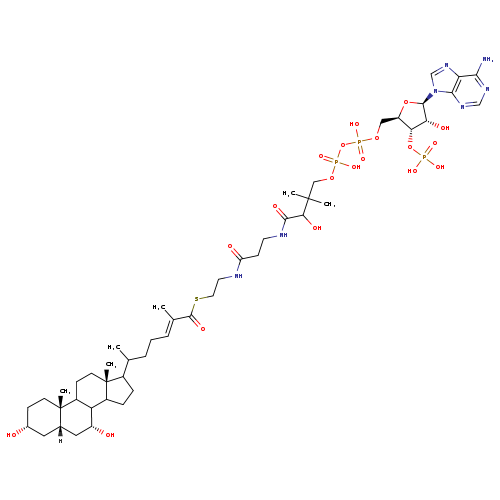
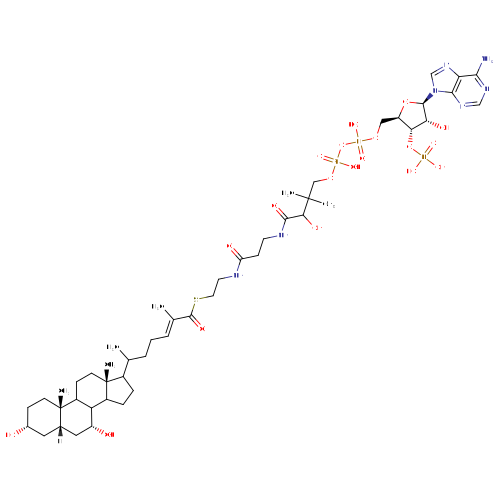
Common Name3a,7a-Dihydroxy-5b-cholest-24-enoyl-CoA
ClassSmall Molecule
Description3alpha,7alpha-Dihydroxy-5beta-cholest-24-enoyl-CoA is an intermediate involved in bile acid synthesis, specifically in the synthesis of chenodeoxyglycocholate. Bile acids are steroid acids found predominantly in the bile of mammals. The distinction between different bile acids is minute, depending only on the presence or absence of hydroxyl groups on positions 3, 7, and 12. Bile acids are physiological detergents that facilitate excretion, absorption, and transport of fats and sterols in the intestine and liver. Bile acids are also steroidal amphipathic molecules derived from the catabolism of cholesterol. They modulate bile flow and lipid secretion, are essential for the absorption of dietary fats and vitamins, and have been implicated in the regulation of all the key enzymes involved in cholesterol homeostasis. Bile acids recirculate through the liver, bile ducts, small intestine and portal vein to form an enterohepatic circuit. They exist as anions at physiological pH and, consequently, require a carrier for transport across the membranes of the enterohepatic tissues. The unique detergent properties of bile acids are essential for the digestion and intestinal absorption of hydrophobic nutrients. Bile acids have potent toxic properties (e.g. membrane disruption) and there are a plethora of mechanisms to limit their accumulation in blood and tissues (PMID: 11316487, 16037564, 12576301, 11907135).
Contaminant Sources
  • FooDB Chemicals
Contaminant TypeNot Available
Chemical Structure
Thumb
Synonyms
ValueSource
3a,7a-Dihydroxy-5b-cholest-24-enoyl-coenzyme AHMDB
3alpha,7alpha-Dihydroxy-5beta-cholest-24-enoyl-CoAHMDB
3alpha,7alpha-Dihydroxy-5beta-cholest-24-enoyl-coenzyme AHMDB
Chemical FormulaC48H78N7O19P3S
Average Molecular Mass1182.155 g/mol
Monoisotopic Mass1181.429 g/mol
CAS Registry NumberNot Available
IUPAC Name{[(2R,3S,4R,5R)-5-(6-amino-9H-purin-9-yl)-2-({[({[3-({2-[(2-{[(2E)-6-[(2S,5R,7S,9R,15R)-5,9-dihydroxy-2,15-dimethyltetracyclo[8.7.0.0²,⁷.0¹¹,¹⁵]heptadecan-14-yl]-2-methylhept-2-enoyl]sulfanyl}ethyl)carbamoyl]ethyl}carbamoyl)-3-hydroxy-2,2-dimethylpropoxy](hydroxy)phosphoryl}oxy)(hydroxy)phosphoryl]oxy}methyl)-4-hydroxyoxolan-3-yl]oxy}phosphonic acid
Traditional Name[(2R,3S,4R,5R)-5-(6-aminopurin-9-yl)-2-[({[3-({2-[(2-{[(2E)-6-[(2S,5R,7S,9R,15R)-5,9-dihydroxy-2,15-dimethyltetracyclo[8.7.0.0²,⁷.0¹¹,¹⁵]heptadecan-14-yl]-2-methylhept-2-enoyl]sulfanyl}ethyl)carbamoyl]ethyl}carbamoyl)-3-hydroxy-2,2-dimethylpropoxy(hydroxy)phosphoryl]oxy(hydroxy)phosphoryl}oxy)methyl]-4-hydroxyoxolan-3-yl]oxyphosphonic acid
SMILESCC(CC\C=C(/C)C(=O)SCCNC(=O)CCNC(=O)C(O)C(C)(C)COP(O)(=O)OP(O)(=O)OC[C@H]1O[C@H]([C@H](O)[C@@H]1OP(O)(O)=O)N1C=NC2=C1N=CN=C2N)C1CCC2C3[C@H](O)C[C@]4([H])C[C@H](O)CC[C@]4(C)C3CC[C@]12C
InChI IdentifierInChI=1S/C48H78N7O19P3S/c1-26(30-10-11-31-36-32(13-16-48(30,31)6)47(5)15-12-29(56)20-28(47)21-33(36)57)8-7-9-27(2)45(62)78-19-18-50-35(58)14-17-51-43(61)40(60)46(3,4)23-71-77(68,69)74-76(66,67)70-22-34-39(73-75(63,64)65)38(59)44(72-34)55-25-54-37-41(49)52-24-53-42(37)55/h9,24-26,28-34,36,38-40,44,56-57,59-60H,7-8,10-23H2,1-6H3,(H,50,58)(H,51,61)(H,66,67)(H,68,69)(H2,49,52,53)(H2,63,64,65)/b27-9+/t26?,28-,29+,30?,31?,32?,33+,34+,36?,38+,39+,40?,44+,47-,48+/m0/s1
InChI KeySEBZZAWTQNNGPK-YOKOLYSVSA-N
Chemical Taxonomy
Description belongs to the class of organic compounds known as acyl coas. These are organic compounds containing a coenzyme A substructure linked to an acyl chain.

KingdomOrganic compounds
Super ClassLipids and lipid-like molecules
ClassFatty Acyls
Sub ClassFatty acyl thioesters
Direct ParentAcyl CoAs
Alternative Parents
Substituents
  • Coenzyme a or derivatives
  • Purine ribonucleoside 3',5'-bisphosphate
  • Purine ribonucleoside bisphosphate
  • Purine ribonucleoside diphosphate
  • Steroidal glycoside
  • Dihydroxy bile acid, alcohol, or derivatives
  • Hydroxy bile acid, alcohol, or derivatives
  • Cholane-skeleton
  • Bile acid, alcohol, or derivatives
  • 3-hydroxysteroid
  • Hydroxysteroid
  • 3-alpha-hydroxysteroid
  • 7-hydroxysteroid
  • Steroid
  • Ribonucleoside 3'-phosphate
  • Pentose phosphate
  • Pentose-5-phosphate
  • Beta amino acid or derivatives
  • Glycosyl compound
  • N-glycosyl compound
  • Organic pyrophosphate
  • 6-aminopurine
  • Pentose monosaccharide
  • Monosaccharide phosphate
  • Purine
  • Imidazopyrimidine
  • Monoalkyl phosphate
  • Aminopyrimidine
  • Pyrimidine
  • Monosaccharide
  • N-acyl-amine
  • Phosphoric acid ester
  • Fatty amide
  • N-substituted imidazole
  • Imidolactam
  • Organic phosphoric acid derivative
  • Alkyl phosphate
  • Azole
  • Tetrahydrofuran
  • Cyclic alcohol
  • Imidazole
  • Heteroaromatic compound
  • Amino acid or derivatives
  • Carbothioic s-ester
  • Carboxamide group
  • Thiocarboxylic acid ester
  • Secondary carboxylic acid amide
  • Secondary alcohol
  • Thiocarboxylic acid or derivatives
  • Oxacycle
  • Sulfenyl compound
  • Azacycle
  • Carboxylic acid derivative
  • Organoheterocyclic compound
  • Primary amine
  • Alcohol
  • Carbonyl group
  • Organic oxygen compound
  • Organosulfur compound
  • Organooxygen compound
  • Organopnictogen compound
  • Amine
  • Organic nitrogen compound
  • Organonitrogen compound
  • Hydrocarbon derivative
  • Organic oxide
  • Aromatic heteropolycyclic compound
Molecular FrameworkAromatic heteropolycyclic compounds
External DescriptorsNot Available
Biological Properties
StatusDetected and Not Quantified
OriginNot Available
Cellular LocationsNot Available
Biofluid LocationsNot Available
Tissue LocationsNot Available
PathwaysNot Available
ApplicationsNot Available
Biological RolesNot Available
Chemical RolesNot Available
Physical Properties
StateNot Available
AppearanceNot Available
Experimental Properties
PropertyValue
Melting PointNot Available
Boiling PointNot Available
SolubilityNot Available
Predicted Properties
PropertyValueSource
Water Solubility0.2 g/LALOGPS
logP1.88ALOGPS
logP-1.5ChemAxon
logS-3.8ALOGPS
pKa (Strongest Acidic)0.83ChemAxon
pKa (Strongest Basic)4.95ChemAxon
Physiological Charge-4ChemAxon
Hydrogen Acceptor Count19ChemAxon
Hydrogen Donor Count11ChemAxon
Polar Surface Area404.09 ŲChemAxon
Rotatable Bond Count25ChemAxon
Refractivity283.49 m³·mol⁻¹ChemAxon
Polarizability117.4 ųChemAxon
Number of Rings7ChemAxon
Bioavailability0ChemAxon
Rule of FiveNoChemAxon
Ghose FilterNoChemAxon
Veber's RuleNoChemAxon
MDDR-like RuleYesChemAxon
Spectra
Spectra
Spectrum TypeDescriptionSplash KeyView
Predicted LC-MS/MSPredicted LC-MS/MS Spectrum - 10V, Positivesplash10-000i-1900112000-3614385f2311d2073e3eSpectrum
Predicted LC-MS/MSPredicted LC-MS/MS Spectrum - 20V, Positivesplash10-000i-0900315000-797cccaf3753018d956fSpectrum
Predicted LC-MS/MSPredicted LC-MS/MS Spectrum - 40V, Positivesplash10-000i-1900001000-61457f78771a3bf83e48Spectrum
Predicted LC-MS/MSPredicted LC-MS/MS Spectrum - 10V, Negativesplash10-01q9-2901331400-4cfedec67e85eb7be44dSpectrum
Predicted LC-MS/MSPredicted LC-MS/MS Spectrum - 20V, Negativesplash10-001i-3901121010-afd20923316bb8e01988Spectrum
Predicted LC-MS/MSPredicted LC-MS/MS Spectrum - 40V, Negativesplash10-057i-5900100000-37ffc9114d81e845dfb6Spectrum
Predicted LC-MS/MSPredicted LC-MS/MS Spectrum - 10V, Negativesplash10-001i-0900000000-666ad42e52868013faf0Spectrum
Predicted LC-MS/MSPredicted LC-MS/MS Spectrum - 20V, Negativesplash10-01sr-3600902200-f9e74c1c38fcce635049Spectrum
Predicted LC-MS/MSPredicted LC-MS/MS Spectrum - 40V, Negativesplash10-014r-5204604900-8df87961a4c0ed8e78f2Spectrum
Predicted LC-MS/MSPredicted LC-MS/MS Spectrum - 10V, Positivesplash10-001i-0900000110-84949aea2a7fdac5d446Spectrum
Predicted LC-MS/MSPredicted LC-MS/MS Spectrum - 20V, Positivesplash10-000i-0900001310-f616923d144fd5c5bd08Spectrum
Predicted LC-MS/MSPredicted LC-MS/MS Spectrum - 40V, Positivesplash10-004i-0000119000-c7ffdca0daf17da9409fSpectrum
1D NMR13C NMR SpectrumNot AvailableSpectrum
1D NMR1H NMR SpectrumNot AvailableSpectrum
1D NMR13C NMR SpectrumNot AvailableSpectrum
1D NMR1H NMR SpectrumNot AvailableSpectrum
1D NMR13C NMR SpectrumNot AvailableSpectrum
1D NMR1H NMR SpectrumNot AvailableSpectrum
1D NMR13C NMR SpectrumNot AvailableSpectrum
1D NMR1H NMR SpectrumNot AvailableSpectrum
1D NMR13C NMR SpectrumNot AvailableSpectrum
1D NMR1H NMR SpectrumNot AvailableSpectrum
1D NMR13C NMR SpectrumNot AvailableSpectrum
1D NMR1H NMR SpectrumNot AvailableSpectrum
1D NMR13C NMR SpectrumNot AvailableSpectrum
1D NMR1H NMR SpectrumNot AvailableSpectrum
1D NMR13C NMR SpectrumNot AvailableSpectrum
1D NMR1H NMR SpectrumNot AvailableSpectrum
1D NMR13C NMR SpectrumNot AvailableSpectrum
1D NMR1H NMR SpectrumNot AvailableSpectrum
1D NMR13C NMR SpectrumNot AvailableSpectrum
1D NMR1H NMR SpectrumNot AvailableSpectrum
Toxicity Profile
Route of ExposureNot Available
Mechanism of ToxicityNot Available
MetabolismNot Available
Toxicity ValuesNot Available
Lethal DoseNot Available
Carcinogenicity (IARC Classification)Not Available
Uses/SourcesNot Available
Minimum Risk LevelNot Available
Health EffectsNot Available
SymptomsNot Available
TreatmentNot Available
Concentrations
Not Available
DrugBank IDNot Available
HMDB IDHMDB0006895
FooDB IDFDB024142
Phenol Explorer IDNot Available
KNApSAcK IDNot Available
BiGG ID45830
BioCyc IDNot Available
METLIN IDNot Available
PDB IDNot Available
Wikipedia LinkNot Available
Chemspider ID4444354
ChEBI ID27393
PubChem Compound ID5280796
Kegg Compound IDC05447
YMDB IDNot Available
ECMDB IDNot Available
References
Synthesis ReferenceNot Available
MSDSNot Available
General References
1. St-Pierre MV, Kullak-Ublick GA, Hagenbuch B, Meier PJ: Transport of bile acids in hepatic and non-hepatic tissues. J Exp Biol. 2001 May;204(Pt 10):1673-86.
2. Claudel T, Staels B, Kuipers F: The Farnesoid X receptor: a molecular link between bile acid and lipid and glucose metabolism. Arterioscler Thromb Vasc Biol. 2005 Oct;25(10):2020-30. Epub 2005 Jul 21.
3. Chiang JY: Bile acid regulation of hepatic physiology: III. Bile acids and nuclear receptors. Am J Physiol Gastrointest Liver Physiol. 2003 Mar;284(3):G349-56.
4. Davis RA, Miyake JH, Hui TY, Spann NJ: Regulation of cholesterol-7alpha-hydroxylase: BAREly missing a SHP. J Lipid Res. 2002 Apr;43(4):533-43.