| Record Information |
|---|
| Version | 1.0 |
|---|
| Creation Date | 2016-05-26 07:09:12 UTC |
|---|
| Update Date | 2016-11-09 01:21:25 UTC |
|---|
| Accession Number | CHEM036006 |
|---|
| Identification |
|---|
| Common Name | 3,3'-Diiodothyronine |
|---|
| Class | Small Molecule |
|---|
| Description | |
|---|
| Contaminant Sources | |
|---|
| Contaminant Type | Not Available |
|---|
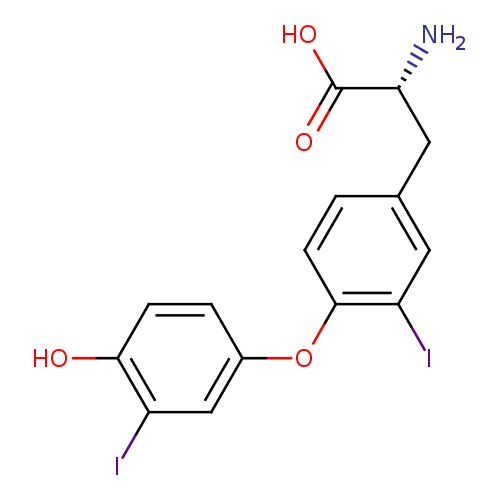
| Chemical Structure | |
|---|
| Synonyms | | Value | Source |
|---|
| 3,3'-diiodo-L-Thyronine | HMDB | | 3,3'-T2 | HMDB | | 3-[4-(4-Hydroxy-3-iodophenoxy)-3-iodophenyl]-L-alanine | HMDB | | L-3-[4-(4-Hydroxy-3-iodophenoxy)-3-iodophenyl]-alanine | HMDB | | L-beta-[4-(4-Hydroxy-3-iodophenoxy)-3-iodophenyl]-alanine | HMDB | | O-(4-Hydroxy-3-iodophenyl)-3-iodo-L-tyrosine | HMDB | | O-(4-Hydroxy-3-iodophenyl)-3-iodo-tyrosine | HMDB | | O-(4-Hydroxy-3-iodophenyl)-3-iodotyrosine | HMDB | | 3,3'-Diiodothyronine, (L)-isomer | MeSH, HMDB | | 3,3'-Diiodothyronine, (L)-isomer, 125I-labeled | MeSH, HMDB | | 3,3'-Diiodothyronine, (DL)-isomer | MeSH, HMDB | | (2R)-2-Amino-3-[4-(4-hydroxy-3-iodophenoxy)-3-iodophenyl]propanoate | Generator, HMDB | | 3,3'-Diiodothyronine | MeSH |
|
|---|
| Chemical Formula | C15H13I2NO4 |
|---|
| Average Molecular Mass | 525.077 g/mol |
|---|
| Monoisotopic Mass | 524.893 g/mol |
|---|
| CAS Registry Number | 70-40-6 |
|---|
| IUPAC Name | (2R)-2-amino-3-[4-(4-hydroxy-3-iodophenoxy)-3-iodophenyl]propanoic acid |
|---|
| Traditional Name | 3,3'-diiodo-L-thyronine |
|---|
| SMILES | N[C@H](CC1=CC(I)=C(OC2=CC(I)=C(O)C=C2)C=C1)C(O)=O |
|---|
| InChI Identifier | InChI=1S/C15H13I2NO4/c16-10-7-9(2-3-13(10)19)22-14-4-1-8(5-11(14)17)6-12(18)15(20)21/h1-5,7,12,19H,6,18H2,(H,20,21)/t12-/m1/s1 |
|---|
| InChI Key | CPCJBZABTUOGNM-GFCCVEGCSA-N |
|---|
| Chemical Taxonomy |
|---|
| Description | belongs to the class of organic compounds known as phenylalanine and derivatives. Phenylalanine and derivatives are compounds containing phenylalanine or a derivative thereof resulting from reaction of phenylalanine at the amino group or the carboxy group, or from the replacement of any hydrogen of glycine by a heteroatom. |
|---|
| Kingdom | Organic compounds |
|---|
| Super Class | Organic acids and derivatives |
|---|
| Class | Carboxylic acids and derivatives |
|---|
| Sub Class | Amino acids, peptides, and analogues |
|---|
| Direct Parent | Phenylalanine and derivatives |
|---|
| Alternative Parents | |
|---|
| Substituents | - Phenylalanine or derivatives
- Diphenylether
- Diaryl ether
- 3-phenylpropanoic-acid
- Alpha-amino acid
- Amphetamine or derivatives
- D-alpha-amino acid
- Phenoxy compound
- 2-iodophenol
- 2-halophenol
- Phenol ether
- Iodobenzene
- 1-hydroxy-2-unsubstituted benzenoid
- Halobenzene
- Phenol
- Aralkylamine
- Aryl iodide
- Aryl halide
- Monocyclic benzene moiety
- Benzenoid
- Amino acid
- Ether
- Carboxylic acid
- Monocarboxylic acid or derivatives
- Organic nitrogen compound
- Primary aliphatic amine
- Organohalogen compound
- Organoiodide
- Organonitrogen compound
- Organooxygen compound
- Primary amine
- Carbonyl group
- Hydrocarbon derivative
- Organic oxide
- Organopnictogen compound
- Organic oxygen compound
- Amine
- Aromatic homomonocyclic compound
|
|---|
| Molecular Framework | Aromatic homomonocyclic compounds |
|---|
| External Descriptors | Not Available |
|---|
| Biological Properties |
|---|
| Status | Detected and Not Quantified |
|---|
| Origin | Not Available |
|---|
| Cellular Locations | Not Available |
|---|
| Biofluid Locations | Not Available |
|---|
| Tissue Locations | Not Available |
|---|
| Pathways | Not Available |
|---|
| Applications | Not Available |
|---|
| Biological Roles | Not Available |
|---|
| Chemical Roles | Not Available |
|---|
| Physical Properties |
|---|
| State | Not Available |
|---|
| Appearance | Not Available |
|---|
| Experimental Properties | | Property | Value |
|---|
| Melting Point | Not Available | | Boiling Point | Not Available | | Solubility | Not Available |
|
|---|
| Predicted Properties | |
|---|
| Spectra |
|---|
| Spectra | | Spectrum Type | Description | Splash Key | View |
|---|
| Predicted GC-MS | Predicted GC-MS Spectrum - GC-MS (Non-derivatized) - 70eV, Positive | splash10-004i-6031920000-71c3f9fd5d3525d32324 | Spectrum | | Predicted GC-MS | Predicted GC-MS Spectrum - GC-MS (2 TMS) - 70eV, Positive | splash10-0udr-9220062000-622a98eee44fd2a653d5 | Spectrum | | Predicted LC-MS/MS | Predicted LC-MS/MS Spectrum - 10V, Positive | splash10-004i-0000980000-858065ad3e75dc6659f2 | Spectrum | | Predicted LC-MS/MS | Predicted LC-MS/MS Spectrum - 20V, Positive | splash10-004i-0000910000-a2dcc5e08cee0881ad4e | Spectrum | | Predicted LC-MS/MS | Predicted LC-MS/MS Spectrum - 40V, Positive | splash10-0fr6-0090400000-a070e8cbcc117f994f6c | Spectrum | | Predicted LC-MS/MS | Predicted LC-MS/MS Spectrum - 10V, Negative | splash10-00di-0000090000-65d3cc7d62473f25536e | Spectrum | | Predicted LC-MS/MS | Predicted LC-MS/MS Spectrum - 20V, Negative | splash10-05gi-0041490000-5c480959f3bd3dc4837a | Spectrum | | Predicted LC-MS/MS | Predicted LC-MS/MS Spectrum - 40V, Negative | splash10-0pir-8394100000-89e4e80d17cbdfd7d9e4 | Spectrum | | Predicted LC-MS/MS | Predicted LC-MS/MS Spectrum - 10V, Positive | splash10-004i-0000970000-81a694fc24040341b724 | Spectrum | | Predicted LC-MS/MS | Predicted LC-MS/MS Spectrum - 20V, Positive | splash10-004i-0001900000-ad927620975a1b760382 | Spectrum | | Predicted LC-MS/MS | Predicted LC-MS/MS Spectrum - 40V, Positive | splash10-0005-0092100000-8085fd591d50843db9fa | Spectrum | | Predicted LC-MS/MS | Predicted LC-MS/MS Spectrum - 10V, Negative | splash10-00di-0000290000-d0a979f9285e9d348d71 | Spectrum | | Predicted LC-MS/MS | Predicted LC-MS/MS Spectrum - 20V, Negative | splash10-0229-2101950000-c313cc0aa358b2f36374 | Spectrum | | Predicted LC-MS/MS | Predicted LC-MS/MS Spectrum - 40V, Negative | splash10-004i-0912000000-9f2ef8ddde02d9a68c1a | Spectrum |
|
|---|
| Toxicity Profile |
|---|
| Route of Exposure | Not Available |
|---|
| Mechanism of Toxicity | Not Available |
|---|
| Metabolism | Not Available |
|---|
| Toxicity Values | Not Available |
|---|
| Lethal Dose | Not Available |
|---|
| Carcinogenicity (IARC Classification) | Not Available |
|---|
| Uses/Sources | Not Available |
|---|
| Minimum Risk Level | Not Available |
|---|
| Health Effects | Not Available |
|---|
| Symptoms | Not Available |
|---|
| Treatment | Not Available |
|---|
| Concentrations |
|---|
| Not Available |
|---|
| External Links |
|---|
| DrugBank ID | Not Available |
|---|
| HMDB ID | HMDB0005869 |
|---|
| FooDB ID | FDB023783 |
|---|
| Phenol Explorer ID | Not Available |
|---|
| KNApSAcK ID | C00037453 |
|---|
| BiGG ID | Not Available |
|---|
| BioCyc ID | Not Available |
|---|
| METLIN ID | Not Available |
|---|
| PDB ID | Not Available |
|---|
| Wikipedia Link | 3,3'-Diiodothyronine |
|---|
| Chemspider ID | Not Available |
|---|
| ChEBI ID | 35430 |
|---|
| PubChem Compound ID | 53477796 |
|---|
| Kegg Compound ID | Not Available |
|---|
| YMDB ID | Not Available |
|---|
| ECMDB ID | Not Available |
|---|
| References |
|---|
| Synthesis Reference | Not Available |
|---|
| MSDS | Not Available |
|---|
| General References | | 1. Gavin LA, Bui F, McMahon F, Cavalieri RR: Sequential deiodination of thyroxine to 3,3'-diiodothyronine via 3,5,3'-triiodothyronine and 3,3',5'-triiodothyronine in rat liver homogenate. The effects of fasting versus glucose feeding. J Biol Chem. 1980 Jan 10;255(1):49-54. | | 2. Sorimachi K, Niwa A, Yasumura Y: Metabolism of 3,3'-Diiodothyronine and 3'-monoiodothyronine, and effect of potassium cyanide and dinitrophenol and glucuronidation of thyroxine in cultured rat hepatoma cells. Endocrinol Jpn. 1980 Oct;27(5):631-6. | | 3. Campos-Barros A, Meinhold H, Stula M, Muller F, Kohler R, Eravci M, Putzien O, Baumgartner A: The influence of desipramine on thyroid hormone metabolism in rat brain. J Pharmacol Exp Ther. 1994 Mar;268(3):1143-52. | | 4. Burman KD, Strum D, Dimond RC, Djuh YY, Wright FD, Earll JM, Wartofsky L: A radioimmunoassay for 3,3'-L-diiodothyronine (3,3'T2). J Clin Endocrinol Metab. 1977 Aug;45(2):339-52. | | 5. Corcoran JM, Eastman CJ: Measurement of 3'-monoiodothyronine in human serum. Clin Endocrinol (Oxf). 1981 Jul;15(1):11-8. | | 6. Dickstein Y, Schwartz H, Gross J, Gordon A: The metabolism of T4 and T3 in cultured chick-embryo heart cells. Mol Cell Endocrinol. 1980 Oct;20(1):45-57. | | 7. Burman KD, Dimond RC, Djuh YY, Bruton J, Washburn TB, Wright FD, Wartofsky L: Failure of 3,3'-diiodothyronine administration to alter TSH and prolactin responses to TRH stimulation. Metabolism. 1978 Jun;27(6):677-83. | | 8. Jaedig S, Faber J: The effect of starvation and refeeding with oral versus intravenous glucose on serum 3,5-,3,3'-and 3'-5'-diiodothyronine and 3'-monoiodothyronine. Acta Endocrinol (Copenh). 1982 Jul;100(3):388-92. | | 9. Esfandiari A, Gavaret JM, Lennon AM, Pierre M, Courtin F: Sulfation after deiodination of 3,5,3'-triiodothyronine in rat cultured astrocytes. Endocrinology. 1994 Nov;135(5):2086-92. | | 10. Baumgartner A, Campos-Barros A, Gaio U, Hessenius C, Flechner A, Meinhold H: Carbamazepine affects triiodothyronine production and metabolization in rat hippocampus. Life Sci. 1994;54(23):PL401-7. | | 11. Burman KD: Recent developments in thyroid hormone metabolism: interpretation and significance of measurements of reverse T3, 3,3'T2, and thyroglobulin. Metabolism. 1978 May;27(5):615-30. | | 12. Nishikawa M, Inada M, Naito K, Ishii H, Tanaka K, Mashio Y, Imura H: Age-related changes of serum 3,3'-diiodothyronine, 3',5'-diiodothyronine, and 3,5-diiodothyronine concentrations in man. J Clin Endocrinol Metab. 1981 Mar;52(3):517-22. | | 13. Burman KD, Read J, Dimond RC, Strum D, Wright FD, Patow W, Earll JM, Wartofsky L: Measurement of 3,3',5'-Triiodothyroinine (reverse T3), 3,3'-L-diiodothyronine, T3 and T4 in human amniotic fluid and in cord and maternal serum. J Clin Endocrinol Metab. 1976 Dec;43(6):1351-9. | | 14. Langer P, Foldes O, Straussova K, Gschwendtova K: Preliminary observations on the absorption of biliary iodothyronines from the intestine in vivo in rats. Endocrinol Exp. 1982 Jun;16(2):117-27. | | 15. Smallridge RC, Wartofsky L, Chopra IJ, Marinelli PV, Broughton RE, Dimond RC, Burman KD: Neonatal thyrotoxicosis: alterations in serum concentrations of LATS-protector, T4, T3, reverse T3, and 3,3'T2. J Pediatr. 1978 Jul;93(1):118-20. |
|
|---|