| Record Information |
|---|
| Version | 1.0 |
|---|
| Creation Date | 2016-05-26 06:14:49 UTC |
|---|
| Update Date | 2016-11-09 01:21:22 UTC |
|---|
| Accession Number | CHEM035756 |
|---|
| Identification |
|---|
| Common Name | Trihexosylceramide (d18:1/24:1(15Z)) |
|---|
| Class | Small Molecule |
|---|
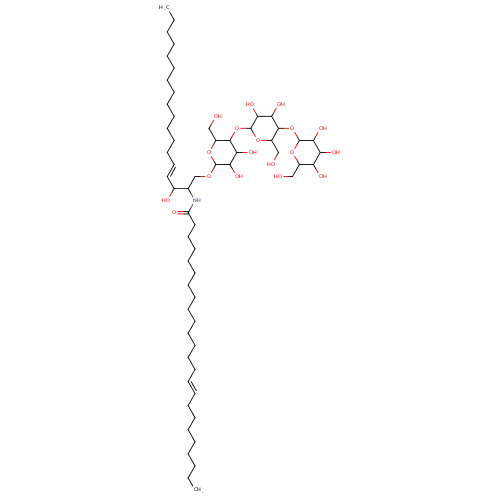
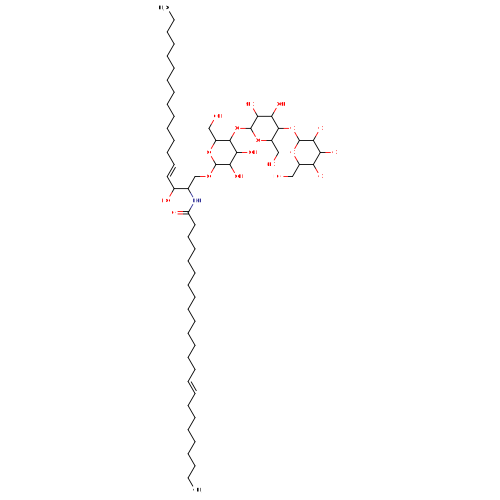
| Description | Trihexosylceramide is a glycosphingolipid which contains a trisaccharide (galactose-galactose-glucose) moiety bound in glycosidic linkage to the hydroxyl group of ceramide as the polar head group. It accumulates in tissue due to a defect in ceramide trihexosidase and is the cause of angiokeratoma corporis diffusum (Fabry disease). Although normal human colonic epithelial cells lack the glycosphingolipid globotriaosylceramide (Gb(3)), this molecule is highly expressed in metastatic colon cancer (PubMed ID 16365318 ). |
|---|
| Contaminant Sources | - FooDB Chemicals
- HMDB Contaminants - Urine
|
|---|
| Contaminant Type | Not Available |
|---|
| Chemical Structure | |
|---|
| Synonyms | | Value | Source |
|---|
| Ceramide trihexoside | HMDB | | D-Galactosyl-1,4-D-galactosyl-1,4-D-glucosylceramide | HMDB | | delta-Galactosyl-1,4-delta-galactosyl-1,4-delta-glucosylceramide | HMDB | | Fabry glycolipid | HMDB | | Gal-alpha1->4gal-beta1->4GLC-beta1->1'cer | HMDB | | Gal-alpha1->4gal-beta1->4GLC-beta1->1'cer(D18:1/24:1 | HMDB | | Gal-alpha1->4laccer | HMDB | | Ganglioside GL3 | HMDB | | Gb3 | HMDB | | globo-N-Triaosylceramide | HMDB | | Globotriaosylceramide | HMDB | | Globotriglycosylceramide | HMDB | | Globotriosylceramide | HMDB | | Shiga toxin receptor | HMDB | | N-[(4E)-1-[(5-{[3,4-dihydroxy-6-(hydroxymethyl)-5-{[3,4,5-trihydroxy-6-(hydroxymethyl)oxan-2-yl]oxy}oxan-2-yl]oxy}-3,4-dihydroxy-6-(hydroxymethyl)oxan-2-yl)oxy]-3-hydroxyoctadec-4-en-2-yl]tetracos-15-enimidate | Generator, HMDB |
|
|---|
| Chemical Formula | C60H111NO18 |
|---|
| Average Molecular Mass | 1134.519 g/mol |
|---|
| Monoisotopic Mass | 1133.780 g/mol |
|---|
| CAS Registry Number | Not Available |
|---|
| IUPAC Name | (15E)-N-[(4E)-1-[(5-{[3,4-dihydroxy-6-(hydroxymethyl)-5-{[3,4,5-trihydroxy-6-(hydroxymethyl)oxan-2-yl]oxy}oxan-2-yl]oxy}-3,4-dihydroxy-6-(hydroxymethyl)oxan-2-yl)oxy]-3-hydroxyoctadec-4-en-2-yl]tetracos-15-enamide |
|---|
| Traditional Name | (15E)-N-[(4E)-1-[(5-{[3,4-dihydroxy-6-(hydroxymethyl)-5-{[3,4,5-trihydroxy-6-(hydroxymethyl)oxan-2-yl]oxy}oxan-2-yl]oxy}-3,4-dihydroxy-6-(hydroxymethyl)oxan-2-yl)oxy]-3-hydroxyoctadec-4-en-2-yl]tetracos-15-enamide |
|---|
| SMILES | CCCCCCCCCCCCC\C=C\C(O)C(COC1OC(CO)C(OC2OC(CO)C(OC3OC(CO)C(O)C(O)C3O)C(O)C2O)C(O)C1O)NC(=O)CCCCCCCCCCCCC\C=C\CCCCCCCC |
|---|
| InChI Identifier | InChI=1S/C60H111NO18/c1-3-5-7-9-11-13-15-17-18-19-20-21-22-23-24-26-28-30-32-34-36-38-48(66)61-43(44(65)37-35-33-31-29-27-25-16-14-12-10-8-6-4-2)42-74-58-54(72)51(69)56(46(40-63)76-58)79-60-55(73)52(70)57(47(41-64)77-60)78-59-53(71)50(68)49(67)45(39-62)75-59/h17-18,35,37,43-47,49-60,62-65,67-73H,3-16,19-34,36,38-42H2,1-2H3,(H,61,66)/b18-17+,37-35+ |
|---|
| InChI Key | FZLJBZZCTNZGFA-YOPMPTLHSA-N |
|---|
| Chemical Taxonomy |
|---|
| Description | belongs to the class of organic compounds known as glycosyl-n-acylsphingosines. Glycosyl-N-acylsphingosines are compounds containing a sphingosine linked to a simple glucosyl moiety. |
|---|
| Kingdom | Organic compounds |
|---|
| Super Class | Lipids and lipid-like molecules |
|---|
| Class | Sphingolipids |
|---|
| Sub Class | Glycosphingolipids |
|---|
| Direct Parent | Glycosyl-N-acylsphingosines |
|---|
| Alternative Parents | |
|---|
| Substituents | - Glycosyl-n-acylsphingosine
- Oligosaccharide
- Fatty acyl glycoside
- Alkyl glycoside
- Glycosyl compound
- O-glycosyl compound
- Fatty amide
- N-acyl-amine
- Oxane
- Fatty acyl
- Secondary alcohol
- Secondary carboxylic acid amide
- Carboxamide group
- Oxacycle
- Polyol
- Organoheterocyclic compound
- Carboxylic acid derivative
- Acetal
- Primary alcohol
- Alcohol
- Organopnictogen compound
- Organic oxide
- Organic oxygen compound
- Hydrocarbon derivative
- Organonitrogen compound
- Carbonyl group
- Organooxygen compound
- Organic nitrogen compound
- Aliphatic heteromonocyclic compound
|
|---|
| Molecular Framework | Aliphatic heteromonocyclic compounds |
|---|
| External Descriptors | Not Available |
|---|
| Biological Properties |
|---|
| Status | Detected and Not Quantified |
|---|
| Origin | Not Available |
|---|
| Cellular Locations | Not Available |
|---|
| Biofluid Locations | Not Available |
|---|
| Tissue Locations | Not Available |
|---|
| Pathways | Not Available |
|---|
| Applications | Not Available |
|---|
| Biological Roles | Not Available |
|---|
| Chemical Roles | Not Available |
|---|
| Physical Properties |
|---|
| State | Not Available |
|---|
| Appearance | Not Available |
|---|
| Experimental Properties | | Property | Value |
|---|
| Melting Point | Not Available | | Boiling Point | Not Available | | Solubility | Not Available |
|
|---|
| Predicted Properties | |
|---|
| Spectra |
|---|
| Spectra | | Spectrum Type | Description | Splash Key | View |
|---|
| Predicted LC-MS/MS | Predicted LC-MS/MS Spectrum - 10V, Negative | splash10-001i-0900000002-805e30ffb0a5d60b8dd9 | Spectrum | | Predicted LC-MS/MS | Predicted LC-MS/MS Spectrum - 20V, Negative | splash10-01q9-4901000101-5844f6678219ce713a1a | Spectrum | | Predicted LC-MS/MS | Predicted LC-MS/MS Spectrum - 40V, Negative | splash10-0a6r-8908242364-af78af40043a1c6078cd | Spectrum | | Predicted LC-MS/MS | Predicted LC-MS/MS Spectrum - 10V, Positive | splash10-02aj-2902002002-15eac83f56ce7a3381bd | Spectrum | | Predicted LC-MS/MS | Predicted LC-MS/MS Spectrum - 20V, Positive | splash10-001i-0901001101-a2c40cf6de274f024f29 | Spectrum | | Predicted LC-MS/MS | Predicted LC-MS/MS Spectrum - 40V, Positive | splash10-01ox-5900001000-b7df8d8830ffe1e3c174 | Spectrum |
|
|---|
| Toxicity Profile |
|---|
| Route of Exposure | Not Available |
|---|
| Mechanism of Toxicity | Not Available |
|---|
| Metabolism | Not Available |
|---|
| Toxicity Values | Not Available |
|---|
| Lethal Dose | Not Available |
|---|
| Carcinogenicity (IARC Classification) | Not Available |
|---|
| Uses/Sources | Not Available |
|---|
| Minimum Risk Level | Not Available |
|---|
| Health Effects | Not Available |
|---|
| Symptoms | Not Available |
|---|
| Treatment | Not Available |
|---|
| Concentrations |
|---|
| Not Available |
|---|
| External Links |
|---|
| DrugBank ID | Not Available |
|---|
| HMDB ID | HMDB0004883 |
|---|
| FooDB ID | FDB023476 |
|---|
| Phenol Explorer ID | Not Available |
|---|
| KNApSAcK ID | Not Available |
|---|
| BiGG ID | Not Available |
|---|
| BioCyc ID | Not Available |
|---|
| METLIN ID | Not Available |
|---|
| PDB ID | Not Available |
|---|
| Wikipedia Link | Not Available |
|---|
| Chemspider ID | 16744896 |
|---|
| ChEBI ID | Not Available |
|---|
| PubChem Compound ID | 20057318 |
|---|
| Kegg Compound ID | Not Available |
|---|
| YMDB ID | Not Available |
|---|
| ECMDB ID | Not Available |
|---|
| References |
|---|
| Synthesis Reference | Not Available |
|---|
| MSDS | Not Available |
|---|
| General References | | 1. Wenger DA, DeGala G, Williams C, Taylor HA, Stevenson RE, Pruitt JR, Miller J, Garen PD, Balentine JD: Clinical, pathological, and biochemical studies on an infantile case of sulfatide/GM1 activator protein deficiency. Am J Med Genet. 1989 Jun;33(2):255-65. | | 2. Ohdoi C, Nyhan WL, Kuhara T: Chemical diagnosis of Lesch-Nyhan syndrome using gas chromatography-mass spectrometry detection. J Chromatogr B Analyt Technol Biomed Life Sci. 2003 Jul 15;792(1):123-30. | | 3. Ledvinova J, Poupetova H, Hanackova A, Pisacka M, Elleder M: Blood group B glycosphingolipids in alpha-galactosidase deficiency (Fabry disease): influence of secretor status. Biochim Biophys Acta. 1997 Apr 1;1345(2):180-7. | | 4. Hara A, Kitazawa N, Taketomi T: Abnormalities of glycosphingolipids in mucopolysaccharidosis type III B. J Lipid Res. 1984 Feb;25(2):175-84. | | 5. Thurberg BL, Randolph Byers H, Granter SR, Phelps RG, Gordon RE, O'Callaghan M: Monitoring the 3-year efficacy of enzyme replacement therapy in fabry disease by repeated skin biopsies. J Invest Dermatol. 2004 Apr;122(4):900-8. | | 6. Thurberg BL, Rennke H, Colvin RB, Dikman S, Gordon RE, Collins AB, Desnick RJ, O'Callaghan M: Globotriaosylceramide accumulation in the Fabry kidney is cleared from multiple cell types after enzyme replacement therapy. Kidney Int. 2002 Dec;62(6):1933-46. | | 7. Kovbasnjuk O, Mourtazina R, Baibakov B, Wang T, Elowsky C, Choti MA, Kane A, Donowitz M: The glycosphingolipid globotriaosylceramide in the metastatic transformation of colon cancer. Proc Natl Acad Sci U S A. 2005 Dec 27;102(52):19087-92. Epub 2005 Dec 19. | | 8. Roder B, Dabrowski J, Dabrowski U, Egge H, Peter-Katalinic J, Schwarzmann G, Sandhoff K: The determination of phytosphingosine-containing globotriaosylceramide from human kidney in the presence of lactosylceramide. Chem Phys Lipids. 1990 Mar;53(1):85-9. | | 9. Eng CM, Guffon N, Wilcox WR, Germain DP, Lee P, Waldek S, Caplan L, Linthorst GE, Desnick RJ: Safety and efficacy of recombinant human alpha-galactosidase A replacement therapy in Fabry's disease. N Engl J Med. 2001 Jul 5;345(1):9-16. | | 10. Abe A, Wild SR, Lee WL, Shayman JA: Agents for the treatment of glycosphingolipid storage disorders. Curr Drug Metab. 2001 Sep;2(3):331-8. | | 11. Mignani R, Cagnoli L: Enzyme replacement therapy in Fabry's disease: recent advances and clinical applications. J Nephrol. 2004 May-Jun;17(3):354-63. | | 12. Kanekura T, Fukushige T, Kanda A, Tsuyama S, Murata F, Sakuraba H, Kanzaki T: Immunoelectron-microscopic detection of globotriaosylceramide accumulated in the skin of patients with Fabry disease. Br J Dermatol. 2005 Sep;153(3):544-8. | | 13. Li SC, Kundu SK, Degasperi R, Li YT: Accumulation of globotriaosylceramide in a case of leiomyosarcoma. Biochem J. 1986 Dec 15;240(3):925-7. | | 14. Wilcox WR, Banikazemi M, Guffon N, Waldek S, Lee P, Linthorst GE, Desnick RJ, Germain DP: Long-term safety and efficacy of enzyme replacement therapy for Fabry disease. Am J Hum Genet. 2004 Jul;75(1):65-74. Epub 2004 May 20. |
|
|---|