Record Information
Version1.0
Creation Date2016-05-26 05:57:54 UTC
Update Date2026-04-06 12:13:21 UTC
Accession NumberCHEM035658
Identification
Common Name13,14-Dihydro PGF2a
ClassSmall Molecule
Description
Contaminant Sources
  • FooDB Chemicals
Contaminant TypeNot Available
Chemical Structure
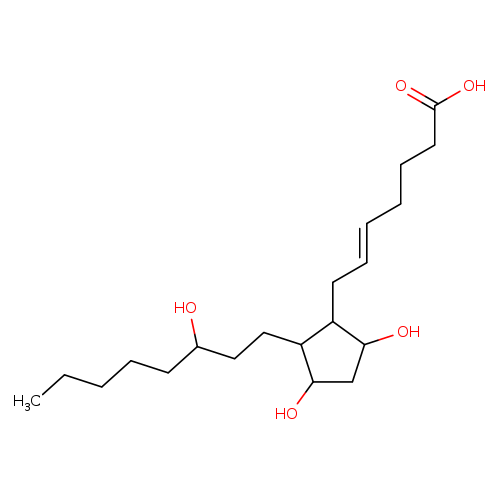
Thumb
Synonyms
ValueSource
13,14-Dihydro-prostaglandin F2alphaMeSH
13,14-Dihydroprostaglandin F2alphaMeSH
13,14-Dihydro-PGF2alphaMeSH
13,14-Dihydroprostaglandin F2alpha, (5Z,9alpha,11alpha)-isomerMeSH
(5Z,9-alpha,11-alpha,15S)-9,11,15-Trihydroxy-prost-5-en-1-OateHMDB
(5Z,9-alpha,11-alpha,15S)-9,11,15-Trihydroxy-prost-5-en-1-Oic acidHMDB
13,14-dihydro-PGF2-alphaHMDB
13,14-DihydrodinoprostHMDB
13,14-Dihydroprostaglandin F2-alphaHMDB
7-(3,5-Dihydroxy-2-(3-hydroxyoctyl)cyclopentyl)-5-heptenoateHMDB
7-(3,5-Dihydroxy-2-(3-hydroxyoctyl)cyclopentyl)-5-heptenoic acidHMDB
(5E)-7-[3,5-Dihydroxy-2-(3-hydroxyoctyl)cyclopentyl]hept-5-enoateGenerator, HMDB
Chemical FormulaC20H36O5
Average Molecular Mass356.497 g/mol
Monoisotopic Mass356.256 g/mol
CAS Registry Number27376-74-5
IUPAC Name(5E)-7-[3,5-dihydroxy-2-(3-hydroxyoctyl)cyclopentyl]hept-5-enoic acid
Traditional Name13,14-dihydro-pgf2-α
SMILESCCCCCC(O)CCC1C(O)CC(O)C1C\C=C\CCCC(O)=O
InChI IdentifierInChI=1S/C20H36O5/c1-2-3-6-9-15(21)12-13-17-16(18(22)14-19(17)23)10-7-4-5-8-11-20(24)25/h4,7,15-19,21-23H,2-3,5-6,8-14H2,1H3,(H,24,25)/b7-4+
InChI KeyLLQBSJQTCKVWTD-QPJJXVBHSA-N
Chemical Taxonomy
Description belongs to the class of organic compounds known as prostaglandins and related compounds. These are unsaturated carboxylic acids consisting of a 20 carbon skeleton that also contains a five member ring, and are based upon the fatty acid arachidonic acid.
KingdomOrganic compounds
Super ClassLipids and lipid-like molecules
ClassFatty Acyls
Sub ClassEicosanoids
Direct ParentProstaglandins and related compounds
Alternative Parents
Substituents
  • Prostaglandin skeleton
  • Long-chain fatty acid
  • Hydroxy fatty acid
  • Cyclopentanol
  • Fatty acid
  • Unsaturated fatty acid
  • Cyclic alcohol
  • Secondary alcohol
  • Carboxylic acid derivative
  • Carboxylic acid
  • Monocarboxylic acid or derivatives
  • Organic oxide
  • Organic oxygen compound
  • Alcohol
  • Hydrocarbon derivative
  • Organooxygen compound
  • Carbonyl group
  • Aliphatic homomonocyclic compound
Molecular FrameworkAliphatic homomonocyclic compounds
External DescriptorsNot Available
Biological Properties
StatusDetected and Not Quantified
OriginNot Available
Cellular LocationsNot Available
Biofluid LocationsNot Available
Tissue LocationsNot Available
PathwaysNot Available
ApplicationsNot Available
Biological RolesNot Available
Chemical RolesNot Available
Physical Properties
StateNot Available
AppearanceNot Available
Experimental Properties
PropertyValue
Melting PointNot Available
Boiling PointNot Available
SolubilityNot Available
Predicted Properties
PropertyValueSource
Water Solubility0.14 g/LALOGPS
logP4.1ALOGPS
logP2.82ChemAxon
logS-3.4ALOGPS
pKa (Strongest Acidic)4.31ChemAxon
pKa (Strongest Basic)-1.3ChemAxon
Physiological Charge-1ChemAxon
Hydrogen Acceptor Count5ChemAxon
Hydrogen Donor Count4ChemAxon
Polar Surface Area97.99 ŲChemAxon
Rotatable Bond Count13ChemAxon
Refractivity99.51 m³·mol⁻¹ChemAxon
Polarizability42.47 ųChemAxon
Number of Rings1ChemAxon
Bioavailability1ChemAxon
Rule of FiveYesChemAxon
Ghose FilterYesChemAxon
Veber's RuleNoChemAxon
MDDR-like RuleNoChemAxon
Spectra
Spectra
Spectrum TypeDescriptionSplash KeyView
Predicted GC-MSPredicted GC-MS Spectrum - GC-MS (Non-derivatized) - 70eV, Positivesplash10-01q0-6398000000-6336b0f9c8622102b3ddSpectrum
Predicted GC-MSPredicted GC-MS Spectrum - GC-MS (4 TMS) - 70eV, Positivesplash10-00gi-3400279000-b9a5a3f06dbbfac61228Spectrum
Predicted GC-MSPredicted GC-MS Spectrum - GC-MS (Non-derivatized) - 70eV, PositiveNot AvailableSpectrum
Predicted LC-MS/MSPredicted LC-MS/MS Spectrum - 10V, Positivesplash10-00dr-0009000000-e73ee683923f18658db0Spectrum
Predicted LC-MS/MSPredicted LC-MS/MS Spectrum - 20V, Positivesplash10-00dr-2289000000-141f8c955665a3884c1cSpectrum
Predicted LC-MS/MSPredicted LC-MS/MS Spectrum - 40V, Positivesplash10-05bf-9170000000-6f21abde220bd787fc46Spectrum
Predicted LC-MS/MSPredicted LC-MS/MS Spectrum - 10V, Negativesplash10-0a4r-0009000000-81348dda2ad025fd81d8Spectrum
Predicted LC-MS/MSPredicted LC-MS/MS Spectrum - 20V, Negativesplash10-052r-1029000000-7ccfba41f1513e5d36ccSpectrum
Predicted LC-MS/MSPredicted LC-MS/MS Spectrum - 40V, Negativesplash10-0a4l-9042000000-738256e4d93d4bfdc448Spectrum
Predicted LC-MS/MSPredicted LC-MS/MS Spectrum - 10V, Positivesplash10-00dr-0019000000-b100e87d9e613b0c680dSpectrum
Predicted LC-MS/MSPredicted LC-MS/MS Spectrum - 20V, Positivesplash10-00di-9556000000-43a5141208d1df0dc9fbSpectrum
Predicted LC-MS/MSPredicted LC-MS/MS Spectrum - 40V, Positivesplash10-05fu-9400000000-8f60cd186586af166944Spectrum
Predicted LC-MS/MSPredicted LC-MS/MS Spectrum - 10V, Negativesplash10-0a4i-0009000000-ca50430fcebead154dceSpectrum
Predicted LC-MS/MSPredicted LC-MS/MS Spectrum - 20V, Negativesplash10-0a4i-0059000000-f1c4ada2baf575a9aba1Spectrum
Predicted LC-MS/MSPredicted LC-MS/MS Spectrum - 40V, Negativesplash10-000x-7192000000-fca35727e2408193ef27Spectrum
Toxicity Profile
Route of ExposureNot Available
Mechanism of ToxicityNot Available
MetabolismNot Available
Toxicity ValuesNot Available
Lethal DoseNot Available
Carcinogenicity (IARC Classification)Not Available
Uses/SourcesNot Available
Minimum Risk LevelNot Available
Health EffectsNot Available
SymptomsNot Available
TreatmentNot Available
Concentrations
Not Available
DrugBank IDNot Available
HMDB IDHMDB0004239
FooDB IDFDB023344
Phenol Explorer IDNot Available
KNApSAcK IDNot Available
BiGG IDNot Available
BioCyc IDNot Available
METLIN IDNot Available
PDB IDNot Available
Wikipedia LinkNot Available
Chemspider ID4938997
ChEBI ID170865
PubChem Compound ID6434009
Kegg Compound IDNot Available
YMDB IDNot Available
ECMDB IDNot Available
References
Synthesis ReferenceNot Available
MSDSNot Available
General References
1. Masoodi M, Nicolaou A: Lipidomic analysis of twenty-seven prostanoids and isoprostanes by liquid chromatography/electrospray tandem mass spectrometry. Rapid Commun Mass Spectrom. 2006;20(20):3023-9.