Record Information
Version1.0
Creation Date2016-05-26 05:55:47 UTC
Update Date2026-04-06 13:03:16 UTC
Accession NumberCHEM035615
Identification
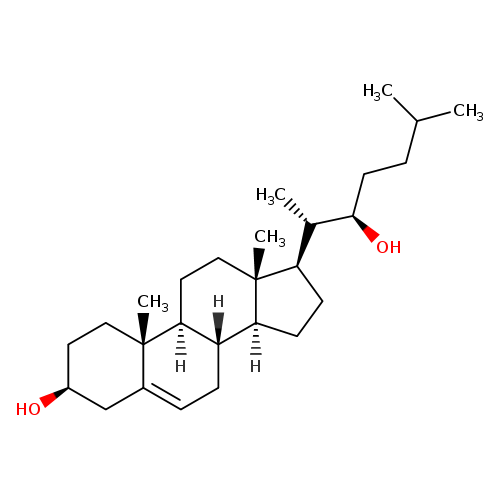
Common Name22beta-Hydroxycholesterol
ClassSmall Molecule
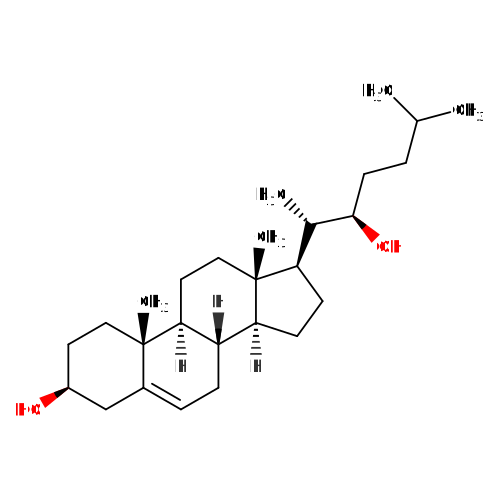
Description22b-Hydroxycholesterol, also known as cholest-5-en-3b,22R-diol or 22(R)OH cholesterol, belongs to the class of organic compounds known as dihydroxy bile acids, alcohols and derivatives. Dihydroxy bile acids, alcohols and derivatives are compounds containing or derived from a bile acid or alcohol, and which bears exactly two carboxylic acid groups. Thus, 22b-hydroxycholesterol is considered to be a sterol lipid molecule. 22b-Hydroxycholesterol is a very hydrophobic molecule, practically insoluble (in water), and relatively neutral. 22b-Hydroxycholesterol exists in all eukaryotes, ranging from yeast to humans. 22b-Hydroxycholesterol participates in a number of enzymatic reactions, within cattle. In particular, 22b-Hydroxycholesterol can be converted into 20a,22b-dihydroxycholesterol through its interaction with the enzyme cholesterol side-chain cleavage enzyme, mitochondrial. In addition, 22b-Hydroxycholesterol can be biosynthesized from cholesterol through its interaction with the enzyme cholesterol side-chain cleavage enzyme, mitochondrial. In cattle, 22b-hydroxycholesterol is involved in the metabolic pathway called the steroidogenesis pathway.
Contaminant Sources
  • FooDB Chemicals
Contaminant TypeNot Available
Chemical Structure
Thumb
Synonyms
ValueSource
(3beta,22R)-Cholest-5-ene-3,22-diolChEBI
22beta-HydroxycholesterolChEBI
22R-HydroxycholesterolChEBI
Cholest-5-en-3beta,22R-diolChEBI
(22R)-22-HydroxycholesterolKegg
(3b,22R)-Cholest-5-ene-3,22-diolGenerator
(3Β,22R)-cholest-5-ene-3,22-diolGenerator
22Β-hydroxycholesterolGenerator
Cholest-5-en-3b,22R-diolGenerator
Cholest-5-en-3β,22R-diolGenerator
22-Hydroxycholesterol, (3beta,20R,22R)-isomerHMDB
22-Hydroxycholesterol, (3beta,20R,22S)-isomerHMDB
Cholest-5-ene-3beta,22-diolHMDB
22(R)-HydroxycholesterolHMDB
22-Hydroxycholesterol, (3beta,22S)-isomerHMDB
22(R)OH CholesterolHMDB
22-HydroxycholesterolHMDB
22-Hydroxycholesterol, (3beta,22R)-isomerHMDB
22S-HydroxycholesterolHMDB
Chemical FormulaC27H46O2
Average Molecular Mass402.653 g/mol
Monoisotopic Mass402.350 g/mol
CAS Registry Number17954-98-2
IUPAC Name(1S,2R,5S,10S,11S,14R,15S)-14-[(2S,3R)-3-hydroxy-6-methylheptan-2-yl]-2,15-dimethyltetracyclo[8.7.0.0²,⁷.0¹¹,¹⁵]heptadec-7-en-5-ol
Traditional Name22R-hydroxycholesterol
SMILES[H][C@@]12CC[C@H]([C@H](C)[C@H](O)CCC(C)C)[C@@]1(C)CC[C@@]1([H])[C@@]2([H])CC=C2C[C@@H](O)CC[C@]12C
InChI IdentifierInChI=1S/C27H46O2/c1-17(2)6-11-25(29)18(3)22-9-10-23-21-8-7-19-16-20(28)12-14-26(19,4)24(21)13-15-27(22,23)5/h7,17-18,20-25,28-29H,6,8-16H2,1-5H3/t18-,20-,21-,22+,23-,24-,25+,26-,27+/m0/s1
InChI KeyRZPAXNJLEKLXNO-GFKLAVDKSA-N
Chemical Taxonomy
Description belongs to the class of organic compounds known as dihydroxy bile acids, alcohols and derivatives. Dihydroxy bile acids, alcohols and derivatives are compounds containing or derived from a bile acid or alcohol, and which bears exactly two carboxylic acid groups.

KingdomOrganic compounds
Super ClassLipids and lipid-like molecules
ClassSteroids and steroid derivatives
Sub ClassBile acids, alcohols and derivatives
Direct ParentDihydroxy bile acids, alcohols and derivatives
Alternative Parents
Substituents
  • Cholesterol
  • Cholesterol-skeleton
  • Cholestane-skeleton
  • Dihydroxy bile acid, alcohol, or derivatives
  • 22-hydroxysteroid
  • Hydroxysteroid
  • 3-hydroxy-delta-5-steroid
  • 3-beta-hydroxysteroid
  • 3-hydroxysteroid
  • 3-beta-hydroxy-delta-5-steroid
  • Delta-5-steroid
  • Cyclic alcohol
  • Secondary alcohol
  • Organooxygen compound
  • Hydrocarbon derivative
  • Organic oxygen compound
  • Alcohol
  • Aliphatic homopolycyclic compound
Molecular FrameworkAliphatic homopolycyclic compounds
External Descriptors
Biological Properties
StatusDetected and Not Quantified
OriginNot Available
Cellular LocationsNot Available
Biofluid LocationsNot Available
Tissue LocationsNot Available
PathwaysNot Available
ApplicationsNot Available
Biological RolesNot Available
Chemical RolesNot Available
Physical Properties
StateNot Available
AppearanceNot Available
Experimental Properties
PropertyValue
Melting PointNot Available
Boiling PointNot Available
SolubilityNot Available
Predicted Properties
PropertyValueSource
Water Solubility0.00065 g/LALOGPS
logP5.69ALOGPS
logP5.8ChemAxon
logS-5.8ALOGPS
pKa (Strongest Acidic)18.2ChemAxon
pKa (Strongest Basic)-0.73ChemAxon
Physiological Charge0ChemAxon
Hydrogen Acceptor Count2ChemAxon
Hydrogen Donor Count2ChemAxon
Polar Surface Area40.46 ŲChemAxon
Rotatable Bond Count5ChemAxon
Refractivity122.21 m³·mol⁻¹ChemAxon
Polarizability50.77 ųChemAxon
Number of Rings4ChemAxon
Bioavailability1ChemAxon
Rule of FiveNoChemAxon
Ghose FilterNoChemAxon
Veber's RuleNoChemAxon
MDDR-like RuleNoChemAxon
Spectra
Spectra
Spectrum TypeDescriptionSplash KeyView
Predicted GC-MSPredicted GC-MS Spectrum - GC-MS (Non-derivatized) - 70eV, Positivesplash10-00dr-1009000000-ed60780a407ecfba86a3Spectrum
Predicted GC-MSPredicted GC-MS Spectrum - GC-MS (2 TMS) - 70eV, Positivesplash10-001i-2111490000-e04dc3bb7ab36f5571f8Spectrum
Predicted GC-MSPredicted GC-MS Spectrum - GC-MS (Non-derivatized) - 70eV, PositiveNot AvailableSpectrum
Predicted LC-MS/MSPredicted LC-MS/MS Spectrum - 10V, Positivesplash10-0f79-0009200000-2ae8fb6172d46e818cefSpectrum
Predicted LC-MS/MSPredicted LC-MS/MS Spectrum - 20V, Positivesplash10-00kr-2119100000-9925177c38f63ddc14a1Spectrum
Predicted LC-MS/MSPredicted LC-MS/MS Spectrum - 40V, Positivesplash10-0a4i-6049000000-44d8c7fcd6055391f8ddSpectrum
Predicted LC-MS/MSPredicted LC-MS/MS Spectrum - 10V, Negativesplash10-0udi-0004900000-10b9f0186b2a2ac37d53Spectrum
Predicted LC-MS/MSPredicted LC-MS/MS Spectrum - 20V, Negativesplash10-0ue9-1019700000-6b5a6ee8410d635f82c6Spectrum
Predicted LC-MS/MSPredicted LC-MS/MS Spectrum - 40V, Negativesplash10-0f79-4059000000-8d88574ef4b0b7d39b85Spectrum
Predicted LC-MS/MSPredicted LC-MS/MS Spectrum - 10V, Positivesplash10-0gbi-0109200000-bd7670f27e11ece2eac0Spectrum
Predicted LC-MS/MSPredicted LC-MS/MS Spectrum - 20V, Positivesplash10-014r-5339000000-858a48abc2f1b02935f5Spectrum
Predicted LC-MS/MSPredicted LC-MS/MS Spectrum - 40V, Positivesplash10-0a4l-6960000000-73b0982e9fcef4fa83d0Spectrum
Predicted LC-MS/MSPredicted LC-MS/MS Spectrum - 10V, Negativesplash10-0udi-0000900000-84d3363c4aa86f104c55Spectrum
Predicted LC-MS/MSPredicted LC-MS/MS Spectrum - 20V, Negativesplash10-0udi-0012900000-973e1345841477d95a76Spectrum
Predicted LC-MS/MSPredicted LC-MS/MS Spectrum - 40V, Negativesplash10-0uea-7049300000-8042d2ca5cd8469196daSpectrum
Toxicity Profile
Route of ExposureNot Available
Mechanism of ToxicityNot Available
MetabolismNot Available
Toxicity ValuesNot Available
Lethal DoseNot Available
Carcinogenicity (IARC Classification)Not Available
Uses/SourcesNot Available
Minimum Risk LevelNot Available
Health EffectsNot Available
SymptomsNot Available
TreatmentNot Available
Concentrations
Not Available
DrugBank IDNot Available
HMDB IDHMDB0004035
FooDB IDFDB023285
Phenol Explorer IDNot Available
KNApSAcK IDNot Available
BiGG IDNot Available
BioCyc IDNot Available
METLIN ID7006
PDB IDNot Available
Wikipedia LinkNot Available
Chemspider ID146693
ChEBI ID67237
PubChem Compound ID167685
Kegg Compound IDC05502
YMDB IDYMDB00310
ECMDB IDNot Available
References
Synthesis ReferenceNot Available
MSDSNot Available
General References
1. Koreeda, Masato; Ricca, Daniel J. Chirality transfer in stereoselective synthesis. A highly stereocontrolled synthesis of 22-hydroxylated steroid side chains via the [2,3]-Wittig rearrangement. Journal of Organic Chemistry (1986), 51(21), 4090-2.
2. Haidar B, Denis M, Marcil M, Krimbou L, Genest J Jr: Apolipoprotein A-I activates cellular cAMP signaling through the ABCA1 transporter. J Biol Chem. 2004 Mar 12;279(11):9963-9. Epub 2003 Dec 29.
3. Yao ZX, Brown RC, Teper G, Greeson J, Papadopoulos V: 22R-Hydroxycholesterol protects neuronal cells from beta-amyloid-induced cytotoxicity by binding to beta-amyloid peptide. J Neurochem. 2002 Dec;83(5):1110-9.
4. Matsuzaki J, Tsuji T, Imazeki I, Ikeda H, Nishimura T: Immunosteroid as a regulator for Th1/Th2 balance: its possible role in autoimmune diseases. Autoimmunity. 2005 Aug;38(5):369-75.
5. Tuckey RC: Cholesterol side-chain cleavage by mitochondria from the human placenta. Studies using hydroxycholesterols as substrates. J Steroid Biochem Mol Biol. 1992 Sep;42(8):883-90.
6. Hanley K, Ng DC, He SS, Lau P, Min K, Elias PM, Bikle DD, Mangelsdorf DJ, Williams ML, Feingold KR: Oxysterols induce differentiation in human keratinocytes and increase Ap-1-dependent involucrin transcription. J Invest Dermatol. 2000 Mar;114(3):545-53.
7. https://www.ncbi.nlm.nih.gov/pubmed/?term=1238395