| Record Information |
|---|
| Version | 1.0 |
|---|
| Creation Date | 2016-05-26 05:34:03 UTC |
|---|
| Update Date | 2016-11-09 01:21:16 UTC |
|---|
| Accession Number | CHEM035197 |
|---|
| Identification |
|---|
| Common Name | Diguanosine pentaphosphate |
|---|
| Class | Small Molecule |
|---|
| Description | |
|---|
| Contaminant Sources | |
|---|
| Contaminant Type | Not Available |
|---|
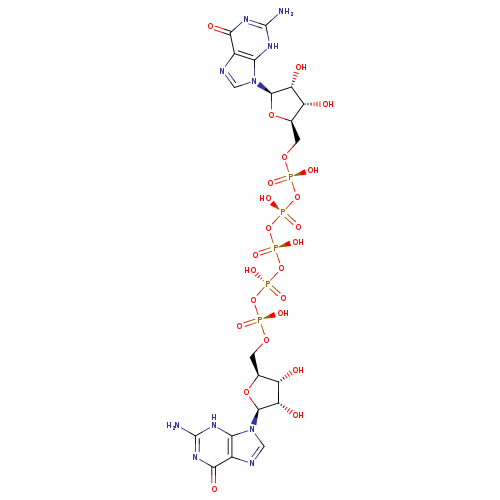
| Chemical Structure | |
|---|
| Synonyms | | Value | Source |
|---|
| Diguanosine pentaphosphoric acid | Generator | | Diguanosine-pentaphosphate | HMDB | | GPPPPPG | MeSH, HMDB | | ({[({[(2R,3S,4R,5R)-3,4-dihydroxy-5-(6-hydroxy-2-imino-3,9-dihydro-2H-purin-9-yl)oxolan-2-yl]methoxy}(hydroxy)phosphoryl)oxy](hydroxy)phosphoryl}oxy)({[({[(2S,3R,4S,5S)-3,4-dihydroxy-5-(6-hydroxy-2-imino-3,9-dihydro-2H-purin-9-yl)oxolan-2-yl]methoxy}(hydroxy)phosphoryl)oxy](hydroxy)phosphoryl}oxy)phosphinate | Generator, HMDB | | Diguanosine pentaphosphate | MeSH |
|
|---|
| Chemical Formula | C20H29N10O24P5 |
|---|
| Average Molecular Mass | 948.366 g/mol |
|---|
| Monoisotopic Mass | 948.004 g/mol |
|---|
| CAS Registry Number | 78101-73-2 |
|---|
| IUPAC Name | {[(2S,3R,4S,5S)-5-(2-amino-6-oxo-6,9-dihydro-3H-purin-9-yl)-3,4-dihydroxyoxolan-2-yl]methoxy}[({[({[({[(2R,3S,4R,5R)-5-(2-amino-6-oxo-6,9-dihydro-3H-purin-9-yl)-3,4-dihydroxyoxolan-2-yl]methoxy}(hydroxy)phosphoryl)oxy](hydroxy)phosphoryl}oxy)(hydroxy)phosphoryl]oxy}(hydroxy)phosphoryl)oxy]phosphinic acid |
|---|
| Traditional Name | [(2S,3R,4S,5S)-5-(2-amino-6-oxo-3H-purin-9-yl)-3,4-dihydroxyoxolan-2-yl]methoxy({[({[(2R,3S,4R,5R)-5-(2-amino-6-oxo-3H-purin-9-yl)-3,4-dihydroxyoxolan-2-yl]methoxy(hydroxy)phosphoryl}oxy(hydroxy)phosphoryl)oxy(hydroxy)phosphoryl]oxy(hydroxy)phosphoryl}oxy)phosphinic acid |
|---|
| SMILES | NC1=NC(=O)C2=C(N1)N(C=N2)[C@H]1O[C@@H](CO[P@](O)(=O)O[P@](O)(=O)O[P@](O)(=O)O[P@@](O)(=O)O[P@](O)(=O)OC[C@H]2O[C@H]([C@H](O)[C@@H]2O)N2C=NC3=C2NC(N)=NC3=O)[C@H](O)[C@@H]1O |
|---|
| InChI Identifier | InChI=1S/C20H29N10O24P5/c21-19-25-13-7(15(35)27-19)23-3-29(13)17-11(33)9(31)5(49-17)1-47-55(37,38)51-57(41,42)53-59(45,46)54-58(43,44)52-56(39,40)48-2-6-10(32)12(34)18(50-6)30-4-24-8-14(30)26-20(22)28-16(8)36/h3-6,9-12,17-18,31-34H,1-2H2,(H,37,38)(H,39,40)(H,41,42)(H,43,44)(H,45,46)(H3,21,25,27,35)(H3,22,26,28,36)/t5-,6+,9-,10+,11-,12+,17-,18+ |
|---|
| InChI Key | RELSGTOCAPVUGP-DTFXMBEISA-N |
|---|
| Chemical Taxonomy |
|---|
| Description | belongs to the class of organic compounds known as (5'->5')-dinucleotides. These are dinucleotides where the two bases are connected via a (5'->5')-phosphodiester linkage. |
|---|
| Kingdom | Organic compounds |
|---|
| Super Class | Nucleosides, nucleotides, and analogues |
|---|
| Class | (5'->5')-dinucleotides |
|---|
| Sub Class | Not Available |
|---|
| Direct Parent | (5'->5')-dinucleotides |
|---|
| Alternative Parents | |
|---|
| Substituents | - (5'->5')-dinucleotide
- Purine ribonucleoside polyphosphate
- Purine nucleotide sugar
- Purine ribonucleoside monophosphate
- Pentose phosphate
- Pentose-5-phosphate
- Glycosyl compound
- N-glycosyl compound
- 6-oxopurine
- Hypoxanthine
- Monosaccharide phosphate
- Imidazopyrimidine
- Purine
- Pyrimidone
- Monoalkyl phosphate
- Aminopyrimidine
- Pyrimidine
- Alkyl phosphate
- Phosphoric acid ester
- Monosaccharide
- N-substituted imidazole
- Organic phosphoric acid derivative
- Tetrahydrofuran
- Vinylogous amide
- Azole
- Imidazole
- Heteroaromatic compound
- Secondary alcohol
- Organoheterocyclic compound
- Azacycle
- Oxacycle
- Organic nitrogen compound
- Amine
- Organic oxide
- Organopnictogen compound
- Organic oxygen compound
- Primary amine
- Alcohol
- Hydrocarbon derivative
- Organooxygen compound
- Organonitrogen compound
- Aromatic heteropolycyclic compound
|
|---|
| Molecular Framework | Aromatic heteropolycyclic compounds |
|---|
| External Descriptors | Not Available |
|---|
| Biological Properties |
|---|
| Status | Detected and Not Quantified |
|---|
| Origin | Not Available |
|---|
| Cellular Locations | Not Available |
|---|
| Biofluid Locations | Not Available |
|---|
| Tissue Locations | Not Available |
|---|
| Pathways | Not Available |
|---|
| Applications | Not Available |
|---|
| Biological Roles | Not Available |
|---|
| Chemical Roles | Not Available |
|---|
| Physical Properties |
|---|
| State | Not Available |
|---|
| Appearance | Not Available |
|---|
| Experimental Properties | | Property | Value |
|---|
| Melting Point | Not Available | | Boiling Point | Not Available | | Solubility | Not Available |
|
|---|
| Predicted Properties | |
|---|
| Spectra |
|---|
| Spectra | | Spectrum Type | Description | Splash Key | View |
|---|
| Predicted LC-MS/MS | Predicted LC-MS/MS Spectrum - 10V, Positive | splash10-0udi-0910010003-66a8053f95fd1b795344 | Spectrum | | Predicted LC-MS/MS | Predicted LC-MS/MS Spectrum - 20V, Positive | splash10-0udi-0900000000-8ea0384d6b31c5bfc018 | Spectrum | | Predicted LC-MS/MS | Predicted LC-MS/MS Spectrum - 40V, Positive | splash10-0udi-0900000000-b6d72fa43d8ec7d63315 | Spectrum | | Predicted LC-MS/MS | Predicted LC-MS/MS Spectrum - 10V, Negative | splash10-0f6t-0600001009-5f91e14641422bce2dbe | Spectrum | | Predicted LC-MS/MS | Predicted LC-MS/MS Spectrum - 20V, Negative | splash10-0udi-1900002001-04beef57265abbf71d11 | Spectrum | | Predicted LC-MS/MS | Predicted LC-MS/MS Spectrum - 40V, Negative | splash10-0udi-2905010000-0bb0cda07d89b2304132 | Spectrum | | Predicted LC-MS/MS | Predicted LC-MS/MS Spectrum - 10V, Positive | splash10-0udi-0900000204-2a706d2085f619f9fe72 | Spectrum | | Predicted LC-MS/MS | Predicted LC-MS/MS Spectrum - 20V, Positive | splash10-0ufs-0900000707-fe7bde91387571f46c80 | Spectrum | | Predicted LC-MS/MS | Predicted LC-MS/MS Spectrum - 40V, Positive | splash10-0udi-0930003200-aca52a1cc348fe05923e | Spectrum | | Predicted LC-MS/MS | Predicted LC-MS/MS Spectrum - 10V, Negative | splash10-0002-0200000009-7da9f63e3dcf2c3e88e8 | Spectrum | | Predicted LC-MS/MS | Predicted LC-MS/MS Spectrum - 20V, Negative | splash10-002b-0100010149-83066328b1ffc6e5f21a | Spectrum | | Predicted LC-MS/MS | Predicted LC-MS/MS Spectrum - 40V, Negative | splash10-001i-0212092012-7b38a314311c99236769 | Spectrum |
|
|---|
| Toxicity Profile |
|---|
| Route of Exposure | Not Available |
|---|
| Mechanism of Toxicity | Not Available |
|---|
| Metabolism | Not Available |
|---|
| Toxicity Values | Not Available |
|---|
| Lethal Dose | Not Available |
|---|
| Carcinogenicity (IARC Classification) | Not Available |
|---|
| Uses/Sources | Not Available |
|---|
| Minimum Risk Level | Not Available |
|---|
| Health Effects | Not Available |
|---|
| Symptoms | Not Available |
|---|
| Treatment | Not Available |
|---|
| Concentrations |
|---|
| Not Available |
|---|
| External Links |
|---|
| DrugBank ID | Not Available |
|---|
| HMDB ID | HMDB0001380 |
|---|
| FooDB ID | FDB022591 |
|---|
| Phenol Explorer ID | Not Available |
|---|
| KNApSAcK ID | Not Available |
|---|
| BiGG ID | Not Available |
|---|
| BioCyc ID | Not Available |
|---|
| METLIN ID | Not Available |
|---|
| PDB ID | GP5 |
|---|
| Wikipedia Link | Not Available |
|---|
| Chemspider ID | 4484327 |
|---|
| ChEBI ID | Not Available |
|---|
| PubChem Compound ID | 5327071 |
|---|
| Kegg Compound ID | Not Available |
|---|
| YMDB ID | Not Available |
|---|
| ECMDB ID | Not Available |
|---|
| References |
|---|
| Synthesis Reference | Not Available |
|---|
| MSDS | Not Available |
|---|
| General References | | 1. van der Giet M, Westhoff T, Cinkilic O, Jankowski J, Schluter H, Zidek W, Tepel M: The critical role of adenosine and guanosine in the affinity of dinucleoside polyphosphates to P(2X)-receptors in the isolated perfused rat kidney. Br J Pharmacol. 2001 Jan;132(2):467-74. | | 2. Ralevic V, Jankowski J, Schluter H: Structure-activity relationships of diadenosine polyphosphates (Ap(n)As), adenosine polyphospho guanosines (Ap(n)Gs) and guanosine polyphospho guanosines (Gp(n)Gs) at P2 receptors in the rat mesenteric arterial bed. Br J Pharmacol. 2001 Nov;134(5):1073-83. | | 3. Jankowski J, Hagemann J, Tepel M, van Der Giet M, Stephan N, Henning L, Gouni-Berthold I, Sachinidis A, Zidek W, Schluter H: Dinucleotides as growth-promoting extracellular mediators. Presence of dinucleoside diphosphates Ap2A, Ap2G, and Gp2G in releasable granules of platelets. J Biol Chem. 2001 Mar 23;276(12):8904-9. Epub 2000 Dec 13. |
|
|---|