Record Information
Version1.0
Creation Date2016-05-26 05:33:44 UTC
Update Date2016-11-09 01:21:16 UTC
Accession NumberCHEM035191
Identification
Common NameN-Acetyl-glucosamine 1-phosphate
ClassSmall Molecule
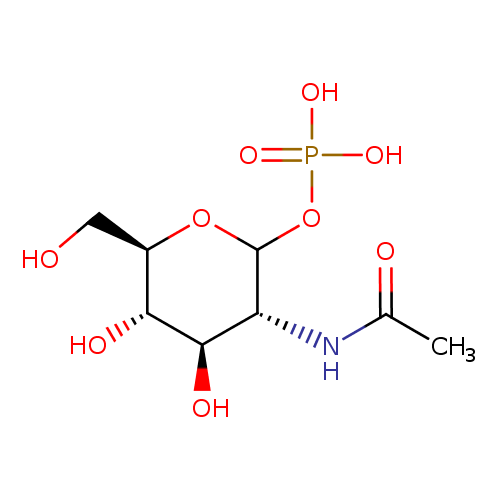
DescriptionN-Acetyl-glucosamine 1-phosphate, also known as n-acetyl-glucosamine 1-phosphate, belongs to the class of organic compounds known as n-acyl-alpha-hexosamines. These are carbohydrate derivatives containing a hexose moiety in which the oxygen atom is replaced by an n-acyl group. N-Acetyl-glucosamine 1-phosphate is possibly soluble (in water) and an extremely weak basic (essentially neutral) compound (based on its pKa). N-Acetyl-glucosamine 1-phosphate exists in all eukaryotes, ranging from yeast to humans. N-Acetyl-glucosamine 1-phosphate participates in a number of enzymatic reactions, within cattle. In particular, N-Acetyl-glucosamine 1-phosphate can be biosynthesized from N-acetyl-D-glucosamine 6-phosphate; which is catalyzed by the enzyme phosphoacetylglucosamine mutase. In addition, N-Acetyl-glucosamine 1-phosphate and uridine triphosphate can be converted into uridine diphosphate-N-acetylglucosamine through its interaction with the enzyme UDP-N-acetylhexosamine pyrophosphorylase. In cattle, N-acetyl-glucosamine 1-phosphate is involved in the metabolic pathway called the amino sugar metabolism pathway.
Contaminant Sources
  • FooDB Chemicals
Contaminant TypeNot Available
Chemical Structure
Thumb
Synonyms
ValueSource
2-(Acetylamino)-2-deoxy-D-glucopyranose 1-(dihydrogen phosphate)ChEBI
2-Acetamido-2-deoxy-1-O-phosphono-D-glucopyranoseChEBI
N-Acetyl-D-glucosamine 1-phosphateChEBI
N-Acetylglucosamine-1-phosphateChEBI
2-(Acetylamino)-2-deoxy-D-glucopyranose 1-(dihydrogen phosphoric acid)Generator
N-Acetyl-D-glucosamine 1-phosphoric acidGenerator
N-Acetylglucosamine-1-phosphoric acidGenerator
N-Acetyl-glucosamine 1-phosphoric acidGenerator
D-Glucosamine 1-phosphateHMDB
delta-Glucosamine 1-phosphateHMDB
N-Acetyl-alpha-D-glucosamine 1-phosphateHMDB
N-Acetyl-alpha-delta-glucosamine 1-phosphateHMDB
N-Acetyl-delta-glucosamine 1-phosphateHMDB
N-Acetyl-glucosamine-1-phosphateHMDB
GlcNAc-1-phosphateHMDB
Chemical FormulaC8H16NO9P
Average Molecular Mass301.188 g/mol
Monoisotopic Mass301.056 g/mol
CAS Registry Number6866-69-9
IUPAC Name{[(3R,4R,5S,6R)-3-acetamido-4,5-dihydroxy-6-(hydroxymethyl)oxan-2-yl]oxy}phosphonic acid
Traditional Name[(3R,4R,5S,6R)-3-acetamido-4,5-dihydroxy-6-(hydroxymethyl)oxan-2-yl]oxyphosphonic acid
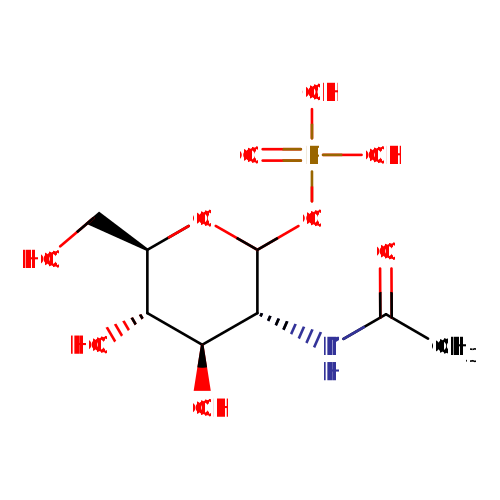
SMILESCC(=O)N[C@@H]1[C@@H](O)[C@H](O)[C@@H](CO)OC1OP(O)(O)=O
InChI IdentifierInChI=1S/C8H16NO9P/c1-3(11)9-5-7(13)6(12)4(2-10)17-8(5)18-19(14,15)16/h4-8,10,12-13H,2H2,1H3,(H,9,11)(H2,14,15,16)/t4-,5-,6-,7-,8?/m1/s1
InChI KeyFZLJPEPAYPUMMR-RTRLPJTCSA-N
Chemical Taxonomy
Description belongs to the class of organic compounds known as n-acyl-alpha-hexosamines. These are carbohydrate derivatives containing a hexose moiety in which the oxygen atom is replaced by an n-acyl group.
KingdomOrganic compounds
Super ClassOrganic oxygen compounds
ClassOrganooxygen compounds
Sub ClassCarbohydrates and carbohydrate conjugates
Direct ParentN-acyl-alpha-hexosamines
Alternative Parents
Substituents
  • N-acyl-alpha-hexosamine
  • Hexose monosaccharide
  • Monosaccharide phosphate
  • Monoalkyl phosphate
  • Monosaccharide
  • Organic phosphoric acid derivative
  • Oxane
  • Phosphoric acid ester
  • Alkyl phosphate
  • Acetamide
  • Secondary carboxylic acid amide
  • Secondary alcohol
  • Carboxamide group
  • Carboxylic acid derivative
  • Organoheterocyclic compound
  • Oxacycle
  • Primary alcohol
  • Carbonyl group
  • Organonitrogen compound
  • Organic oxide
  • Alcohol
  • Organopnictogen compound
  • Organic nitrogen compound
  • Hydrocarbon derivative
  • Aliphatic heteromonocyclic compound
Molecular FrameworkAliphatic heteromonocyclic compounds
External Descriptors
Biological Properties
StatusDetected and Not Quantified
OriginNot Available
Cellular LocationsNot Available
Biofluid LocationsNot Available
Tissue LocationsNot Available
PathwaysNot Available
ApplicationsNot Available
Biological RolesNot Available
Chemical RolesNot Available
Physical Properties
StateNot Available
AppearanceNot Available
Experimental Properties
PropertyValue
Melting PointNot Available
Boiling PointNot Available
SolubilityNot Available
Predicted Properties
PropertyValueSource
Water Solubility18.4 g/LALOGPS
logP-2ALOGPS
logP-3.3ChemAxon
logS-1.2ALOGPS
pKa (Strongest Acidic)1.18ChemAxon
pKa (Strongest Basic)-0.79ChemAxon
Physiological Charge-2ChemAxon
Hydrogen Acceptor Count8ChemAxon
Hydrogen Donor Count6ChemAxon
Polar Surface Area165.78 ŲChemAxon
Rotatable Bond Count4ChemAxon
Refractivity57.9 m³·mol⁻¹ChemAxon
Polarizability25.41 ųChemAxon
Number of Rings1ChemAxon
Bioavailability1ChemAxon
Rule of FiveNoChemAxon
Ghose FilterNoChemAxon
Veber's RuleNoChemAxon
MDDR-like RuleNoChemAxon
Spectra
Spectra
Spectrum TypeDescriptionSplash KeyView
Predicted GC-MSPredicted GC-MS Spectrum - GC-MS (Non-derivatized) - 70eV, Positivesplash10-007k-9230000000-37cdd3ef185356d03c19Spectrum
Predicted GC-MSPredicted GC-MS Spectrum - GC-MS (3 TMS) - 70eV, Positivesplash10-0f6t-9211240000-817e06893a2ccced098bSpectrum
Predicted GC-MSPredicted GC-MS Spectrum - GC-MS (Non-derivatized) - 70eV, PositiveNot AvailableSpectrum
Predicted LC-MS/MSPredicted LC-MS/MS Spectrum - 10V, Positivesplash10-0udi-1094000000-f1e04aaf05d431b8b0abSpectrum
Predicted LC-MS/MSPredicted LC-MS/MS Spectrum - 20V, Positivesplash10-0f7k-6290000000-6ff96a8c8bf54d5e8bfaSpectrum
Predicted LC-MS/MSPredicted LC-MS/MS Spectrum - 40V, Positivesplash10-0f6t-9620000000-3e2ee2ffc3801abdb7daSpectrum
Predicted LC-MS/MSPredicted LC-MS/MS Spectrum - 10V, Negativesplash10-002s-9211000000-7f3631860a58ca188060Spectrum
Predicted LC-MS/MSPredicted LC-MS/MS Spectrum - 20V, Negativesplash10-004i-9110000000-9614f2b717f8fb17cc08Spectrum
Predicted LC-MS/MSPredicted LC-MS/MS Spectrum - 40V, Negativesplash10-004i-9000000000-1a4f6aa02a49053d5b95Spectrum
Predicted LC-MS/MSPredicted LC-MS/MS Spectrum - 10V, Positivesplash10-0udi-0269000000-3075b429edd6182c13baSpectrum
Predicted LC-MS/MSPredicted LC-MS/MS Spectrum - 20V, Positivesplash10-0udi-0559000000-4ca1cd5a6e65977c0024Spectrum
Predicted LC-MS/MSPredicted LC-MS/MS Spectrum - 40V, Positivesplash10-0fk9-6900000000-1cb673f71135d27b87a1Spectrum
Predicted LC-MS/MSPredicted LC-MS/MS Spectrum - 10V, Negativesplash10-0udi-1019000000-7dfe9f6a1a82e9cc6643Spectrum
Predicted LC-MS/MSPredicted LC-MS/MS Spectrum - 20V, Negativesplash10-004i-9021000000-405c928cec60fc405bdbSpectrum
Predicted LC-MS/MSPredicted LC-MS/MS Spectrum - 40V, Negativesplash10-004j-9000000000-5c37c1fa0342ac32c556Spectrum
1D NMR13C NMR SpectrumNot AvailableSpectrum
1D NMR1H NMR SpectrumNot AvailableSpectrum
1D NMR13C NMR SpectrumNot AvailableSpectrum
1D NMR1H NMR SpectrumNot AvailableSpectrum
1D NMR13C NMR SpectrumNot AvailableSpectrum
1D NMR1H NMR SpectrumNot AvailableSpectrum
1D NMR13C NMR SpectrumNot AvailableSpectrum
1D NMR1H NMR SpectrumNot AvailableSpectrum
1D NMR13C NMR SpectrumNot AvailableSpectrum
1D NMR1H NMR SpectrumNot AvailableSpectrum
1D NMR13C NMR SpectrumNot AvailableSpectrum
1D NMR1H NMR SpectrumNot AvailableSpectrum
1D NMR13C NMR SpectrumNot AvailableSpectrum
1D NMR1H NMR SpectrumNot AvailableSpectrum
1D NMR13C NMR SpectrumNot AvailableSpectrum
1D NMR1H NMR SpectrumNot AvailableSpectrum
1D NMR13C NMR SpectrumNot AvailableSpectrum
1D NMR1H NMR SpectrumNot AvailableSpectrum
1D NMR13C NMR SpectrumNot AvailableSpectrum
1D NMR1H NMR SpectrumNot AvailableSpectrum
Toxicity Profile
Route of ExposureNot Available
Mechanism of ToxicityNot Available
MetabolismNot Available
Toxicity ValuesNot Available
Lethal DoseNot Available
Carcinogenicity (IARC Classification)Not Available
Uses/SourcesNot Available
Minimum Risk LevelNot Available
Health EffectsNot Available
SymptomsNot Available
TreatmentNot Available
Concentrations
Not Available
DrugBank IDNot Available
HMDB IDHMDB0001367
FooDB IDFDB022581
Phenol Explorer IDNot Available
KNApSAcK IDC00019581
BiGG ID43457
BioCyc IDN-ACETYL-D-GLUCOSAMINE-1-P
METLIN ID6194
PDB IDNot Available
Wikipedia LinkNot Available
Chemspider ID389248
ChEBI ID7125
PubChem Compound ID440272
Kegg Compound IDC04256
YMDB IDYMDB00043
ECMDB IDNot Available
References
Synthesis ReferenceNot Available
MSDSNot Available
General References
1. Elshenawy S, Pinney SE, Stuart T, Doulias PT, Zura G, Parry S, Elovitz MA, Bennett MJ, Bansal A, Strauss JF 3rd, Ischiropoulos H, Simmons RA: The Metabolomic Signature of the Placenta in Spontaneous Preterm Birth. Int J Mol Sci. 2020 Feb 4;21(3). pii: ijms21031043. doi: 10.3390/ijms21031043.