Record Information
Version1.0
Creation Date2016-05-26 05:15:24 UTC
Update Date2016-11-09 01:21:11 UTC
Accession NumberCHEM034827
Identification
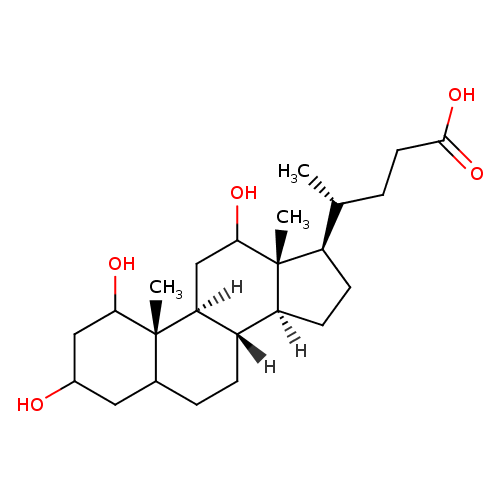
Common Name1,3,12-Trihydroxycholan-24-oic acid
ClassSmall Molecule
Description1,3,12-Trihydroxycholan-24-oic acid is a bile acid. Bile acids are steroid acids found predominantly in the bile of mammals. The distinction between different bile acids is minute, depending only on the presence or absence of hydroxyl groups on positions 3, 7, and 12. Bile acids are physiological detergents that facilitate excretion, absorption, and transport of fats and sterols in the intestine and liver. Bile acids are also steroidal amphipathic molecules derived from the catabolism of cholesterol. They modulate bile flow and lipid secretion, are essential for the absorption of dietary fats and vitamins, and have been implicated in the regulation of all the key enzymes involved in cholesterol homeostasis. Bile acids recirculate through the liver, bile ducts, small intestine and portal vein to form an enterohepatic circuit. They exist as anions at physiological pH and, consequently, require a carrier for transport across the membranes of the enterohepatic tissues. The unique detergent properties of bile acids are essential for the digestion and intestinal absorption of hydrophobic nutrients. Bile acids have potent toxic properties (e.g. membrane disruption) and there are a plethora of mechanisms to limit their accumulation in blood and tissues (PMID: 11316487, 16037564, 12576301, 11907135).
Contaminant Sources
  • FooDB Chemicals
Contaminant TypeNot Available
Chemical Structure
Thumb
Synonyms
ValueSource
1,3,12-Trihydroxycholan-24-OateGenerator
1,3,12-Trihydroxy-5b-cholanoateHMDB
1,3,12-Trihydroxy-5b-cholanoic acidHMDB
1,3,12-Trihydroxy-cholan-24-OateHMDB
1,3,12-Trihydroxy-cholan-24-Oic acidHMDB
1 beta,3 alpha,12 alpha-Trihydroxy-5 beta-cholanoic acidMeSH, HMDB
1,3,12-Trihydroxycholanoic acidMeSH, HMDB
(4R)-4-[(1S,2S,10S,11S,14R,15R)-3,5,16-Trihydroxy-2,15-dimethyltetracyclo[8.7.0.0²,⁷.0¹¹,¹⁵]heptadecan-14-yl]pentanoateGenerator, HMDB
Chemical FormulaC24H40O5
Average Molecular Mass408.571 g/mol
Monoisotopic Mass408.288 g/mol
CAS Registry Number63266-91-1
IUPAC Name(4R)-4-[(1S,2S,10S,11S,14R,15R)-3,5,16-trihydroxy-2,15-dimethyltetracyclo[8.7.0.0²,⁷.0¹¹,¹⁵]heptadecan-14-yl]pentanoic acid
Traditional Name(4R)-4-[(1S,2S,10S,11S,14R,15R)-3,5,16-trihydroxy-2,15-dimethyltetracyclo[8.7.0.0²,⁷.0¹¹,¹⁵]heptadecan-14-yl]pentanoic acid
SMILES[H][C@@]12CC[C@H]([C@H](C)CCC(O)=O)[C@@]1(C)C(O)C[C@@]1([H])[C@@]2([H])CCC2CC(O)CC(O)[C@]12C
InChI IdentifierInChI=1S/C24H40O5/c1-13(4-9-22(28)29)17-7-8-18-16-6-5-14-10-15(25)11-20(26)23(14,2)19(16)12-21(27)24(17,18)3/h13-21,25-27H,4-12H2,1-3H3,(H,28,29)/t13-,14?,15?,16+,17-,18+,19+,20?,21?,23+,24-/m1/s1
InChI KeyDAKYVYUAVGJDRK-JZBKOBKOSA-N
Chemical Taxonomy
Description belongs to the class of organic compounds known as trihydroxy bile acids, alcohols and derivatives. These are prenol lipids structurally characterized by a bile acid or alcohol which bears three hydroxyl groups.
KingdomOrganic compounds
Super ClassLipids and lipid-like molecules
ClassSteroids and steroid derivatives
Sub ClassBile acids, alcohols and derivatives
Direct ParentTrihydroxy bile acids, alcohols and derivatives
Alternative Parents
Substituents
  • Trihydroxy bile acid, alcohol, or derivatives
  • 3-hydroxysteroid
  • 1-hydroxysteroid
  • 12-hydroxysteroid
  • Hydroxysteroid
  • Cyclic alcohol
  • Secondary alcohol
  • Carboxylic acid derivative
  • Carboxylic acid
  • Polyol
  • Monocarboxylic acid or derivatives
  • Organic oxide
  • Alcohol
  • Organic oxygen compound
  • Hydrocarbon derivative
  • Carbonyl group
  • Organooxygen compound
  • Aliphatic homopolycyclic compound
Molecular FrameworkAliphatic homopolycyclic compounds
External DescriptorsNot Available
Biological Properties
StatusDetected and Not Quantified
OriginNot Available
Cellular LocationsNot Available
Biofluid LocationsNot Available
Tissue LocationsNot Available
PathwaysNot Available
ApplicationsNot Available
Biological RolesNot Available
Chemical RolesNot Available
Physical Properties
StateNot Available
AppearanceNot Available
Experimental Properties
PropertyValue
Melting PointNot Available
Boiling PointNot Available
SolubilityNot Available
Predicted Properties
PropertyValueSource
Water Solubility0.074 g/LALOGPS
logP2.46ALOGPS
logP2.49ChemAxon
logS-3.7ALOGPS
pKa (Strongest Acidic)4.65ChemAxon
pKa (Strongest Basic)-0.4ChemAxon
Physiological Charge-1ChemAxon
Hydrogen Acceptor Count5ChemAxon
Hydrogen Donor Count4ChemAxon
Polar Surface Area97.99 ŲChemAxon
Rotatable Bond Count4ChemAxon
Refractivity110.67 m³·mol⁻¹ChemAxon
Polarizability47.46 ųChemAxon
Number of Rings4ChemAxon
Bioavailability1ChemAxon
Rule of FiveYesChemAxon
Ghose FilterYesChemAxon
Veber's RuleNoChemAxon
MDDR-like RuleNoChemAxon
Spectra
Spectra
Spectrum TypeDescriptionSplash KeyView
Predicted GC-MSPredicted GC-MS Spectrum - GC-MS (Non-derivatized) - 70eV, Positivesplash10-03dl-0129000000-93342685f3ac80b739efSpectrum
Predicted GC-MSPredicted GC-MS Spectrum - GC-MS (4 TMS) - 70eV, Positivesplash10-001i-1010049000-b3e7856d53a8de4e67bfSpectrum
Predicted GC-MSPredicted GC-MS Spectrum - GC-MS (Non-derivatized) - 70eV, PositiveNot AvailableSpectrum
Predicted GC-MSPredicted GC-MS Spectrum - GC-MS (TMS_1_1) - 70eV, PositiveNot AvailableSpectrum
Predicted GC-MSPredicted GC-MS Spectrum - GC-MS (TMS_1_2) - 70eV, PositiveNot AvailableSpectrum
Predicted GC-MSPredicted GC-MS Spectrum - GC-MS (TMS_1_3) - 70eV, PositiveNot AvailableSpectrum
Predicted GC-MSPredicted GC-MS Spectrum - GC-MS (TMS_1_4) - 70eV, PositiveNot AvailableSpectrum
Predicted GC-MSPredicted GC-MS Spectrum - GC-MS (TMS_2_1) - 70eV, PositiveNot AvailableSpectrum
Predicted GC-MSPredicted GC-MS Spectrum - GC-MS (TMS_2_2) - 70eV, PositiveNot AvailableSpectrum
Predicted GC-MSPredicted GC-MS Spectrum - GC-MS (TMS_2_3) - 70eV, PositiveNot AvailableSpectrum
Predicted GC-MSPredicted GC-MS Spectrum - GC-MS (TMS_2_4) - 70eV, PositiveNot AvailableSpectrum
Predicted GC-MSPredicted GC-MS Spectrum - GC-MS (TMS_2_5) - 70eV, PositiveNot AvailableSpectrum
Predicted GC-MSPredicted GC-MS Spectrum - GC-MS (TMS_2_6) - 70eV, PositiveNot AvailableSpectrum
Predicted GC-MSPredicted GC-MS Spectrum - GC-MS (TMS_3_1) - 70eV, PositiveNot AvailableSpectrum
Predicted GC-MSPredicted GC-MS Spectrum - GC-MS (TMS_3_2) - 70eV, PositiveNot AvailableSpectrum
Predicted GC-MSPredicted GC-MS Spectrum - GC-MS (TMS_3_3) - 70eV, PositiveNot AvailableSpectrum
Predicted GC-MSPredicted GC-MS Spectrum - GC-MS (TMS_3_4) - 70eV, PositiveNot AvailableSpectrum
Predicted GC-MSPredicted GC-MS Spectrum - GC-MS (TBDMS_1_1) - 70eV, PositiveNot AvailableSpectrum
Predicted GC-MSPredicted GC-MS Spectrum - GC-MS (TBDMS_1_2) - 70eV, PositiveNot AvailableSpectrum
Predicted GC-MSPredicted GC-MS Spectrum - GC-MS (TBDMS_1_3) - 70eV, PositiveNot AvailableSpectrum
Predicted GC-MSPredicted GC-MS Spectrum - GC-MS (TBDMS_1_4) - 70eV, PositiveNot AvailableSpectrum
Predicted GC-MSPredicted GC-MS Spectrum - GC-MS (TBDMS_2_1) - 70eV, PositiveNot AvailableSpectrum
Predicted GC-MSPredicted GC-MS Spectrum - GC-MS (TBDMS_2_2) - 70eV, PositiveNot AvailableSpectrum
Predicted GC-MSPredicted GC-MS Spectrum - GC-MS (TBDMS_2_3) - 70eV, PositiveNot AvailableSpectrum
Predicted GC-MSPredicted GC-MS Spectrum - GC-MS (TBDMS_2_4) - 70eV, PositiveNot AvailableSpectrum
Predicted LC-MS/MSPredicted LC-MS/MS Spectrum - 10V, Positivesplash10-00dl-0009000000-0c122eee1b1dbeb1519dSpectrum
Predicted LC-MS/MSPredicted LC-MS/MS Spectrum - 20V, Positivesplash10-00dl-0009000000-06969fbf9e69cbf7a0c1Spectrum
Predicted LC-MS/MSPredicted LC-MS/MS Spectrum - 40V, Positivesplash10-014i-3129000000-56243498de002b81b85eSpectrum
Predicted LC-MS/MSPredicted LC-MS/MS Spectrum - 10V, Negativesplash10-0a4r-0009800000-4a0ab06b262a99f18ff4Spectrum
Predicted LC-MS/MSPredicted LC-MS/MS Spectrum - 20V, Negativesplash10-052r-0009200000-9a24af3f58b590ac86cdSpectrum
Predicted LC-MS/MSPredicted LC-MS/MS Spectrum - 40V, Negativesplash10-0a4l-9008000000-a912af299a7dc32524d7Spectrum
Predicted LC-MS/MSPredicted LC-MS/MS Spectrum - 10V, Positivesplash10-05fu-0009400000-ff2767ac04483681d132Spectrum
Predicted LC-MS/MSPredicted LC-MS/MS Spectrum - 20V, Positivesplash10-059l-3149100000-a3dc8d53445fbc4a7996Spectrum
Predicted LC-MS/MSPredicted LC-MS/MS Spectrum - 40V, Positivesplash10-0a4i-9870000000-0ab9e32eda3ce672b1feSpectrum
Predicted LC-MS/MSPredicted LC-MS/MS Spectrum - 10V, Negativesplash10-0a4i-0000900000-ec1d9319a9eaf1f2aba6Spectrum
Predicted LC-MS/MSPredicted LC-MS/MS Spectrum - 20V, Negativesplash10-0a4r-0009800000-986af7877e34b89e542aSpectrum
Predicted LC-MS/MSPredicted LC-MS/MS Spectrum - 40V, Negativesplash10-0gw1-1019100000-fe9fc0214b53ec36a531Spectrum
Toxicity Profile
Route of ExposureNot Available
Mechanism of ToxicityNot Available
MetabolismNot Available
Toxicity ValuesNot Available
Lethal DoseNot Available
Carcinogenicity (IARC Classification)Not Available
Uses/SourcesNot Available
Minimum Risk LevelNot Available
Health EffectsNot Available
SymptomsNot Available
TreatmentNot Available
Concentrations
Not Available
DrugBank IDNot Available
HMDB IDHMDB0000371
FooDB IDFDB021990
Phenol Explorer IDNot Available
KNApSAcK IDNot Available
BiGG IDNot Available
BioCyc IDNot Available
METLIN IDNot Available
PDB IDNot Available
Wikipedia LinkNot Available
Chemspider ID13628070
ChEBI ID156200
PubChem Compound ID20849394
Kegg Compound IDNot Available
YMDB IDNot Available
ECMDB IDNot Available
References
Synthesis ReferenceNot Available
MSDSNot Available
General References
1. St-Pierre MV, Kullak-Ublick GA, Hagenbuch B, Meier PJ: Transport of bile acids in hepatic and non-hepatic tissues. J Exp Biol. 2001 May;204(Pt 10):1673-86.
2. Claudel T, Staels B, Kuipers F: The Farnesoid X receptor: a molecular link between bile acid and lipid and glucose metabolism. Arterioscler Thromb Vasc Biol. 2005 Oct;25(10):2020-30. Epub 2005 Jul 21.
3. Chiang JY: Bile acid regulation of hepatic physiology: III. Bile acids and nuclear receptors. Am J Physiol Gastrointest Liver Physiol. 2003 Mar;284(3):G349-56.
4. Davis RA, Miyake JH, Hui TY, Spann NJ: Regulation of cholesterol-7alpha-hydroxylase: BAREly missing a SHP. J Lipid Res. 2002 Apr;43(4):533-43.